 Add to Chrome
 Add to Firefox
 Add to Edge
Text Template Tokens Are Implicit Semantic Registers in Diffusion Transformers
Jul 21, 2026
Text-to-image diffusion transformers (DiTs) jointly process text and image tokens, yet their internal computation during denoising remains poorly understood. We introduce a causal interpretability framework for modern large-scale DiTs that combines attention decomposition with targeted interventions across token spans, heads, and layers. Using it to separate prompt-content tokens from structural template tokens, we find that the structural tokens carry little prompt-specific information at the encoder output. Yet surprisingly, they emerge as dominant image-to-text attention sinks and causally maintain object identity inside the DiT, acting as implicit semantic registers. We show that they acquire this identity indirectly, with prompt semantics first injected into the image latents and then read back into the template tokens rather than transferred directly from the prompt tokens. Inspired by the above findings, we design a training-free pruning rule for DiTs. Heads that attend most strongly to prompt tokens are dispensable, and pruning them removes $20\%$ of attention FLOPs with only a $1.4$-point drop on GenEval. We further reveal how generative computation in DiTs is organized across heads and depth, separating semantic routing from visual synthesis and progressing from identity formation to propagation and refinement. Our work not only reveals that the tokens encoding semantics at input need not be those that maintain it during generation, but also provides a causal view of internal mechanisms in DiTs.

Linear-DPO: Linear Direct Preference Optimization for Diffusion and Flow-Matching Generative Models
May 20, 2026Direct Preference Optimization (DPO) is successful for alignment in LLMs but still faces challenges in text-to-image generation. Existing studies are confined to denoising diffusion models while overlooking flow-matching, and suffer from an objective mismatch when applying discrete NLP-based DPO to regression-based generative tasks.\ In this paper, we derive a generalized DPO objective that covers both diffusion and flow-matching via a unified reverse-time SDE framework, and point out from a gradient perspective that the standard DPO objective is suboptimal for text-to-image generation. Consequently, we propose Linear-DPO, which replaces the aggressive sigmoid-based utility function with a sustained linear utility and incorporates an EMA-updated reference model. Qualitative and quantitative experiments on diffusion models (SD1.5, SDXL) and flow-matching model (SD3-Medium) demonstrate the superiority of our approach over existing baselines.
Rethinking Cross-Layer Information Routing in Diffusion Transformers
May 20, 2026Diffusion Transformers (DiTs) have become a de facto backbone of modern visual generation, and nearly every major axis of their design -- tokenization, attention, conditioning, objectives, and latent autoencoders -- has been extensively revisited. The residual stream that governs how information accumulates across layers, however, has been directly inherited from the original Transformer. In this paper, we present a systematic empirical analysis of cross-layer information flow in DiTs, jointly along depth and denoising timestep, and identify three concrete symptoms of traditional residual addition, namely monotonic forward magnitude inflation, sharp backward gradient decay, and pronounced block-wise redundancy. Motivated by this diagnosis, we propose Diffusion-Adaptive Routing (\textsc{DAR}), a drop-in residual replacement that performs \emph{learnable, timestep-adaptive, and non-incremental} aggregation over the history of sublayer outputs. Moreover, the proposed \textsc{DAR} is compatible with many modern Transformer enhancement methods, such as REPA. On ImageNet $256\times256$, \textsc{DAR} improves SiT-XL/2 by $2.11$ FID ($7.56$ vs.\ $9.67$) and matches the baseline's converged quality with $8.75\times$ fewer training iterations. Stacked on top of REPA, it yields a $2\times$ training acceleration in the early stage, suggesting cross-layer information routing as an underexplored design axis in diffusion modeling, one that operates orthogonally to existing representation-alignment objectives. Beyond pretraining, \textsc{DAR} can also be applied during the fine-tuning stage of large-scale T2I models and preserves high-frequency details during Distribution Matching Distillation.
Qwen-Image-2.0 Technical Report
May 11, 2026We present Qwen-Image-2.0, an omni-capable image generation foundation model that unifies high-fidelity generation and precise image editing within a single framework. Despite recent progress, existing models still struggle with ultra-long text rendering, multilingual typography, high-resolution photorealism, robust instruction following, and efficient deployment, especially in text-rich and compositionally complex scenarios. Qwen-Image-2.0 addresses these challenges by coupling Qwen3-VL as the condition encoder with a Multimodal Diffusion Transformer for joint condition-target modeling, supported by large-scale data curation and a customized multi-stage training pipeline. This enables strong multimodal understanding while preserving flexible generation and editing capabilities. The model supports instructions of up to 1K tokens for generating text-rich content such as slides, posters, infographics, and comics, while significantly improving multilingual text fidelity and typography. It also enhances photorealistic generation with richer details, more realistic textures, and coherent lighting, and follows complex prompts more reliably across diverse styles. Extensive human evaluations show that Qwen-Image-2.0 substantially outperforms previous Qwen-Image models in both generation and editing, marking a step toward more general, reliable, and practical image generation foundation models.
Apertus: Democratizing Open and Compliant LLMs for Global Language Environments
Sep 17, 2025
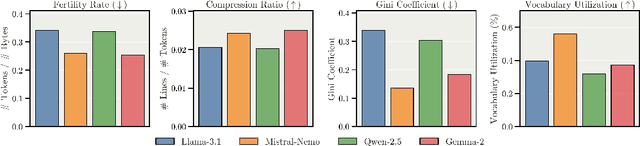

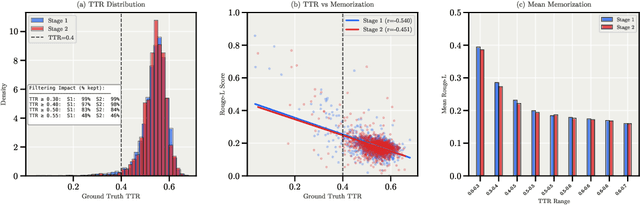
We present Apertus, a fully open suite of large language models (LLMs) designed to address two systemic shortcomings in today's open model ecosystem: data compliance and multilingual representation. Unlike many prior models that release weights without reproducible data pipelines or regard for content-owner rights, Apertus models are pretrained exclusively on openly available data, retroactively respecting robots.txt exclusions and filtering for non-permissive, toxic, and personally identifiable content. To mitigate risks of memorization, we adopt the Goldfish objective during pretraining, strongly suppressing verbatim recall of data while retaining downstream task performance. The Apertus models also expand multilingual coverage, training on 15T tokens from over 1800 languages, with ~40% of pretraining data allocated to non-English content. Released at 8B and 70B scales, Apertus approaches state-of-the-art results among fully open models on multilingual benchmarks, rivalling or surpassing open-weight counterparts. Beyond model weights, we release all scientific artifacts from our development cycle with a permissive license, including data preparation scripts, checkpoints, evaluation suites, and training code, enabling transparent audit and extension.
Positional Fragility in LLMs: How Offset Effects Reshape Our Understanding of Memorization Risks
May 19, 2025Large language models are known to memorize parts of their training data, posing risk of copyright violations. To systematically examine this risk, we pretrain language models (1B/3B/8B) from scratch on 83B tokens, mixing web-scale data with public domain books used to simulate copyrighted content at controlled frequencies at lengths at least ten times longer than prior work. We thereby identified the offset effect, a phenomenon characterized by two key findings: (1) verbatim memorization is most strongly triggered by short prefixes drawn from the beginning of the context window, with memorization decreasing counterintuitively as prefix length increases; and (2) a sharp decline in verbatim recall when prefix begins offset from the initial tokens of the context window. We attribute this to positional fragility: models rely disproportionately on the earliest tokens in their context window as retrieval anchors, making them sensitive to even slight shifts. We further observe that when the model fails to retrieve memorized content, it often produces degenerated text. Leveraging these findings, we show that shifting sensitive data deeper into the context window suppresses both extractable memorization and degeneration. Our results suggest that positional offset is a critical and previously overlooked axis for evaluating memorization risks, since prior work implicitly assumed uniformity by probing only from the beginning of training sequences.
Uplifting Range-View-based 3D Semantic Segmentation in Real-Time with Multi-Sensor Fusion
Jul 12, 2024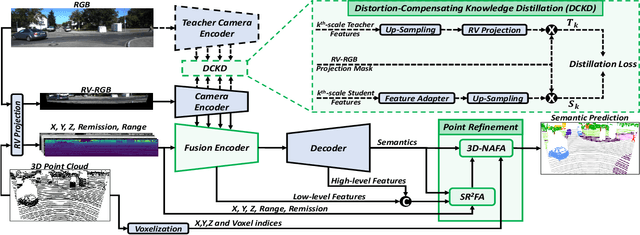
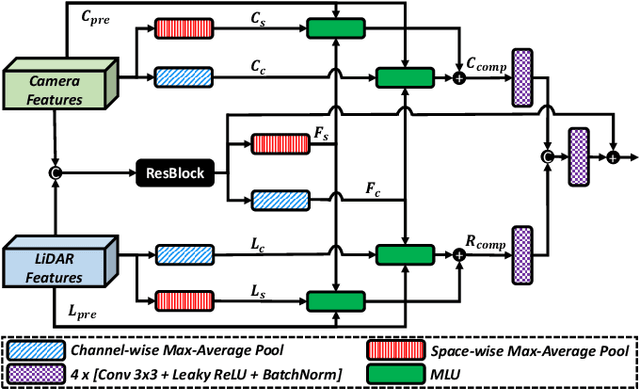
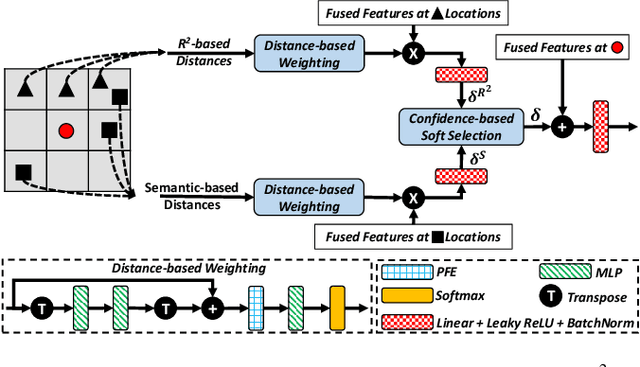
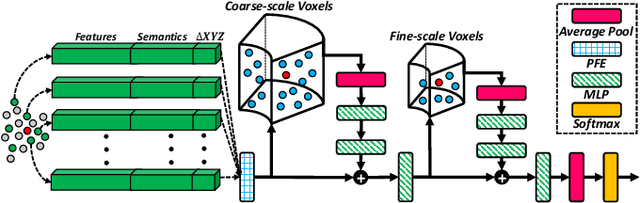
Range-View(RV)-based 3D point cloud segmentation is widely adopted due to its compact data form. However, RV-based methods fall short in providing robust segmentation for the occluded points and suffer from distortion of projected RGB images due to the sparse nature of 3D point clouds. To alleviate these problems, we propose a new LiDAR and Camera Range-view-based 3D point cloud semantic segmentation method (LaCRange). Specifically, a distortion-compensating knowledge distillation (DCKD) strategy is designed to remedy the adverse effect of RV projection of RGB images. Moreover, a context-based feature fusion module is introduced for robust and preservative sensor fusion. Finally, in order to address the limited resolution of RV and its insufficiency of 3D topology, a new point refinement scheme is devised for proper aggregation of features in 2D and augmentation of point features in 3D. We evaluated the proposed method on large-scale autonomous driving datasets \ie SemanticKITTI and nuScenes. In addition to being real-time, the proposed method achieves state-of-the-art results on nuScenes benchmark
Video Frame Interpolation for Polarization via Swin-Transformer
Jun 17, 2024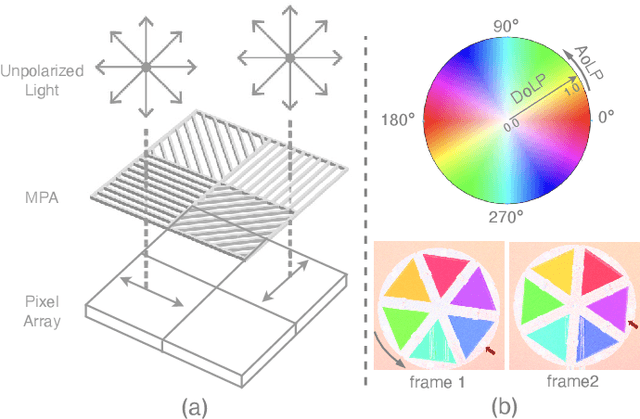
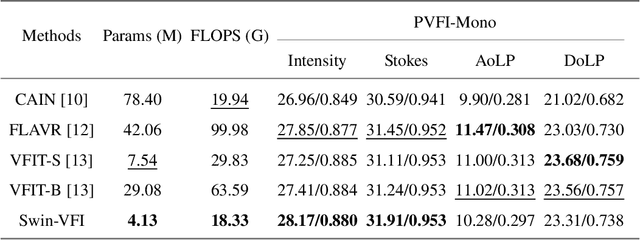
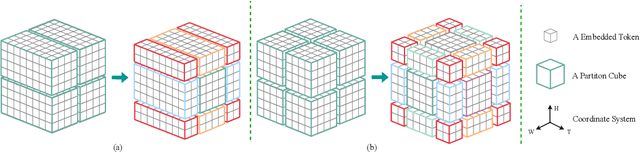
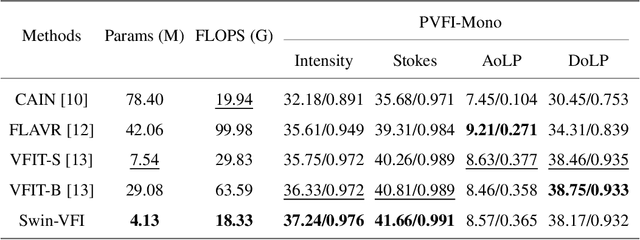
Video Frame Interpolation (VFI) has been extensively explored and demonstrated, yet its application to polarization remains largely unexplored. Due to the selective transmission of light by polarized filters, longer exposure times are typically required to ensure sufficient light intensity, which consequently lower the temporal sample rates. Furthermore, because polarization reflected by objects varies with shooting perspective, focusing solely on estimating pixel displacement is insufficient to accurately reconstruct the intermediate polarization. To tackle these challenges, this study proposes a multi-stage and multi-scale network called Swin-VFI based on the Swin-Transformer and introduces a tailored loss function to facilitate the network's understanding of polarization changes. To ensure the practicality of our proposed method, this study evaluates its interpolated frames in Shape from Polarization (SfP) and Human Shape Reconstruction tasks, comparing them with other state-of-the-art methods such as CAIN, FLAVR, and VFIT. Experimental results demonstrate our approach's superior reconstruction accuracy across all tasks.
Analyze the Robustness of Classifiers under Label Noise
Dec 12, 2023This study explores the robustness of label noise classifiers, aiming to enhance model resilience against noisy data in complex real-world scenarios. Label noise in supervised learning, characterized by erroneous or imprecise labels, significantly impairs model performance. This research focuses on the increasingly pertinent issue of label noise's impact on practical applications. Addressing the prevalent challenge of inaccurate training data labels, we integrate adversarial machine learning (AML) and importance reweighting techniques. Our approach involves employing convolutional neural networks (CNN) as the foundational model, with an emphasis on parameter adjustment for individual training samples. This strategy is designed to heighten the model's focus on samples critically influencing performance.
Analyze the robustness of three NMF algorithms (Robust NMF with L1 norm, L2-1 norm NMF, L2 NMF)
Dec 03, 2023Non-negative matrix factorization (NMF) and its variants have been widely employed in clustering and classification tasks (Long, & Jian , 2021). However, noises can seriously affect the results of our experiments. Our research is dedicated to investigating the noise robustness of non-negative matrix factorization (NMF) in the face of different types of noise. Specifically, we adopt three different NMF algorithms, namely L1 NMF, L2 NMF, and L21 NMF, and use the ORL and YaleB data sets to simulate a series of experiments with salt-and-pepper noise and Block-occlusion noise separately. In the experiment, we use a variety of evaluation indicators, including root mean square error (RMSE), accuracy (ACC), and normalized mutual information (NMI), to evaluate the performance of different NMF algorithms in noisy environments. Through these indicators, we quantify the resistance of NMF algorithms to noise and gain insights into their feasibility in practical applications.