 Add to Chrome
 Add to Firefox
 Add to Edge
Qwen-Image-2.0-RL Technical Report
Jun 25, 2026
We present Qwen-Image-2.0-RL, a post-training pipeline that applies reinforcement learning from human feedback (RLHF) and on-policy distillation (OPD) to improve both the visual quality and instruction-following capability of the Qwen-Image-2.0 diffusion model. To provide reliable reward signals, we construct task-specific composite reward models by fine-tuning vision-language models with a pointwise scoring paradigm and chain-of-thought reasoning. For text-to-image generation, the reward models cover alignment, aesthetics, and portrait fidelity dimensions. For image editing tasks, the reward system addresses instruction-following accuracy and face identity preservation. Building on this reward system, we develop a scalable GRPO-based RL training framework, incorporating a hybrid classifier-free guidance (CFG) strategy to preserve pre-trained knowledge, prompt curation via intra-group reward range filtering, and per-category reward weight calibration. To merge the task-specialized RL policies for T2I and editing, we propose on-policy distillation as the final training stage, which consolidates multiple teachers into a single student model through trajectory-level velocity matching. Extensive evaluation shows that Qwen-Image-2.0-RL achieves 57.84 overall score on Qwen-Image-Bench (+2.61 over the base model), Elo ratings of 1193 in text-to-image arena (+78) and 1349 in image edit arena (+93), demonstrating consistent gains in aesthetic quality, prompt adherence, and editing accuracy.

SoulX-Transcriber: A Robust End-to-End Framework for Multi-Speaker Speech Transcription
Jun 01, 2026Recent advances in Automatic Speech Recognition (ASR) and Large Language Models (LLMs) have significantly improved speech understanding capabilities. However, multi-speaker speech transcription remains challenging task, constrained by highly similar speaker voices, rapid turn-taking transitions, overlapping utterances and inaccurate speaker boundary segmentation. These challenges become particularly pronounced in real-world conversational audio, where speaker dynamics and acoustic conditions are highly variable. This technical report presents SoulX-Transcriber, a unified multi-speaker transcription system that jointly models speaker diarization (SD) and ASR within an LLM-based framework. SoulX-Transcriber adopts a two-stage training strategy to improve both speaker discrimination and transcription robustness. In the first stage, speaker-aware multi-task continuous pre-training enhances speaker representation learning and boundary perception. In the second stage, supervised fine-tuning further optimizes the model for accurate end-to-end speaker-attributed transcription under complex multi-speaker conditions. SoulX-Transcriber delivers strong performance and robustness across multiple public benchmarks, including AliMeeting, AISHELL-4, and AMI, while maintaining high adaptability to multi-domain scenarios.
Qwen-Image-VAE-2.0 Technical Report
May 13, 2026We present Qwen-Image-VAE-2.0, a suite of high-compression Variational Autoencoders (VAEs) that achieve significant advances in both reconstruction fidelity and diffusability. To address the reconstruction bottlenecks of high compression, we adopt an improved architecture featuring Global Skip Connections (GSC) and expanded latent channels. Moreover, we scale training to billions of images and incorporate a synthetic rendering engine to improve performance in text-rich scenarios. To tackle the convergence challenges of high-dimensional latent space, we implement an enhanced semantic alignment strategy to make the latent space highly amenable to diffusion modeling. To optimize computational efficiency, we leverage an asymmetric and attention-free encoder-decoder backbone to minimize encoding overhead. We present a comprehensive evaluation of Qwen-Image-VAE-2.0 on public reconstruction benchmarks. To evaluate performance in text-rich scenarios, we propose OmniDoc-TokenBench, a new benchmark comprising a diverse collection of real-world documents coupled with specialized OCR-based evaluation metrics. Qwen-Image-VAE-2.0 achieves state-of-the-art reconstruction performance, demonstrating exceptional capabilities in both general domains and text-rich scenarios at high compression ratio. Furthermore, downstream DiT experiments reveal our models possess superior diffusability, significantly accelerating convergence compared to existing high-compression baselines. These establish Qwen-Image-VAE-2.0 as a leading model with high compression, superior reconstruction, and exceptional diffusability.
Qwen-Image-2.0 Technical Report
May 11, 2026We present Qwen-Image-2.0, an omni-capable image generation foundation model that unifies high-fidelity generation and precise image editing within a single framework. Despite recent progress, existing models still struggle with ultra-long text rendering, multilingual typography, high-resolution photorealism, robust instruction following, and efficient deployment, especially in text-rich and compositionally complex scenarios. Qwen-Image-2.0 addresses these challenges by coupling Qwen3-VL as the condition encoder with a Multimodal Diffusion Transformer for joint condition-target modeling, supported by large-scale data curation and a customized multi-stage training pipeline. This enables strong multimodal understanding while preserving flexible generation and editing capabilities. The model supports instructions of up to 1K tokens for generating text-rich content such as slides, posters, infographics, and comics, while significantly improving multilingual text fidelity and typography. It also enhances photorealistic generation with richer details, more realistic textures, and coherent lighting, and follows complex prompts more reliably across diverse styles. Extensive human evaluations show that Qwen-Image-2.0 substantially outperforms previous Qwen-Image models in both generation and editing, marking a step toward more general, reliable, and practical image generation foundation models.
Aligning Language Models for Lyric-to-Melody Generation with Rule-Based Musical Constraints
Apr 20, 2026Large Language Models (LLMs) show promise in lyric-to-melody generation, but models trained with Supervised Fine-Tuning (SFT) often produce musically implausible melodies with issues like poor rhythm and unsuitable vocal ranges, a phenomenon we term "constraint violation". To address this, we propose a novel alignment framework that instills musical knowledge without human annotation. We define rule-based musical constraints to automatically generate a preference dataset from an SFT model's outputs. The model is then aligned through a sequential process, first using Direct Preference Optimization (DPO) on paired preference data, followed by Kahneman-Tversky Optimization (KTO) on unpaired negative samples. Experimental results demonstrate that our aligned model substantially reduces rule violations and outperforms strong baselines in both objective and subjective evaluations, generating melodies with substantially improved musicality and coherence. An interactive demo with audio comparisons is available at https://arain233.github.io/AligningMelody-demo.
TIGFlow-GRPO: Trajectory Forecasting via Interaction-Aware Flow Matching and Reward-Driven Optimization
Mar 26, 2026Human trajectory forecasting is important for intelligent multimedia systems operating in visually complex environments, such as autonomous driving and crowd surveillance. Although Conditional Flow Matching (CFM) has shown strong ability in modeling trajectory distributions from spatio-temporal observations, existing approaches still focus primarily on supervised fitting, which may leave social norms and scene constraints insufficiently reflected in generated trajectories. To address this issue, we propose TIGFlow-GRPO, a two-stage generative framework that aligns flow-based trajectory generation with behavioral rules. In the first stage, we build a CFM-based predictor with a Trajectory-Interaction-Graph (TIG) module to model fine-grained visual-spatial interactions and strengthen context encoding. This stage captures both agent-agent and agent-scene relations more effectively, providing more informative conditional features for subsequent alignment. In the second stage, we perform Flow-GRPO post-training,where deterministic flow rollout is reformulated as stochastic ODE-to-SDE sampling to enable trajectory exploration, and a composite reward combines view-aware social compliance with map-aware physical feasibility. By evaluating trajectories explored through SDE rollout, GRPO progressively steers multimodal predictions toward behaviorally plausible futures. Experiments on the ETH/UCY and SDD datasets show that TIGFlow-GRPO improves forecasting accuracy and long-horizon stability while generating trajectories that are more socially compliant and physically feasible. These results suggest that the proposed framework provides an effective way to connect flow-based trajectory modeling with behavior-aware alignment in dynamic multimedia environments.
SoulX-Duplug: Plug-and-Play Streaming State Prediction Module for Realtime Full-Duplex Speech Conversation
Mar 16, 2026Recent advances in spoken dialogue systems have brought increased attention to human-like full-duplex voice interactions. However, our comprehensive review of this field reveals several challenges, including the difficulty in obtaining training data, catastrophic forgetting, and limited scalability. In this work, we propose SoulX-Duplug, a plug-and-play streaming state prediction module for full-duplex spoken dialogue systems. By jointly performing streaming ASR, SoulX-Duplug explicitly leverages textual information to identify user intent, effectively serving as a semantic VAD. To promote fair evaluation, we introduce SoulX-Duplug-Eval, extending widely used benchmarks with improved bilingual coverage. Experimental results show that SoulX-Duplug enables low-latency streaming dialogue state control, and the system built upon it outperforms existing full-duplex models in overall turn management and latency performance. We have open-sourced SoulX-Duplug and SoulX-Duplug-Eval.
SoulX-Singer: Towards High-Quality Zero-Shot Singing Voice Synthesis
Feb 08, 2026While recent years have witnessed rapid progress in speech synthesis, open-source singing voice synthesis (SVS) systems still face significant barriers to industrial deployment, particularly in terms of robustness and zero-shot generalization. In this report, we introduce SoulX-Singer, a high-quality open-source SVS system designed with practical deployment considerations in mind. SoulX-Singer supports controllable singing generation conditioned on either symbolic musical scores (MIDI) or melodic representations, enabling flexible and expressive control in real-world production workflows. Trained on more than 42,000 hours of vocal data, the system supports Mandarin Chinese, English, and Cantonese and consistently achieves state-of-the-art synthesis quality across languages under diverse musical conditions. Furthermore, to enable reliable evaluation of zero-shot SVS performance in practical scenarios, we construct SoulX-Singer-Eval, a dedicated benchmark with strict training-test disentanglement, facilitating systematic assessment in zero-shot settings.
Video Deblurring by Sharpness Prior Detection and Edge Information
Jan 21, 2025Video deblurring is essential task for autonomous driving, facial recognition, and security surveillance. Traditional methods directly estimate motion blur kernels, often introducing artifacts and leading to poor results. Recent approaches utilize the detection of sharp frames within video sequences to enhance deblurring. However, existing datasets rely on fixed number of sharp frames, which may be too restrictive for some applications and may introduce a bias during model training. To address these limitations and enhance domain adaptability, this work first introduces GoPro Random Sharp (GoProRS), a new dataset where the the frequency of sharp frames within the sequence is customizable, allowing more diverse training and testing scenarios. Furthermore, it presents a novel video deblurring model, called SPEINet, that integrates sharp frame features into blurry frame reconstruction through an attention-based encoder-decoder architecture, a lightweight yet robust sharp frame detection and an edge extraction phase. Extensive experimental results demonstrate that SPEINet outperforms state-of-the-art methods across multiple datasets, achieving an average of +3.2% PSNR improvement over recent techniques. Given such promising results, we believe that both the proposed model and dataset pave the way for future advancements in video deblurring based on the detection of sharp frames.
3D Interacting Hand Pose Estimation by Hand De-occlusion and Removal
Jul 22, 2022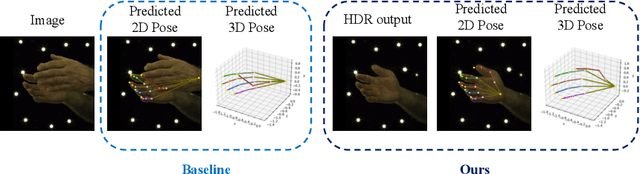
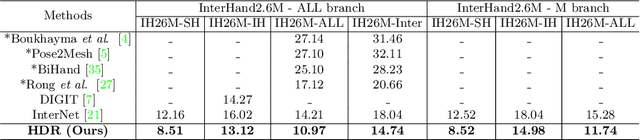
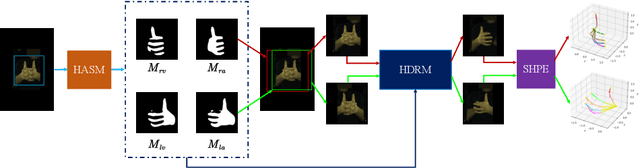
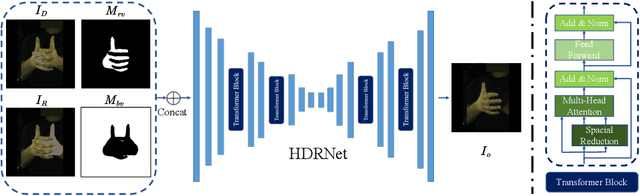
Estimating 3D interacting hand pose from a single RGB image is essential for understanding human actions. Unlike most previous works that directly predict the 3D poses of two interacting hands simultaneously, we propose to decompose the challenging interacting hand pose estimation task and estimate the pose of each hand separately. In this way, it is straightforward to take advantage of the latest research progress on the single-hand pose estimation system. However, hand pose estimation in interacting scenarios is very challenging, due to (1) severe hand-hand occlusion and (2) ambiguity caused by the homogeneous appearance of hands. To tackle these two challenges, we propose a novel Hand De-occlusion and Removal (HDR) framework to perform hand de-occlusion and distractor removal. We also propose the first large-scale synthetic amodal hand dataset, termed Amodal InterHand Dataset (AIH), to facilitate model training and promote the development of the related research. Experiments show that the proposed method significantly outperforms previous state-of-the-art interacting hand pose estimation approaches. Codes and data are available at https://github.com/MengHao666/HDR.