 Add to Chrome
 Add to Firefox
 Add to Edge
Text Template Tokens Are Implicit Semantic Registers in Diffusion Transformers
Jul 21, 2026
Text-to-image diffusion transformers (DiTs) jointly process text and image tokens, yet their internal computation during denoising remains poorly understood. We introduce a causal interpretability framework for modern large-scale DiTs that combines attention decomposition with targeted interventions across token spans, heads, and layers. Using it to separate prompt-content tokens from structural template tokens, we find that the structural tokens carry little prompt-specific information at the encoder output. Yet surprisingly, they emerge as dominant image-to-text attention sinks and causally maintain object identity inside the DiT, acting as implicit semantic registers. We show that they acquire this identity indirectly, with prompt semantics first injected into the image latents and then read back into the template tokens rather than transferred directly from the prompt tokens. Inspired by the above findings, we design a training-free pruning rule for DiTs. Heads that attend most strongly to prompt tokens are dispensable, and pruning them removes $20\%$ of attention FLOPs with only a $1.4$-point drop on GenEval. We further reveal how generative computation in DiTs is organized across heads and depth, separating semantic routing from visual synthesis and progressing from identity formation to propagation and refinement. Our work not only reveals that the tokens encoding semantics at input need not be those that maintain it during generation, but also provides a causal view of internal mechanisms in DiTs.

Rethinking Cross-Layer Information Routing in Diffusion Transformers
May 20, 2026Diffusion Transformers (DiTs) have become a de facto backbone of modern visual generation, and nearly every major axis of their design -- tokenization, attention, conditioning, objectives, and latent autoencoders -- has been extensively revisited. The residual stream that governs how information accumulates across layers, however, has been directly inherited from the original Transformer. In this paper, we present a systematic empirical analysis of cross-layer information flow in DiTs, jointly along depth and denoising timestep, and identify three concrete symptoms of traditional residual addition, namely monotonic forward magnitude inflation, sharp backward gradient decay, and pronounced block-wise redundancy. Motivated by this diagnosis, we propose Diffusion-Adaptive Routing (\textsc{DAR}), a drop-in residual replacement that performs \emph{learnable, timestep-adaptive, and non-incremental} aggregation over the history of sublayer outputs. Moreover, the proposed \textsc{DAR} is compatible with many modern Transformer enhancement methods, such as REPA. On ImageNet $256\times256$, \textsc{DAR} improves SiT-XL/2 by $2.11$ FID ($7.56$ vs.\ $9.67$) and matches the baseline's converged quality with $8.75\times$ fewer training iterations. Stacked on top of REPA, it yields a $2\times$ training acceleration in the early stage, suggesting cross-layer information routing as an underexplored design axis in diffusion modeling, one that operates orthogonally to existing representation-alignment objectives. Beyond pretraining, \textsc{DAR} can also be applied during the fine-tuning stage of large-scale T2I models and preserves high-frequency details during Distribution Matching Distillation.
Uncertainty Quantification for LLM-based Code Generation
May 12, 2026Prediction sets provide a theoretically grounded framework for quantifying uncertainty in machine learning models. Adapting them to structured generation tasks, in particular, large language model (LLM) based code generation, remains a challenging problem. An existing attempt proposes PAC prediction sets but is limited by its strong monotonicity assumption on risk and single-label classification framework, which severely limits the space of candidate programs and cannot accommodate the multiple valid outputs inherent to code generation. To address these limitations, we propose an approach RisCoSet that leverages multiple hypothesis testing to construct risk-controlling predictions for LLM-based code generation. Given a trained code generation model, we produce a prediction set represented by a partial program, which is guaranteed to contain a correct solution with high confidence. Extensive experiments on three LLMs demonstrate the effectiveness of the proposed method. For instance, compared with the state-of-the-art, our method can significantly reduce the code removal by up to 24.5%, at the same level of risk.
Fair Conformal Classification via Learning Representation-Based Groups
May 12, 2026Conformal prediction methods provide statistically rigorous marginal coverage guarantees for machine learning models, but such guarantees fail to account for algorithmic biases, thereby undermining fairness and trust. This paper introduces a fair conformal inference framework for classification tasks. The proposed method constructs prediction sets that guarantee conditional coverage on adaptively identified subgroups, which can be implicitly defined through nonlinear feature combinations. By balancing effectiveness and efficiency in producing compact, informative prediction sets and ensuring adaptive equalized coverage across unfairly treated subgroups, our approach paves a practical pathway toward trustworthy machine learning. Extensive experiments on both synthetic and real-world datasets demonstrate the effectiveness of the framework.
Exploring the Dialogue Comprehension Ability of Large Language Models
Nov 16, 2023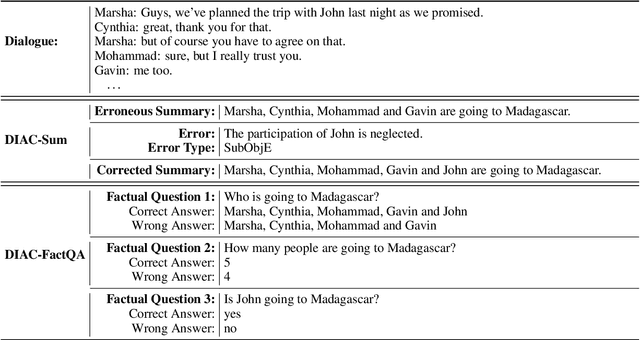
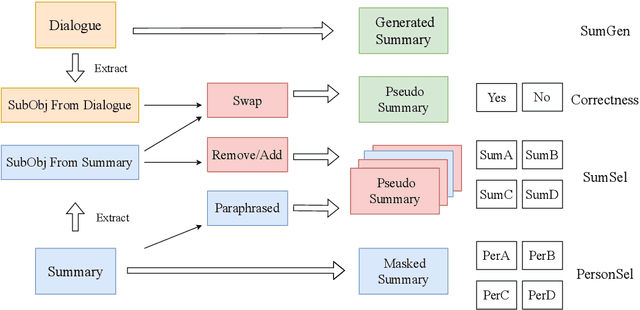
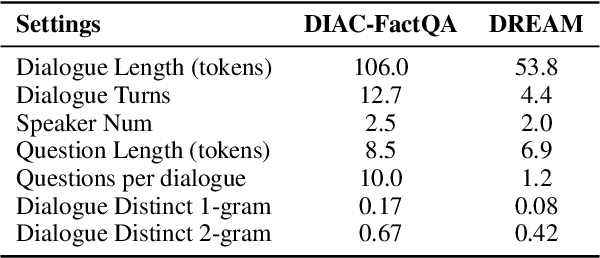
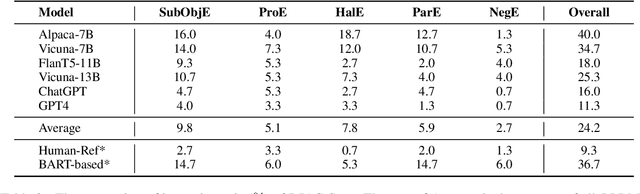
LLMs may interact with users in the form of dialogue and generate responses following their instructions, which naturally require dialogue comprehension abilities. However, dialogue comprehension is a general language ability which is hard to be evaluated directly. In this work, we propose to perform the evaluation with the help of the dialogue summarization task. Beside evaluating and analyzing the dialogue summarization performance (DIAC-Sum) of different LLMs, we also derive factual questions from the generated summaries and use them as a more flexible measurement of dialogue comprehension (DIAC-FactQA). Our evaluation shows that, on average, 27% of the summaries generated by LLMs contain factual inconsistency. Even ChatGPT, the strongest model evaluated, has such errors in 16% of its summaries. For answering the factual questions, which is more challenging, the average error rate of all evaluated LLMs is 37.2%. Both results indicate serious deficiencies. Detailed analysis shows that the understanding of subject/object of the conversation is still the most challenging problem for LLMs. Furthermore, to stimulate and enhance the dialogue comprehension ability of LLMs, we propose a fine-tuning paradigm with auto-constructed multi-task data. The experimental results demonstrate that our method achieved an error rate improvement of 10.9% on DIAC-FactQA.