 Add to Chrome
 Add to Firefox
 Add to Edge
Prompt Generation Technical Report
Jul 13, 2026
Generative retrieval has become an increasingly adopted paradigm for industrial search, recommendation, and advertising systems, delivering significant online gains. Most existing work combines user behavior sequences with large language models (LLMs) to model user preferences. In practice, feature engineering remains critical to model effectiveness, yet its complexity slows offline iteration and makes online deployment heavy and hard to reuse, all under tight online latency budgets. The root cause is a tight coupling between feature-processing logic and model architecture, where every feature change touches the training and serving code and resists reuse across scenarios. To break this coupling, we present Prompt Generation (PG), a high-level tokenizer and configuration-driven framework that decouples feature-processing logic from model architecture through two declarative JSON files, which serve as the single source of truth for both offline training and online serving, ensuring feature consistency across the two stages. Organizing features under four types with three composable processing components to assemble and compress heterogeneous features, PG delivers acceleration at three levels: (1)fast training iteration: feature experiments require only configuration changes, with built-in token compression for ultra-long sequences; (2)fast deployment: a new scenario only needs to conform to the PG schema and plug into a universal pipeline, with no scenario-specific engineering; (3)fast online inference: engine applies unified optimizations over the standardized configuration, reducing PG's overhead to a negligible level. PG has been deployed on Taobao Search with statistically significant online A/B uplifts of +0.47% in transaction count and +0.51% in GMV, and has been applied across multiple Taobao search and recommendation teams as the iteration framework for generative retrieval.

BEAM: Binary Expert Activation Masking for Dynamic Routing in MoE
May 14, 2026Mixture-of-Experts (MoE) architectures enhance the efficiency of large language models by activating only a subset of experts per token. However, standard MoE employs a fixed Top-K routing strategy, leading to redundant computation and suboptimal inference latency. Existing acceleration methods either require costly retraining with architectural changes or suffer from severe performance drop at high sparsity due to train-inference mismatch. To address these limitations, we propose BEAM (Binary Expert Activation Masking), a novel method that learns token-adaptive expert selection via trainable binary masks. With a straight-through estimator and an auxiliary regularization loss, BEAM induces dynamic expert sparsity through end-to-end training while maintaining model capability. We further implement an efficient custom CUDA kernel for BEAM, ensuring seamless integration with the vLLM inference framework. Experiments show that BEAM retains over 98\% of the original model's performance while reducing MoE layer FLOPs by up to 85\%, achieving up to 2.5$\times$ faster decoding and 1.4$\times$ higher throughput, demonstrating its effectiveness as a practical, plug-and-play solution for efficient MoE inference.
SERE: Similarity-based Expert Re-routing for Efficient Batch Decoding in MoE Models
Feb 07, 2026Mixture-of-Experts (MoE) architectures employ sparse activation to deliver faster training and inference with higher accuracy than dense LLMs. However, in production serving, MoE models require batch inference to optimize hardware efficiency, which may cause excessive expert activation and thus slow the memory-bound decoding stage. To address the fundamental tension between batch decoding and expert sparsity, we present SERE, a Similarity-based Expert Re-routing method for Efficient batch decoding in MoE models. SERE dynamically reduces the number of active experts in an input-aware manner by re-routing tokens from secondary experts to their most similar primary counterparts. It also leverages similarity patterns to identify and preserve critical experts, thereby preventing capability loss. Notably, SERE avoids static expert pruning or merging, instead enabling dynamic expert skipping based on batch-level expert redundancy. Additionally, we provide an efficient custom CUDA kernel for SERE, enabling plug-and-play use in vLLM with only a single-line code change. Extensive experiments on various complex reasoning benchmarks demonstrate that SERE achieves up to 2.0x speedup with minimal quality loss, providing a practical solution for cost-efficient and latency-sensitive large-scale MoE deployment. Code implementation of SERE can be found in https://github.com/JL-Cheng/SERE.
EDiT: A Local-SGD-Based Efficient Distributed Training Method for Large Language Models
Dec 10, 2024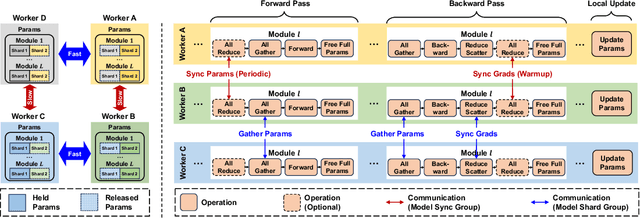


Distributed training methods are crucial for large language models (LLMs). However, existing distributed training methods often suffer from communication bottlenecks, stragglers, and limited elasticity. Local SGD methods have been proposed to address these issues, but their effectiveness remains limited to small-scale training due to additional memory overhead and lack of concerns on efficiency and stability. To tackle these issues, we propose EDiT, an innovative Efficient Distributed Training method that combines a tailored Local SGD approach with model sharding techniques to enhance large-scale training efficiency. EDiT performs layer-wise parameter synchronization during forward pass, reducing communication and memory overhead and enabling the overlap of computation and communication. Besides, EDiT employs a pseudo gradient penalty strategy to suppress loss spikes, which ensures training stability and improve performance. Additionally, we introduce A-EDiT, a fully asynchronous variant of EDiT that accommodates heterogeneous clusters. Building on EDiT/A-EDiT, we conduct a series of experiments to validate large-scale asynchronous training for LLMs, accompanied by comprehensive analyses. Experimental results demonstrate the superior performance of EDiT/A-EDiT, establishing them as robust solutions for distributed LLM training in diverse computational ecosystems.