 Add to Chrome
 Add to Firefox
 Add to Edge
SuperCorrect: Supervising and Correcting Language Models with Error-Driven Insights
Oct 11, 2024
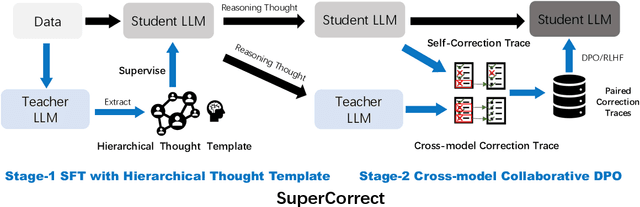
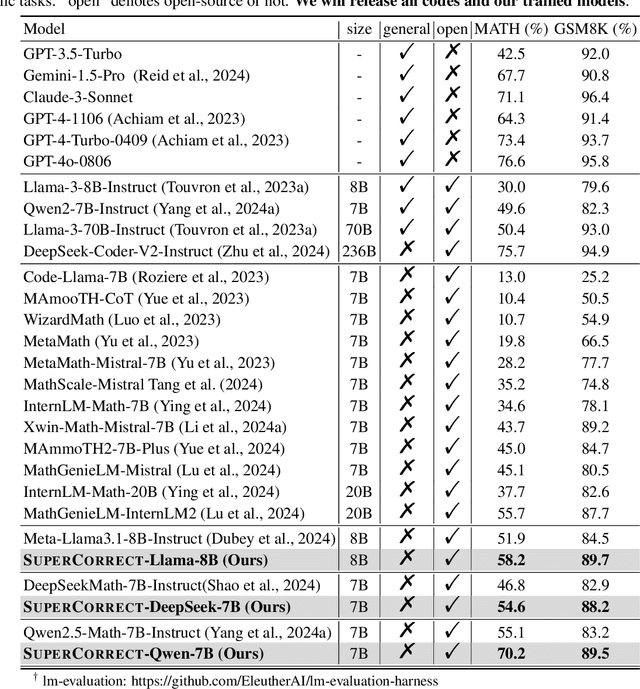
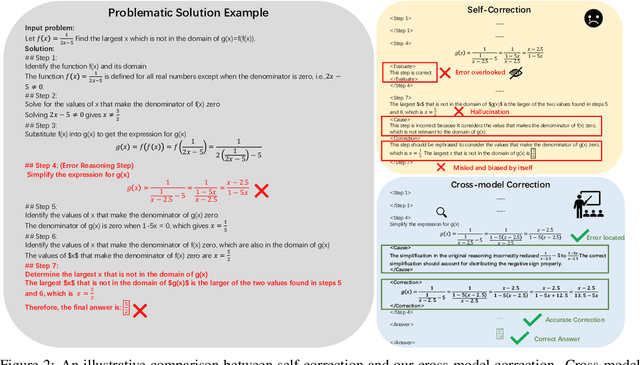

Large language models (LLMs) like GPT-4, PaLM, and LLaMA have shown significant improvements in various reasoning tasks. However, smaller models such as Llama-3-8B and DeepSeekMath-Base still struggle with complex mathematical reasoning because they fail to effectively identify and correct reasoning errors. Recent reflection-based methods aim to address these issues by enabling self-reflection and self-correction, but they still face challenges in independently detecting errors in their reasoning steps. To overcome these limitations, we propose SuperCorrect, a novel two-stage framework that uses a large teacher model to supervise and correct both the reasoning and reflection processes of a smaller student model. In the first stage, we extract hierarchical high-level and detailed thought templates from the teacher model to guide the student model in eliciting more fine-grained reasoning thoughts. In the second stage, we introduce cross-model collaborative direct preference optimization (DPO) to enhance the self-correction abilities of the student model by following the teacher's correction traces during training. This cross-model DPO approach teaches the student model to effectively locate and resolve erroneous thoughts with error-driven insights from the teacher model, breaking the bottleneck of its thoughts and acquiring new skills and knowledge to tackle challenging problems. Extensive experiments consistently demonstrate our superiority over previous methods. Notably, our SuperCorrect-7B model significantly surpasses powerful DeepSeekMath-7B by 7.8%/5.3% and Qwen2.5-Math-7B by 15.1%/6.3% on MATH/GSM8K benchmarks, achieving new SOTA performance among all 7B models. Code: https://github.com/YangLing0818/SuperCorrect-llm

Meissonic: Revitalizing Masked Generative Transformers for Efficient High-Resolution Text-to-Image Synthesis
Oct 10, 2024
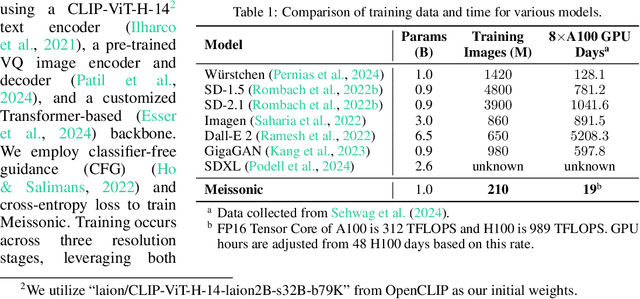
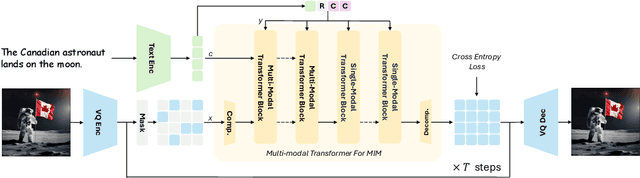
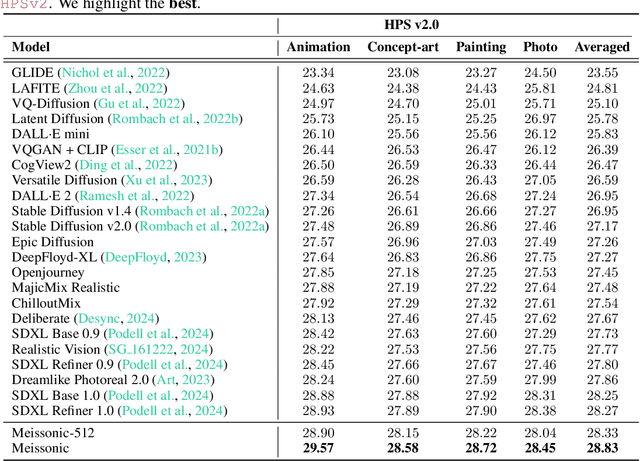
Diffusion models, such as Stable Diffusion, have made significant strides in visual generation, yet their paradigm remains fundamentally different from autoregressive language models, complicating the development of unified language-vision models. Recent efforts like LlamaGen have attempted autoregressive image generation using discrete VQVAE tokens, but the large number of tokens involved renders this approach inefficient and slow. In this work, we present Meissonic, which elevates non-autoregressive masked image modeling (MIM) text-to-image to a level comparable with state-of-the-art diffusion models like SDXL. By incorporating a comprehensive suite of architectural innovations, advanced positional encoding strategies, and optimized sampling conditions, Meissonic substantially improves MIM's performance and efficiency. Additionally, we leverage high-quality training data, integrate micro-conditions informed by human preference scores, and employ feature compression layers to further enhance image fidelity and resolution. Our model not only matches but often exceeds the performance of existing models like SDXL in generating high-quality, high-resolution images. Extensive experiments validate Meissonic's capabilities, demonstrating its potential as a new standard in text-to-image synthesis. We release a model checkpoint capable of producing $1024 \times 1024$ resolution images.
Poison-splat: Computation Cost Attack on 3D Gaussian Splatting
Oct 10, 2024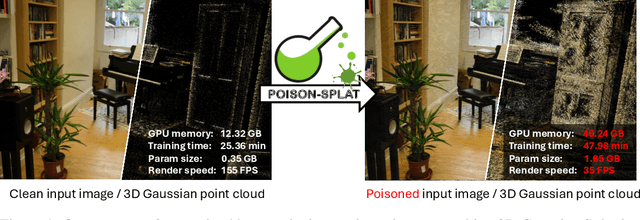
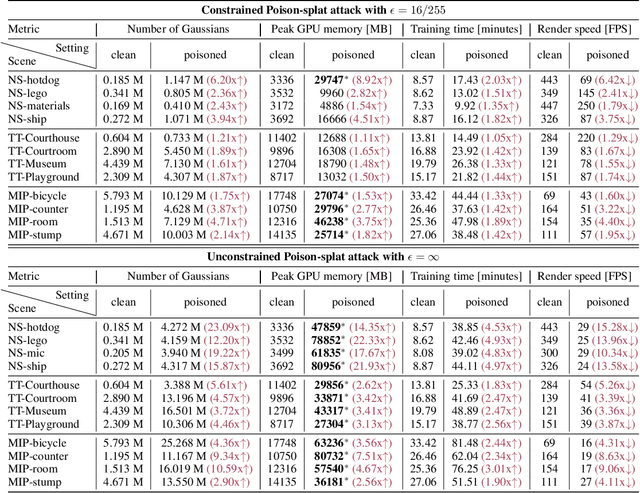
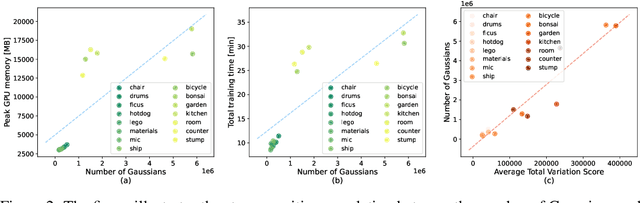
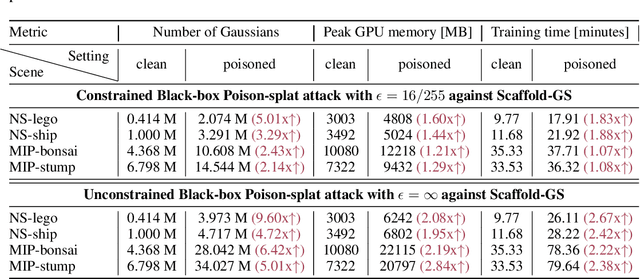
3D Gaussian splatting (3DGS), known for its groundbreaking performance and efficiency, has become a dominant 3D representation and brought progress to many 3D vision tasks. However, in this work, we reveal a significant security vulnerability that has been largely overlooked in 3DGS: the computation cost of training 3DGS could be maliciously tampered by poisoning the input data. By developing an attack named Poison-splat, we reveal a novel attack surface where the adversary can poison the input images to drastically increase the computation memory and time needed for 3DGS training, pushing the algorithm towards its worst computation complexity. In extreme cases, the attack can even consume all allocable memory, leading to a Denial-of-Service (DoS) that disrupts servers, resulting in practical damages to real-world 3DGS service vendors. Such a computation cost attack is achieved by addressing a bi-level optimization problem through three tailored strategies: attack objective approximation, proxy model rendering, and optional constrained optimization. These strategies not only ensure the effectiveness of our attack but also make it difficult to defend with simple defensive measures. We hope the revelation of this novel attack surface can spark attention to this crucial yet overlooked vulnerability of 3DGS systems.
MoE++: Accelerating Mixture-of-Experts Methods with Zero-Computation Experts
Oct 09, 2024In this work, we aim to simultaneously enhance the effectiveness and efficiency of Mixture-of-Experts (MoE) methods. To achieve this, we propose MoE++, a general and heterogeneous MoE framework that integrates both Feed-Forward Network~(FFN) and zero-computation experts. Specifically, we introduce three types of zero-computation experts: the zero expert, copy expert, and constant expert, which correspond to discard, skip, and replace operations, respectively. This design offers three key advantages: (i) Low Computing Overhead: Unlike the uniform mixing mechanism for all tokens within vanilla MoE, MoE++ allows each token to engage with a dynamic number of FFNs, be adjusted by constant vectors, or even skip the MoE layer entirely. (ii) High Performance: By enabling simple tokens to utilize fewer FFN experts, MoE++ allows more experts to focus on challenging tokens, thereby unlocking greater performance potential than vanilla MoE. (iii) Deployment Friendly: Given that zero-computation experts have negligible parameters, we can deploy all zero-computation experts on each GPU, eliminating the significant communication overhead and expert load imbalance associated with FFN experts distributed across different GPUs. Moreover, we leverage gating residuals, enabling each token to consider the pathway taken in the previous layer when selecting the appropriate experts. Extensive experimental results demonstrate that MoE++ achieves better performance while delivering 1.1-2.1x expert forward throughput compared to a vanilla MoE model of the same size, which lays a solid foundation for developing advanced and efficient MoE-related models.
Optimization Hyper-parameter Laws for Large Language Models
Sep 07, 2024Large Language Models have driven significant AI advancements, yet their training is resource-intensive and highly sensitive to hyper-parameter selection. While scaling laws provide valuable guidance on model size and data requirements, they fall short in choosing dynamic hyper-parameters, such as learning-rate (LR) schedules, that evolve during training. To bridge this gap, we present Optimization Hyper-parameter Laws (Opt-Laws), a framework that effectively captures the relationship between hyper-parameters and training outcomes, enabling the pre-selection of potential optimal schedules. Grounded in stochastic differential equations, Opt-Laws introduce novel mathematical interpretability and offer a robust theoretical foundation for some popular LR schedules. Our extensive validation across diverse model sizes and data scales demonstrates Opt-Laws' ability to accurately predict training loss and identify optimal LR schedule candidates in pre-training, continual training, and fine-tuning scenarios. This approach significantly reduces computational costs while enhancing overall model performance.
PointDGMamba: Domain Generalization of Point Cloud Classification via Generalized State Space Model
Aug 24, 2024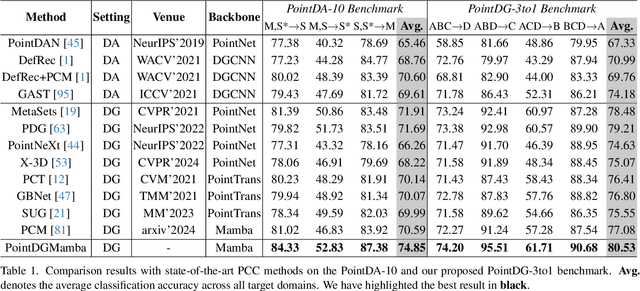
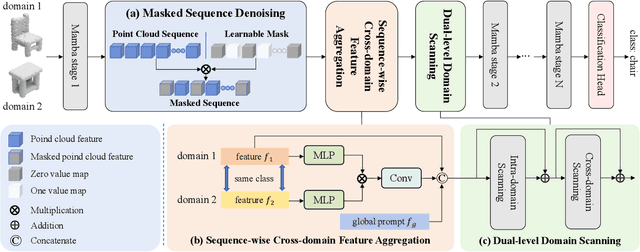
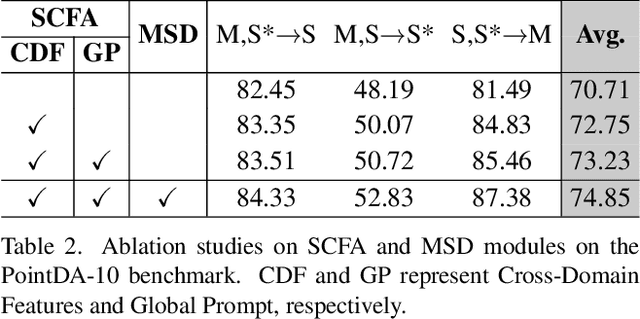
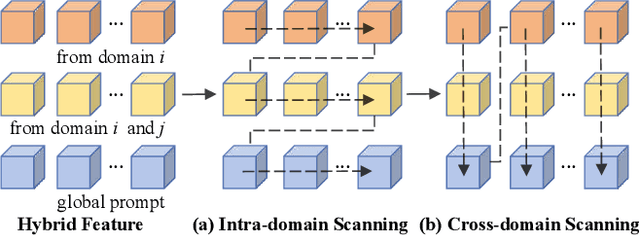
Domain Generalization (DG) has been recently explored to improve the generalizability of point cloud classification (PCC) models toward unseen domains. However, they often suffer from limited receptive fields or quadratic complexity due to the use of convolution neural networks or vision Transformers. In this paper, we present the first work that studies the generalizability of state space models (SSMs) in DG PCC and find that directly applying SSMs into DG PCC will encounter several challenges: the inherent topology of the point cloud tends to be disrupted and leads to noise accumulation during the serialization stage. Besides, the lack of designs in domain-agnostic feature learning and data scanning will introduce unanticipated domain-specific information into the 3D sequence data. To this end, we propose a novel framework, PointDGMamba, that excels in strong generalizability toward unseen domains and has the advantages of global receptive fields and efficient linear complexity. PointDGMamba consists of three innovative components: Masked Sequence Denoising (MSD), Sequence-wise Cross-domain Feature Aggregation (SCFA), and Dual-level Domain Scanning (DDS). In particular, MSD selectively masks out the noised point tokens of the point cloud sequences, SCFA introduces cross-domain but same-class point cloud features to encourage the model to learn how to extract more generalized features. DDS includes intra-domain scanning and cross-domain scanning to facilitate information exchange between features. In addition, we propose a new and more challenging benchmark PointDG-3to1 for multi-domain generalization. Extensive experiments demonstrate the effectiveness and state-of-the-art performance of our presented PointDGMamba.
EasyInv: Toward Fast and Better DDIM Inversion
Aug 09, 2024



This paper introduces EasyInv, an easy yet novel approach that significantly advances the field of DDIM Inversion by addressing the inherent inefficiencies and performance limitations of traditional iterative optimization methods. At the core of our EasyInv is a refined strategy for approximating inversion noise, which is pivotal for enhancing the accuracy and reliability of the inversion process. By prioritizing the initial latent state, which encapsulates rich information about the original images, EasyInv steers clear of the iterative refinement of noise items. Instead, we introduce a methodical aggregation of the latent state from the preceding time step with the current state, effectively increasing the influence of the initial latent state and mitigating the impact of noise. We illustrate that EasyInv is capable of delivering results that are either on par with or exceed those of the conventional DDIM Inversion approach, especially under conditions where the model's precision is limited or computational resources are scarce. Concurrently, our EasyInv offers an approximate threefold enhancement regarding inference efficiency over off-the-shelf iterative optimization techniques.
Skywork-Math: Data Scaling Laws for Mathematical Reasoning in Large Language Models -- The Story Goes On
Jul 11, 2024
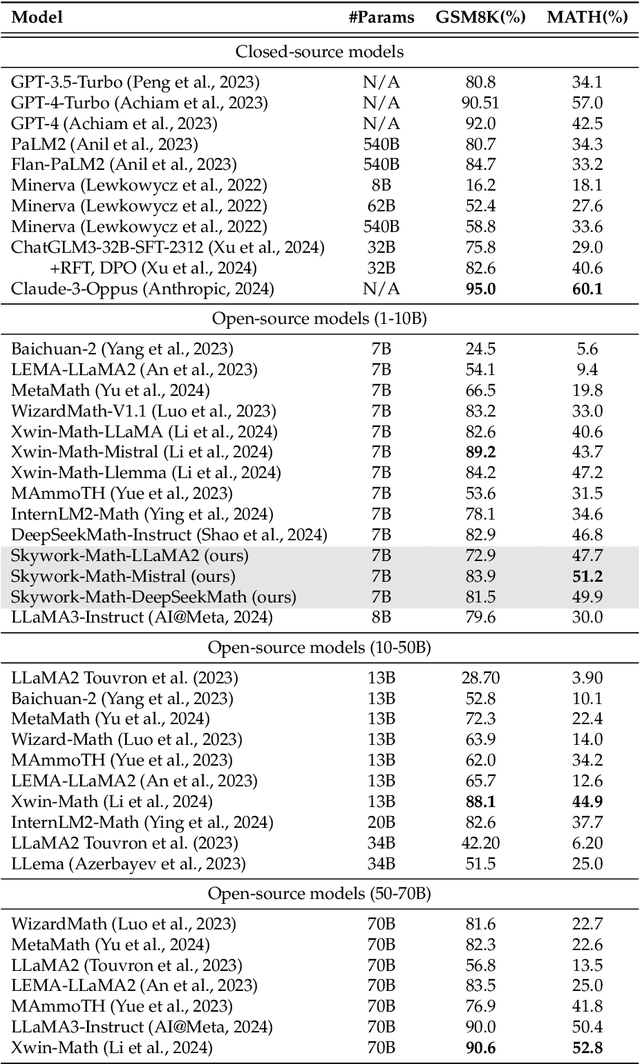
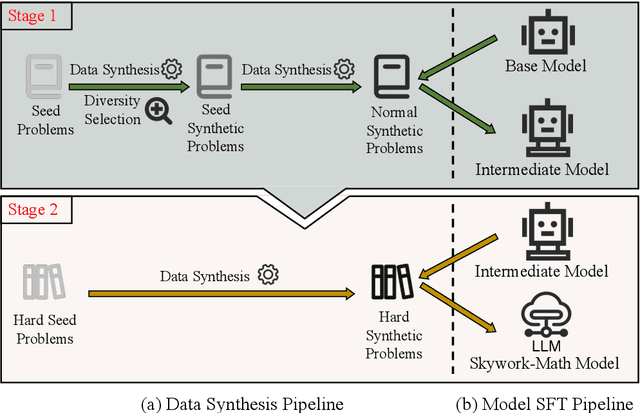
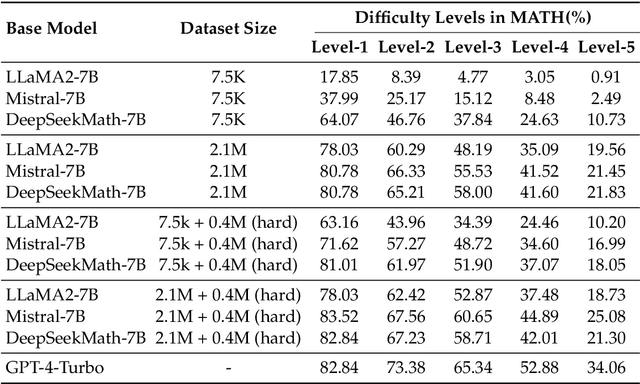
In this paper, we investigate the underlying factors that potentially enhance the mathematical reasoning capabilities of large language models (LLMs). We argue that the data scaling law for math reasoning capabilities in modern LLMs is far from being saturated, highlighting how the model's quality improves with increases in data quantity. To support this claim, we introduce the Skywork-Math model series, supervised fine-tuned (SFT) on common 7B LLMs using our proposed 2.5M-instance Skywork-MathQA dataset. Skywork-Math 7B has achieved impressive accuracies of 51.2% on the competition-level MATH benchmark and 83.9% on the GSM8K benchmark using only SFT data, outperforming an early version of GPT-4 on MATH. The superior performance of Skywork-Math models contributes to our novel two-stage data synthesis and model SFT pipelines, which include three different augmentation methods and a diverse seed problem set, ensuring both the quantity and quality of Skywork-MathQA dataset across varying difficulty levels. Most importantly, we provide several practical takeaways to enhance math reasoning abilities in LLMs for both research and industry applications.
LLMs-as-Instructors: Learning from Errors Toward Automating Model Improvement
Jun 29, 2024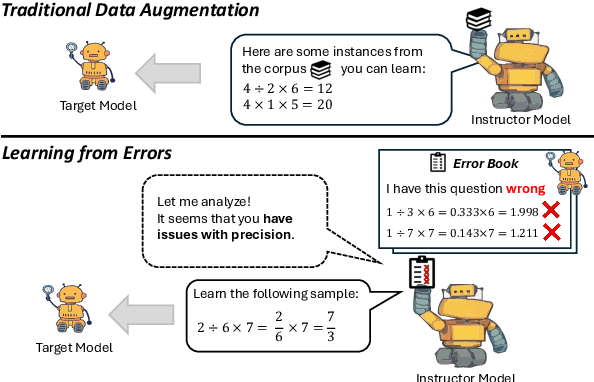
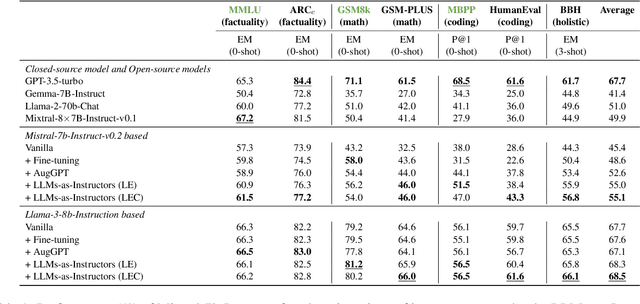
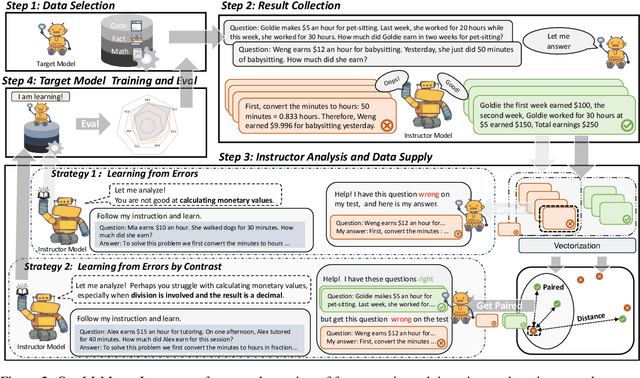
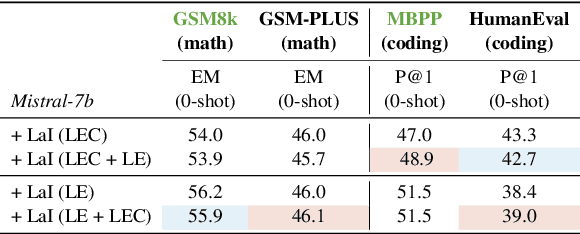
This paper introduces the innovative "LLMs-as-Instructors" framework, which leverages the advanced Large Language Models (LLMs) to autonomously enhance the training of smaller target models. Inspired by the theory of "Learning from Errors", this framework employs an instructor LLM to meticulously analyze the specific errors within a target model, facilitating targeted and efficient training cycles. Within this framework, we implement two strategies: "Learning from Error," which focuses solely on incorrect responses to tailor training data, and "Learning from Error by Contrast", which uses contrastive learning to analyze both correct and incorrect responses for a deeper understanding of errors. Our empirical studies, conducted with several open-source models, demonstrate significant improvements across multiple benchmarks, including mathematical reasoning, coding abilities, and factual knowledge. Notably, the refined Llama-3-8b-Instruction has outperformed ChatGPT, illustrating the effectiveness of our approach. By leveraging the strengths of both strategies, we have attained a more balanced performance improvement on both in-domain and out-of-domain benchmarks. Our code can be found at https://yingjiahao14.github.io/LLMs-as-Instructors-pages/.
OMG-LLaVA: Bridging Image-level, Object-level, Pixel-level Reasoning and Understanding
Jun 27, 2024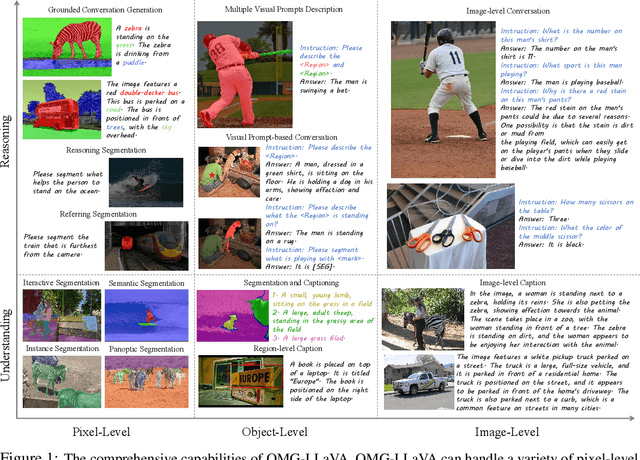
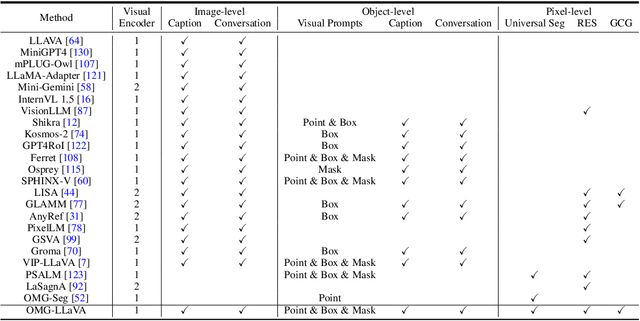

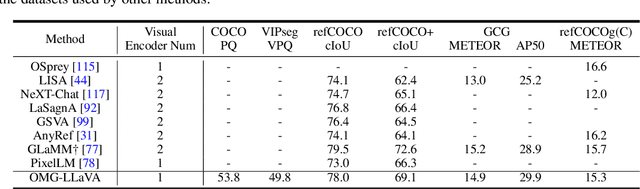
Current universal segmentation methods demonstrate strong capabilities in pixel-level image and video understanding. However, they lack reasoning abilities and cannot be controlled via text instructions. In contrast, large vision-language multimodal models exhibit powerful vision-based conversation and reasoning capabilities but lack pixel-level understanding and have difficulty accepting visual prompts for flexible user interaction. This paper proposes OMG-LLaVA, a new and elegant framework combining powerful pixel-level vision understanding with reasoning abilities. It can accept various visual and text prompts for flexible user interaction. Specifically, we use a universal segmentation method as the visual encoder, integrating image information, perception priors, and visual prompts into visual tokens provided to the LLM. The LLM is responsible for understanding the user's text instructions and providing text responses and pixel-level segmentation results based on the visual information. We propose perception prior embedding to better integrate perception priors with image features. OMG-LLaVA achieves image-level, object-level, and pixel-level reasoning and understanding in a single model, matching or surpassing the performance of specialized methods on multiple benchmarks. Rather than using LLM to connect each specialist, our work aims at end-to-end training on one encoder, one decoder, and one LLM. The code and model have been released for further research.