 Add to Chrome
 Add to Firefox
 Add to Edge
Retrieve in Time, Correct in Frequency
Aug 07, 2026
Frozen vision-language-action (VLA) policies generate temporally extended action chunks, but long-horizon manipulation remains vulnerable to accumulated execution error and visual aliasing across task stages. Successful rollouts provide useful corrective evidence, yet current frame retrieval can return progress-misaligned actions,while direct replay or time-domain fusion can overwrite the reactive structure of the policy proposal. We introduce Retrieve in Time, Correct in Frequency (RTCF), a training-free test-time correction framework that improves frozen VLA performance with low model-side overhead.RTCF separates which experience to retrieve from which part of its action to transfer. Progressive Memory Alignment (PMA) causally aligns the growing visual execution history with complete successful trajectories through incrementally updated monotonic frontiers, jointly identifying a relevant memory and the current aligned memory position without stage labels. From the aligned action chunk,RTCF transfers a coefficient-wise-clipped low-frequency residual on motion channels. Higher-frequency components and gripper decisions remain inherited from the frozen policy. Across four LIBERO suites and 2,000 episodes per condition, RTCF raises aggregate success from 86.4% to 88.4% and improves LIBERO-Long from 61.6% to 68.6%.These gains require no parameter updates, repeated VLA inference, or additional GPU resources: correction can be performed on the client CPU after a single policy invocation, and the median latencies sum to only 10.99 ms per action chunk

Beyond Supervised Clarification: Input Rewriting with LLMs for Dialogue Discourse Parsing
Jul 02, 2026Rewriting inputs to improve frozen downstream models has become a common strategy in modern NLP pipelines. Prior work on incremental dialogue discourse parsing (DDP) shows that supervised clarification models can rewrite fragmentary or underspecified utterances, such as resolving ellipsis or references, to improve parsing accuracy. In this work, we revisit this idea under realistic deployment conditions, where no clarification supervision is available and the clarifier must rely on zero-shot prompting or feedback from a frozen parser. Across three Segmented Discourse Representation Theory (SDRT) datasets and multiple parsers, we find that last-utterance clarification is far less reliable than suggested by supervised settings. Parser-agnostic rewriting often introduces more regressions than repairs, as edits that enable fixes also disrupt discourse cues relied upon by the parser. A best-of-8 rewriting analysis further reveals a practical ceiling: a large fraction of errors are not repairable through input rewriting alone. A parser-aware clarifier trained with GRPO reduces regressions by up to 37% by learning conservative abstention, yet still fails to produce selectivity-aware clarifications that consistently improve parsing. Together, these findings recast clarification as a selective intervention problem. We identify rewritability prediction, deciding whether an utterance is repairable before intervention, as the key missing capability for input-side optimization of frozen discourse parsers, and a critical direction for improving agentic pipelines more broadly.
EVA: Accelerating LLM Decoding via an Efficient Vector Quantization Architecture
May 22, 2026Large Language Models (LLMs) have achieved impressive performance across diverse domains but remain inefficient during the autoregressive decoding phase. Unlike the prefill stage, which employs compute-bound GEMM operations, decoding executes a sequence of small GEMV-like computations that are memory-bound and underutilize modern accelerators. Weight-only vector quantization (VQ) has emerged as an effective compression technique that clusters model weights into a shared codebook and replaces the original weight matrix with low-precision indices, enabling 2-bit-level weight compression. While this approach substantially reduces model size and memory bandwidth, it still suffers from two critical inefficiencies: the low utilization of GEMV computation and frequent memory conflicts during codebook lookups. This paper presents EVA, an efficient vector-quantization-based architecture that addresses both computational and memory bottlenecks in LLM decoding. EVA builds on a simple yet effective insight that combines input-codebook computation with conflict-free memory access. Instead of reconstructing quantized weights from indices, EVA directly performs dot products between input vectors and the weight codebook, transforming LLM decoding from GEMV to GEMM computation. It then performs structured lookups from an intermediate output buffer, eliminating memory bank conflicts. We further design a hardware-software co-optimized architecture specialized for LLM decoding while remaining compatible with conventional prefill execution. Evaluations show that EVA achieves up to 11.17$\times$ speedup and 7.17$\times$ higher energy efficiency compared with the SOTA lookup-based architecture, while preserving arithmetic precision after vector quantization. Our code is available at https://github.com/dbw6/Eva.git.
DeepInv: A Novel Self-supervised Learning Approach for Fast and Accurate Diffusion Inversion
Jan 04, 2026Diffusion inversion is a task of recovering the noise of an image in a diffusion model, which is vital for controllable diffusion image editing. At present, diffusion inversion still remains a challenging task due to the lack of viable supervision signals. Thus, most existing methods resort to approximation-based solutions, which however are often at the cost of performance or efficiency. To remedy these shortcomings, we propose a novel self-supervised diffusion inversion approach in this paper, termed Deep Inversion (DeepInv). Instead of requiring ground-truth noise annotations, we introduce a self-supervised objective as well as a data augmentation strategy to generate high-quality pseudo noises from real images without manual intervention. Based on these two innovative designs, DeepInv is also equipped with an iterative and multi-scale training regime to train a parameterized inversion solver, thereby achieving the fast and accurate image-to-noise mapping. To the best of our knowledge, this is the first attempt of presenting a trainable solver to predict inversion noise step by step. The extensive experiments show that our DeepInv can achieve much better performance and inference speed than the compared methods, e.g., +40.435% SSIM than EasyInv and +9887.5% speed than ReNoise on COCO dataset. Moreover, our careful designs of trainable solvers can also provide insights to the community. Codes and model parameters will be released in https://github.com/potato-kitty/DeepInv.
Listening, Imagining \& Refining: A Heuristic Optimized ASR Correction Framework with LLMs
Sep 18, 2025Automatic Speech Recognition (ASR) systems remain prone to errors that affect downstream applications. In this paper, we propose LIR-ASR, a heuristic optimized iterative correction framework using LLMs, inspired by human auditory perception. LIR-ASR applies a "Listening-Imagining-Refining" strategy, generating phonetic variants and refining them in context. A heuristic optimization with finite state machine (FSM) is introduced to prevent the correction process from being trapped in local optima and rule-based constraints help maintain semantic fidelity. Experiments on both English and Chinese ASR outputs show that LIR-ASR achieves average reductions in CER/WER of up to 1.5 percentage points compared to baselines, demonstrating substantial accuracy gains in transcription.
EMind: A Foundation Model for Multi-task Electromagnetic Signals Understanding
Aug 26, 2025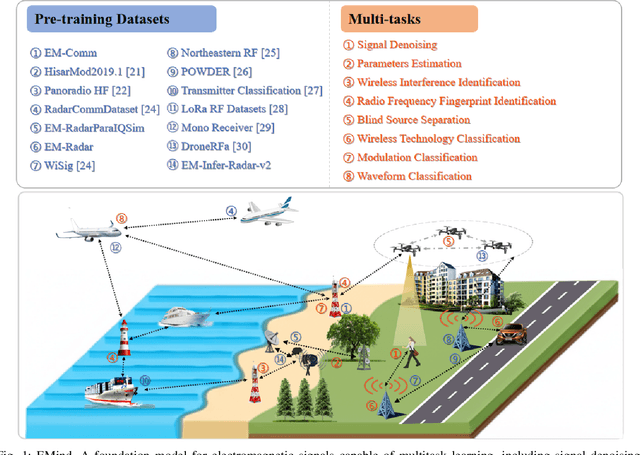
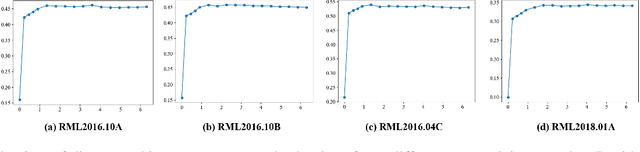
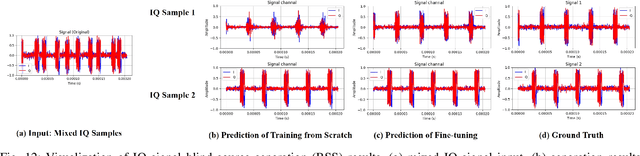
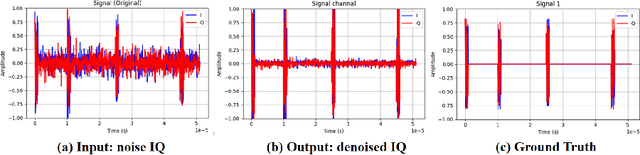
Deep understanding of electromagnetic signals is fundamental to dynamic spectrum management, intelligent transportation, autonomous driving and unmanned vehicle perception. The field faces challenges because electromagnetic signals differ greatly from text and images, showing high heterogeneity, strong background noise and complex joint time frequency structure, which prevents existing general models from direct use. Electromagnetic communication and sensing tasks are diverse, current methods lack cross task generalization and transfer efficiency, and the scarcity of large high quality datasets blocks the creation of a truly general multitask learning framework. To overcome these issue, we introduce EMind, an electromagnetic signals foundation model that bridges large scale pretraining and the unique nature of this modality. We build the first unified and largest standardized electromagnetic signal dataset covering multiple signal types and tasks. By exploiting the physical properties of electromagnetic signals, we devise a length adaptive multi-signal packing method and a hardware-aware training strategy that enable efficient use and representation learning from heterogeneous multi-source signals. Experiments show that EMind achieves strong performance and broad generalization across many downstream tasks, moving decisively from task specific models to a unified framework for electromagnetic intelligence. The code is available at: https://github.com/GabrielleTse/EMind.
FMSD-TTS: Few-shot Multi-Speaker Multi-Dialect Text-to-Speech Synthesis for Ü-Tsang, Amdo and Kham Speech Dataset Generation
May 20, 2025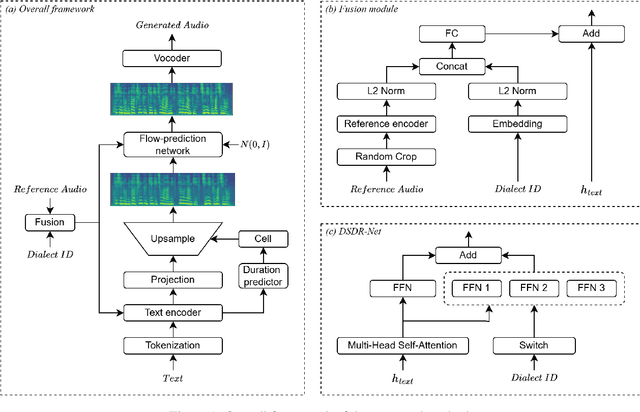

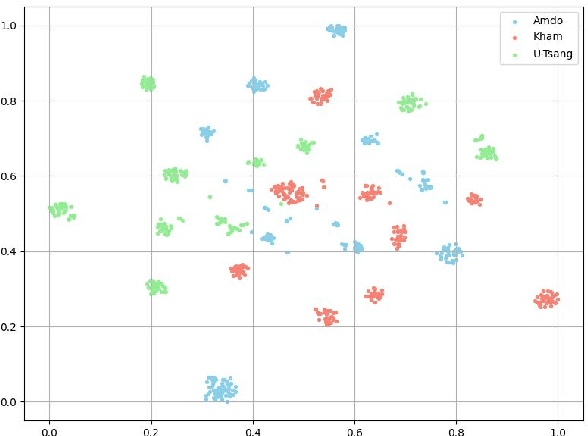
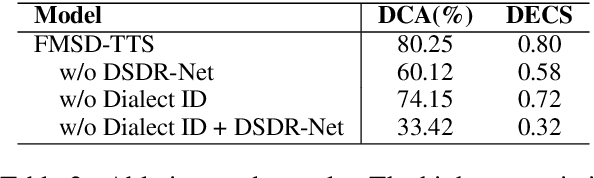
Tibetan is a low-resource language with minimal parallel speech corpora spanning its three major dialects-\"U-Tsang, Amdo, and Kham-limiting progress in speech modeling. To address this issue, we propose FMSD-TTS, a few-shot, multi-speaker, multi-dialect text-to-speech framework that synthesizes parallel dialectal speech from limited reference audio and explicit dialect labels. Our method features a novel speaker-dialect fusion module and a Dialect-Specialized Dynamic Routing Network (DSDR-Net) to capture fine-grained acoustic and linguistic variations across dialects while preserving speaker identity. Extensive objective and subjective evaluations demonstrate that FMSD-TTS significantly outperforms baselines in both dialectal expressiveness and speaker similarity. We further validate the quality and utility of the synthesized speech through a challenging speech-to-speech dialect conversion task. Our contributions include: (1) a novel few-shot TTS system tailored for Tibetan multi-dialect speech synthesis, (2) the public release of a large-scale synthetic Tibetan speech corpus generated by FMSD-TTS, and (3) an open-source evaluation toolkit for standardized assessment of speaker similarity, dialect consistency, and audio quality.
TiSpell: A Semi-Masked Methodology for Tibetan Spelling Correction covering Multi-Level Error with Data Augmentation
May 14, 2025Multi-level Tibetan spelling correction addresses errors at both the character and syllable levels within a unified model. Existing methods focus mainly on single-level correction and lack effective integration of both levels. Moreover, there are no open-source datasets or augmentation methods tailored for this task in Tibetan. To tackle this, we propose a data augmentation approach using unlabeled text to generate multi-level corruptions, and introduce TiSpell, a semi-masked model capable of correcting both character- and syllable-level errors. Although syllable-level correction is more challenging due to its reliance on global context, our semi-masked strategy simplifies this process. We synthesize nine types of corruptions on clean sentences to create a robust training set. Experiments on both simulated and real-world data demonstrate that TiSpell, trained on our dataset, outperforms baseline models and matches the performance of state-of-the-art approaches, confirming its effectiveness.
SCOPE-DTI: Semi-Inductive Dataset Construction and Framework Optimization for Practical Usability Enhancement in Deep Learning-Based Drug Target Interaction Prediction
Mar 12, 2025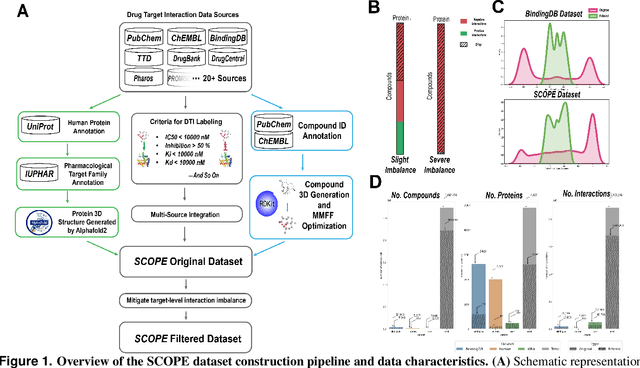
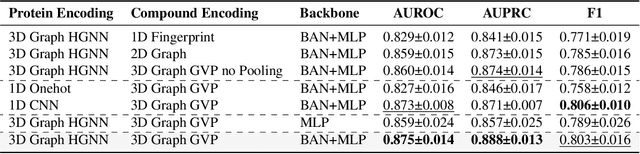
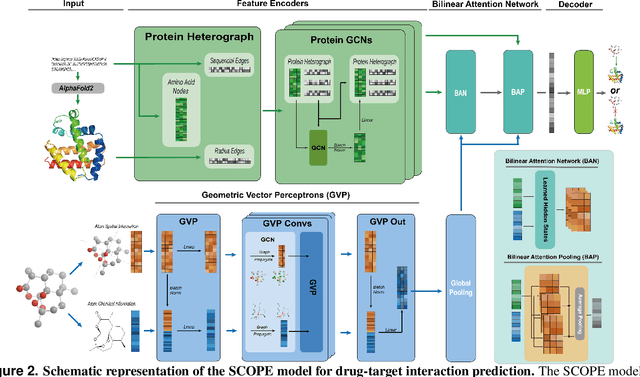
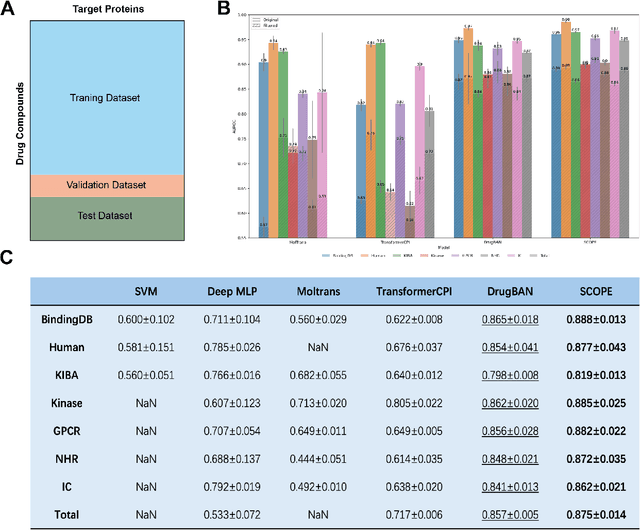
Deep learning-based drug-target interaction (DTI) prediction methods have demonstrated strong performance; however, real-world applicability remains constrained by limited data diversity and modeling complexity. To address these challenges, we propose SCOPE-DTI, a unified framework combining a large-scale, balanced semi-inductive human DTI dataset with advanced deep learning modeling. Constructed from 13 public repositories, the SCOPE dataset expands data volume by up to 100-fold compared to common benchmarks such as the Human dataset. The SCOPE model integrates three-dimensional protein and compound representations, graph neural networks, and bilinear attention mechanisms to effectively capture cross domain interaction patterns, significantly outperforming state-of-the-art methods across various DTI prediction tasks. Additionally, SCOPE-DTI provides a user-friendly interface and database. We further validate its effectiveness by experimentally identifying anticancer targets of Ginsenoside Rh1. By offering comprehensive data, advanced modeling, and accessible tools, SCOPE-DTI accelerates drug discovery research.
LightMotion: A Light and Tuning-free Method for Simulating Camera Motion in Video Generation
Mar 11, 2025Existing camera motion-controlled video generation methods face computational bottlenecks in fine-tuning and inference. This paper proposes LightMotion, a light and tuning-free method for simulating camera motion in video generation. Operating in the latent space, it eliminates additional fine-tuning, inpainting, and depth estimation, making it more streamlined than existing methods. The endeavors of this paper comprise: (i) The latent space permutation operation effectively simulates various camera motions like panning, zooming, and rotation. (ii) The latent space resampling strategy combines background-aware sampling and cross-frame alignment to accurately fill new perspectives while maintaining coherence across frames. (iii) Our in-depth analysis shows that the permutation and resampling cause an SNR shift in latent space, leading to poor-quality generation. To address this, we propose latent space correction, which reintroduces noise during denoising to mitigate SNR shift and enhance video generation quality. Exhaustive experiments show that our LightMotion outperforms existing methods, both quantitatively and qualitatively.