 Add to Chrome
 Add to Firefox
 Add to Edge
Selectivity Drives Productivity: Efficient Dataset Pruning for Enhanced Transfer Learning
Oct 16, 2023
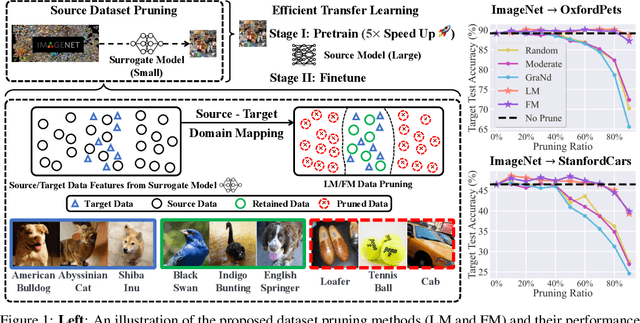


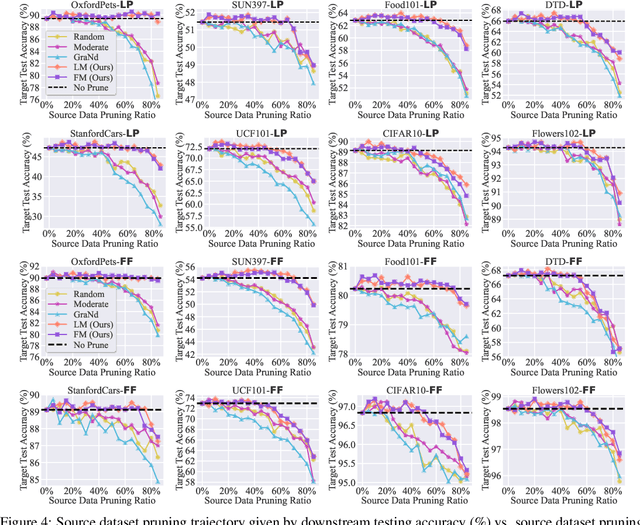
Massive data is often considered essential for deep learning applications, but it also incurs significant computational and infrastructural costs. Therefore, dataset pruning (DP) has emerged as an effective way to improve data efficiency by identifying and removing redundant training samples without sacrificing performance. In this work, we aim to address the problem of DP for transfer learning, i.e., how to prune a source dataset for improved pretraining efficiency and lossless finetuning accuracy on downstream target tasks. To our best knowledge, the problem of DP for transfer learning remains open, as previous studies have primarily addressed DP and transfer learning as separate problems. By contrast, we establish a unified viewpoint to integrate DP with transfer learning and find that existing DP methods are not suitable for the transfer learning paradigm. We then propose two new DP methods, label mapping and feature mapping, for supervised and self-supervised pretraining settings respectively, by revisiting the DP problem through the lens of source-target domain mapping. Furthermore, we demonstrate the effectiveness of our approach on numerous transfer learning tasks. We show that source data classes can be pruned by up to 40% ~ 80% without sacrificing downstream performance, resulting in a significant 2 ~ 5 times speed-up during the pretraining stage. Besides, our proposal exhibits broad applicability and can improve other computationally intensive transfer learning techniques, such as adversarial pretraining. Codes are available at https://github.com/OPTML-Group/DP4TL.

GDL-DS: A Benchmark for Geometric Deep Learning under Distribution Shifts
Oct 12, 2023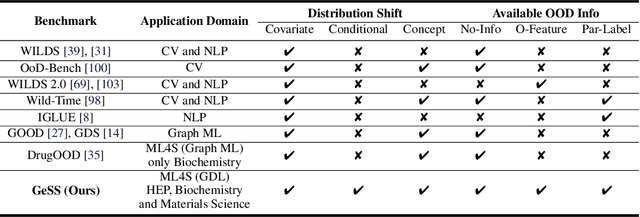
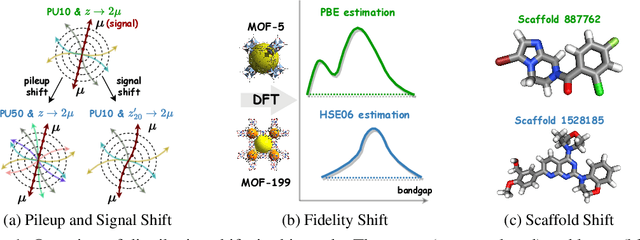
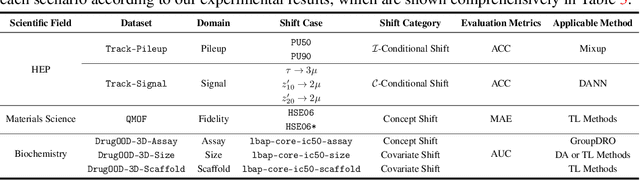
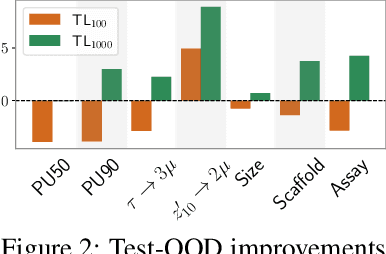
Geometric deep learning (GDL) has gained significant attention in various scientific fields, chiefly for its proficiency in modeling data with intricate geometric structures. Yet, very few works have delved into its capability of tackling the distribution shift problem, a prevalent challenge in many relevant applications. To bridge this gap, we propose GDL-DS, a comprehensive benchmark designed for evaluating the performance of GDL models in scenarios with distribution shifts. Our evaluation datasets cover diverse scientific domains from particle physics and materials science to biochemistry, and encapsulate a broad spectrum of distribution shifts including conditional, covariate, and concept shifts. Furthermore, we study three levels of information access from the out-of-distribution (OOD) testing data, including no OOD information, only OOD features without labels, and OOD features with a few labels. Overall, our benchmark results in 30 different experiment settings, and evaluates 3 GDL backbones and 11 learning algorithms in each setting. A thorough analysis of the evaluation results is provided, poised to illuminate insights for DGL researchers and domain practitioners who are to use DGL in their applications.
Audio-Visual Neural Syntax Acquisition
Oct 11, 2023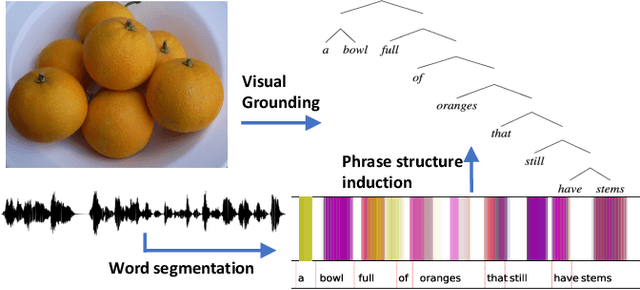
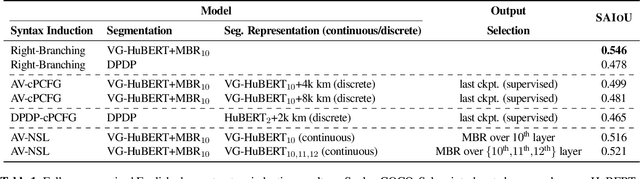
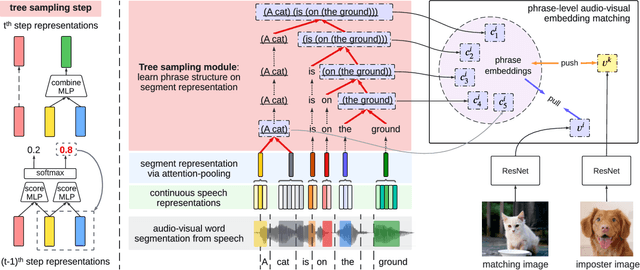
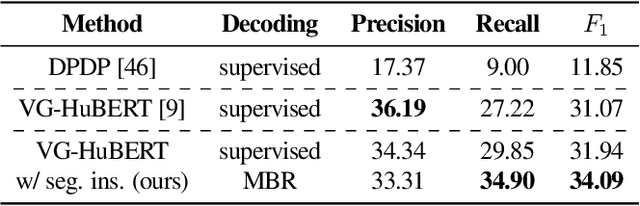
We study phrase structure induction from visually-grounded speech. The core idea is to first segment the speech waveform into sequences of word segments, and subsequently induce phrase structure using the inferred segment-level continuous representations. We present the Audio-Visual Neural Syntax Learner (AV-NSL) that learns phrase structure by listening to audio and looking at images, without ever being exposed to text. By training on paired images and spoken captions, AV-NSL exhibits the capability to infer meaningful phrase structures that are comparable to those derived by naturally-supervised text parsers, for both English and German. Our findings extend prior work in unsupervised language acquisition from speech and grounded grammar induction, and present one approach to bridge the gap between the two topics.
Robust Mixture-of-Expert Training for Convolutional Neural Networks
Aug 19, 2023Sparsely-gated Mixture of Expert (MoE), an emerging deep model architecture, has demonstrated a great promise to enable high-accuracy and ultra-efficient model inference. Despite the growing popularity of MoE, little work investigated its potential to advance convolutional neural networks (CNNs), especially in the plane of adversarial robustness. Since the lack of robustness has become one of the main hurdles for CNNs, in this paper we ask: How to adversarially robustify a CNN-based MoE model? Can we robustly train it like an ordinary CNN model? Our pilot study shows that the conventional adversarial training (AT) mechanism (developed for vanilla CNNs) no longer remains effective to robustify an MoE-CNN. To better understand this phenomenon, we dissect the robustness of an MoE-CNN into two dimensions: Robustness of routers (i.e., gating functions to select data-specific experts) and robustness of experts (i.e., the router-guided pathways defined by the subnetworks of the backbone CNN). Our analyses show that routers and experts are hard to adapt to each other in the vanilla AT. Thus, we propose a new router-expert alternating Adversarial training framework for MoE, termed AdvMoE. The effectiveness of our proposal is justified across 4 commonly-used CNN model architectures over 4 benchmark datasets. We find that AdvMoE achieves 1% ~ 4% adversarial robustness improvement over the original dense CNN, and enjoys the efficiency merit of sparsity-gated MoE, leading to more than 50% inference cost reduction. Codes are available at https://github.com/OPTML-Group/Robust-MoE-CNN.
Certified Robustness for Large Language Models with Self-Denoising
Jul 14, 2023Although large language models (LLMs) have achieved great success in vast real-world applications, their vulnerabilities towards noisy inputs have significantly limited their uses, especially in high-stake environments. In these contexts, it is crucial to ensure that every prediction made by large language models is stable, i.e., LLM predictions should be consistent given minor differences in the input. This largely falls into the study of certified robust LLMs, i.e., all predictions of LLM are certified to be correct in a local region around the input. Randomized smoothing has demonstrated great potential in certifying the robustness and prediction stability of LLMs. However, randomized smoothing requires adding noise to the input before model prediction, and its certification performance depends largely on the model's performance on corrupted data. As a result, its direct application to LLMs remains challenging and often results in a small certification radius. To address this issue, we take advantage of the multitasking nature of LLMs and propose to denoise the corrupted inputs with LLMs in a self-denoising manner. Different from previous works like denoised smoothing, which requires training a separate model to robustify LLM, our method enjoys far better efficiency and flexibility. Our experiment results show that our method outperforms the existing certification methods under both certified robustness and empirical robustness. The codes are available at https://github.com/UCSB-NLP-Chang/SelfDenoise.
Improving Diffusion Models for Scene Text Editing with Dual Encoders
Apr 12, 2023
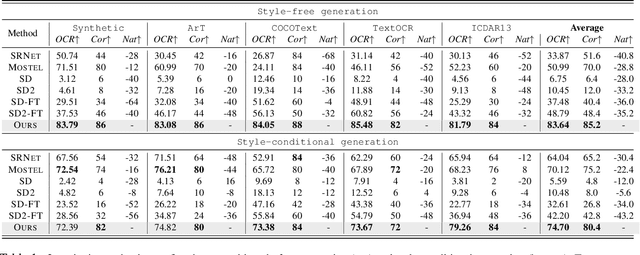

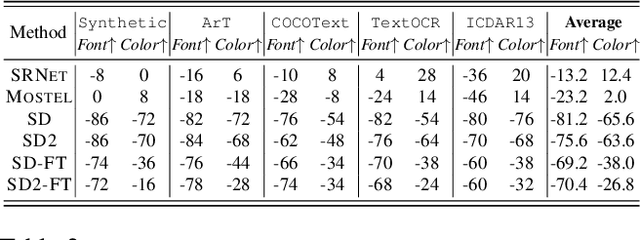
Scene text editing is a challenging task that involves modifying or inserting specified texts in an image while maintaining its natural and realistic appearance. Most previous approaches to this task rely on style-transfer models that crop out text regions and feed them into image transfer models, such as GANs. However, these methods are limited in their ability to change text style and are unable to insert texts into images. Recent advances in diffusion models have shown promise in overcoming these limitations with text-conditional image editing. However, our empirical analysis reveals that state-of-the-art diffusion models struggle with rendering correct text and controlling text style. To address these problems, we propose DIFFSTE to improve pre-trained diffusion models with a dual encoder design, which includes a character encoder for better text legibility and an instruction encoder for better style control. An instruction tuning framework is introduced to train our model to learn the mapping from the text instruction to the corresponding image with either the specified style or the style of the surrounding texts in the background. Such a training method further brings our method the zero-shot generalization ability to the following three scenarios: generating text with unseen font variation, e.g., italic and bold, mixing different fonts to construct a new font, and using more relaxed forms of natural language as the instructions to guide the generation task. We evaluate our approach on five datasets and demonstrate its superior performance in terms of text correctness, image naturalness, and style controllability. Our code is publicly available. https://github.com/UCSB-NLP-Chang/DiffSTE
Harnessing the Spatial-Temporal Attention of Diffusion Models for High-Fidelity Text-to-Image Synthesis
Apr 07, 2023
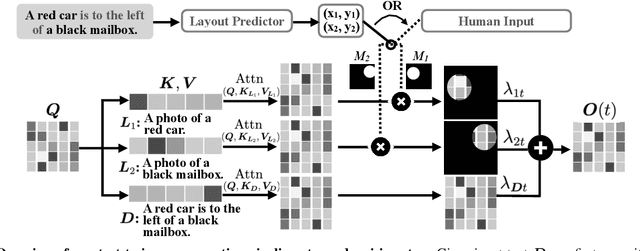

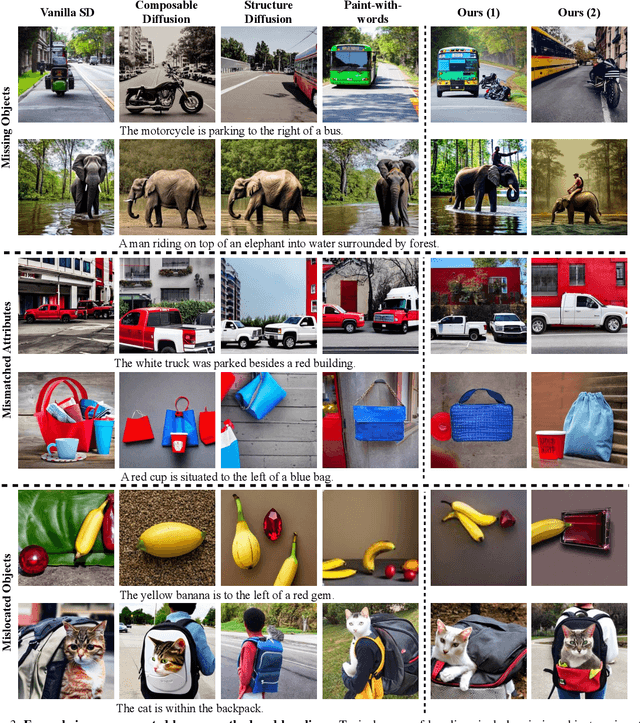
Diffusion-based models have achieved state-of-the-art performance on text-to-image synthesis tasks. However, one critical limitation of these models is the low fidelity of generated images with respect to the text description, such as missing objects, mismatched attributes, and mislocated objects. One key reason for such inconsistencies is the inaccurate cross-attention to text in both the spatial dimension, which controls at what pixel region an object should appear, and the temporal dimension, which controls how different levels of details are added through the denoising steps. In this paper, we propose a new text-to-image algorithm that adds explicit control over spatial-temporal cross-attention in diffusion models. We first utilize a layout predictor to predict the pixel regions for objects mentioned in the text. We then impose spatial attention control by combining the attention over the entire text description and that over the local description of the particular object in the corresponding pixel region of that object. The temporal attention control is further added by allowing the combination weights to change at each denoising step, and the combination weights are optimized to ensure high fidelity between the image and the text. Experiments show that our method generates images with higher fidelity compared to diffusion-model-based baselines without fine-tuning the diffusion model. Our code is publicly available at https://github.com/UCSB-NLP-Chang/Diffusion-SpaceTime-Attn.
Towards Coherent Image Inpainting Using Denoising Diffusion Implicit Models
Apr 06, 2023Image inpainting refers to the task of generating a complete, natural image based on a partially revealed reference image. Recently, many research interests have been focused on addressing this problem using fixed diffusion models. These approaches typically directly replace the revealed region of the intermediate or final generated images with that of the reference image or its variants. However, since the unrevealed regions are not directly modified to match the context, it results in incoherence between revealed and unrevealed regions. To address the incoherence problem, a small number of methods introduce a rigorous Bayesian framework, but they tend to introduce mismatches between the generated and the reference images due to the approximation errors in computing the posterior distributions. In this paper, we propose COPAINT, which can coherently inpaint the whole image without introducing mismatches. COPAINT also uses the Bayesian framework to jointly modify both revealed and unrevealed regions, but approximates the posterior distribution in a way that allows the errors to gradually drop to zero throughout the denoising steps, thus strongly penalizing any mismatches with the reference image. Our experiments verify that COPAINT can outperform the existing diffusion-based methods under both objective and subjective metrics. The codes are available at https://github.com/UCSB-NLP-Chang/CoPaint/.
Users are the North Star for AI Transparency
Mar 09, 2023Despite widespread calls for transparent artificial intelligence systems, the term is too overburdened with disparate meanings to express precise policy aims or to orient concrete lines of research. Consequently, stakeholders often talk past each other, with policymakers expressing vague demands and practitioners devising solutions that may not address the underlying concerns. Part of why this happens is that a clear ideal of AI transparency goes unsaid in this body of work. We explicitly name such a north star -- transparency that is user-centered, user-appropriate, and honest. We conduct a broad literature survey, identifying many clusters of similar conceptions of transparency, tying each back to our north star with analysis of how it furthers or hinders our ideal AI transparency goals. We conclude with a discussion on common threads across all the clusters, to provide clearer common language whereby policymakers, stakeholders, and practitioners can communicate concrete demands and deliver appropriate solutions. We hope for future work on AI transparency that further advances confident, user-beneficial goals and provides clarity to regulators and developers alike.
TextGrad: Advancing Robustness Evaluation in NLP by Gradient-Driven Optimization
Dec 19, 2022Robustness evaluation against adversarial examples has become increasingly important to unveil the trustworthiness of the prevailing deep models in natural language processing (NLP). However, in contrast to the computer vision domain where the first-order projected gradient descent (PGD) is used as the benchmark approach to generate adversarial examples for robustness evaluation, there lacks a principled first-order gradient-based robustness evaluation framework in NLP. The emerging optimization challenges lie in 1) the discrete nature of textual inputs together with the strong coupling between the perturbation location and the actual content, and 2) the additional constraint that the perturbed text should be fluent and achieve a low perplexity under a language model. These challenges make the development of PGD-like NLP attacks difficult. To bridge the gap, we propose TextGrad, a new attack generator using gradient-driven optimization, supporting high-accuracy and high-quality assessment of adversarial robustness in NLP. Specifically, we address the aforementioned challenges in a unified optimization framework. And we develop an effective convex relaxation method to co-optimize the continuously-relaxed site selection and perturbation variables and leverage an effective sampling method to establish an accurate mapping from the continuous optimization variables to the discrete textual perturbations. Moreover, as a first-order attack generation method, TextGrad can be baked into adversarial training to further improve the robustness of NLP models. Extensive experiments are provided to demonstrate the effectiveness of TextGrad not only in attack generation for robustness evaluation but also in adversarial defense.