 Add to Chrome
 Add to Firefox
 Add to Edge
Navigating the Clutter: Waypoint-Based Bi-Level Planning for Multi-Robot Systems
Apr 22, 2026
Multi-robot control in cluttered environments is a challenging problem that involves complex physical constraints, including robot-robot collisions, robot-obstacle collisions, and unreachable motions. Successful planning in such settings requires joint optimization over high-level task planning and low-level motion planning, as violations of physical constraints may arise from failures at either level. However, jointly optimizing task and motion planning is difficult due to the complex parameterization of low-level motion trajectories and the ambiguity of credit assignment across the two planning levels. In this paper, we propose a hybrid multi-robot control framework that jointly optimizes task and motion planning. To enable effective parameterization of low-level planning, we introduce waypoints, a simple yet expressive representation for motion trajectories. To address the credit assignment challenge, we adopt a curriculum-based training strategy with a modified RLVR algorithm that propagates motion feasibility feedback from the motion planner to the task planner. Experiments on BoxNet3D-OBS, a challenging multi-robot benchmark with dense obstacles and up to nine robots, show that our approach consistently improves task success over motion-agnostic and VLA-based baselines. Our code is available at https://github.com/UCSB-NLP-Chang/navigate-cluster

How Well Do Agentic Skills Work in the Wild: Benchmarking LLM Skill Usage in Realistic Settings
Apr 06, 2026Agent skills, which are reusable, domain-specific knowledge artifacts, have become a popular mechanism for extending LLM-based agents, yet formally benchmarking skill usage performance remains scarce. Existing skill benchmarking efforts focus on overly idealized conditions, where LLMs are directly provided with hand-crafted, narrowly-tailored task-specific skills for each task, whereas in many realistic settings, the LLM agent may have to search for and select relevant skills on its own, and even the closest matching skills may not be well-tailored for the task. In this paper, we conduct the first comprehensive study of skill utility under progressively challenging realistic settings, where agents must retrieve skills from a large collection of 34k real-world skills and may not have access to any hand-curated skills. Our findings reveal that the benefits of skills are fragile: performance gains degrade consistently as settings become more realistic, with pass rates approaching no-skill baselines in the most challenging scenarios. To narrow this gap, we study skill refinement strategies, including query-specific and query-agnostic approaches, and we show that query-specific refinement substantially recovers lost performance when the initial skills are of reasonable relevance and quality. We further demonstrate the generality of retrieval and refinement on Terminal-Bench 2.0, where they improve the pass rate of Claude Opus 4.6 from 57.7% to 65.5%. Our results, consistent across multiple models, highlight both the promise and the current limitations of skills for LLM-based agents. Our code is available at https://github.com/UCSB-NLP-Chang/Skill-Usage.
HardTests: Synthesizing High-Quality Test Cases for LLM Coding
May 30, 2025Verifiers play a crucial role in large language model (LLM) reasoning, needed by post-training techniques such as reinforcement learning. However, reliable verifiers are hard to get for difficult coding problems, because a well-disguised wrong solution may only be detected by carefully human-written edge cases that are difficult to synthesize. To address this issue, we propose HARDTESTGEN, a pipeline for high-quality test synthesis using LLMs. With this pipeline, we curate a comprehensive competitive programming dataset HARDTESTS with 47k problems and synthetic high-quality tests. Compared with existing tests, HARDTESTGEN tests demonstrate precision that is 11.3 percentage points higher and recall that is 17.5 percentage points higher when evaluating LLM-generated code. For harder problems, the improvement in precision can be as large as 40 points. HARDTESTS also proves to be more effective for model training, measured by downstream code generation performance. We will open-source our dataset and synthesis pipeline at https://leililab.github.io/HardTests/.
Collision- and Reachability-Aware Multi-Robot Control with Grounded LLM Planners
May 26, 2025Large language models (LLMs) have demonstrated strong performance in various robot control tasks. However, their deployment in real-world applications remains constrained. Even state-ofthe-art LLMs, such as GPT-o4mini, frequently produce invalid action plans that violate physical constraints, such as directing a robot to an unreachable location or causing collisions between robots. This issue primarily arises from a lack of awareness of these physical constraints during the reasoning process. To address this issue, we propose a novel framework that integrates reinforcement learning with verifiable rewards (RLVR) to incentivize knowledge of physical constraints into LLMs to induce constraints-aware reasoning during plan generation. In this approach, only valid action plans that successfully complete a control task receive positive rewards. We applied our method to two small-scale LLMs: a non-reasoning Qwen2.5-3B-Instruct and a reasoning Qwen3-4B. The experiment results demonstrate that constraint-aware small LLMs largely outperform large-scale models without constraints, grounded on both the BoxNet task and a newly developed BoxNet3D environment built using MuJoCo. This work highlights the effectiveness of grounding even small LLMs with physical constraints to enable scalable and efficient multi-robot control in complex, physically constrained environments.
ThinkPrune: Pruning Long Chain-of-Thought of LLMs via Reinforcement Learning
Apr 02, 2025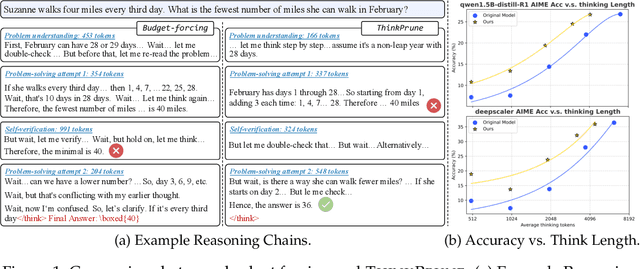
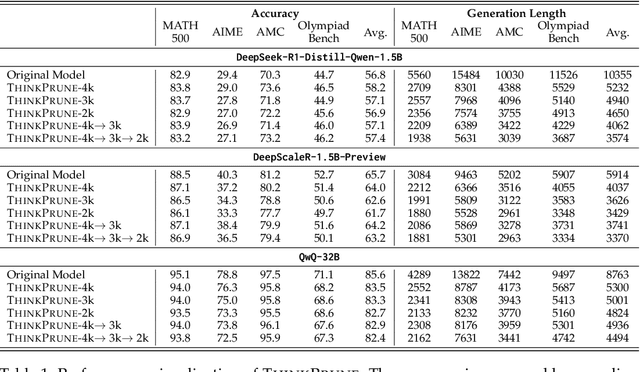
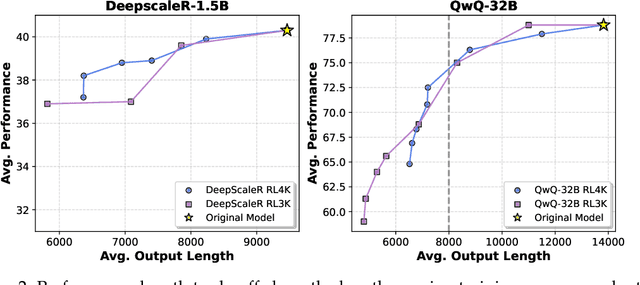
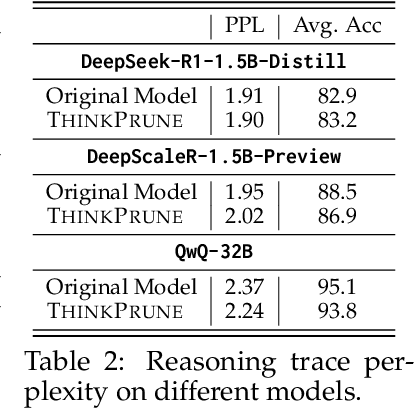
We present ThinkPrune, a simple yet effective method for pruning the thinking length for long-thinking LLMs, which has been found to often produce inefficient and redundant thinking processes. Existing preliminary explorations of reducing thinking length primarily focus on forcing the thinking process to early exit, rather than adapting the LLM to optimize and consolidate the thinking process, and therefore the length-performance tradeoff observed so far is sub-optimal. To fill this gap, ThinkPrune offers a simple solution that continuously trains the long-thinking LLMs via reinforcement learning (RL) with an added token limit, beyond which any unfinished thoughts and answers will be discarded, resulting in a zero reward. To further preserve model performance, we introduce an iterative length pruning approach, where multiple rounds of RL are conducted, each with an increasingly more stringent token limit. We observed that ThinkPrune results in a remarkable performance-length tradeoff -- on the AIME24 dataset, the reasoning length of DeepSeek-R1-Distill-Qwen-1.5B can be reduced by half with only 2% drop in performance. We also observed that after pruning, the LLMs can bypass unnecessary steps while keeping the core reasoning process complete. Code is available at https://github.com/UCSB-NLP-Chang/ThinkPrune.
Reversing the Forget-Retain Objectives: An Efficient LLM Unlearning Framework from Logit Difference
Jun 12, 2024As Large Language Models (LLMs) demonstrate extensive capability in learning from documents, LLM unlearning becomes an increasingly important research area to address concerns of LLMs in terms of privacy, copyright, etc. A conventional LLM unlearning task typically involves two goals: (1) The target LLM should forget the knowledge in the specified forget documents, and (2) it should retain the other knowledge that the LLM possesses, for which we assume access to a small number of retain documents. To achieve both goals, a mainstream class of LLM unlearning methods introduces an optimization framework with a combination of two objectives - maximizing the prediction loss on the forget documents while minimizing that on the retain documents, which suffers from two challenges, degenerated output and catastrophic forgetting. In this paper, we propose a novel unlearning framework called Unlearning from Logit Difference (ULD), which introduces an assistant LLM that aims to achieve the opposite of the unlearning goals: remembering the forget documents and forgetting the retain knowledge. ULD then derives the unlearned LLM by computing the logit difference between the target and the assistant LLMs. We show that such reversed objectives would naturally resolve both aforementioned challenges while significantly improving the training efficiency. Extensive experiments demonstrate that our method efficiently achieves the intended forgetting while preserving the LLM's overall capabilities, reducing training time by more than threefold. Notably, our method loses 0% of model utility on the ToFU benchmark, whereas baseline methods may sacrifice 17% of utility on average to achieve comparable forget quality. Our code will be publicly available at https://github.com/UCSB-NLP-Chang/ULD.
Advancing the Robustness of Large Language Models through Self-Denoised Smoothing
Apr 18, 2024


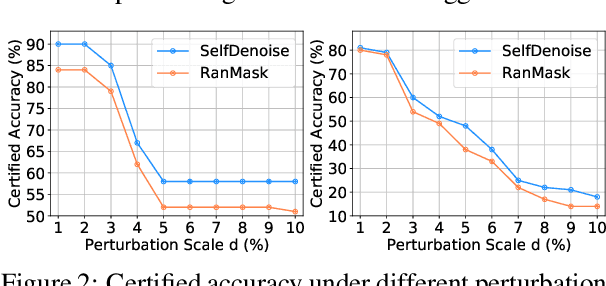
Although large language models (LLMs) have achieved significant success, their vulnerability to adversarial perturbations, including recent jailbreak attacks, has raised considerable concerns. However, the increasing size of these models and their limited access make improving their robustness a challenging task. Among various defense strategies, randomized smoothing has shown great potential for LLMs, as it does not require full access to the model's parameters or fine-tuning via adversarial training. However, randomized smoothing involves adding noise to the input before model prediction, and the final model's robustness largely depends on the model's performance on these noise corrupted data. Its effectiveness is often limited by the model's sub-optimal performance on noisy data. To address this issue, we propose to leverage the multitasking nature of LLMs to first denoise the noisy inputs and then to make predictions based on these denoised versions. We call this procedure self-denoised smoothing. Unlike previous denoised smoothing techniques in computer vision, which require training a separate model to enhance the robustness of LLMs, our method offers significantly better efficiency and flexibility. Our experimental results indicate that our method surpasses existing methods in both empirical and certified robustness in defending against adversarial attacks for both downstream tasks and human alignments (i.e., jailbreak attacks). Our code is publicly available at https://github.com/UCSB-NLP-Chang/SelfDenoise
Defending Large Language Models against Jailbreak Attacks via Semantic Smoothing
Feb 28, 2024


Aligned large language models (LLMs) are vulnerable to jailbreaking attacks, which bypass the safeguards of targeted LLMs and fool them into generating objectionable content. While initial defenses show promise against token-based threat models, there do not exist defenses that provide robustness against semantic attacks and avoid unfavorable trade-offs between robustness and nominal performance. To meet this need, we propose SEMANTICSMOOTH, a smoothing-based defense that aggregates the predictions of multiple semantically transformed copies of a given input prompt. Experimental results demonstrate that SEMANTICSMOOTH achieves state-of-the-art robustness against GCG, PAIR, and AutoDAN attacks while maintaining strong nominal performance on instruction following benchmarks such as InstructionFollowing and AlpacaEval. The codes will be publicly available at https://github.com/UCSB-NLP-Chang/SemanticSmooth.
Augment before You Try: Knowledge-Enhanced Table Question Answering via Table Expansion
Jan 28, 2024Table question answering is a popular task that assesses a model's ability to understand and interact with structured data. However, the given table often does not contain sufficient information for answering the question, necessitating the integration of external knowledge. Existing methods either convert both the table and external knowledge into text, which neglects the structured nature of the table; or they embed queries for external sources in the interaction with the table, which complicates the process. In this paper, we propose a simple yet effective method to integrate external information in a given table. Our method first constructs an augmenting table containing the missing information and then generates a SQL query over the two tables to answer the question. Experiments show that our method outperforms strong baselines on three table QA benchmarks. Our code is publicly available at https://github.com/UCSB-NLP-Chang/Augment_tableQA.
Improving Diffusion Models for Scene Text Editing with Dual Encoders
Apr 12, 2023
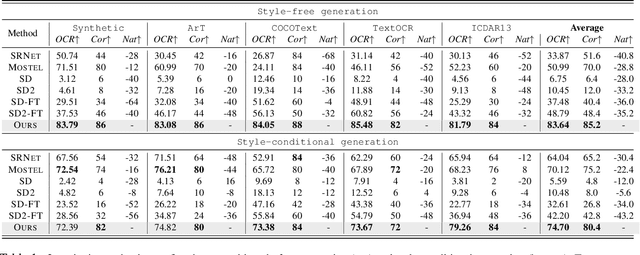
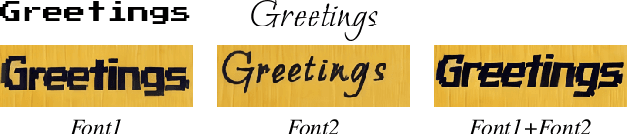
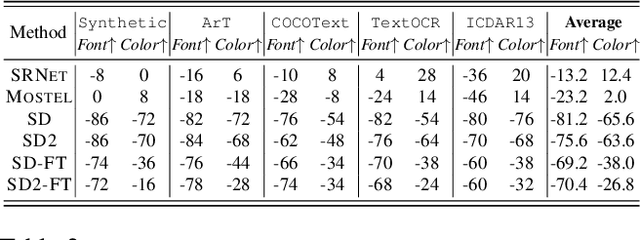
Scene text editing is a challenging task that involves modifying or inserting specified texts in an image while maintaining its natural and realistic appearance. Most previous approaches to this task rely on style-transfer models that crop out text regions and feed them into image transfer models, such as GANs. However, these methods are limited in their ability to change text style and are unable to insert texts into images. Recent advances in diffusion models have shown promise in overcoming these limitations with text-conditional image editing. However, our empirical analysis reveals that state-of-the-art diffusion models struggle with rendering correct text and controlling text style. To address these problems, we propose DIFFSTE to improve pre-trained diffusion models with a dual encoder design, which includes a character encoder for better text legibility and an instruction encoder for better style control. An instruction tuning framework is introduced to train our model to learn the mapping from the text instruction to the corresponding image with either the specified style or the style of the surrounding texts in the background. Such a training method further brings our method the zero-shot generalization ability to the following three scenarios: generating text with unseen font variation, e.g., italic and bold, mixing different fonts to construct a new font, and using more relaxed forms of natural language as the instructions to guide the generation task. We evaluate our approach on five datasets and demonstrate its superior performance in terms of text correctness, image naturalness, and style controllability. Our code is publicly available. https://github.com/UCSB-NLP-Chang/DiffSTE