 Add to Chrome
 Add to Firefox
 Add to Edge
Robust Cross-View Geo-Localization via Content-Viewpoint Disentanglement
May 17, 2025
Cross-view geo-localization (CVGL) aims to match images of the same geographic location captured from different perspectives, such as drones and satellites. Despite recent advances, CVGL remains highly challenging due to significant appearance changes and spatial distortions caused by viewpoint variations. Existing methods typically assume that cross-view images can be directly aligned within a shared feature space by maximizing feature similarity through contrastive learning. Nonetheless, this assumption overlooks the inherent conflicts induced by viewpoint discrepancies, resulting in extracted features containing inconsistent information that hinders precise localization. In this study, we take a manifold learning perspective and model the feature space of cross-view images as a composite manifold jointly governed by content and viewpoint information. Building upon this insight, we propose $\textbf{CVD}$, a new CVGL framework that explicitly disentangles $\textit{content}$ and $\textit{viewpoint}$ factors. To promote effective disentanglement, we introduce two constraints: $\textit{(i)}$ An intra-view independence constraint, which encourages statistical independence between the two factors by minimizing their mutual information. $\textit{(ii)}$ An inter-view reconstruction constraint that reconstructs each view by cross-combining $\textit{content}$ and $\textit{viewpoint}$ from paired images, ensuring factor-specific semantics are preserved. As a plug-and-play module, CVD can be seamlessly integrated into existing geo-localization pipelines. Extensive experiments on four benchmarks, i.e., University-1652, SUES-200, CVUSA, and CVACT, demonstrate that CVD consistently improves both localization accuracy and generalization across multiple baselines.

EDBench: Large-Scale Electron Density Data for Molecular Modeling
May 14, 2025Existing molecular machine learning force fields (MLFFs) generally focus on the learning of atoms, molecules, and simple quantum chemical properties (such as energy and force), but ignore the importance of electron density (ED) $\rho(r)$ in accurately understanding molecular force fields (MFFs). ED describes the probability of finding electrons at specific locations around atoms or molecules, which uniquely determines all ground state properties (such as energy, molecular structure, etc.) of interactive multi-particle systems according to the Hohenberg-Kohn theorem. However, the calculation of ED relies on the time-consuming first-principles density functional theory (DFT) which leads to the lack of large-scale ED data and limits its application in MLFFs. In this paper, we introduce EDBench, a large-scale, high-quality dataset of ED designed to advance learning-based research at the electronic scale. Built upon the PCQM4Mv2, EDBench provides accurate ED data, covering 3.3 million molecules. To comprehensively evaluate the ability of models to understand and utilize electronic information, we design a suite of ED-centric benchmark tasks spanning prediction, retrieval, and generation. Our evaluation on several state-of-the-art methods demonstrates that learning from EDBench is not only feasible but also achieves high accuracy. Moreover, we show that learning-based method can efficiently calculate ED with comparable precision while significantly reducing the computational cost relative to traditional DFT calculations. All data and benchmarks from EDBench will be freely available, laying a robust foundation for ED-driven drug discovery and materials science.
VITA-Audio: Fast Interleaved Cross-Modal Token Generation for Efficient Large Speech-Language Model
May 06, 2025With the growing requirement for natural human-computer interaction, speech-based systems receive increasing attention as speech is one of the most common forms of daily communication. However, the existing speech models still experience high latency when generating the first audio token during streaming, which poses a significant bottleneck for deployment. To address this issue, we propose VITA-Audio, an end-to-end large speech model with fast audio-text token generation. Specifically, we introduce a lightweight Multiple Cross-modal Token Prediction (MCTP) module that efficiently generates multiple audio tokens within a single model forward pass, which not only accelerates the inference but also significantly reduces the latency for generating the first audio in streaming scenarios. In addition, a four-stage progressive training strategy is explored to achieve model acceleration with minimal loss of speech quality. To our knowledge, VITA-Audio is the first multi-modal large language model capable of generating audio output during the first forward pass, enabling real-time conversational capabilities with minimal latency. VITA-Audio is fully reproducible and is trained on open-source data only. Experimental results demonstrate that our model achieves an inference speedup of 3~5x at the 7B parameter scale, but also significantly outperforms open-source models of similar model size on multiple benchmarks for automatic speech recognition (ASR), text-to-speech (TTS), and spoken question answering (SQA) tasks.
NeuroLoc: Encoding Navigation Cells for 6-DOF Camera Localization
May 02, 2025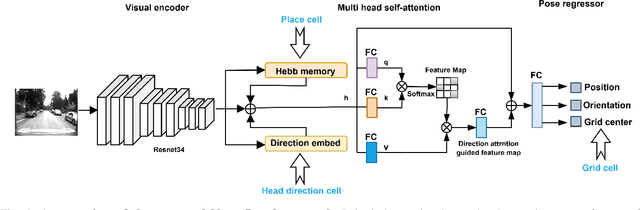
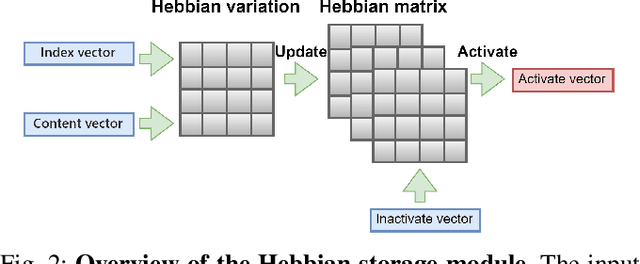
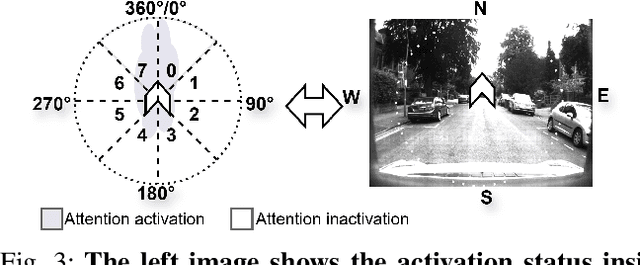
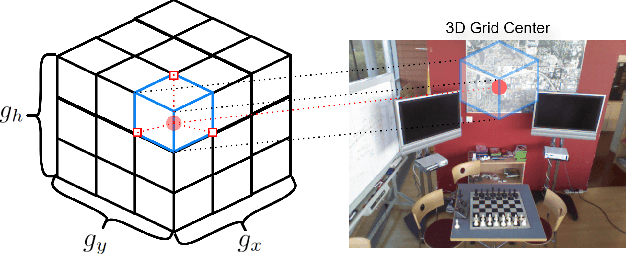
Recently, camera localization has been widely adopted in autonomous robotic navigation due to its efficiency and convenience. However, autonomous navigation in unknown environments often suffers from scene ambiguity, environmental disturbances, and dynamic object transformation in camera localization. To address this problem, inspired by the biological brain navigation mechanism (such as grid cells, place cells, and head direction cells), we propose a novel neurobiological camera location method, namely NeuroLoc. Firstly, we designed a Hebbian learning module driven by place cells to save and replay historical information, aiming to restore the details of historical representations and solve the issue of scene fuzziness. Secondly, we utilized the head direction cell-inspired internal direction learning as multi-head attention embedding to help restore the true orientation in similar scenes. Finally, we added a 3D grid center prediction in the pose regression module to reduce the final wrong prediction. We evaluate the proposed NeuroLoc on commonly used benchmark indoor and outdoor datasets. The experimental results show that our NeuroLoc can enhance the robustness in complex environments and improve the performance of pose regression by using only a single image.
Dolphin: A Large-Scale Automatic Speech Recognition Model for Eastern Languages
Mar 26, 2025This report introduces Dolphin, a large-scale multilingual automatic speech recognition (ASR) model that extends the Whisper architecture to support a wider range of languages. Our approach integrates in-house proprietary and open-source datasets to refine and optimize Dolphin's performance. The model is specifically designed to achieve notable recognition accuracy for 40 Eastern languages across East Asia, South Asia, Southeast Asia, and the Middle East, while also supporting 22 Chinese dialects. Experimental evaluations show that Dolphin significantly outperforms current state-of-the-art open-source models across various languages. To promote reproducibility and community-driven innovation, we are making our trained models and inference source code publicly available.
Optimal Parameter Adaptation for Safety-Critical Control via Safe Barrier Bayesian Optimization
Mar 25, 2025Safety is of paramount importance in control systems to avoid costly risks and catastrophic damages. The control barrier function (CBF) method, a promising solution for safety-critical control, poses a new challenge of enhancing control performance due to its direct modification of original control design and the introduction of uncalibrated parameters. In this work, we shed light on the crucial role of configurable parameters in the CBF method for performance enhancement with a systematical categorization. Based on that, we propose a novel framework combining the CBF method with Bayesian optimization (BO) to optimize the safe control performance. Considering feasibility/safety-critical constraints, we develop a safe version of BO using the barrier-based interior method to efficiently search for promising feasible configurable parameters. Furthermore, we provide theoretical criteria of our framework regarding safety and optimality. An essential advantage of our framework lies in that it can work in model-agnostic environments, leaving sufficient flexibility in designing objective and constraint functions. Finally, simulation experiments on swing-up control and high-fidelity adaptive cruise control are conducted to demonstrate the effectiveness of our framework.
VA-AR: Learning Velocity-Aware Action Representations with Mixture of Window Attention
Mar 14, 2025Action recognition is a crucial task in artificial intelligence, with significant implications across various domains. We initially perform a comprehensive analysis of seven prominent action recognition methods across five widely-used datasets. This analysis reveals a critical, yet previously overlooked, observation: as the velocity of actions increases, the performance of these methods variably declines, undermining their robustness. This decline in performance poses significant challenges for their application in real-world scenarios. Building on these findings, we introduce the Velocity-Aware Action Recognition (VA-AR) framework to obtain robust action representations across different velocities. Our principal insight is that rapid actions (e.g., the giant circle backward in uneven bars or a smash in badminton) occur within short time intervals, necessitating smaller temporal attention windows to accurately capture intricate changes. Conversely, slower actions (e.g., drinking water or wiping face) require larger windows to effectively encompass the broader context. VA-AR employs a Mixture of Window Attention (MoWA) strategy, dynamically adjusting its attention window size based on the action's velocity. This adjustment enables VA-AR to obtain a velocity-aware representation, thereby enhancing the accuracy of action recognition. Extensive experiments confirm that VA-AR achieves state-of-the-art performance on the same five datasets, demonstrating VA-AR's effectiveness across a broad spectrum of action recognition scenarios.
MoFlow: One-Step Flow Matching for Human Trajectory Forecasting via Implicit Maximum Likelihood Estimation based Distillation
Mar 13, 2025In this paper, we address the problem of human trajectory forecasting, which aims to predict the inherently multi-modal future movements of humans based on their past trajectories and other contextual cues. We propose a novel motion prediction conditional flow matching model, termed MoFlow, to predict K-shot future trajectories for all agents in a given scene. We design a novel flow matching loss function that not only ensures at least one of the $K$ sets of future trajectories is accurate but also encourages all $K$ sets of future trajectories to be diverse and plausible. Furthermore, by leveraging the implicit maximum likelihood estimation (IMLE), we propose a novel distillation method for flow models that only requires samples from the teacher model. Extensive experiments on the real-world datasets, including SportVU NBA games, ETH-UCY, and SDD, demonstrate that both our teacher flow model and the IMLE-distilled student model achieve state-of-the-art performance. These models can generate diverse trajectories that are physically and socially plausible. Moreover, our one-step student model is $\textbf{100}$ times faster than the teacher flow model during sampling. The code, model, and data are available at our project page: https://moflow-imle.github.io
KiteRunner: Language-Driven Cooperative Local-Global Navigation Policy with UAV Mapping in Outdoor Environments
Mar 11, 2025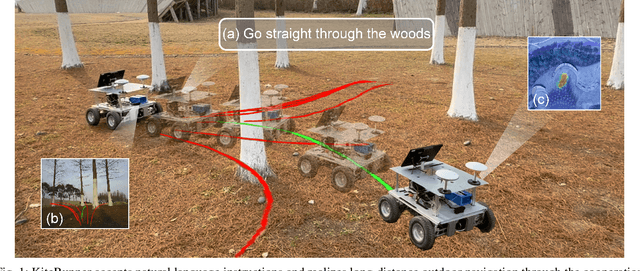
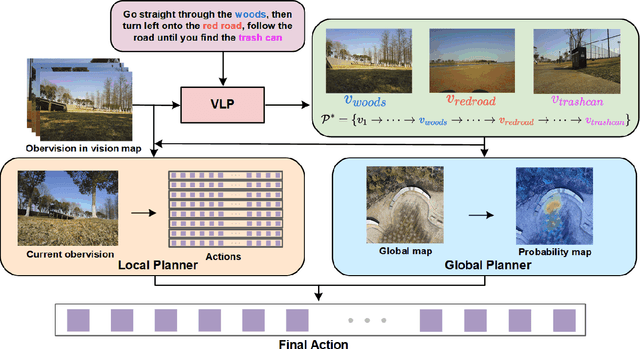
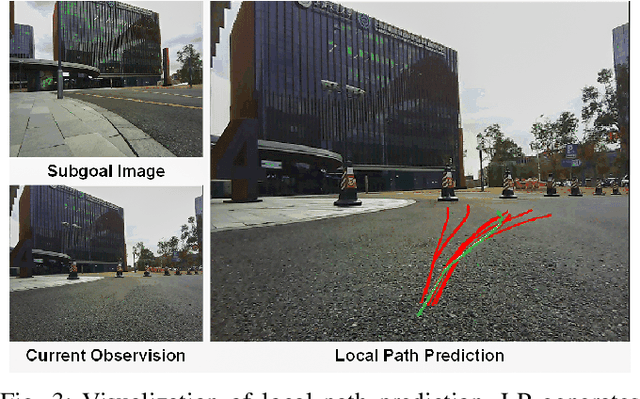
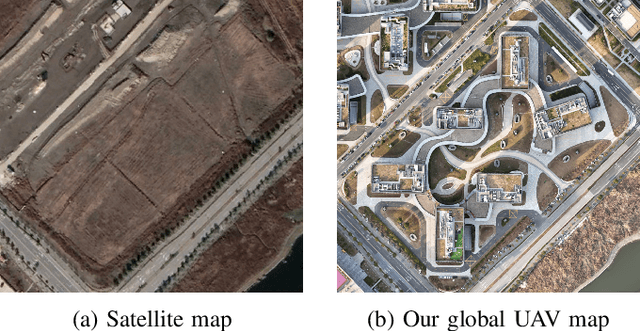
Autonomous navigation in open-world outdoor environments faces challenges in integrating dynamic conditions, long-distance spatial reasoning, and semantic understanding. Traditional methods struggle to balance local planning, global planning, and semantic task execution, while existing large language models (LLMs) enhance semantic comprehension but lack spatial reasoning capabilities. Although diffusion models excel in local optimization, they fall short in large-scale long-distance navigation. To address these gaps, this paper proposes KiteRunner, a language-driven cooperative local-global navigation strategy that combines UAV orthophoto-based global planning with diffusion model-driven local path generation for long-distance navigation in open-world scenarios. Our method innovatively leverages real-time UAV orthophotography to construct a global probability map, providing traversability guidance for the local planner, while integrating large models like CLIP and GPT to interpret natural language instructions. Experiments demonstrate that KiteRunner achieves 5.6% and 12.8% improvements in path efficiency over state-of-the-art methods in structured and unstructured environments, respectively, with significant reductions in human interventions and execution time.
LLaVA-RadZ: Can Multimodal Large Language Models Effectively Tackle Zero-shot Radiology Recognition?
Mar 10, 2025Recently, multimodal large models (MLLMs) have demonstrated exceptional capabilities in visual understanding and reasoning across various vision-language tasks. However, MLLMs usually perform poorly in zero-shot medical disease recognition, as they do not fully exploit the captured features and available medical knowledge. To address this challenge, we propose LLaVA-RadZ, a simple yet effective framework for zero-shot medical disease recognition. Specifically, we design an end-to-end training strategy, termed Decoding-Side Feature Alignment Training (DFAT) to take advantage of the characteristics of the MLLM decoder architecture and incorporate modality-specific tokens tailored for different modalities, which effectively utilizes image and text representations and facilitates robust cross-modal alignment. Additionally, we introduce a Domain Knowledge Anchoring Module (DKAM) to exploit the intrinsic medical knowledge of large models, which mitigates the category semantic gap in image-text alignment. DKAM improves category-level alignment, allowing for accurate disease recognition. Extensive experiments on multiple benchmarks demonstrate that our LLaVA-RadZ significantly outperforms traditional MLLMs in zero-shot disease recognition and exhibits the state-of-the-art performance compared to the well-established and highly-optimized CLIP-based approaches.