 Add to Chrome
 Add to Firefox
 Add to Edge
Nexusformer: Nonlinear Attention Expansion for Stable and Inheritable Transformer Scaling
Apr 21, 2026
Scaling Transformers typically necessitates training larger models from scratch, as standard architectures struggle to expand without discarding learned representations. We identify the primary bottleneck in the attention mechanism's linear projections, which strictly confine feature extraction to fixed-dimensional subspaces, limiting both expressivity and incremental capacity. To address this, we introduce Nexusformer, which replaces linear $Q/K/V$ projections with a Nexus-Rank layer, a three-stage nonlinear mapping driven by dual activations in progressively higher dimensional spaces. This design overcomes the linearity constraint and enables lossless structured growth: new capacity can be injected along two axes via zero-initialized blocks that preserve pretrained knowledge. Experiments on language modeling and reasoning benchmarks demonstrate that Nexusformer matches Tokenformer's perplexity using up to 41.5\% less training compute during progressive scaling (240M to 440M). Furthermore, our analysis of growth dynamics reveals that zero initialization induces a stable convergence trajectory, allowing us to derive a geometric scaling law that accurately predicts performance across expansion scales.

EDBench: Large-Scale Electron Density Data for Molecular Modeling
May 14, 2025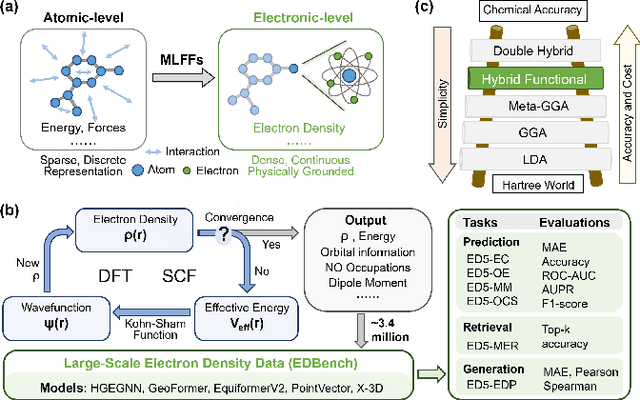
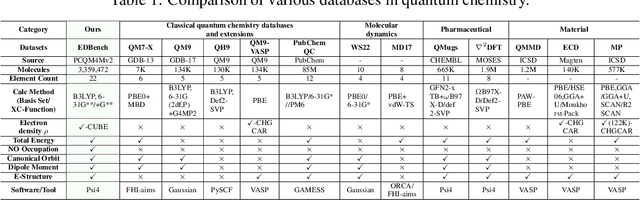

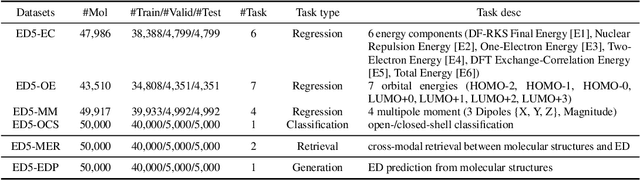
Existing molecular machine learning force fields (MLFFs) generally focus on the learning of atoms, molecules, and simple quantum chemical properties (such as energy and force), but ignore the importance of electron density (ED) $\rho(r)$ in accurately understanding molecular force fields (MFFs). ED describes the probability of finding electrons at specific locations around atoms or molecules, which uniquely determines all ground state properties (such as energy, molecular structure, etc.) of interactive multi-particle systems according to the Hohenberg-Kohn theorem. However, the calculation of ED relies on the time-consuming first-principles density functional theory (DFT) which leads to the lack of large-scale ED data and limits its application in MLFFs. In this paper, we introduce EDBench, a large-scale, high-quality dataset of ED designed to advance learning-based research at the electronic scale. Built upon the PCQM4Mv2, EDBench provides accurate ED data, covering 3.3 million molecules. To comprehensively evaluate the ability of models to understand and utilize electronic information, we design a suite of ED-centric benchmark tasks spanning prediction, retrieval, and generation. Our evaluation on several state-of-the-art methods demonstrates that learning from EDBench is not only feasible but also achieves high accuracy. Moreover, we show that learning-based method can efficiently calculate ED with comparable precision while significantly reducing the computational cost relative to traditional DFT calculations. All data and benchmarks from EDBench will be freely available, laying a robust foundation for ED-driven drug discovery and materials science.