 Add to Chrome
 Add to Firefox
 Add to Edge
STBridge: Shared-Target Alignment for Bridging Understanding and Generation in UMMs
Jul 19, 2026
Unified multimodal models (UMMs) aim to integrate visual understanding and generation within a single architecture, but architectural unification alone does not ensure semantic consistency. A model may describe the intended target correctly while generating an inconsistent edit. This exposes an understanding-generation alignment gap: linguistic and visual outputs live in different spaces, yet should be governed by the same target semantics. We study this gap in image editing, where an instruction defines a target state that can be both described and visually realized. Given a source image and an edit instruction, we compare a UMM's target caption with its edited image to test whether the two outputs converge on the same result. Our analysis shows that existing UMMs remain weakly aligned, especially for fine-grained entities, attributes, spatial relations, and local details, indicating that semantic unification is not achieved by architecture alone. To bridge this gap, we propose STBridge, a shared-target alignment framework that connects understanding and generation through a common target state. Here the target caption expresses the desired visual result, while the edited image realizes it visually, replacing separate task-specific paths with a shared information flow from target expression to target realization. STBridge follows an align-then-optimize strategy: supervised fine-tuning first establishes the shared-target channel, and sequential reinforcement learning further refines target-centered coordination. Across visual understanding, image generation, and image editing benchmarks, STBridge consistently improves over the initialization model. Alignment analysis confirms that STBridge narrows the gap between what the model describes and what it generates, demonstrating shared-target alignment as an effective post-training strategy for bridging understanding and generation in UMMs.

OmniView-Space: Reinforcing Spatial Reasoning via Multi-Perspective Spatial Mapping
Jul 01, 2026Spatial intelligence remains a persistent challenge for Multimodal Large Language Models (MLLMs), as it requires coherent spatial scene representations beyond basic object recognition. Existing methods typically build such representations through textual reasoning or 3D reconstruction. However, they often falter during multi-step reasoning, particularly when required to dynamically re-anchor evidence to the specific camera-, object-, or direction-centric reference frames demanded by complex queries. To address this, we propose OmniView-Space, a framework designed to maintain spatial consistency through multimodal egocentric evidence. Our approach consists of three core components: (1) Multi-Perspective Spatial Mapping (MPSM), which re-anchors reconstructed geometry into a query-aligned visual cognitive map and a textual spatial graph; (2) Tool-Guided Egocentric Reasoning, an interleaved policy trained to actively select the ego anchor required by the query and request the corresponding MPSM evidence; and (3) Cognitive-Map Distillation, which uses MPSM-generated trajectories and ego-frame rewards to train the model to reason with self-generated cognitive maps. Experiments on single- and multi-image spatial reasoning benchmarks show that OmniView-Space achieves state-of-the-art performance. Furthermore, the distilled model maintains this performance while reducing reliance on external geometry pipelines.
RISE-Video: Can Video Generators Decode Implicit World Rules?
Feb 05, 2026While generative video models have achieved remarkable visual fidelity, their capacity to internalize and reason over implicit world rules remains a critical yet under-explored frontier. To bridge this gap, we present RISE-Video, a pioneering reasoning-oriented benchmark for Text-Image-to-Video (TI2V) synthesis that shifts the evaluative focus from surface-level aesthetics to deep cognitive reasoning. RISE-Video comprises 467 meticulously human-annotated samples spanning eight rigorous categories, providing a structured testbed for probing model intelligence across diverse dimensions, ranging from commonsense and spatial dynamics to specialized subject domains. Our framework introduces a multi-dimensional evaluation protocol consisting of four metrics: \textit{Reasoning Alignment}, \textit{Temporal Consistency}, \textit{Physical Rationality}, and \textit{Visual Quality}. To further support scalable evaluation, we propose an automated pipeline leveraging Large Multimodal Models (LMMs) to emulate human-centric assessment. Extensive experiments on 11 state-of-the-art TI2V models reveal pervasive deficiencies in simulating complex scenarios under implicit constraints, offering critical insights for the advancement of future world-simulating generative models.
Youtu-VL: Unleashing Visual Potential via Unified Vision-Language Supervision
Jan 27, 2026Despite the significant advancements represented by Vision-Language Models (VLMs), current architectures often exhibit limitations in retaining fine-grained visual information, leading to coarse-grained multimodal comprehension. We attribute this deficiency to a suboptimal training paradigm inherent in prevailing VLMs, which exhibits a text-dominant optimization bias by conceptualizing visual signals merely as passive conditional inputs rather than supervisory targets. To mitigate this, we introduce Youtu-VL, a framework leveraging the Vision-Language Unified Autoregressive Supervision (VLUAS) paradigm, which fundamentally shifts the optimization objective from ``vision-as-input'' to ``vision-as-target.'' By integrating visual tokens directly into the prediction stream, Youtu-VL applies unified autoregressive supervision to both visual details and linguistic content. Furthermore, we extend this paradigm to encompass vision-centric tasks, enabling a standard VLM to perform vision-centric tasks without task-specific additions. Extensive empirical evaluations demonstrate that Youtu-VL achieves competitive performance on both general multimodal tasks and vision-centric tasks, establishing a robust foundation for the development of comprehensive generalist visual agents.
Streaming Video Instruction Tuning
Dec 24, 2025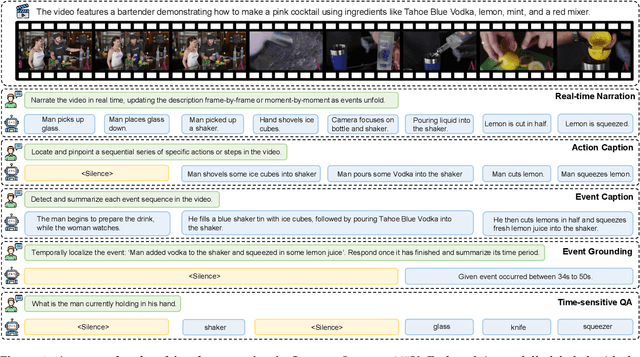
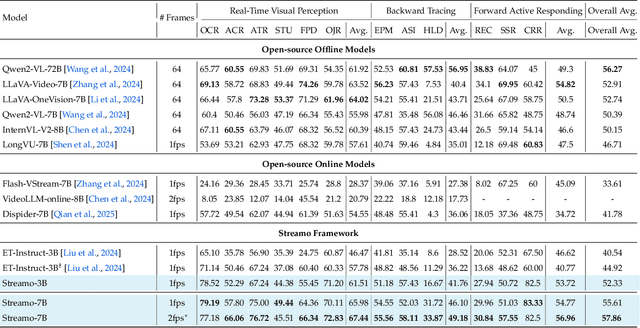
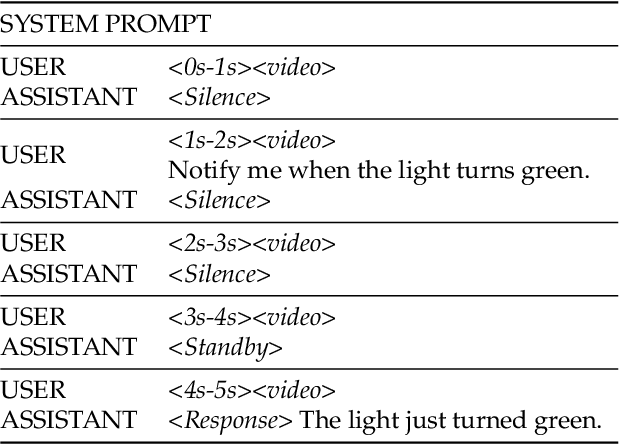
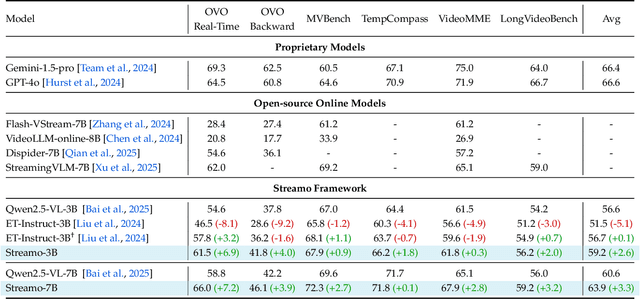
We present Streamo, a real-time streaming video LLM that serves as a general-purpose interactive assistant. Unlike existing online video models that focus narrowly on question answering or captioning, Streamo performs a broad spectrum of streaming video tasks, including real-time narration, action understanding, event captioning, temporal event grounding, and time-sensitive question answering. To develop such versatility, we construct Streamo-Instruct-465K, a large-scale instruction-following dataset tailored for streaming video understanding. The dataset covers diverse temporal contexts and multi-task supervision, enabling unified training across heterogeneous streaming tasks. After training end-to-end on the instruction-following dataset through a streamlined pipeline, Streamo exhibits strong temporal reasoning, responsive interaction, and broad generalization across a variety of streaming benchmarks. Extensive experiments show that Streamo bridges the gap between offline video perception models and real-time multimodal assistants, making a step toward unified, intelligent video understanding in continuous video streams.
Zooming from Context to Cue: Hierarchical Preference Optimization for Multi-Image MLLMs
May 28, 2025Multi-modal Large Language Models (MLLMs) excel at single-image tasks but struggle with multi-image understanding due to cross-modal misalignment, leading to hallucinations (context omission, conflation, and misinterpretation). Existing methods using Direct Preference Optimization (DPO) constrain optimization to a solitary image reference within the input sequence, neglecting holistic context modeling. We propose Context-to-Cue Direct Preference Optimization (CcDPO), a multi-level preference optimization framework that enhances per-image perception in multi-image settings by zooming into visual clues -- from sequential context to local details. It features: (i) Context-Level Optimization : Re-evaluates cognitive biases underlying MLLMs' multi-image context comprehension and integrates a spectrum of low-cost global sequence preferences for bias mitigation. (ii) Needle-Level Optimization : Directs attention to fine-grained visual details through region-targeted visual prompts and multimodal preference supervision. To support scalable optimization, we also construct MultiScope-42k, an automatically generated dataset with high-quality multi-level preference pairs. Experiments show that CcDPO significantly reduces hallucinations and yields consistent performance gains across general single- and multi-image tasks.
VITA-Audio: Fast Interleaved Cross-Modal Token Generation for Efficient Large Speech-Language Model
May 06, 2025With the growing requirement for natural human-computer interaction, speech-based systems receive increasing attention as speech is one of the most common forms of daily communication. However, the existing speech models still experience high latency when generating the first audio token during streaming, which poses a significant bottleneck for deployment. To address this issue, we propose VITA-Audio, an end-to-end large speech model with fast audio-text token generation. Specifically, we introduce a lightweight Multiple Cross-modal Token Prediction (MCTP) module that efficiently generates multiple audio tokens within a single model forward pass, which not only accelerates the inference but also significantly reduces the latency for generating the first audio in streaming scenarios. In addition, a four-stage progressive training strategy is explored to achieve model acceleration with minimal loss of speech quality. To our knowledge, VITA-Audio is the first multi-modal large language model capable of generating audio output during the first forward pass, enabling real-time conversational capabilities with minimal latency. VITA-Audio is fully reproducible and is trained on open-source data only. Experimental results demonstrate that our model achieves an inference speedup of 3~5x at the 7B parameter scale, but also significantly outperforms open-source models of similar model size on multiple benchmarks for automatic speech recognition (ASR), text-to-speech (TTS), and spoken question answering (SQA) tasks.
Long-VITA: Scaling Large Multi-modal Models to 1 Million Tokens with Leading Short-Context Accuray
Feb 07, 2025Establishing the long-context capability of large vision-language models is crucial for video understanding, high-resolution image understanding, multi-modal agents and reasoning. We introduce Long-VITA, a simple yet effective large multi-modal model for long-context visual-language understanding tasks. It is adept at concurrently processing and analyzing modalities of image, video, and text over 4K frames or 1M tokens while delivering advanced performances on short-context multi-modal tasks. We propose an effective multi-modal training schema that starts with large language models and proceeds through vision-language alignment, general knowledge learning, and two sequential stages of long-sequence fine-tuning. We further implement context-parallelism distributed inference and logits-masked language modeling head to scale Long-VITA to infinitely long inputs of images and texts during model inference. Regarding training data, Long-VITA is built on a mix of $17$M samples from public datasets only and demonstrates the state-of-the-art performance on various multi-modal benchmarks, compared against recent cutting-edge models with internal data. Long-VITA is fully reproducible and supports both NPU and GPU platforms for training and testing. We hope Long-VITA can serve as a competitive baseline and offer valuable insights for the open-source community in advancing long-context multi-modal understanding.
VEGA: Learning Interleaved Image-Text Comprehension in Vision-Language Large Models
Jun 14, 2024The swift progress of Multi-modal Large Models (MLLMs) has showcased their impressive ability to tackle tasks blending vision and language. Yet, most current models and benchmarks cater to scenarios with a narrow scope of visual and textual contexts. These models often fall short when faced with complex comprehension tasks, which involve navigating through a plethora of irrelevant and potentially misleading information in both text and image forms. To bridge this gap, we introduce a new, more demanding task known as Interleaved Image-Text Comprehension (IITC). This task challenges models to discern and disregard superfluous elements in both images and text to accurately answer questions and to follow intricate instructions to pinpoint the relevant image. In support of this task, we further craft a new VEGA dataset, tailored for the IITC task on scientific content, and devised a subtask, Image-Text Association (ITA), to refine image-text correlation skills. Our evaluation of four leading closed-source models, as well as various open-source models using VEGA, underscores the rigorous nature of IITC. Even the most advanced models, such as Gemini-1.5-pro and GPT4V, only achieved modest success. By employing a multi-task, multi-scale post-training strategy, we have set a robust baseline for MLLMs on the IITC task, attaining an $85.8\%$ accuracy rate in image association and a $0.508$ Rouge score. These results validate the effectiveness of our dataset in improving MLLMs capabilities for nuanced image-text comprehension.
Video-MME: The First-Ever Comprehensive Evaluation Benchmark of Multi-modal LLMs in Video Analysis
May 31, 2024


In the quest for artificial general intelligence, Multi-modal Large Language Models (MLLMs) have emerged as a focal point in recent advancements. However, the predominant focus remains on developing their capabilities in static image understanding. The potential of MLLMs in processing sequential visual data is still insufficiently explored, highlighting the absence of a comprehensive, high-quality assessment of their performance. In this paper, we introduce Video-MME, the first-ever full-spectrum, Multi-Modal Evaluation benchmark of MLLMs in Video analysis. Our work distinguishes from existing benchmarks through four key features: 1) Diversity in video types, spanning 6 primary visual domains with 30 subfields to ensure broad scenario generalizability; 2) Duration in temporal dimension, encompassing both short-, medium-, and long-term videos, ranging from 11 seconds to 1 hour, for robust contextual dynamics; 3) Breadth in data modalities, integrating multi-modal inputs besides video frames, including subtitles and audios, to unveil the all-round capabilities of MLLMs; 4) Quality in annotations, utilizing rigorous manual labeling by expert annotators to facilitate precise and reliable model assessment. 900 videos with a total of 256 hours are manually selected and annotated by repeatedly viewing all the video content, resulting in 2,700 question-answer pairs. With Video-MME, we extensively evaluate various state-of-the-art MLLMs, including GPT-4 series and Gemini 1.5 Pro, as well as open-source image models like InternVL-Chat-V1.5 and video models like LLaVA-NeXT-Video. Our experiments reveal that Gemini 1.5 Pro is the best-performing commercial model, significantly outperforming the open-source models. Our dataset along with these findings underscores the need for further improvements in handling longer sequences and multi-modal data. Project Page: https://video-mme.github.io