 Add to Chrome
 Add to Firefox
 Add to Edge
Unified Gradient Projection: Language-Balanced Continual Learning for Multilingual Low-Resource ASR
Jul 13, 2026
Large-scale pretrained ASR models such as Whisper exhibit strong multilingual capabilities. However, fine-tuning on low-resource languages often causes catastrophic forgetting. Although continual learning mitigates this issue, existing methods struggle to regulate cross-task interference in multilingual settings, where dominant languages bias optimization. We propose Unified Gradient Projection (UGP), which constrains parameter updates using reference gradients from language-balanced replay in a unified projection space. By equalizing per-language contributions in the projection, UGP reduces dominant-language bias and improves cross-lingual stability. We further show that combining gradient-level projection with data-level replay yields complementary gains in stability and plasticity. Across diverse low-resource language groups and model scales, UGP enables effective adaptation while substantially mitigating forgetting. On Whisper-large-v3, it achieves near-zero average forgetting.

GigaSpeechBench: A Real-World Multilingual Speech-to-Text Benchmark
Jun 27, 2026While modern ASR systems achieve low error rates on high-resource benchmarks, such performance often overestimates real-world robustness. Existing evaluations address challenges in isolation, lacking a unified benchmark for domain terminology, age variation, dialects, accents, and low-resource languages, particularly across the Middle East and Southeast Asia, representing over one billion under-evaluated speakers. To address this gap, we introduce GigaSpeechBench, a comprehensive multilingual and multidimensional in-the-wild ASR & AST benchmark comprising 680 hours of human-annotated speech. It features five modules: (1) 12 low-resource Middle Eastern and Southeast Asian languages, plus challenging Japanese and Korean; (2) 6 Chinese dialects; (3) 6 English accents; (4) dense terminology across 12 vertical domains for Chinese and English; and (5) older adult and child speech. We further provide human-annotated Chinese and English translations for 11 languages to support AST evaluation. Extensive evaluations of leading foundation models and commercial APIs reveal significant performance degradation in these challenging settings, exposing critical evaluation blind spots.
Enhancing Multilingual LLM-based ASR with Mixture of Experts and Dynamic Downsampling
Jun 09, 2026The rapid progress of large language models (LLMs) has opened up a new frontier for automatic speech recognition (ASR), making their effective integration a critical and challenging research direction. To this end, this work proposes a projector-based LLM-ASR framework targeting the key challenges of multilingual generalization and modality alignment. Our approach incorporates a Mixture of Experts (MoE) architecture to improve cross-lingual adaptability, and a Continuous Integrate-and-Fire (CIF) mechanism for dynamic downsampling and modality alignment. Experimental results show that the combination of these components yields substantial performance improvements, surpassing strong baseline models. The proposed method represents a step toward building more accurate, robust, and generalizable LLM-based ASR systems.
* Accepted by ICASSP 2026
Dolphin: A Large-Scale Automatic Speech Recognition Model for Eastern Languages
Mar 26, 2025This report introduces Dolphin, a large-scale multilingual automatic speech recognition (ASR) model that extends the Whisper architecture to support a wider range of languages. Our approach integrates in-house proprietary and open-source datasets to refine and optimize Dolphin's performance. The model is specifically designed to achieve notable recognition accuracy for 40 Eastern languages across East Asia, South Asia, Southeast Asia, and the Middle East, while also supporting 22 Chinese dialects. Experimental evaluations show that Dolphin significantly outperforms current state-of-the-art open-source models across various languages. To promote reproducibility and community-driven innovation, we are making our trained models and inference source code publicly available.
Simul-Whisper: Attention-Guided Streaming Whisper with Truncation Detection
Jun 14, 2024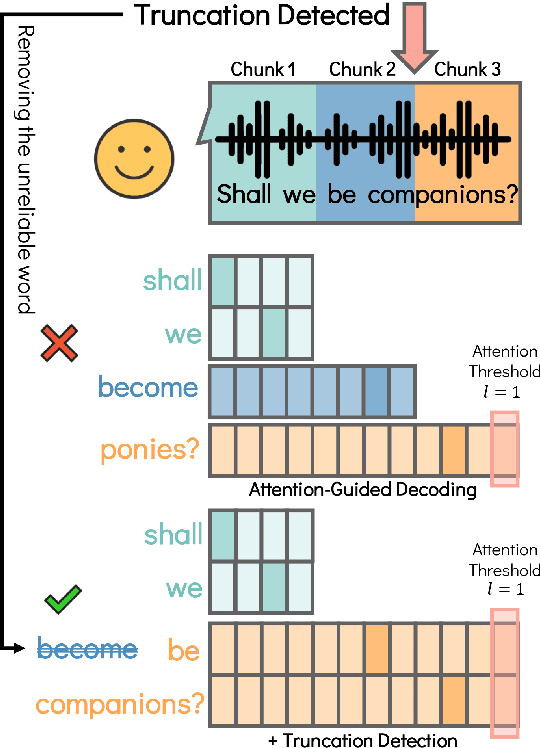
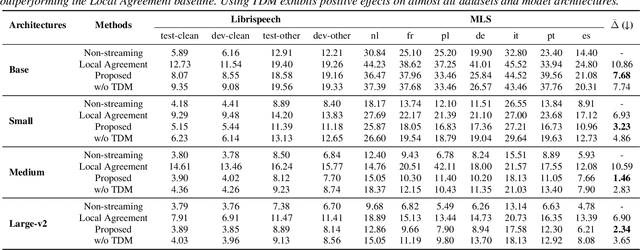
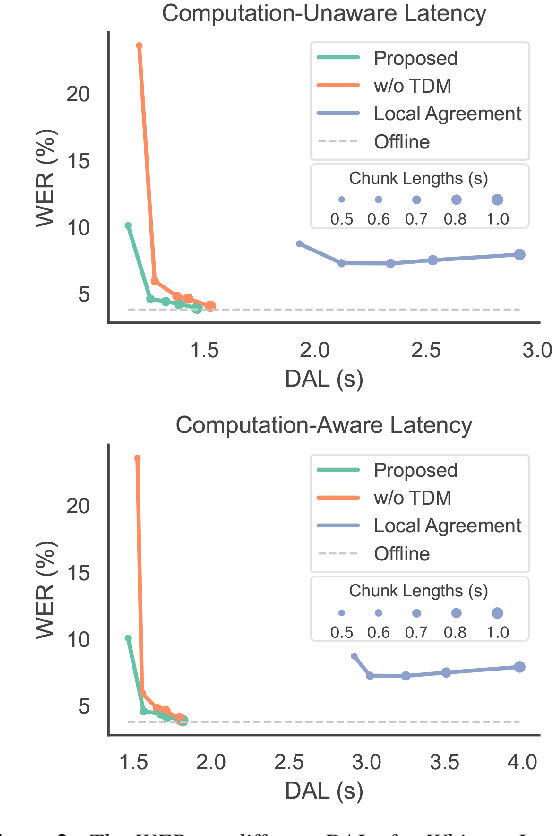
As a robust and large-scale multilingual speech recognition model, Whisper has demonstrated impressive results in many low-resource and out-of-distribution scenarios. However, its encoder-decoder structure hinders its application to streaming speech recognition. In this paper, we introduce Simul-Whisper, which uses the time alignment embedded in Whisper's cross-attention to guide auto-regressive decoding and achieve chunk-based streaming ASR without any fine-tuning of the pre-trained model. Furthermore, we observe the negative effect of the truncated words at the chunk boundaries on the decoding results and propose an integrate-and-fire-based truncation detection model to address this issue. Experiments on multiple languages and Whisper architectures show that Simul-Whisper achieves an average absolute word error rate degradation of only 1.46% at a chunk size of 1 second, which significantly outperforms the current state-of-the-art baseline.