 Add to Chrome
 Add to Firefox
 Add to Edge
RadFabric: Agentic AI System with Reasoning Capability for Radiology
Jun 17, 2025
Chest X ray (CXR) imaging remains a critical diagnostic tool for thoracic conditions, but current automated systems face limitations in pathology coverage, diagnostic accuracy, and integration of visual and textual reasoning. To address these gaps, we propose RadFabric, a multi agent, multimodal reasoning framework that unifies visual and textual analysis for comprehensive CXR interpretation. RadFabric is built on the Model Context Protocol (MCP), enabling modularity, interoperability, and scalability for seamless integration of new diagnostic agents. The system employs specialized CXR agents for pathology detection, an Anatomical Interpretation Agent to map visual findings to precise anatomical structures, and a Reasoning Agent powered by large multimodal reasoning models to synthesize visual, anatomical, and clinical data into transparent and evidence based diagnoses. RadFabric achieves significant performance improvements, with near-perfect detection of challenging pathologies like fractures (1.000 accuracy) and superior overall diagnostic accuracy (0.799) compared to traditional systems (0.229 to 0.527). By integrating cross modal feature alignment and preference-driven reasoning, RadFabric advances AI-driven radiology toward transparent, anatomically precise, and clinically actionable CXR analysis.

ComplexBench-Edit: Benchmarking Complex Instruction-Driven Image Editing via Compositional Dependencies
Jun 15, 2025Text-driven image editing has achieved remarkable success in following single instructions. However, real-world scenarios often involve complex, multi-step instructions, particularly ``chain'' instructions where operations are interdependent. Current models struggle with these intricate directives, and existing benchmarks inadequately evaluate such capabilities. Specifically, they often overlook multi-instruction and chain-instruction complexities, and common consistency metrics are flawed. To address this, we introduce ComplexBench-Edit, a novel benchmark designed to systematically assess model performance on complex, multi-instruction, and chain-dependent image editing tasks. ComplexBench-Edit also features a new vision consistency evaluation method that accurately assesses non-modified regions by excluding edited areas. Furthermore, we propose a simple yet powerful Chain-of-Thought (CoT)-based approach that significantly enhances the ability of existing models to follow complex instructions. Our extensive experiments demonstrate ComplexBench-Edit's efficacy in differentiating model capabilities and highlight the superior performance of our CoT-based method in handling complex edits. The data and code are released at https://github.com/llllly26/ComplexBench-Edit.
Post-Training Quantization for Video Matting
Jun 12, 2025Video matting is crucial for applications such as film production and virtual reality, yet deploying its computationally intensive models on resource-constrained devices presents challenges. Quantization is a key technique for model compression and acceleration. As an efficient approach, Post-Training Quantization (PTQ) is still in its nascent stages for video matting, facing significant hurdles in maintaining accuracy and temporal coherence. To address these challenges, this paper proposes a novel and general PTQ framework specifically designed for video matting models, marking, to the best of our knowledge, the first systematic attempt in this domain. Our contributions include: (1) A two-stage PTQ strategy that combines block-reconstruction-based optimization for fast, stable initial quantization and local dependency capture, followed by a global calibration of quantization parameters to minimize accuracy loss. (2) A Statistically-Driven Global Affine Calibration (GAC) method that enables the network to compensate for cumulative statistical distortions arising from factors such as neglected BN layer effects, even reducing the error of existing PTQ methods on video matting tasks up to 20%. (3) An Optical Flow Assistance (OFA) component that leverages temporal and semantic priors from frames to guide the PTQ process, enhancing the model's ability to distinguish moving foregrounds in complex scenes and ultimately achieving near full-precision performance even under ultra-low-bit quantization. Comprehensive quantitative and visual results show that our PTQ4VM achieves the state-of-the-art accuracy performance across different bit-widths compared to the existing quantization methods. We highlight that the 4-bit PTQ4VM even achieves performance close to the full-precision counterpart while enjoying 8x FLOP savings.
Test-Time Training Done Right
May 29, 2025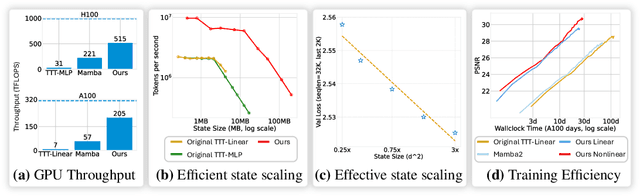

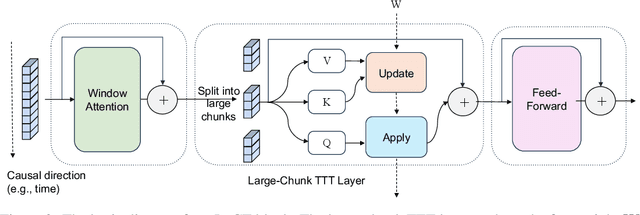
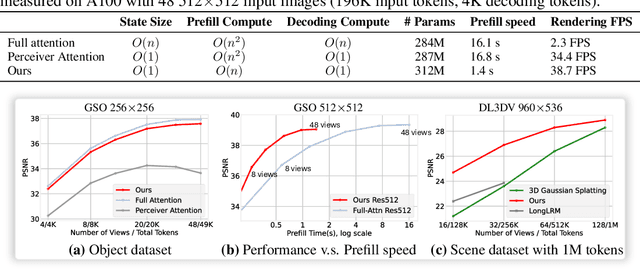
Test-Time Training (TTT) models context dependencies by adapting part of the model's weights (referred to as fast weights) during inference. This fast weight, akin to recurrent states in RNNs, stores temporary memories of past tokens in the current sequence. Existing TTT methods struggled to show effectiveness in handling long-context data, due to their inefficiency on modern GPUs. The TTT layers in many of these approaches operate with extremely low FLOPs utilization (often <5%) because they deliberately apply small online minibatch sizes (e.g., updating fast weights every 16 or 64 tokens). Moreover, a small minibatch implies fine-grained block-wise causal dependencies in the data, unsuitable for data beyond 1D ordered sequences, like sets or N-dimensional grids such as images or videos. In contrast, we pursue the opposite direction by using an extremely large chunk update, ranging from 2K to 1M tokens across tasks of varying modalities, which we refer to as Large Chunk Test-Time Training (LaCT). It improves hardware utilization by orders of magnitude, and more importantly, facilitates scaling of nonlinear state size (up to 40% of model parameters), hence substantially improving state capacity, all without requiring cumbersome and error-prone kernel implementations. It also allows easy integration of sophisticated optimizers, e.g. Muon for online updates. We validate our approach across diverse modalities and tasks, including novel view synthesis with image set, language models, and auto-regressive video diffusion. Our approach can scale up to 14B-parameter AR video diffusion model on sequences up to 56K tokens. In our longest sequence experiment, we perform novel view synthesis with 1 million context length. We hope this work will inspire and accelerate new research in the field of long-context modeling and test-time training. Website: https://tianyuanzhang.com/projects/ttt-done-right
CPathAgent: An Agent-based Foundation Model for Interpretable High-Resolution Pathology Image Analysis Mimicking Pathologists' Diagnostic Logic
May 26, 2025Recent advances in computational pathology have led to the emergence of numerous foundation models. However, these approaches fail to replicate the diagnostic process of pathologists, as they either simply rely on general-purpose encoders with multi-instance learning for classification or directly apply multimodal models to generate reports from images. A significant limitation is their inability to emulate the diagnostic logic employed by pathologists, who systematically examine slides at low magnification for overview before progressively zooming in on suspicious regions to formulate comprehensive diagnoses. To address this gap, we introduce CPathAgent, an innovative agent-based model that mimics pathologists' reasoning processes by autonomously executing zoom-in/out and navigation operations across pathology images based on observed visual features. To achieve this, we develop a multi-stage training strategy unifying patch-level, region-level, and whole-slide capabilities within a single model, which is essential for mimicking pathologists, who require understanding and reasoning capabilities across all three scales. This approach generates substantially more detailed and interpretable diagnostic reports compared to existing methods, particularly for huge region understanding. Additionally, we construct an expert-validated PathMMU-HR$^{2}$, the first benchmark for huge region analysis, a critical intermediate scale between patches and whole slides, as diagnosticians typically examine several key regions rather than entire slides at once. Extensive experiments demonstrate that CPathAgent consistently outperforms existing approaches across three scales of benchmarks, validating the effectiveness of our agent-based diagnostic approach and highlighting a promising direction for the future development of computational pathology.
A Unified Solution to Video Fusion: From Multi-Frame Learning to Benchmarking
May 26, 2025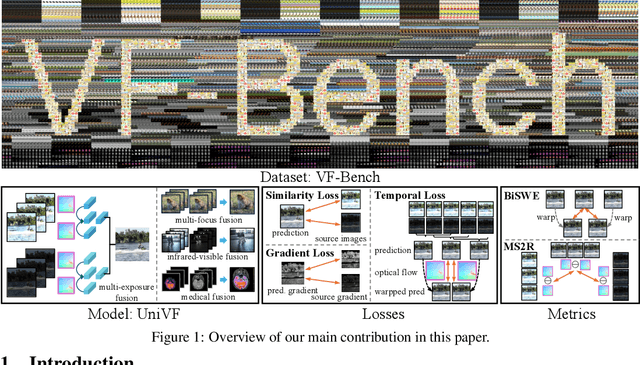
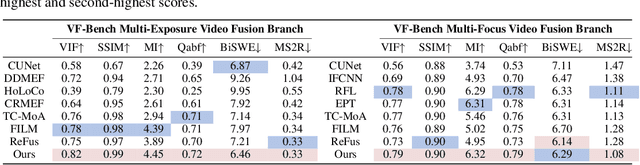
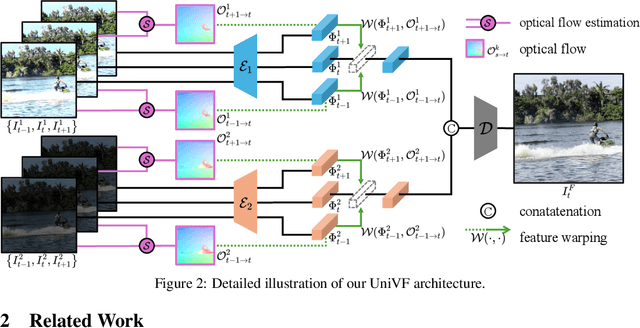
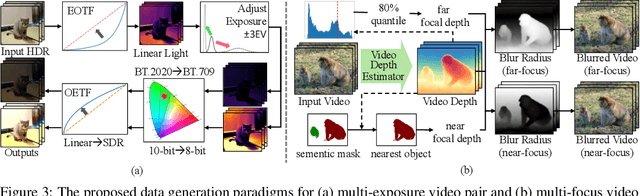
The real world is dynamic, yet most image fusion methods process static frames independently, ignoring temporal correlations in videos and leading to flickering and temporal inconsistency. To address this, we propose Unified Video Fusion (UniVF), a novel framework for temporally coherent video fusion that leverages multi-frame learning and optical flow-based feature warping for informative, temporally coherent video fusion. To support its development, we also introduce Video Fusion Benchmark (VF-Bench), the first comprehensive benchmark covering four video fusion tasks: multi-exposure, multi-focus, infrared-visible, and medical fusion. VF-Bench provides high-quality, well-aligned video pairs obtained through synthetic data generation and rigorous curation from existing datasets, with a unified evaluation protocol that jointly assesses the spatial quality and temporal consistency of video fusion. Extensive experiments show that UniVF achieves state-of-the-art results across all tasks on VF-Bench. Project page: https://vfbench.github.io.
Route to Reason: Adaptive Routing for LLM and Reasoning Strategy Selection
May 26, 2025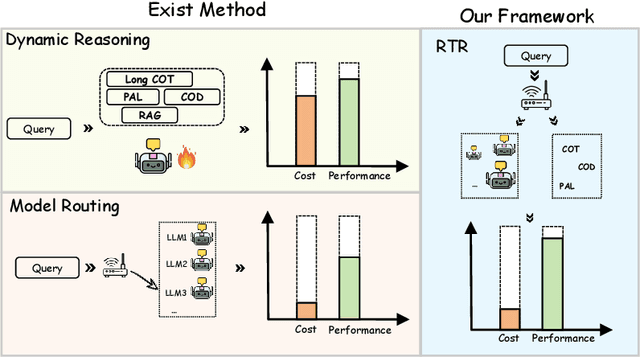
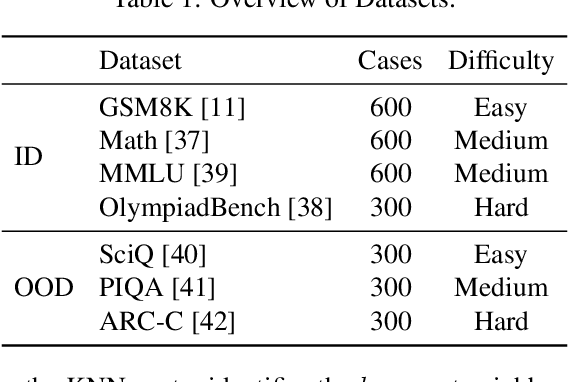
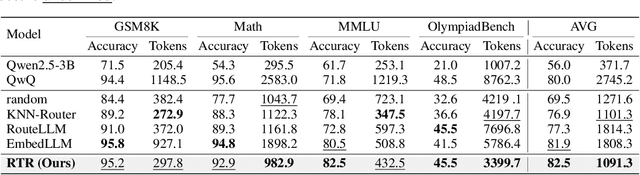
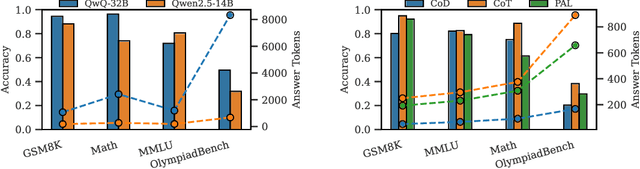
The inherent capabilities of a language model (LM) and the reasoning strategies it employs jointly determine its performance in reasoning tasks. While test-time scaling is regarded as an effective approach to tackling complex reasoning tasks, it incurs substantial computational costs and often leads to "overthinking", where models become trapped in "thought pitfalls". To address this challenge, we propose Route-To-Reason (RTR), a novel unified routing framework that dynamically allocates both LMs and reasoning strategies according to task difficulty under budget constraints. RTR learns compressed representations of both expert models and reasoning strategies, enabling their joint and adaptive selection at inference time. This method is low-cost, highly flexible, and can be seamlessly extended to arbitrary black-box or white-box models and strategies, achieving true plug-and-play functionality. Extensive experiments across seven open source models and four reasoning strategies demonstrate that RTR achieves an optimal trade-off between accuracy and computational efficiency among all baselines, achieving higher accuracy than the best single model while reducing token usage by over 60%.
Self-Reflective Planning with Knowledge Graphs: Enhancing LLM Reasoning Reliability for Question Answering
May 26, 2025Recently, large language models (LLMs) have demonstrated remarkable capabilities in natural language processing tasks, yet they remain prone to hallucinations when reasoning with insufficient internal knowledge. While integrating LLMs with knowledge graphs (KGs) provides access to structured, verifiable information, existing approaches often generate incomplete or factually inconsistent reasoning paths. To this end, we propose Self-Reflective Planning (SRP), a framework that synergizes LLMs with KGs through iterative, reference-guided reasoning. Specifically, given a question and topic entities, SRP first searches for references to guide planning and reflection. In the planning process, it checks initial relations and generates a reasoning path. After retrieving knowledge from KGs through a reasoning path, it implements iterative reflection by judging the retrieval result and editing the reasoning path until the answer is correctly retrieved. Extensive experiments on three public datasets demonstrate that SRP surpasses various strong baselines and further underscore its reliable reasoning ability.
ARM: Adaptive Reasoning Model
May 26, 2025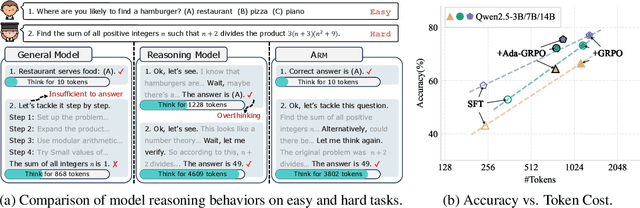
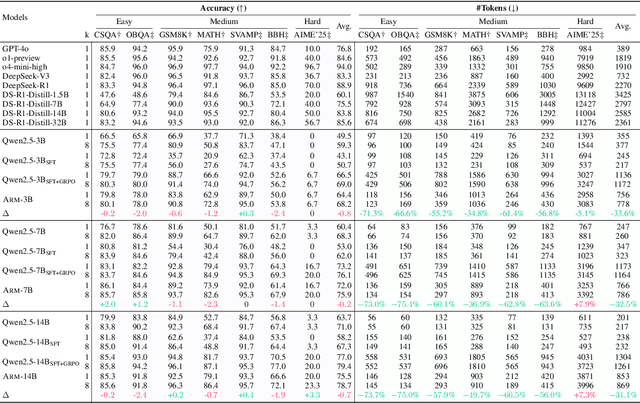

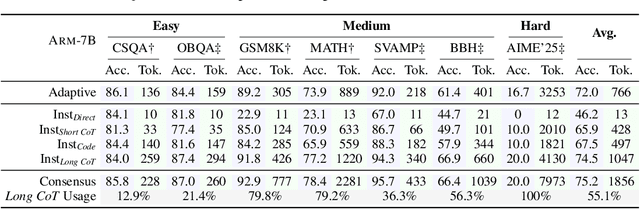
While large reasoning models demonstrate strong performance on complex tasks, they lack the ability to adjust reasoning token usage based on task difficulty. This often leads to the "overthinking" problem -- excessive and unnecessary reasoning -- which, although potentially mitigated by human intervention to control the token budget, still fundamentally contradicts the goal of achieving fully autonomous AI. In this work, we propose Adaptive Reasoning Model (ARM), a reasoning model capable of adaptively selecting appropriate reasoning formats based on the task at hand. These formats include three efficient ones -- Direct Answer, Short CoT, and Code -- as well as a more elaborate format, Long CoT. To train ARM, we introduce Ada-GRPO, an adaptation of Group Relative Policy Optimization (GRPO), which addresses the format collapse issue in traditional GRPO. Ada-GRPO enables ARM to achieve high token efficiency, reducing tokens by an average of 30%, and up to 70%, while maintaining performance comparable to the model that relies solely on Long CoT. Furthermore, not only does it improve inference efficiency through reduced token generation, but it also brings a 2x speedup in training. In addition to the default Adaptive Mode, ARM supports two additional reasoning modes: 1) Instruction-Guided Mode, which allows users to explicitly specify the reasoning format via special tokens -- ideal when the appropriate format is known for a batch of tasks. 2) Consensus-Guided Mode, which aggregates the outputs of the three efficient formats and resorts to Long CoT in case of disagreement, prioritizing performance with higher token usage.
Scaling Up Biomedical Vision-Language Models: Fine-Tuning, Instruction Tuning, and Multi-Modal Learning
May 23, 2025To advance biomedical vison-language model capabilities through scaling up, fine-tuning, and instruction tuning, develop vision-language models with improved performance in handling long text, explore strategies to efficiently adopt vision language models for diverse multi-modal biomedical tasks, and examine the zero-shot learning performance. We developed two biomedical vision language models, BiomedGPT-Large and BiomedGPT-XLarge, based on an encoder-decoder-based transformer architecture. We fine-tuned the two models on 23 benchmark datasets from 6 multi-modal biomedical tasks including one image-only task (image classification), three language-only tasks (text understanding, text summarization and question answering), and two vision-language tasks (visual question answering and image captioning). We compared the developed scaled models with our previous BiomedGPT-Base model and existing prestigious models reported in the literature. We instruction-tuned the two models using a large-scale multi-modal biomedical instruction-tuning dataset and assessed the zero-shot learning performance and alignment accuracy.