 Add to Chrome
 Add to Firefox
 Add to Edge
JoyNexus: Service-Oriented Multi-Tenant Post-Training for VLA Models
Jul 17, 2026
The post-training of Vision-Language-Action (VLA) models is essential due to the diversity of simulators, robot embodiments, and task objectives. Existing compute services, whether offered as direct accelerator rental or batch-workload submission, typically allocate an exclusive set of GPU and CPU resources to a single tenant. While this paradigm maximizes client flexibility, it burdens users with infrastructure adaptation, and the fixed card-hour accounting model renders short or bursty workloads both expensive for tenants and inefficient for the service provider. To address these challenges, we present JoyNexus, a unified service for multi-tenant VLA supervised fine-tuning, reinforcement learning, and evaluation. JoyNexus decouples the Training Model Service, Inference Model Service, and Environment Service, each accessed through APIs and backed by resident shared base models with tenant-specific slots. Tenants can directly invoke high-level semantic APIs for training, rollout, and evaluation, or compose custom algorithms using lower-level APIs and their assigned endpoints. Multiple tenants submit workloads concurrently; their action modules, optimizers, rollout records, and policy versions remain isolated, and the service is scheduled by the global Training Queue and Inference Queue. To further improve multi-tenant training efficiency, JoyNexus introduces group batching for heterogeneous VLA data schemas that share a compatible model-facing prefix, enabling a single shared backbone forward pass over grouped samples. Finally, we evaluate JoyNexus through workload simulation and a group-batching pipeline in a realistic embodied scenario. Results show that, compared with isolated single-tenant execution, JoyNexus reduces aggregate GPU time and improves service utilization via cross-tenant scheduling on shared resources.

Building a Scalable, Reproducible, Evaluatable, and Closed-Loop Simulation Environment Foundation for Embodied Intelligence
Jul 01, 2026This paper presents a cloud-native simulation infrastructure framework for embodied intelligence that supports large-scale training, standardized evaluation, and simulation-based data collection. The framework unifies simulation environment generation, task execution, trajectory collection, model evaluation, data management, and cloud services into a scalable and reproducible platform. To address the high cost, limited scalability, and poor reproducibility of real-world robotic data collection, the framework adopts cloud-native technologies including elastic resource scheduling, containerized simulation, unified data management, and service-oriented system design, enabling efficient large-scale simulation for multi-model and multi-task workloads. Built on a four-layer architecture, the framework provides standardized environment assets, automated task generation, trajectory collection, benchmark evaluation, and closed-loop data optimization. It further integrates representative systems including D-VLA, RL-VLA3, Sword, and Pre-VLA to support scalable simulation, dynamic scheduling, visual augmentation, and real-time data filtering. We argue that cloud-native simulation infrastructure provides a unified foundation for data generation, model training, standardized evaluation, and real-world deployment, and will play a key role in the future development of embodied intelligence.
JoyAI-RA 0.1: A Foundation Model for Robotic Autonomy
Apr 22, 2026Robotic autonomy in open-world environments is fundamentally limited by insufficient data diversity and poor cross-embodiment generalization. Existing robotic datasets are often limited in scale and task coverage, while relatively large differences across robot embodiments impede effective behavior knowledge transfer. To address these challenges, we propose JoyAI-RA, a vision-language-action (VLA) embodied foundation model tailored for generalizable robotic manipulation. JoyAI-RA presents a multi-source multi-level pretraining framework that integrates web data, large-scale egocentric human manipulation videos, simulation-generated trajectories, and real-robot data. Through training on heterogeneous multi-source data with explicit action-space unification, JoyAI-RA effectively bridges embodiment gaps, particularly between human manipulation and robotic control, thereby enhancing cross-embodiment behavior learning. JoyAI-RA outperforms state-of-the-art methods in both simulation and real-world benchmarks, especially on diverse tasks with generalization demands.
Thousand-GPU Large-Scale Training and Optimization Recipe for AI-Native Cloud Embodied Intelligence Infrastructure
Mar 11, 2026Embodied intelligence is a key step towards Artificial General Intelligence (AGI), yet its development faces multiple challenges including data, frameworks, infrastructure, and evaluation systems. To address these issues, we have, for the first time in the industry, launched a cloud-based, thousand-GPU distributed training platform for embodied intelligence, built upon the widely adopted LeRobot framework, and have systematically overcome bottlenecks across the entire pipeline. At the data layer, we have restructured the data pipeline to optimize the flow of embodied training data. In terms of training, for the GR00T-N1.5 model, utilizing thousand-GPU clusters and data at the scale of hundreds of millions, the single-round training time has been reduced from 15 hours to just 22 minutes, achieving a 40-fold speedup. At the model layer, by combining variable-length FlashAttention and Data Packing, we have moved from sample redundancy to sequence integration, resulting in a 188% speed increase; π-0.5 attention optimization has accelerated training by 165%; and FP8 quantization has delivered a 140% speedup. On the infrastructure side, relying on high-performance storage, a 3.2T RDMA network, and a Ray-driven elastic AI data lake, we have achieved deep synergy among data, storage, communication, and computation. We have also built an end-to-end evaluation system, creating a closed loop from training to simulation to assessment. This framework has already been fully validated on thousand-GPU clusters, laying a crucial technical foundation for the development and application of next-generation autonomous intelligent robots, and is expected to accelerate the arrival of the era of human-machine integration.
Debiasing Sequential Recommendation with Time-aware Inverse Propensity Scoring
Mar 05, 2026Sequential Recommendation (SR) predicts users next interactions by modeling the temporal order of their historical behaviors. Existing approaches, including traditional sequential models and generative recommenders, achieve strong performance but primarily rely on explicit interactions such as clicks or purchases while overlooking item exposures. This ignorance introduces selection bias, where exposed but unclicked items are misinterpreted as disinterest, and exposure bias, where unexposed items are treated as irrelevant. Effectively addressing these biases requires distinguishing between items that were "not exposed" and those that were "not of interest", which cannot be reliably inferred from correlations in historical data. Counterfactual reasoning provides a natural solution by estimating user preferences under hypothetical exposure, and Inverse Propensity Scoring (IPS) is a common tool for such estimation. However, conventional IPS methods are static and fail to capture the sequential dependencies and temporal dynamics of user behavior. To overcome these limitations, we propose Time aware Inverse Propensity Scoring (TIPS). Unlike traditional static IPS, TIPS effectively accounts for sequential dependencies and temporal dynamics, thereby capturing user preferences more accurately. Extensive experiments show that TIPS consistently enhances recommendation performance as a plug-in for various sequential recommenders. Our code will be publicly available upon acceptance.
RL-VLA$^3$: Reinforcement Learning VLA Accelerating via Full Asynchronism
Feb 05, 2026In recent years, Vision-Language-Action (VLA) models have emerged as a crucial pathway towards general embodied intelligence, yet their training efficiency has become a key bottleneck. Although existing reinforcement learning (RL)-based training frameworks like RLinf can enhance model generalization, they still rely on synchronous execution, leading to severe resource underutilization and throughput limitations during environment interaction, policy generation (rollout), and model update phases (actor). To overcome this challenge, this paper, for the first time, proposes and implements a fully-asynchronous policy training framework encompassing the entire pipeline from environment interaction, rollout generation, to actor policy updates. Systematically drawing inspiration from asynchronous optimization ideas in large model RL, our framework designs a multi-level decoupled architecture. This includes asynchronous parallelization of environment interaction and trajectory collection, streaming execution for policy generation, and decoupled scheduling for training updates. We validated the effectiveness of our method across diverse VLA models and environments. On the LIBERO benchmark, the framework achieves throughput improvements of up to 59.25\% compared to existing synchronous strategies. When deeply optimizing separation strategies, throughput can be increased by as much as 126.67\%. We verified the effectiveness of each asynchronous component via ablation studies. Scaling law validation across 8 to 256 GPUs demonstrates our method's excellent scalability under most conditions.
Towards Harmonized Uncertainty Estimation for Large Language Models
May 25, 2025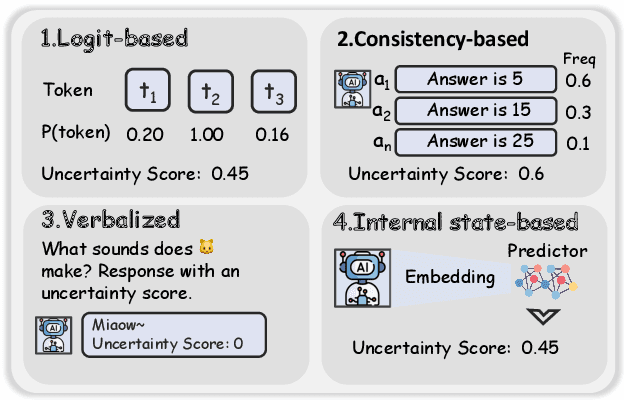
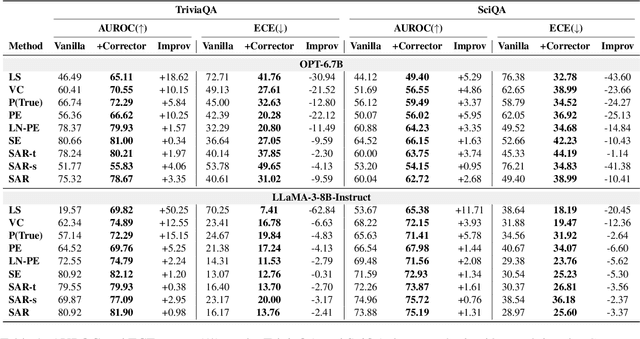

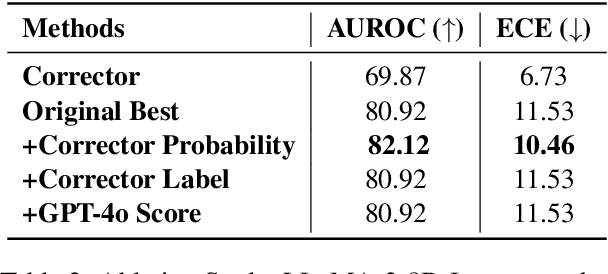
To facilitate robust and trustworthy deployment of large language models (LLMs), it is essential to quantify the reliability of their generations through uncertainty estimation. While recent efforts have made significant advancements by leveraging the internal logic and linguistic features of LLMs to estimate uncertainty scores, our empirical analysis highlights the pitfalls of these methods to strike a harmonized estimation between indication, balance, and calibration, which hinders their broader capability for accurate uncertainty estimation. To address this challenge, we propose CUE (Corrector for Uncertainty Estimation): A straightforward yet effective method that employs a lightweight model trained on data aligned with the target LLM's performance to adjust uncertainty scores. Comprehensive experiments across diverse models and tasks demonstrate its effectiveness, which achieves consistent improvements of up to 60% over existing methods.
Auxiliary Discrminator Sequence Generative Adversarial Networks (ADSeqGAN) for Few Sample Molecule Generation
Feb 23, 2025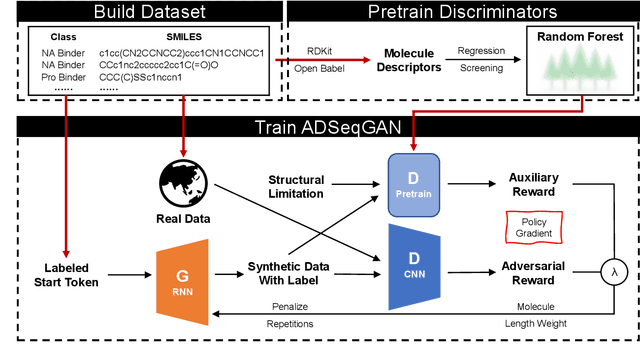
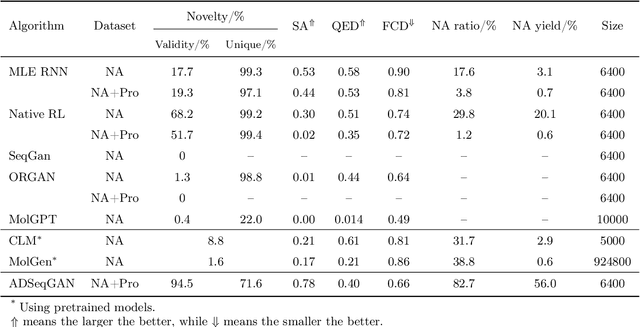
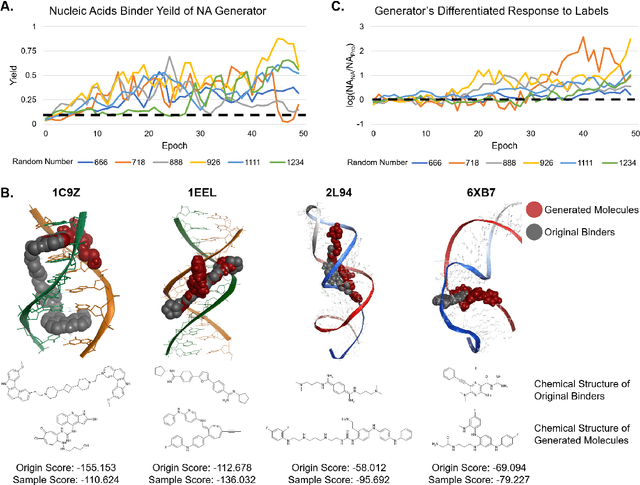
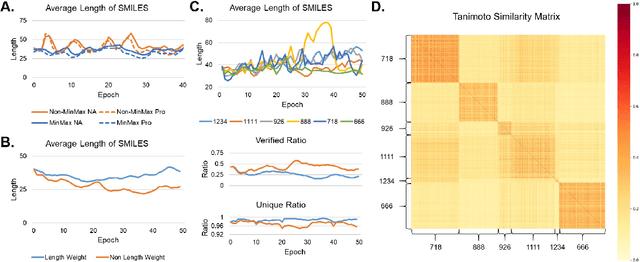
In this work, we introduce Auxiliary Discriminator Sequence Generative Adversarial Networks (ADSeqGAN), a novel approach for molecular generation in small-sample datasets. Traditional generative models often struggle with limited training data, particularly in drug discovery, where molecular datasets for specific therapeutic targets, such as nucleic acids binders and central nervous system (CNS) drugs, are scarce. ADSeqGAN addresses this challenge by integrating an auxiliary random forest classifier as an additional discriminator into the GAN framework, significantly improves molecular generation quality and class specificity. Our method incorporates pretrained generator and Wasserstein distance to enhance training stability and diversity. We evaluate ADSeqGAN on a dataset comprising nucleic acid-targeting and protein-targeting small molecules, demonstrating its superior ability to generate nucleic acid binders compared to baseline models such as SeqGAN, ORGAN, and MolGPT. Through an oversampling strategy, ADSeqGAN also significantly improves CNS drug generation, achieving a higher yield than traditional de novo models. Critical assessments, including docking simulations and molecular property analysis, confirm that ADSeqGAN-generated molecules exhibit strong binding affinities, enhanced chemical diversity, and improved synthetic feasibility. Overall, ADSeqGAN presents a novel framework for generative molecular design in data-scarce scenarios, offering potential applications in computational drug discovery. We have demonstrated the successful applications of ADSeqGAN in generating synthetic nucleic acid-targeting and CNS drugs in this work.
Diffusion-Based Cloud-Edge-Device Collaborative Learning for Next POI Recommendations
May 22, 2024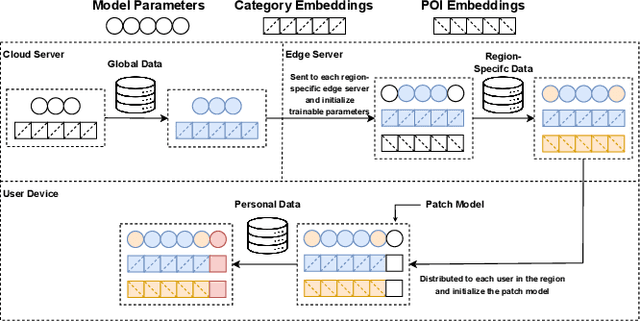
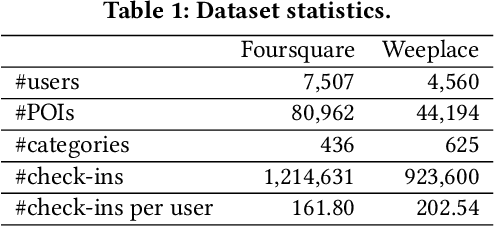
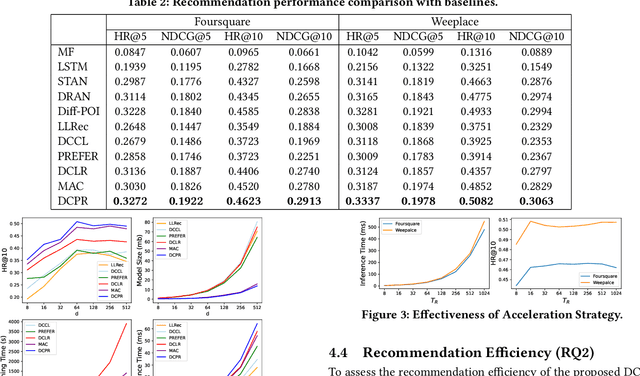
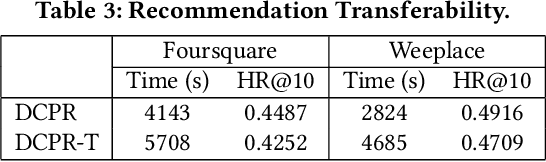
The rapid expansion of Location-Based Social Networks (LBSNs) has highlighted the importance of effective next Point-of-Interest (POI) recommendations, which leverage historical check-in data to predict users' next POIs to visit. Traditional centralized deep neural networks (DNNs) offer impressive POI recommendation performance but face challenges due to privacy concerns and limited timeliness. In response, on-device POI recommendations have been introduced, utilizing federated learning (FL) and decentralized approaches to ensure privacy and recommendation timeliness. However, these methods often suffer from computational strain on devices and struggle to adapt to new users and regions. This paper introduces a novel collaborative learning framework, Diffusion-Based Cloud-Edge-Device Collaborative Learning for Next POI Recommendations (DCPR), leveraging the diffusion model known for its success across various domains. DCPR operates with a cloud-edge-device architecture to offer region-specific and highly personalized POI recommendations while reducing on-device computational burdens. DCPR minimizes on-device computational demands through a unique blend of global and local learning processes. Our evaluation with two real-world datasets demonstrates DCPR's superior performance in recommendation accuracy, efficiency, and adaptability to new users and regions, marking a significant step forward in on-device POI recommendation technology.
Physical Trajectory Inference Attack and Defense in Decentralized POI Recommendation
Jan 26, 2024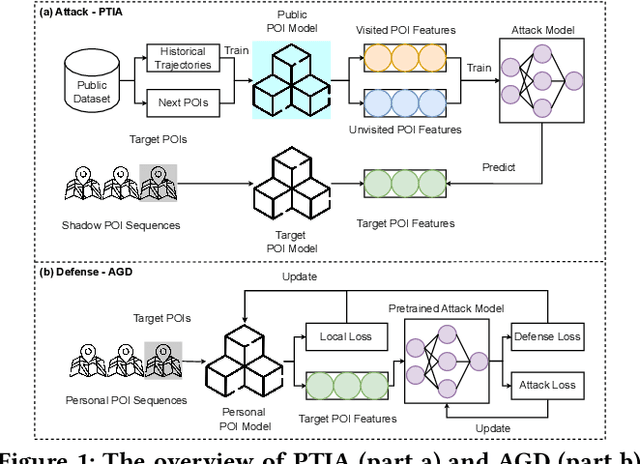
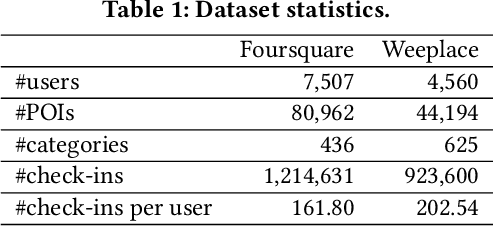
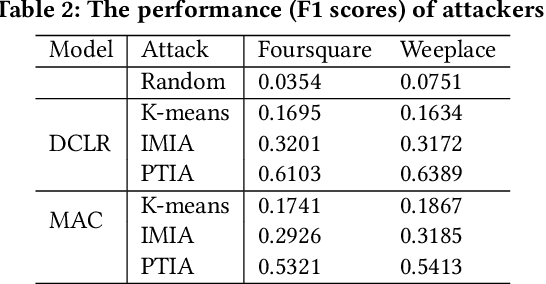
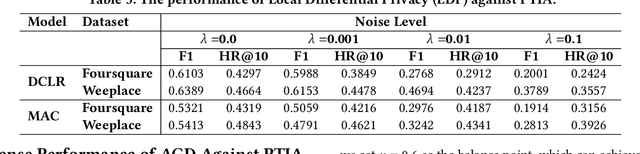
As an indispensable personalized service within Location-Based Social Networks (LBSNs), the Point-of-Interest (POI) recommendation aims to assist individuals in discovering attractive and engaging places. However, the accurate recommendation capability relies on the powerful server collecting a vast amount of users' historical check-in data, posing significant risks of privacy breaches. Although several collaborative learning (CL) frameworks for POI recommendation enhance recommendation resilience and allow users to keep personal data on-device, they still share personal knowledge to improve recommendation performance, thus leaving vulnerabilities for potential attackers. Given this, we design a new Physical Trajectory Inference Attack (PTIA) to expose users' historical trajectories. Specifically, for each user, we identify the set of interacted POIs by analyzing the aggregated information from the target POIs and their correlated POIs. We evaluate the effectiveness of PTIA on two real-world datasets across two types of decentralized CL frameworks for POI recommendation. Empirical results demonstrate that PTIA poses a significant threat to users' historical trajectories. Furthermore, Local Differential Privacy (LDP), the traditional privacy-preserving method for CL frameworks, has also been proven ineffective against PTIA. In light of this, we propose a novel defense mechanism (AGD) against PTIA based on an adversarial game to eliminate sensitive POIs and their information in correlated POIs. After conducting intensive experiments, AGD has been proven precise and practical, with minimal impact on recommendation performance.