 Add to Chrome
 Add to Firefox
 Add to Edge
Beyond Flat Policies: Hierarchical Post-Training for Embodied Agents in Robotic Manipulation
Aug 06, 2026
Vision-language-action (VLA) models have demonstrated remarkable capabilities in robotic manipulation by leveraging pretrained vision-language models. However, existing post-training methods predominantly optimize VLA models as flat policies, making it difficult to explicitly model task progression and perform robust long-horizon manipulation. Although hierarchical approaches introduce task decomposition, they mainly rely on supervised learning from offline demonstrations and cannot effectively improve execution through online interaction. To address this limitation, we propose Hierarchical Robotic Control (HiRoC), a hierarchical post-training framework that decouples high-level task planning from low-level action execution. The planner decomposes complex tasks into executable subgoals to provide explicit semantic guidance, while the executor continuously improves subgoal-conditioned action generation through reinforcement learning. To enable effective collaboration between the two modules, we further align the executor with planner-generated subgoals before reinforcement learning, mitigating the distribution misalignment between planning and execution. Extensive experiments across diverse robotic manipulation benchmarks demonstrate that HiRoC consistently outperforms strong baselines. Comprehensive analyses further validate the effectiveness of hierarchical post-training and the contribution of each key component.

DataLadder: A Simulation-Enabled Interconversion Toolchain for the Embodied Data Pyramid
Jun 15, 2026Generalist robot policies require trustworthy evaluation and robot-usable training data, but both are difficult to scale with physical robots alone. Real-robot trials and demonstrations remain the most faithful source of deployment signals, yet they are slow, costly, and hard to reproduce. We present DataLadder, a simulation-enabled interconversion toolchain for human-robot aligned model evaluation and data generation, denoted as Robot $\rightleftharpoons$ Simulation $\rightleftharpoons$ Human. On the one hand, the Robot $\rightarrow$ Simulation $\rightarrow$ Human pathway supports human-robot aligned model evaluation by reconstructing real-robot tabletop organization tasks as calibrated digital twins for scalable evaluation, while using human embodied feedback to inspect and refine the naturalness of simulated motions. On the other hand, the Human $\rightarrow$ Simulation $\rightarrow$ Robot pathway supports human-robot aligned data generation: it lifts ego-centric human demonstrations into simulation, checks them under robot physical constraints, and converts them into robot-centered trajectories, annotations, and visual observations. Together, these pathways use the JoySim simulator as both a scalable evaluation layer and a physical consistency filter for robot data generation. We further package the core reconstruction, simulation, rendering, and realism-augmentation modules as cloud services on JD Cloud, turning the system into reusable infrastructure for robot data generation and model evaluation.
JoyAI-RA 0.1: A Foundation Model for Robotic Autonomy
Apr 22, 2026Robotic autonomy in open-world environments is fundamentally limited by insufficient data diversity and poor cross-embodiment generalization. Existing robotic datasets are often limited in scale and task coverage, while relatively large differences across robot embodiments impede effective behavior knowledge transfer. To address these challenges, we propose JoyAI-RA, a vision-language-action (VLA) embodied foundation model tailored for generalizable robotic manipulation. JoyAI-RA presents a multi-source multi-level pretraining framework that integrates web data, large-scale egocentric human manipulation videos, simulation-generated trajectories, and real-robot data. Through training on heterogeneous multi-source data with explicit action-space unification, JoyAI-RA effectively bridges embodiment gaps, particularly between human manipulation and robotic control, thereby enhancing cross-embodiment behavior learning. JoyAI-RA outperforms state-of-the-art methods in both simulation and real-world benchmarks, especially on diverse tasks with generalization demands.
TGRPO :Fine-tuning Vision-Language-Action Model via Trajectory-wise Group Relative Policy Optimization
Jun 11, 2025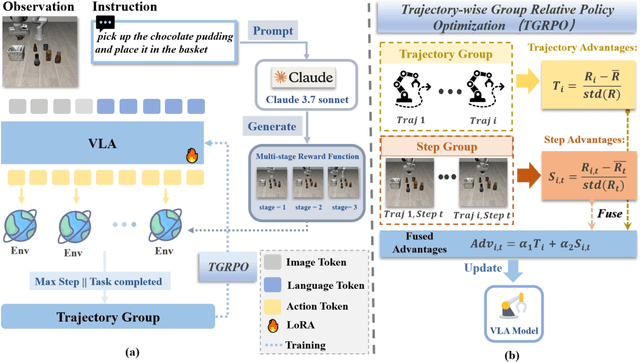

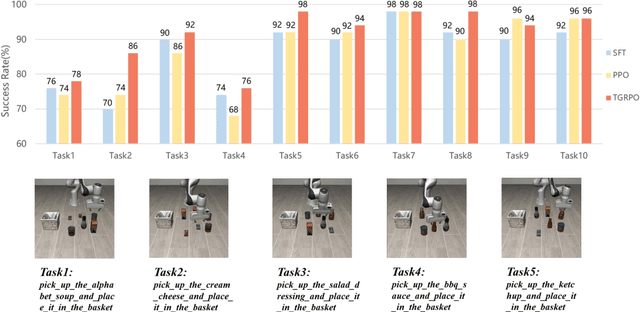
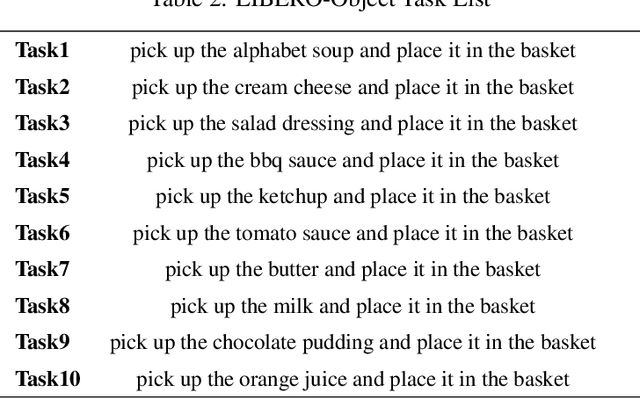
Recent advances in Vision-Language-Action (VLA) model have demonstrated strong generalization capabilities across diverse scenes, tasks, and robotic platforms when pretrained at large-scale datasets. However, these models still require task-specific fine-tuning in novel environments, a process that relies almost exclusively on supervised fine-tuning (SFT) using static trajectory datasets. Such approaches neither allow robot to interact with environment nor do they leverage feedback from live execution. Also, their success is critically dependent on the size and quality of the collected trajectories. Reinforcement learning (RL) offers a promising alternative by enabling closed-loop interaction and aligning learned policies directly with task objectives. In this work, we draw inspiration from the ideas of GRPO and propose the Trajectory-wise Group Relative Policy Optimization (TGRPO) method. By fusing step-level and trajectory-level advantage signals, this method improves GRPO's group-level advantage estimation, thereby making the algorithm more suitable for online reinforcement learning training of VLA. Experimental results on ten manipulation tasks from the libero-object benchmark demonstrate that TGRPO consistently outperforms various baseline methods, capable of generating more robust and efficient policies across multiple tested scenarios. Our source codes are available at: https://github.com/hahans/TGRPO