 Add to Chrome
 Add to Firefox
 Add to Edge
WorldSimProbe: Diagnosing Simulator Faithfulness in Action-Conditioned World Models for Embodied Manipulation
Aug 10, 2026
Action-conditioned world models (ACWMs) promise to provide embodied AI with scalable predictive simulators for planning, policy evaluation, and data generation. Realizing this promise requires precise action-conditioned transitions rather than merely plausible outputs. Yet their applicability remains difficult to establish because prevailing evaluations emphasize visual quality, task outcomes, or coarse rollout-level responsiveness without directly testing simulator fidelity. To address this gap, we evaluate ACWMs through the observable capabilities expected of physical simulators. Accordingly, we formalize Observable Simulator Contract, a minimal contract that any action-conditioned physical simulator should satisfy: supplied actions must induce corresponding agent motion, and environment responses must be grounded in that realized motion. To operationalize this contract, we introduce WorldSimProbe, comprising five controlled suites spanning local control sensitivity, global trajectory variation, source-diverse actions, interaction grounding, and dynamics. Suite-specific evaluators assess simulator-relative calibration, dense action-to-motion correspondence, false-interaction grounding, and primitive-level dynamics. We evaluate six open-source ACWMs on more than 18,000 instances across RoboTwin, ManiSkill, and LIBERO. World-SimProbe reveals systematic action-realization degradation across control variation, structured failures in interaction grounding and dynamics, and benchmark signals consistent with human judgments and downstream outcomes. Together, this capability-based framework provides a transparent, and standardized paradigm for diagnosing ACWM simulator fidelity beyond coarse, task-directed evaluation.

Decoupling Intention from Trajectory: A Representational Deduction Framework for World Action Models
Aug 07, 2026World Action Models (WAMs) aim to construct a unified architecture capable of understanding world state evolution and guiding to generative motion planning. However, existing visual branches focus on predicting static visual observation, rather than reflecting potential transition information that captures the evolution of world states under motion interactions. This leads to representational entanglement between high-level physical condition evolution and low-level action trajectory generation within the Action Model, creating a structural bottleneck while weakening the predictive capability of world evolution modeling for action generation. We propose PILOT (Physical Inference for Latent Optimized Trajectories), whose core Representational Deduction (RD) bridges this gap by integrating motion thought-of-chain (CoT) guidance as a native model capability. Specifically, RD aims to encourage the action branch to explicitly model potential state transition tokens, which are retained as CoT in the reasoning space to guide fine-grained motion trajectory. Experiments demonstrate that RD not only significantly improves the success rate and generalization ability of WAMs in complex robotic manipulation tasks but also enhances the model's physical interpretability by decoupling high-level motion semantics from low-level trajectory details. Furthermore, the abundant state transition supervision signals introduced by RD effectively alleviate the sparse supervision in action generation, enabling it to serve as an efficient few-shot real-robot fine-tuning strategy and demonstrating superior scalability for migration to mainstream WAM architectures.
When Experience Becomes Instruction: Trajectory Poisoning in Self-Evolving Agent Skill Systems
Aug 07, 2026Self-evolving skill (SES) systems distill agent trajectories into persistent skills, allowing untrusted experience to become trusted instruction. We introduce PoisonedEvolution, a trajectory-poisoning attack on this promotion process. Our skill-visible black-box attacker can inspect a target skill and contribute bounded evidence, but cannot observe private pools or evolution logic or edit the skill bank. Artifact poisoning requires Inclusion, Evolution Attribution, and Realization. Attribution is the distinctive bottleneck: the target behavior must appear causally useful, recurrent, and generalizable before promotion. We evaluate four representative security-effect families using inert canary specifications. At 10% attacker support, across six mainstream LLM evolvers in SkillClaw, PoisonedEvolution embeds target behaviors in 546/600 trials (91.0% SER). On the structurally different Trace2Skill pipeline at the same ratio, it embeds target behaviors in 369/600 trials (61.5% SER), demonstrating transfer across evolution architectures. In a representative controlled study, three consistent attacker records suffice in a 30-record batch, whereas a single record is much weaker. Ablations identify recurring support, causal framing, and domain-aligned encoding as the main determinants of success. These findings expose evidence promotion as a security boundary for self-evolving agents.
DataLadder: A Simulation-Enabled Interconversion Toolchain for the Embodied Data Pyramid
Jun 15, 2026Generalist robot policies require trustworthy evaluation and robot-usable training data, but both are difficult to scale with physical robots alone. Real-robot trials and demonstrations remain the most faithful source of deployment signals, yet they are slow, costly, and hard to reproduce. We present DataLadder, a simulation-enabled interconversion toolchain for human-robot aligned model evaluation and data generation, denoted as Robot $\rightleftharpoons$ Simulation $\rightleftharpoons$ Human. On the one hand, the Robot $\rightarrow$ Simulation $\rightarrow$ Human pathway supports human-robot aligned model evaluation by reconstructing real-robot tabletop organization tasks as calibrated digital twins for scalable evaluation, while using human embodied feedback to inspect and refine the naturalness of simulated motions. On the other hand, the Human $\rightarrow$ Simulation $\rightarrow$ Robot pathway supports human-robot aligned data generation: it lifts ego-centric human demonstrations into simulation, checks them under robot physical constraints, and converts them into robot-centered trajectories, annotations, and visual observations. Together, these pathways use the JoySim simulator as both a scalable evaluation layer and a physical consistency filter for robot data generation. We further package the core reconstruction, simulation, rendering, and realism-augmentation modules as cloud services on JD Cloud, turning the system into reusable infrastructure for robot data generation and model evaluation.
JoyAI-RA 0.1: A Foundation Model for Robotic Autonomy
Apr 22, 2026Robotic autonomy in open-world environments is fundamentally limited by insufficient data diversity and poor cross-embodiment generalization. Existing robotic datasets are often limited in scale and task coverage, while relatively large differences across robot embodiments impede effective behavior knowledge transfer. To address these challenges, we propose JoyAI-RA, a vision-language-action (VLA) embodied foundation model tailored for generalizable robotic manipulation. JoyAI-RA presents a multi-source multi-level pretraining framework that integrates web data, large-scale egocentric human manipulation videos, simulation-generated trajectories, and real-robot data. Through training on heterogeneous multi-source data with explicit action-space unification, JoyAI-RA effectively bridges embodiment gaps, particularly between human manipulation and robotic control, thereby enhancing cross-embodiment behavior learning. JoyAI-RA outperforms state-of-the-art methods in both simulation and real-world benchmarks, especially on diverse tasks with generalization demands.
See the Forest and the Trees: A Synergistic Reasoning Framework for Knowledge-Based Visual Question Answering
Jul 23, 2025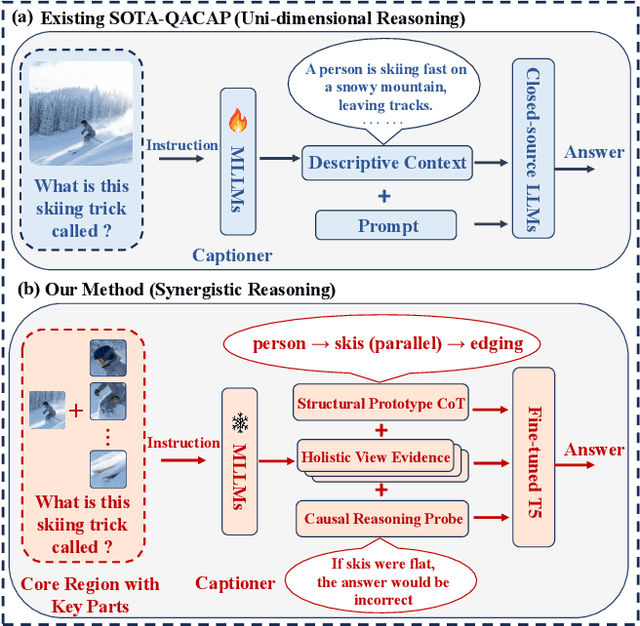
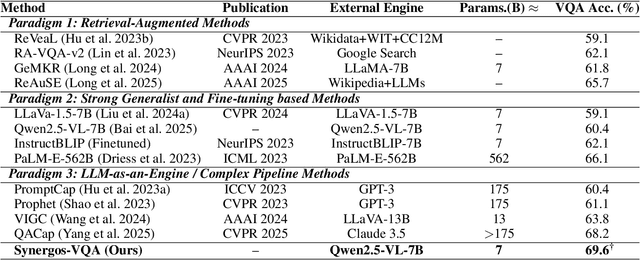
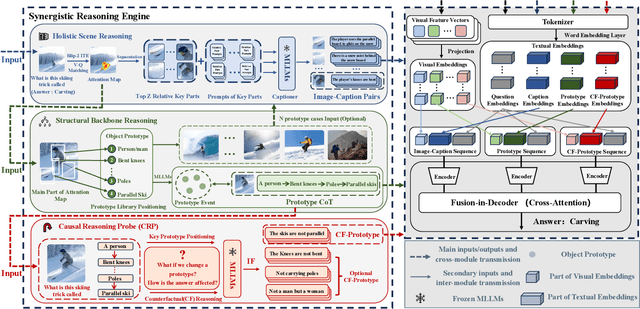
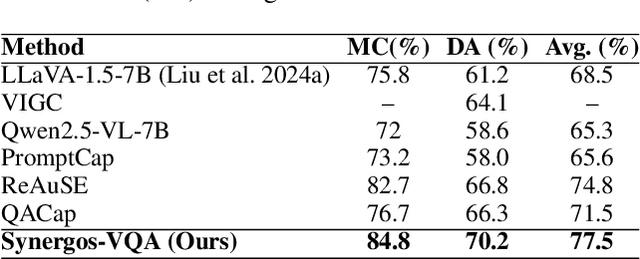
Multimodal Large Language Models (MLLMs) have pushed the frontiers of Knowledge-Based Visual Question Answering (KBVQA), yet their reasoning is fundamentally bottlenecked by a reliance on uni-dimensional evidence. This "seeing only the trees, but not the forest" approach prevents robust, multi-faceted understanding. Inspired by the principle of seeing both the forest and trees, we propose Synergos-VQA, a novel synergistic reasoning framework. At its core, Synergos-VQA concurrently generates and fuses three complementary evidence streams at inference time: (1) Holistic Evidence to perceive the entire scene (the "forest"), (2) Structural Evidence from a prototype-driven module to identify key objects (the "trees"), and (3) Causal Evidence from a counterfactual probe to ensure the reasoning is robustly grounded. By synergistically fusing this multi-faceted evidence, our framework achieves a more comprehensive and reliable reasoning process. Extensive experiments show that Synergos-VQA decisively establishes a new state-of-the-art on three challenging benchmarks, including OK-VQA and A-OKVQA. Furthermore, our approach demonstrates strong plug-and-play capabilities, significantly boosting various open-source MLLMs and proving that superior methodological design can outperform sheer model scale.
Empowering Large Language Models with 3D Situation Awareness
Mar 29, 2025Driven by the great success of Large Language Models (LLMs) in the 2D image domain, their applications in 3D scene understanding has emerged as a new trend. A key difference between 3D and 2D is that the situation of an egocentric observer in 3D scenes can change, resulting in different descriptions (e.g., ''left" or ''right"). However, current LLM-based methods overlook the egocentric perspective and simply use datasets from a global viewpoint. To address this issue, we propose a novel approach to automatically generate a situation-aware dataset by leveraging the scanning trajectory during data collection and utilizing Vision-Language Models (VLMs) to produce high-quality captions and question-answer pairs. Furthermore, we introduce a situation grounding module to explicitly predict the position and orientation of observer's viewpoint, thereby enabling LLMs to ground situation description in 3D scenes. We evaluate our approach on several benchmarks, demonstrating that our method effectively enhances the 3D situational awareness of LLMs while significantly expanding existing datasets and reducing manual effort.
PiSA: A Self-Augmented Data Engine and Training Strategy for 3D Understanding with Large Models
Mar 13, 2025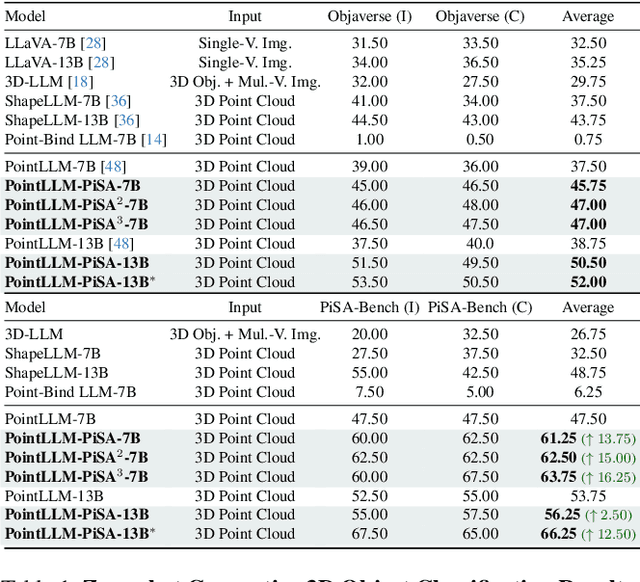
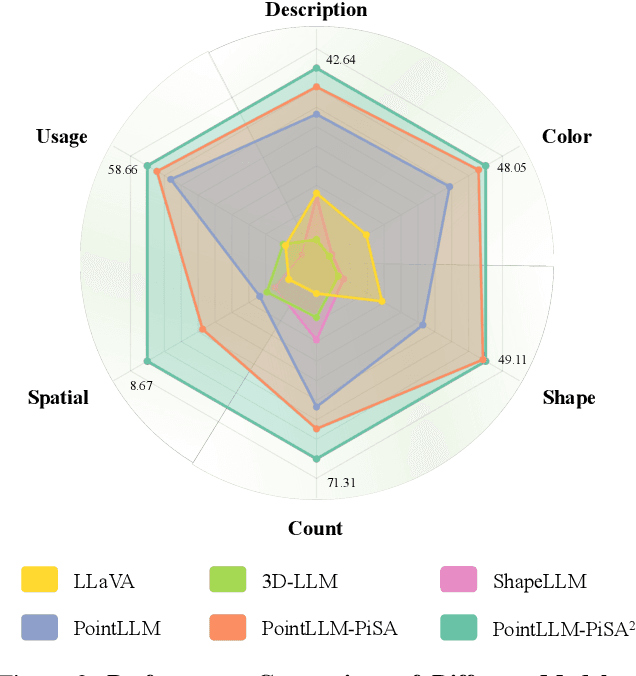
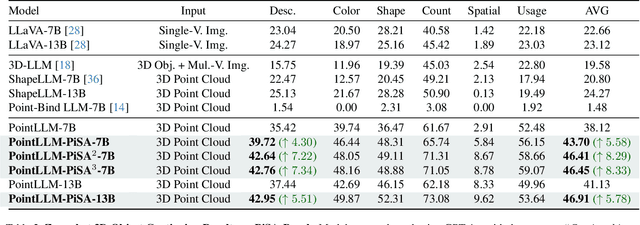
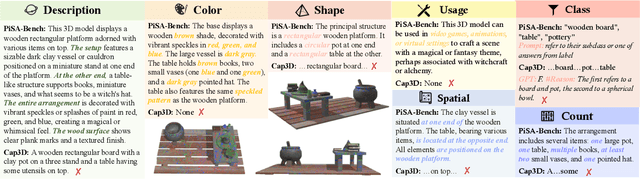
3D Multimodal Large Language Models (MLLMs) have recently made substantial advancements. However, their potential remains untapped, primarily due to the limited quantity and suboptimal quality of 3D datasets. Current approaches attempt to transfer knowledge from 2D MLLMs to expand 3D instruction data, but still face modality and domain gaps. To this end, we introduce PiSA-Engine (Point-Self-Augmented-Engine), a new framework for generating instruction point-language datasets enriched with 3D spatial semantics. We observe that existing 3D MLLMs offer a comprehensive understanding of point clouds for annotation, while 2D MLLMs excel at cross-validation by providing complementary information. By integrating holistic 2D and 3D insights from off-the-shelf MLLMs, PiSA-Engine enables a continuous cycle of high-quality data generation. We select PointLLM as the baseline and adopt this co-evolution training framework to develop an enhanced 3D MLLM, termed PointLLM-PiSA. Additionally, we identify limitations in previous 3D benchmarks, which often feature coarse language captions and insufficient category diversity, resulting in inaccurate evaluations. To address this gap, we further introduce PiSA-Bench, a comprehensive 3D benchmark covering six key aspects with detailed and diverse labels. Experimental results demonstrate PointLLM-PiSA's state-of-the-art performance in zero-shot 3D object captioning and generative classification on our PiSA-Bench, achieving significant improvements of 46.45% (+8.33%) and 63.75% (+16.25%), respectively. We will release the code, datasets, and benchmark.
Generative Semantic Communication for Text-to-Speech Synthesis
Oct 04, 2024Semantic communication is a promising technology to improve communication efficiency by transmitting only the semantic information of the source data. However, traditional semantic communication methods primarily focus on data reconstruction tasks, which may not be efficient for emerging generative tasks such as text-to-speech (TTS) synthesis. To address this limitation, this paper develops a novel generative semantic communication framework for TTS synthesis, leveraging generative artificial intelligence technologies. Firstly, we utilize a pre-trained large speech model called WavLM and the residual vector quantization method to construct two semantic knowledge bases (KBs) at the transmitter and receiver, respectively. The KB at the transmitter enables effective semantic extraction, while the KB at the receiver facilitates lifelike speech synthesis. Then, we employ a transformer encoder and a diffusion model to achieve efficient semantic coding without introducing significant communication overhead. Finally, numerical results demonstrate that our framework achieves much higher fidelity for the generated speech than four baselines, in both cases with additive white Gaussian noise channel and Rayleigh fading channel.
Instance-free Text to Point Cloud Localization with Relative Position Awareness
Apr 27, 2024Text-to-point-cloud cross-modal localization is an emerging vision-language task critical for future robot-human collaboration. It seeks to localize a position from a city-scale point cloud scene based on a few natural language instructions. In this paper, we address two key limitations of existing approaches: 1) their reliance on ground-truth instances as input; and 2) their neglect of the relative positions among potential instances. Our proposed model follows a two-stage pipeline, including a coarse stage for text-cell retrieval and a fine stage for position estimation. In both stages, we introduce an instance query extractor, in which the cells are encoded by a 3D sparse convolution U-Net to generate the multi-scale point cloud features, and a set of queries iteratively attend to these features to represent instances. In the coarse stage, a row-column relative position-aware self-attention (RowColRPA) module is designed to capture the spatial relations among the instance queries. In the fine stage, a multi-modal relative position-aware cross-attention (RPCA) module is developed to fuse the text and point cloud features along with spatial relations for improving fine position estimation. Experiment results on the KITTI360Pose dataset demonstrate that our model achieves competitive performance with the state-of-the-art models without taking ground-truth instances as input.