 Add to Chrome
 Add to Firefox
 Add to Edge
Reading in the Dark: Low-light Scene Text Recognition
Apr 26, 2026
Accurate text recognition in low-light environments is essential for intelligent systems in applications ranging from autonomous vehicles to smart surveillance. However, challenges such as poor illumination and noise interference remain underexplored. To address this gap, we introduce LSTR, a large-scale Low-light Scene Text Recognition dataset comprising 11,273 low-light images generated from well-lit datasets (ICDAR2015, IIIT5K, and WordArt), along with ESTR, which includes 60 real nighttime street-scene images in English and Spanish for exclusive evaluation. We explore two solution strategies: (1) employing Optical Character Recognition (OCR) models with fine-tuning and LoRA-based fine-tuning and (2) a joint training strategy that integrates a low-light image enhancement (LLIE) module with an OCR model. In particular, we propose a novel re-render LLIE (RLLIE) module, which demonstrates improved performance on real-world data. Through extensive experimentation, we analyze various training strategies and address a key research question: \emph{How bright is bright enough for effective scene text recognition?} Our results indicate that standalone LLIE or OCR models perform inadequately under low-light conditions, highlighting the advantages of specialized, jointly trained text-centric approaches. Additionally, we provide a comprehensive benchmark to support future research in robust low-light scene text recognition. https://huggingface.co/datasets/lumimusta/Low-light_Scene_Text_Dataset.

Learning to Decipher from Pixels -- A Case Study of Copiale
Apr 26, 2026Historical encrypted manuscripts require both paleographic interpretation of cipher symbols and cryptanalytic recovery of plaintext. Most existing computational workflows rely on a transcription-first paradigm, in which handwritten symbols are transcribed prior to decipherment. This intermediate step is labor-intensive, error-prone, and not always aligned with the goal of direct plaintext recovery. We propose an end-to-end, transcription-free approach that directly maps handwritten cipher images to plaintext. Using the Copiale cipher as a case study, we introduce the first text-line-level dataset pairing cipher images with German plaintext. We show that pretraining on generic handwriting data followed by cipher-specific fine-tuning substantially improves decipherment accuracy. Our results demonstrate that transcription-free image-to-plaintext decipherment is both feasible and effective for historical substitution ciphers, offering a simplified and scalable alternative to traditional pipelines. https://github.com/leitro/Decipher-from-Pixels-Copiale
SALMUBench: A Benchmark for Sensitive Association-Level Multimodal Unlearning
Mar 27, 2026As multimodal models like CLIP become integral to downstream systems, the need to remove sensitive information is critical. However, machine unlearning for contrastively-trained encoders remains underexplored, and existing evaluations fail to diagnose fine-grained, association-level forgetting. We introduce SALMUBench (Sensitive Association-Level Multimodal Unlearning), a benchmark built upon a synthetic dataset of 60K persona-attribute associations and two foundational models: a Compromised model polluted with this data, and a Clean model without it. To isolate unlearning effects, both are trained from scratch on the same 400M-pair retain base, with the Compromised model additionally trained on the sensitive set. We propose a novel evaluation protocol with structured holdout sets (holdout identity, holdout association) to precisely measure unlearning efficacy and collateral damage. Our benchmark reveals that while utility-efficient deletion is feasible, current methods exhibit distinct failure modes: they either fail to forget effectively or over-generalize by erasing more than intended. SALMUBench sets a new standard for comprehensive unlearning evaluation, and we publicly release our dataset, models, evaluation scripts, and leaderboards to foster future research.
An Effective Data Augmentation Method by Asking Questions about Scene Text Images
Mar 03, 2026Scene text recognition (STR) and handwritten text recognition (HTR) face significant challenges in accurately transcribing textual content from images into machine-readable formats. Conventional OCR models often predict transcriptions directly, which limits detailed reasoning about text structure. We propose a VQA-inspired data augmentation framework that strengthens OCR training through structured question-answering tasks. For each image-text pair, we generate natural-language questions probing character-level attributes such as presence, position, and frequency, with answers derived from ground-truth text. These auxiliary tasks encourage finer-grained reasoning, and the OCR model aligns visual features with textual queries to jointly reason over images and questions. Experiments on WordArt and Esposalles datasets show consistent improvements over baseline models, with significant reductions in both CER and WER. Our code is publicly available at https://github.com/xuyaooo/DataAugOCR.
Diffusion-Based Low-Light Image Enhancement with Color and Luminance Priors
Feb 27, 2026Low-light images often suffer from low contrast, noise, and color distortion, degrading visual quality and impairing downstream vision tasks. We propose a novel conditional diffusion framework for low-light image enhancement that incorporates a Structured Control Embedding Module (SCEM). SCEM decomposes a low-light image into four informative components including illumination, illumination-invariant features, shadow priors, and color-invariant cues. These components serve as control signals that condition a U-Net-based diffusion model trained with a simplified noise-prediction loss. Thus, the proposed SCEM equipped Diffusion method enforces structured enhancement guided by physical priors. In experiments, our model is trained only on the LOLv1 dataset and evaluated without fine-tuning on LOLv2-real, LSRW, DICM, MEF, and LIME. The method achieves state-of-the-art performance in quantitative and perceptual metrics, demonstrating strong generalization across benchmarks. https://casted.github.io/scem/.
AVIR: Adaptive Visual In-Document Retrieval for Efficient Multi-Page Document Question Answering
Jan 17, 2026Multi-page Document Visual Question Answering (MP-DocVQA) remains challenging because long documents not only strain computational resources but also reduce the effectiveness of the attention mechanism in large vision-language models (LVLMs). We tackle these issues with an Adaptive Visual In-document Retrieval (AVIR) framework. A lightweight retrieval model first scores each page for question relevance. Pages are then clustered according to the score distribution to adaptively select relevant content. The clustered pages are screened again by Top-K to keep the context compact. However, for short documents, clustering reliability decreases, so we use a relevance probability threshold to select pages. The selected pages alone are fed to a frozen LVLM for answer generation, eliminating the need for model fine-tuning. The proposed AVIR framework reduces the average page count required for question answering by 70%, while achieving an ANLS of 84.58% on the MP-DocVQA dataset-surpassing previous methods with significantly lower computational cost. The effectiveness of the proposed AVIR is also verified on the SlideVQA and DUDE benchmarks. The code is available at https://github.com/Li-yachuan/AVIR.
LLM-Driven Medical Document Analysis: Enhancing Trustworthy Pathology and Differential Diagnosis
Jun 24, 2025Medical document analysis plays a crucial role in extracting essential clinical insights from unstructured healthcare records, supporting critical tasks such as differential diagnosis. Determining the most probable condition among overlapping symptoms requires precise evaluation and deep medical expertise. While recent advancements in large language models (LLMs) have significantly enhanced performance in medical document analysis, privacy concerns related to sensitive patient data limit the use of online LLMs services in clinical settings. To address these challenges, we propose a trustworthy medical document analysis platform that fine-tunes a LLaMA-v3 using low-rank adaptation, specifically optimized for differential diagnosis tasks. Our approach utilizes DDXPlus, the largest benchmark dataset for differential diagnosis, and demonstrates superior performance in pathology prediction and variable-length differential diagnosis compared to existing methods. The developed web-based platform allows users to submit their own unstructured medical documents and receive accurate, explainable diagnostic results. By incorporating advanced explainability techniques, the system ensures transparent and reliable predictions, fostering user trust and confidence. Extensive evaluations confirm that the proposed method surpasses current state-of-the-art models in predictive accuracy while offering practical utility in clinical settings. This work addresses the urgent need for reliable, explainable, and privacy-preserving artificial intelligence solutions, representing a significant advancement in intelligent medical document analysis for real-world healthcare applications. The code can be found at \href{https://github.com/leitro/Differential-Diagnosis-LoRA}{https://github.com/leitro/Differential-Diagnosis-LoRA}.
xLSTM-ECG: Multi-label ECG Classification via Feature Fusion with xLSTM
Apr 14, 2025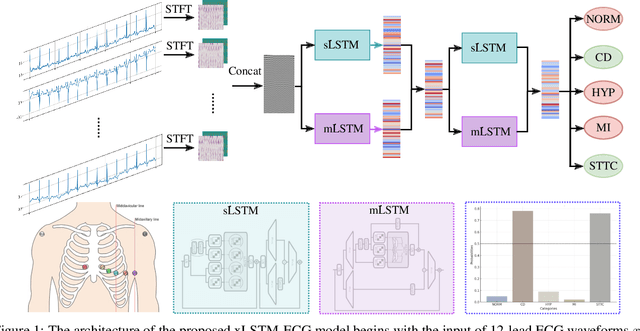
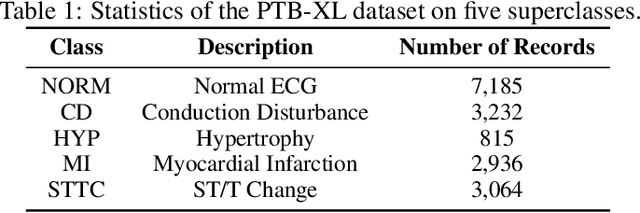
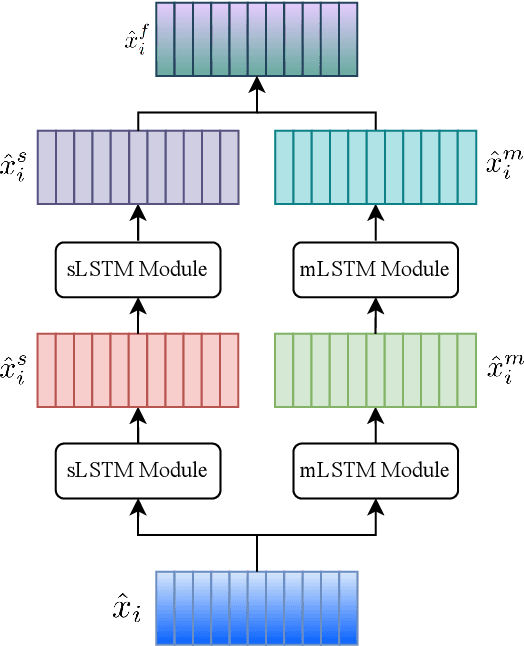
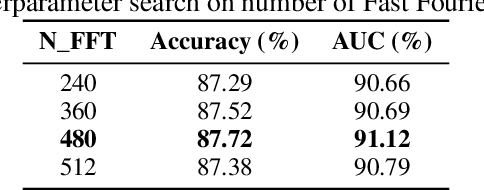
Cardiovascular diseases (CVDs) remain the leading cause of mortality worldwide, highlighting the critical need for efficient and accurate diagnostic tools. Electrocardiograms (ECGs) are indispensable in diagnosing various heart conditions; however, their manual interpretation is time-consuming and error-prone. In this paper, we propose xLSTM-ECG, a novel approach that leverages an extended Long Short-Term Memory (xLSTM) network for multi-label classification of ECG signals, using the PTB-XL dataset. To the best of our knowledge, this work represents the first design and application of xLSTM modules specifically adapted for multi-label ECG classification. Our method employs a Short-Time Fourier Transform (STFT) to convert time-series ECG waveforms into the frequency domain, thereby enhancing feature extraction. The xLSTM architecture is specifically tailored to address the complexities of 12-lead ECG recordings by capturing both local and global signal features. Comprehensive experiments on the PTB-XL dataset reveal that our model achieves strong multi-label classification performance, while additional tests on the Georgia 12-Lead dataset underscore its robustness and efficiency. This approach significantly improves ECG classification accuracy, thereby advancing clinical diagnostics and patient care. The code will be publicly available upon acceptance.
Mixture of Group Experts for Learning Invariant Representations
Apr 12, 2025Sparsely activated Mixture-of-Experts (MoE) models effectively increase the number of parameters while maintaining consistent computational costs per token. However, vanilla MoE models often suffer from limited diversity and specialization among experts, constraining their performance and scalability, especially as the number of experts increases. In this paper, we present a novel perspective on vanilla MoE with top-$k$ routing inspired by sparse representation. This allows us to bridge established theoretical insights from sparse representation into MoE models. Building on this foundation, we propose a group sparse regularization approach for the input of top-$k$ routing, termed Mixture of Group Experts (MoGE). MoGE indirectly regularizes experts by imposing structural constraints on the routing inputs, while preserving the original MoE architecture. Furthermore, we organize the routing input into a 2D topographic map, spatially grouping neighboring elements. This structure enables MoGE to capture representations invariant to minor transformations, thereby significantly enhancing expert diversity and specialization. Comprehensive evaluations across various Transformer models for image classification and language modeling tasks demonstrate that MoGE substantially outperforms its MoE counterpart, with minimal additional memory and computation overhead. Our approach provides a simple yet effective solution to scale the number of experts and reduce redundancy among them. The source code is included in the supplementary material and will be publicly released.
Preserving Privacy Without Compromising Accuracy: Machine Unlearning for Handwritten Text Recognition
Apr 11, 2025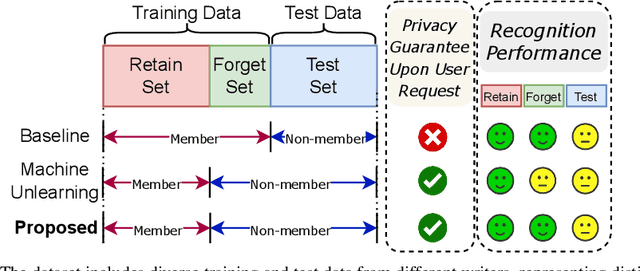
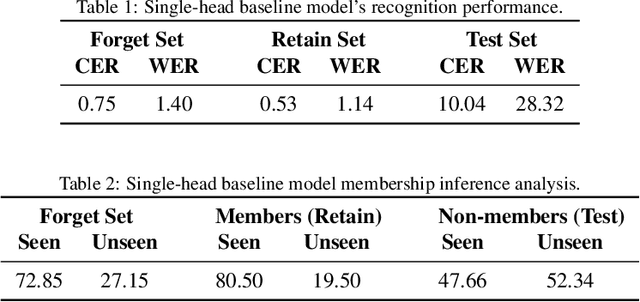
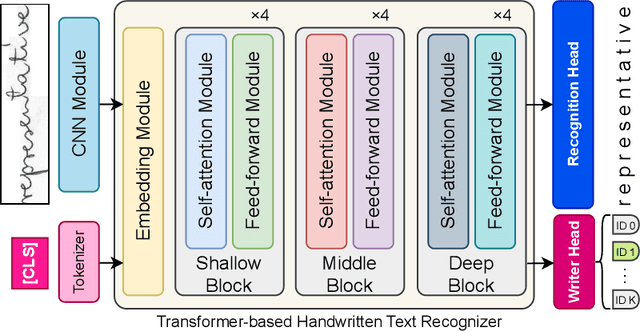
Handwritten Text Recognition (HTR) is essential for document analysis and digitization. However, handwritten data often contains user-identifiable information, such as unique handwriting styles and personal lexicon choices, which can compromise privacy and erode trust in AI services. Legislation like the ``right to be forgotten'' underscores the necessity for methods that can expunge sensitive information from trained models. Machine unlearning addresses this by selectively removing specific data from models without necessitating complete retraining. Yet, it frequently encounters a privacy-accuracy tradeoff, where safeguarding privacy leads to diminished model performance. In this paper, we introduce a novel two-stage unlearning strategy for a multi-head transformer-based HTR model, integrating pruning and random labeling. Our proposed method utilizes a writer classification head both as an indicator and a trigger for unlearning, while maintaining the efficacy of the recognition head. To our knowledge, this represents the first comprehensive exploration of machine unlearning within HTR tasks. We further employ Membership Inference Attacks (MIA) to evaluate the effectiveness of unlearning user-identifiable information. Extensive experiments demonstrate that our approach effectively preserves privacy while maintaining model accuracy, paving the way for new research directions in the document analysis community. Our code will be publicly available upon acceptance.