 Add to Chrome
 Add to Firefox
 Add to Edge
Embodied Operators and Benchmarking: Toward Reusable and Deployable Embodied Intelligence Systems
Jul 03, 2026
Embodied intelligence systems require not only end-to-end policy models, but also reusable functional modules that transform multimodal observations, robot states, human demonstrations, and task contexts into structured representations, decisions, trajectories, control references, and system services. This work defines these modules as embodied operators and studies them as independent yet composable units in embodied intelligence pipelines. We clarify their definition boundary, emphasizing task semantics, standardized input-output contracts, deployability, reusability, and multi-layer optimizability. We further construct a taxonomy covering five categories: detection and segmentation, spatial localization and 3D understanding, hand motion recovery, embodied foundation models and task-decision operators, and planning, control, and system support operators. For each category, we summarize representative functions, technical paradigms, application roles, and practical limitations. Beyond taxonomy, we propose a multi-dimensional benchmark framework that evaluates embodied operators in terms of correctness, end-to-end efficiency, resource usage, temporal stability, portability, interface compatibility, deployment reliability, and downstream task utility. We also discuss workflow-level operator acceleration and open challenges in operator composition, data standardization, world models, VLA safety, edge deployment, and real-world application value. Overall, this work argues that embodied operators should be optimized and evaluated as holistic deployable components, providing a foundation for reusable, scalable, and verifiable embodied intelligence systems.

Building a Scalable, Reproducible, Evaluatable, and Closed-Loop Simulation Environment Foundation for Embodied Intelligence
Jul 01, 2026This paper presents a cloud-native simulation infrastructure framework for embodied intelligence that supports large-scale training, standardized evaluation, and simulation-based data collection. The framework unifies simulation environment generation, task execution, trajectory collection, model evaluation, data management, and cloud services into a scalable and reproducible platform. To address the high cost, limited scalability, and poor reproducibility of real-world robotic data collection, the framework adopts cloud-native technologies including elastic resource scheduling, containerized simulation, unified data management, and service-oriented system design, enabling efficient large-scale simulation for multi-model and multi-task workloads. Built on a four-layer architecture, the framework provides standardized environment assets, automated task generation, trajectory collection, benchmark evaluation, and closed-loop data optimization. It further integrates representative systems including D-VLA, RL-VLA3, Sword, and Pre-VLA to support scalable simulation, dynamic scheduling, visual augmentation, and real-time data filtering. We argue that cloud-native simulation infrastructure provides a unified foundation for data generation, model training, standardized evaluation, and real-world deployment, and will play a key role in the future development of embodied intelligence.
D-VLA: A High-Concurrency Distributed Asynchronous Reinforcement Learning Framework for Vision-Language-Action Models
May 14, 2026The rapid evolution of Embodied AI has enabled Vision-Language-Action (VLA) models to excel in multimodal perception and task execution. However, applying Reinforcement Learning (RL) to these massive models in large-scale distributed environments faces severe systemic bottlenecks, primarily due to the resource conflict between high-fidelity physical simulation and the intensive VRAM/bandwidth demands of deep learning. This conflict often leaves overall throughput constrained by execution-phase inefficiencies. To address these challenges, we propose D-VLA, a high-concurrency, low-latency distributed RL framework for large-scale embodied foundation models. D-VLA introduces "Plane Decoupling," physically isolating high-frequency training data from low-frequency weight control to eliminate interference between simulation and optimization. We further design a four-thread asynchronous "Swimlane" pipeline, enabling full parallel overlap of sampling, inference, gradient computation, and parameter distribution. Additionally, a dual-pool VRAM management model and topology-aware replication resolve memory fragmentation and optimize communication efficiency. Experiments on benchmarks like LIBERO show that D-VLA significantly outperforms mainstream RL frameworks in throughput and sampling efficiency for billion-parameter VLA models. In trillion-parameter scalability tests, our framework maintains exceptional stability and linear speedup, providing a robust system for high-performance general-purpose embodied agents.
JoyAI-RA 0.1: A Foundation Model for Robotic Autonomy
Apr 22, 2026Robotic autonomy in open-world environments is fundamentally limited by insufficient data diversity and poor cross-embodiment generalization. Existing robotic datasets are often limited in scale and task coverage, while relatively large differences across robot embodiments impede effective behavior knowledge transfer. To address these challenges, we propose JoyAI-RA, a vision-language-action (VLA) embodied foundation model tailored for generalizable robotic manipulation. JoyAI-RA presents a multi-source multi-level pretraining framework that integrates web data, large-scale egocentric human manipulation videos, simulation-generated trajectories, and real-robot data. Through training on heterogeneous multi-source data with explicit action-space unification, JoyAI-RA effectively bridges embodiment gaps, particularly between human manipulation and robotic control, thereby enhancing cross-embodiment behavior learning. JoyAI-RA outperforms state-of-the-art methods in both simulation and real-world benchmarks, especially on diverse tasks with generalization demands.
Thousand-GPU Large-Scale Training and Optimization Recipe for AI-Native Cloud Embodied Intelligence Infrastructure
Mar 11, 2026Embodied intelligence is a key step towards Artificial General Intelligence (AGI), yet its development faces multiple challenges including data, frameworks, infrastructure, and evaluation systems. To address these issues, we have, for the first time in the industry, launched a cloud-based, thousand-GPU distributed training platform for embodied intelligence, built upon the widely adopted LeRobot framework, and have systematically overcome bottlenecks across the entire pipeline. At the data layer, we have restructured the data pipeline to optimize the flow of embodied training data. In terms of training, for the GR00T-N1.5 model, utilizing thousand-GPU clusters and data at the scale of hundreds of millions, the single-round training time has been reduced from 15 hours to just 22 minutes, achieving a 40-fold speedup. At the model layer, by combining variable-length FlashAttention and Data Packing, we have moved from sample redundancy to sequence integration, resulting in a 188% speed increase; π-0.5 attention optimization has accelerated training by 165%; and FP8 quantization has delivered a 140% speedup. On the infrastructure side, relying on high-performance storage, a 3.2T RDMA network, and a Ray-driven elastic AI data lake, we have achieved deep synergy among data, storage, communication, and computation. We have also built an end-to-end evaluation system, creating a closed loop from training to simulation to assessment. This framework has already been fully validated on thousand-GPU clusters, laying a crucial technical foundation for the development and application of next-generation autonomous intelligent robots, and is expected to accelerate the arrival of the era of human-machine integration.
RL-VLA$^3$: Reinforcement Learning VLA Accelerating via Full Asynchronism
Feb 05, 2026In recent years, Vision-Language-Action (VLA) models have emerged as a crucial pathway towards general embodied intelligence, yet their training efficiency has become a key bottleneck. Although existing reinforcement learning (RL)-based training frameworks like RLinf can enhance model generalization, they still rely on synchronous execution, leading to severe resource underutilization and throughput limitations during environment interaction, policy generation (rollout), and model update phases (actor). To overcome this challenge, this paper, for the first time, proposes and implements a fully-asynchronous policy training framework encompassing the entire pipeline from environment interaction, rollout generation, to actor policy updates. Systematically drawing inspiration from asynchronous optimization ideas in large model RL, our framework designs a multi-level decoupled architecture. This includes asynchronous parallelization of environment interaction and trajectory collection, streaming execution for policy generation, and decoupled scheduling for training updates. We validated the effectiveness of our method across diverse VLA models and environments. On the LIBERO benchmark, the framework achieves throughput improvements of up to 59.25\% compared to existing synchronous strategies. When deeply optimizing separation strategies, throughput can be increased by as much as 126.67\%. We verified the effectiveness of each asynchronous component via ablation studies. Scaling law validation across 8 to 256 GPUs demonstrates our method's excellent scalability under most conditions.
Time-series Forecast for Indoor Zone Air Temperature with Long Horizons: A Case Study with Sensor-based Data from a Smart Building
Dec 22, 2025With the press of global climate change, extreme weather and sudden weather changes are becoming increasingly common. To maintain a comfortable indoor environment and minimize the contribution of the building to climate change as much as possible, higher requirements are placed on the operation and control of HVAC systems, e.g., more energy-efficient and flexible to response to the rapid change of weather. This places demands on the rapid modeling and prediction of zone air temperatures of buildings. Compared to the traditional simulation-based approach such as EnergyPlus and DOE2, a hybrid approach combined physics and data-driven is more suitable. Recently, the availability of high-quality datasets and algorithmic breakthroughs have driven a considerable amount of work in this field. However, in the niche of short- and long-term predictions, there are still some gaps in existing research. This paper aims to develop a time series forecast model to predict the zone air temperature in a building located in America on a 2-week horizon. The findings could be further improved to support intelligent control and operation of HVAC systems (i.e. demand flexibility) and could also be used as hybrid building energy modeling.
MergeDNA: Context-aware Genome Modeling with Dynamic Tokenization through Token Merging
Nov 17, 2025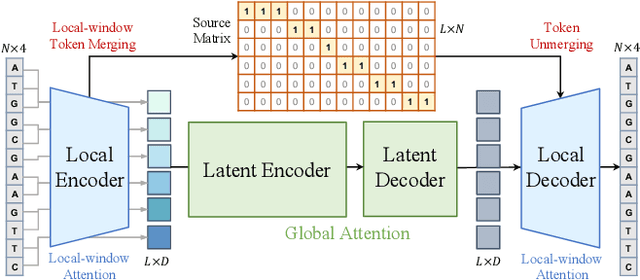

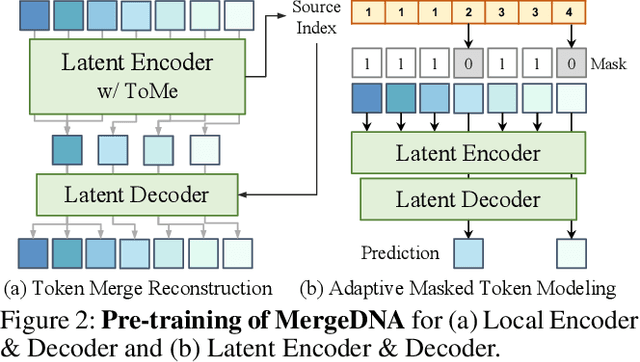
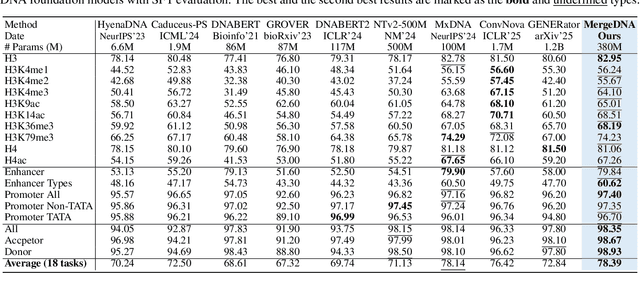
Modeling genomic sequences faces two unsolved challenges: the information density varies widely across different regions, while there is no clearly defined minimum vocabulary unit. Relying on either four primitive bases or independently designed DNA tokenizers, existing approaches with naive masked language modeling pre-training often fail to adapt to the varying complexities of genomic sequences. Leveraging Token Merging techniques, this paper introduces a hierarchical architecture that jointly optimizes a dynamic genomic tokenizer and latent Transformers with context-aware pre-training tasks. As for network structures, the tokenization module automatically chunks adjacent bases into words by stacking multiple layers of the differentiable token merging blocks with local-window constraints, then a Latent Encoder captures the global context of these merged words by full-attention blocks. Symmetrically employing a Latent Decoder and a Local Decoder, MergeDNA learns with two pre-training tasks: Merged Token Reconstruction simultaneously trains the dynamic tokenization module and adaptively filters important tokens, while Adaptive Masked Token Modeling learns to predict these filtered tokens to capture informative contents. Extensive experiments show that MergeDNA achieves superior performance on three popular DNA benchmarks and several multi-omics tasks with fine-tuning or zero-shot evaluation, outperforming typical tokenization methods and large-scale DNA foundation models.
Fine-Tuning Diffusion Generative Models via Rich Preference Optimization
Mar 13, 2025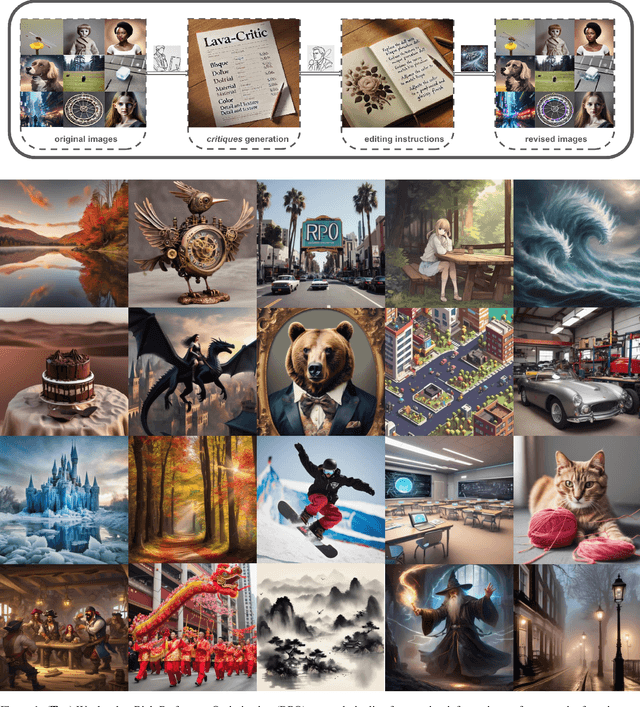
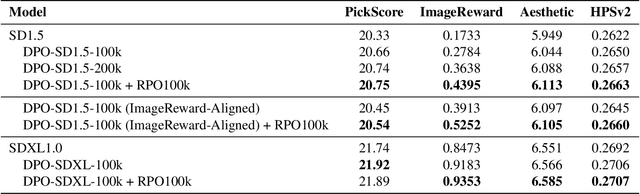
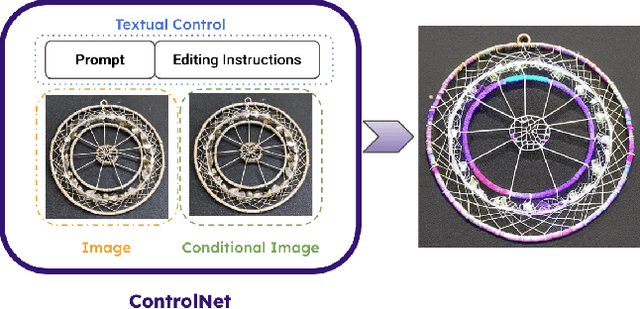
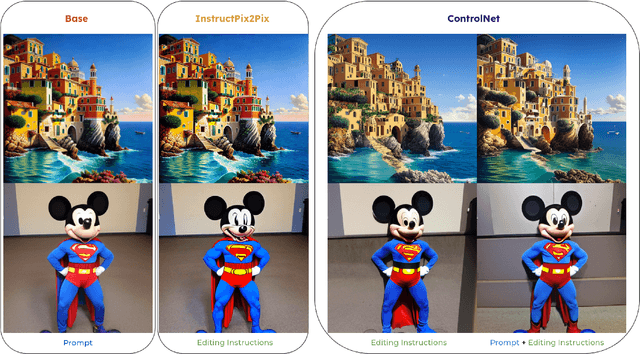
We introduce Rich Preference Optimization (RPO), a novel pipeline that leverages rich feedback signals to improve the curation of preference pairs for fine-tuning text-to-image diffusion models. Traditional methods, like Diffusion-DPO, often rely solely on reward model labeling, which can be opaque, offer limited insights into the rationale behind preferences, and are prone to issues such as reward hacking or overfitting. In contrast, our approach begins with generating detailed critiques of synthesized images to extract reliable and actionable image editing instructions. By implementing these instructions, we create refined images, resulting in synthetic, informative preference pairs that serve as enhanced tuning datasets. We demonstrate the effectiveness of our pipeline and the resulting datasets in fine-tuning state-of-the-art diffusion models.
Life-Code: Central Dogma Modeling with Multi-Omics Sequence Unification
Feb 11, 2025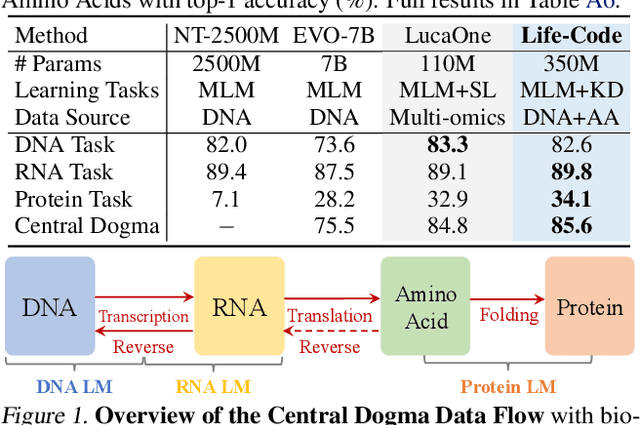
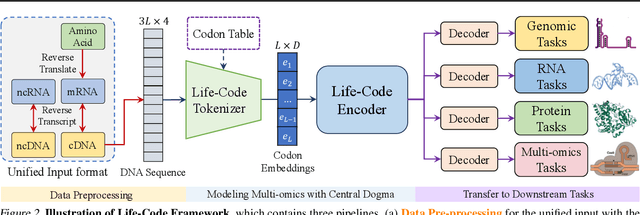

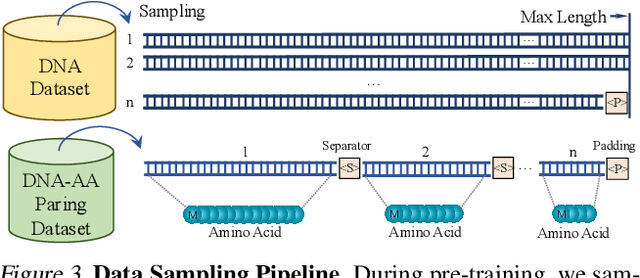
The interactions between DNA, RNA, and proteins are fundamental to biological processes, as illustrated by the central dogma of molecular biology. While modern biological pre-trained models have achieved great success in analyzing these macromolecules individually, their interconnected nature remains under-explored. In this paper, we follow the guidance of the central dogma to redesign both the data and model pipeline and offer a comprehensive framework, Life-Code, that spans different biological functions. As for data flow, we propose a unified pipeline to integrate multi-omics data by reverse-transcribing RNA and reverse-translating amino acids into nucleotide-based sequences. As for the model, we design a codon tokenizer and a hybrid long-sequence architecture to encode the interactions of both coding and non-coding regions with masked modeling pre-training. To model the translation and folding process with coding sequences, Life-Code learns protein structures of the corresponding amino acids by knowledge distillation from off-the-shelf protein language models. Such designs enable Life-Code to capture complex interactions within genetic sequences, providing a more comprehensive understanding of multi-omics with the central dogma. Extensive Experiments show that Life-Code achieves state-of-the-art performance on various tasks across three omics, highlighting its potential for advancing multi-omics analysis and interpretation.