 Add to Chrome
 Add to Firefox
 Add to Edge
CACR:Reinforcing Temporal Answer Grounding in Instructional Video via Candidate-Aware Causal Reasoning
Jun 11, 2026
The task of temporal answer grounding in instructional video (TAGV), which aims to locate precise video segments that respond to natural language queries, is increasingly important for direct video answer retrieval. This task remains challenging due to the need to comprehend semantically complex questions and to address the significant length mismatch between untrimmed videos and short target moments. Existing methods often suffer from sensitivity to irrelevant content or insufficient visual reasoning capabilities. To tackle these limitations, we propose a Candidate-Aware Causal Reasoning (CACR) framework. Our approach first employs a Visual-Language Pre-training based Candidate Selection (VBCS) algorithm to efficiently generate K candidate segments, then applies a temporal logic reasoning module enhanced by a rejection reward mechanism and optimized via Group Relative Policy Optimization (GRPO) for robust inference. Extensive experiments on six benchmarks demonstrate that our method achieves state-of-the-art performance in terms of mean Intersection-over-Union (mIoU), providing a new perspective for reasoning-based retrieval in long videos.

Reinforcing Temporal Answer Grounding in Instructional Video via Candidate-Aware Causal Reasoning
Jun 07, 2026The task of temporal answer grounding in instructional video (TAGV), which aims to locate precise video segments that respond to natural language queries, is increasingly important for direct video answer retrieval. This task remains challenging due to the need to comprehend semantically complex questions and to address the significant length mismatch between untrimmed videos and short target moments. Existing methods often suffer from sensitivity to irrelevant content or insufficient visual reasoning capabilities. To tackle these limitations, we propose a Candidate-Aware Causal Reasoning (CACR) framework. Our approach first employs a Visual-Language Pre-training based Candidate Selection (VBCS) algorithm to efficiently generate K candidate segments, then applies a temporal logic reasoning module enhanced by a rejection reward mechanism and optimized via Group Relative Policy Optimization (GRPO) for robust inference. Extensive experiments on six benchmarks demonstrate that our method achieves state-of-the-art performance in terms of mean Intersection-over-Union (mIoU), providing a new perspective for reasoning-based retrieval in long videos.
NeuroSymb-MRG: Differentiable Abductive Reasoning with Active Uncertainty Minimization for Radiology Report Generation
Mar 02, 2026Automatic generation of radiology reports seeks to reduce clinician workload while improving documentation consistency. Existing methods that adopt encoder-decoder or retrieval-augmented pipelines achieve progress in fluency but remain vulnerable to visual-linguistic biases, factual inconsistency, and lack of explicit multi-hop clinical reasoning. We present NeuroSymb-MRG, a unified framework that integrates NeuroSymbolic abductive reasoning with active uncertainty minimization to produce structured, clinically grounded reports. The system maps image features to probabilistic clinical concepts, composes differentiable logic-based reasoning chains, decodes those chains into templated clauses, and refines the textual output via retrieval and constrained language-model editing. An active sampling loop driven by rule-level uncertainty and diversity guides clinician-in-the-loop adjudication and promptbook refinement. Experiments on standard benchmarks demonstrate consistent improvements in factual consistency and standard language metrics compared to representative baselines.
AdvSynGNN: Structure-Adaptive Graph Neural Nets via Adversarial Synthesis and Self-Corrective Propagation
Feb 19, 2026Graph neural networks frequently encounter significant performance degradation when confronted with structural noise or non-homophilous topologies. To address these systemic vulnerabilities, we present AdvSynGNN, a comprehensive architecture designed for resilient node-level representation learning. The proposed framework orchestrates multi-resolution structural synthesis alongside contrastive objectives to establish geometry-sensitive initializations. We develop a transformer backbone that adaptively accommodates heterophily by modulating attention mechanisms through learned topological signals. Central to our contribution is an integrated adversarial propagation engine, where a generative component identifies potential connectivity alterations while a discriminator enforces global coherence. Furthermore, label refinement is achieved through a residual correction scheme guided by per-node confidence metrics, which facilitates precise control over iterative stability. Empirical evaluations demonstrate that this synergistic approach effectively optimizes predictive accuracy across diverse graph distributions while maintaining computational efficiency. The study concludes with practical implementation protocols to ensure the robust deployment of the AdvSynGNN system in large-scale environments.
ModalImmune: Immunity Driven Unlearning via Self Destructive Training
Feb 18, 2026Multimodal systems are vulnerable to partial or complete loss of input channels at deployment, which undermines reliability in real-world settings. This paper presents ModalImmune, a training framework that enforces modality immunity by intentionally and controllably collapsing selected modality information during training so the model learns joint representations that are robust to destructive modality influence. The framework combines a spectrum-adaptive collapse regularizer, an information-gain guided controller for targeted interventions, curvature-aware gradient masking to stabilize destructive updates, and a certified Neumann-truncated hyper-gradient procedure for automatic meta-parameter adaptation. Empirical evaluation on standard multimodal benchmarks demonstrates that ModalImmune improves resilience to modality removal and corruption while retaining convergence stability and reconstruction capacity.
GaiaFlow: Semantic-Guided Diffusion Tuning for Carbon-Frugal Search
Feb 17, 2026As the burgeoning power requirements of sophisticated neural architectures escalate, the information retrieval community has recognized ecological sustainability as a pivotal priority that necessitates a fundamental paradigm shift in model design. While contemporary neural rankers have attained unprecedented accuracy, the substantial environmental externalities associated with their computational intensity often remain overlooked in large-scale deployments. We present GaiaFlow, an innovative framework engineered to facilitate carbon-frugal search by operationalizing semantic-guided diffusion tuning. Our methodology orchestrates the convergence of retrieval-guided Langevin dynamics and a hardware-independent performance modeling strategy to optimize the trade-off between search precision and environmental preservation. By incorporating adaptive early exit protocols and precision-aware quantized inference, the proposed architecture significantly mitigates operational carbon footprints while maintaining robust retrieval quality across heterogeneous computing infrastructures. Extensive experimental evaluations demonstrate that GaiaFlow achieves a superior equilibrium between effectiveness and energy efficiency, offering a scalable and sustainable pathway for next-generation neural search systems.
SwiftRepertoire: Few-Shot Immune-Signature Synthesis via Dynamic Kernel Codes
Feb 01, 2026Repertoire-level analysis of T cell receptors offers a biologically grounded signal for disease detection and immune monitoring, yet practical deployment is impeded by label sparsity, cohort heterogeneity, and the computational burden of adapting large encoders to new tasks. We introduce a framework that synthesizes compact task-specific parameterizations from a learned dictionary of prototypes conditioned on lightweight task descriptors derived from repertoire probes and pooled embedding statistics. This synthesis produces small adapter modules applied to a frozen pretrained backbone, enabling immediate adaptation to novel tasks with only a handful of support examples and without full model fine-tuning. The architecture preserves interpretability through motif-aware probes and a calibrated motif discovery pipeline that links predictive decisions to sequence-level signals. Together, these components yield a practical, sample-efficient, and interpretable pathway for translating repertoire-informed models into diverse clinical and research settings where labeled data are scarce and computational resources are constrained.
Towards Harmonized Uncertainty Estimation for Large Language Models
May 25, 2025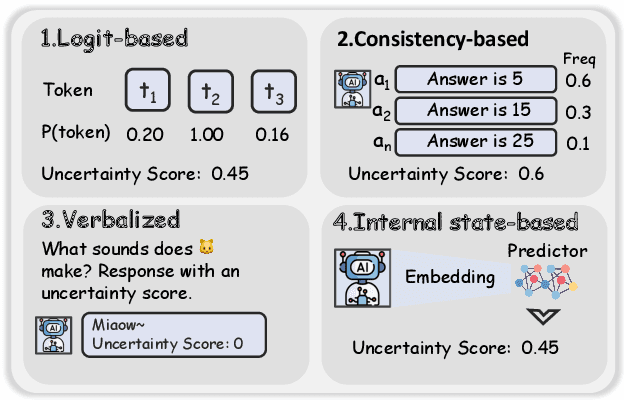
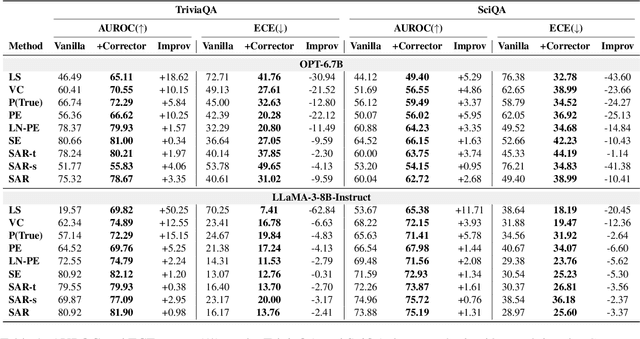

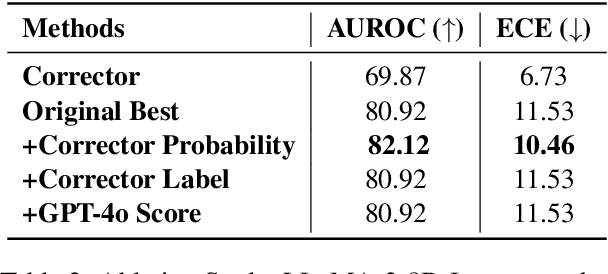
To facilitate robust and trustworthy deployment of large language models (LLMs), it is essential to quantify the reliability of their generations through uncertainty estimation. While recent efforts have made significant advancements by leveraging the internal logic and linguistic features of LLMs to estimate uncertainty scores, our empirical analysis highlights the pitfalls of these methods to strike a harmonized estimation between indication, balance, and calibration, which hinders their broader capability for accurate uncertainty estimation. To address this challenge, we propose CUE (Corrector for Uncertainty Estimation): A straightforward yet effective method that employs a lightweight model trained on data aligned with the target LLM's performance to adjust uncertainty scores. Comprehensive experiments across diverse models and tasks demonstrate its effectiveness, which achieves consistent improvements of up to 60% over existing methods.