 Add to Chrome
 Add to Firefox
 Add to Edge
Self-Consistency Training for Hamiltonian Prediction
Mar 14, 2024
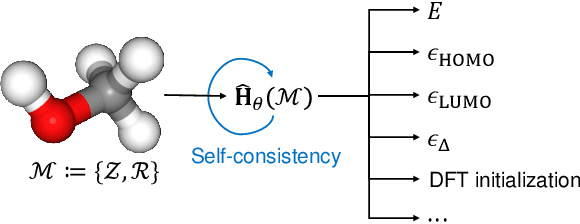
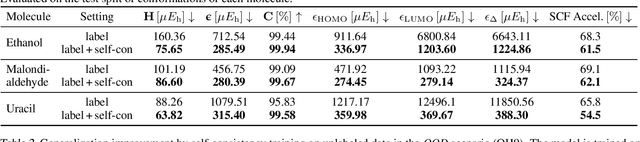
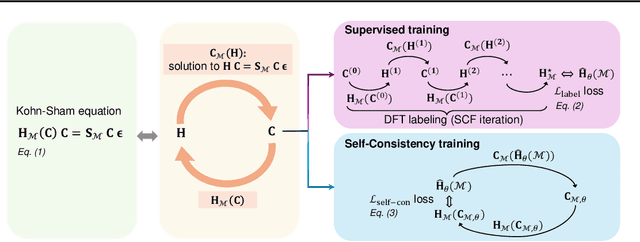

Hamiltonian prediction is a versatile formulation to leverage machine learning for solving molecular science problems. Yet, its applicability is limited by insufficient labeled data for training. In this work, we highlight that Hamiltonian prediction possesses a self-consistency principle, based on which we propose an exact training method that does not require labeled data. This merit addresses the data scarcity difficulty, and distinguishes the task from other property prediction formulations with unique benefits: (1) self-consistency training enables the model to be trained on a large amount of unlabeled data, hence substantially enhances generalization; (2) self-consistency training is more efficient than labeling data with DFT for supervised training, since it is an amortization of DFT calculation over a set of molecular structures. We empirically demonstrate the better generalization in data-scarce and out-of-distribution scenarios, and the better efficiency from the amortization. These benefits push forward the applicability of Hamiltonian prediction to an ever larger scale.

A Preliminary Exploration of YouTubers' Use of Generative-AI in Content Creation
Mar 09, 2024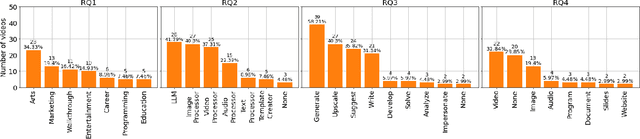
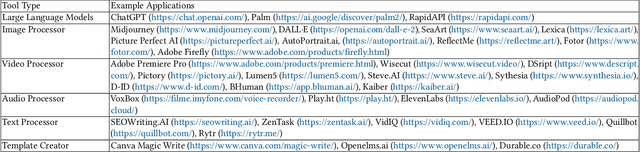
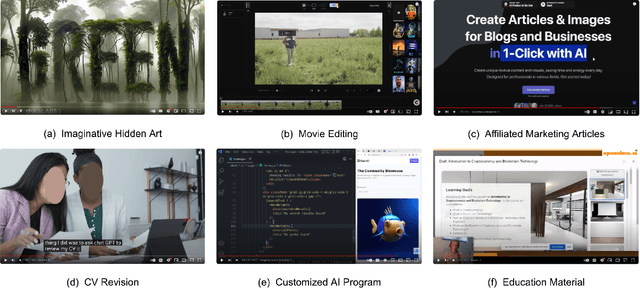
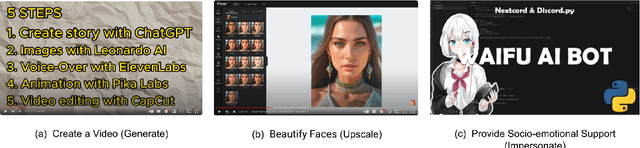
Content creators increasingly utilize generative artificial intelligence (Gen-AI) on platforms such as YouTube, TikTok, Instagram, and various blogging sites to produce imaginative images, AI-generated videos, and articles using Large Language Models (LLMs). Despite its growing popularity, there remains an underexplored area concerning the specific domains where AI-generated content is being applied, and the methodologies content creators employ with Gen-AI tools during the creation process. This study initially explores this emerging area through a qualitative analysis of 68 YouTube videos demonstrating Gen-AI usage. Our research focuses on identifying the content domains, the variety of tools used, the activities performed, and the nature of the final products generated by Gen-AI in the context of user-generated content.
Diffusion Model-Based Image Editing: A Survey
Feb 27, 2024


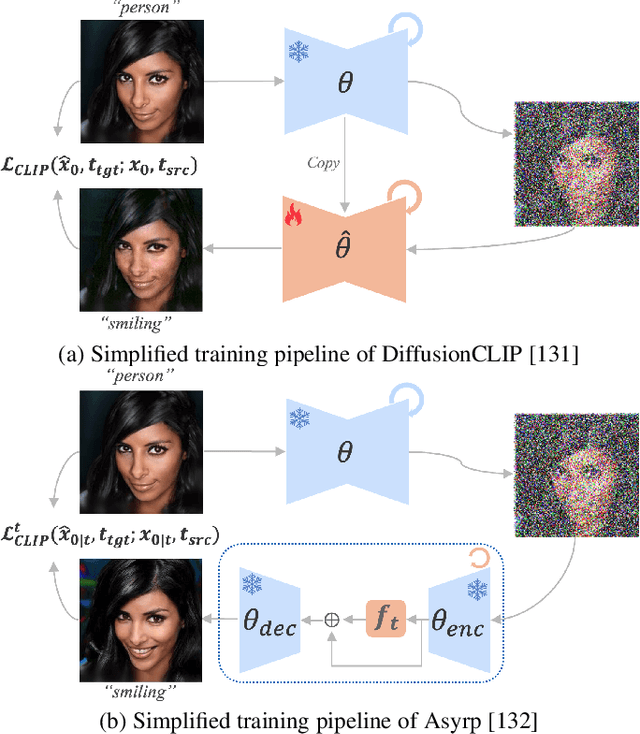
Denoising diffusion models have emerged as a powerful tool for various image generation and editing tasks, facilitating the synthesis of visual content in an unconditional or input-conditional manner. The core idea behind them is learning to reverse the process of gradually adding noise to images, allowing them to generate high-quality samples from a complex distribution. In this survey, we provide an exhaustive overview of existing methods using diffusion models for image editing, covering both theoretical and practical aspects in the field. We delve into a thorough analysis and categorization of these works from multiple perspectives, including learning strategies, user-input conditions, and the array of specific editing tasks that can be accomplished. In addition, we pay special attention to image inpainting and outpainting, and explore both earlier traditional context-driven and current multimodal conditional methods, offering a comprehensive analysis of their methodologies. To further evaluate the performance of text-guided image editing algorithms, we propose a systematic benchmark, EditEval, featuring an innovative metric, LMM Score. Finally, we address current limitations and envision some potential directions for future research. The accompanying repository is released at https://github.com/SiatMMLab/Awesome-Diffusion-Model-Based-Image-Editing-Methods.
Learning Highly Dynamic Behaviors for Quadrupedal Robots
Feb 21, 2024Learning highly dynamic behaviors for robots has been a longstanding challenge. Traditional approaches have demonstrated robust locomotion, but the exhibited behaviors lack diversity and agility. They employ approximate models, which lead to compromises in performance. Data-driven approaches have been shown to reproduce agile behaviors of animals, but typically have not been able to learn highly dynamic behaviors. In this paper, we propose a learning-based approach to enable robots to learn highly dynamic behaviors from animal motion data. The learned controller is deployed on a quadrupedal robot and the results show that the controller is able to reproduce highly dynamic behaviors including sprinting, jumping and sharp turning. Various behaviors can be activated through human interaction using a stick with markers attached to it. Based on the motion pattern of the stick, the robot exhibits walking, running, sitting and jumping, much like the way humans interact with a pet.
VRMN-bD: A Multi-modal Natural Behavior Dataset of Immersive Human Fear Responses in VR Stand-up Interactive Games
Jan 22, 2024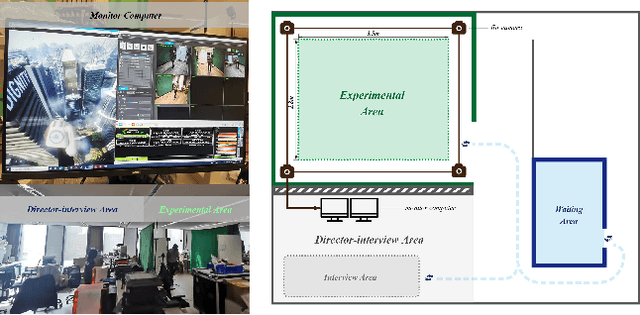
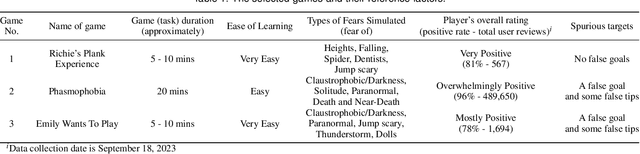


Understanding and recognizing emotions are important and challenging issues in the metaverse era. Understanding, identifying, and predicting fear, which is one of the fundamental human emotions, in virtual reality (VR) environments plays an essential role in immersive game development, scene development, and next-generation virtual human-computer interaction applications. In this article, we used VR horror games as a medium to analyze fear emotions by collecting multi-modal data (posture, audio, and physiological signals) from 23 players. We used an LSTM-based model to predict fear with accuracies of 65.31% and 90.47% under 6-level classification (no fear and five different levels of fear) and 2-level classification (no fear and fear), respectively. We constructed a multi-modal natural behavior dataset of immersive human fear responses (VRMN-bD) and compared it with existing relevant advanced datasets. The results show that our dataset has fewer limitations in terms of collection method, data scale and audience scope. We are unique and advanced in targeting multi-modal datasets of fear and behavior in VR stand-up interactive environments. Moreover, we discussed the implications of this work for communities and applications. The dataset and pre-trained model are available at https://github.com/KindOPSTAR/VRMN-bD.
GOODAT: Towards Test-time Graph Out-of-Distribution Detection
Jan 10, 2024Graph neural networks (GNNs) have found widespread application in modeling graph data across diverse domains. While GNNs excel in scenarios where the testing data shares the distribution of their training counterparts (in distribution, ID), they often exhibit incorrect predictions when confronted with samples from an unfamiliar distribution (out-of-distribution, OOD). To identify and reject OOD samples with GNNs, recent studies have explored graph OOD detection, often focusing on training a specific model or modifying the data on top of a well-trained GNN. Despite their effectiveness, these methods come with heavy training resources and costs, as they need to optimize the GNN-based models on training data. Moreover, their reliance on modifying the original GNNs and accessing training data further restricts their universality. To this end, this paper introduces a method to detect Graph Out-of-Distribution At Test-time (namely GOODAT), a data-centric, unsupervised, and plug-and-play solution that operates independently of training data and modifications of GNN architecture. With a lightweight graph masker, GOODAT can learn informative subgraphs from test samples, enabling the capture of distinct graph patterns between OOD and ID samples. To optimize the graph masker, we meticulously design three unsupervised objective functions based on the graph information bottleneck principle, motivating the masker to capture compact yet informative subgraphs for OOD detection. Comprehensive evaluations confirm that our GOODAT method outperforms state-of-the-art benchmarks across a variety of real-world datasets. The code is available at Github: https://github.com/Ee1s/GOODAT
GraphGuard: Detecting and Counteracting Training Data Misuse in Graph Neural Networks
Dec 13, 2023The emergence of Graph Neural Networks (GNNs) in graph data analysis and their deployment on Machine Learning as a Service platforms have raised critical concerns about data misuse during model training. This situation is further exacerbated due to the lack of transparency in local training processes, potentially leading to the unauthorized accumulation of large volumes of graph data, thereby infringing on the intellectual property rights of data owners. Existing methodologies often address either data misuse detection or mitigation, and are primarily designed for local GNN models rather than cloud-based MLaaS platforms. These limitations call for an effective and comprehensive solution that detects and mitigates data misuse without requiring exact training data while respecting the proprietary nature of such data. This paper introduces a pioneering approach called GraphGuard, to tackle these challenges. We propose a training-data-free method that not only detects graph data misuse but also mitigates its impact via targeted unlearning, all without relying on the original training data. Our innovative misuse detection technique employs membership inference with radioactive data, enhancing the distinguishability between member and non-member data distributions. For mitigation, we utilize synthetic graphs that emulate the characteristics previously learned by the target model, enabling effective unlearning even in the absence of exact graph data. We conduct comprehensive experiments utilizing four real-world graph datasets to demonstrate the efficacy of GraphGuard in both detection and unlearning. We show that GraphGuard attains a near-perfect detection rate of approximately 100% across these datasets with various GNN models. In addition, it performs unlearning by eliminating the impact of the unlearned graph with a marginal decrease in accuracy (less than 5%).
Relightful Harmonization: Lighting-aware Portrait Background Replacement
Dec 11, 2023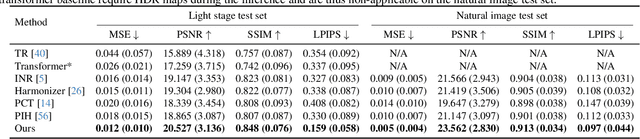
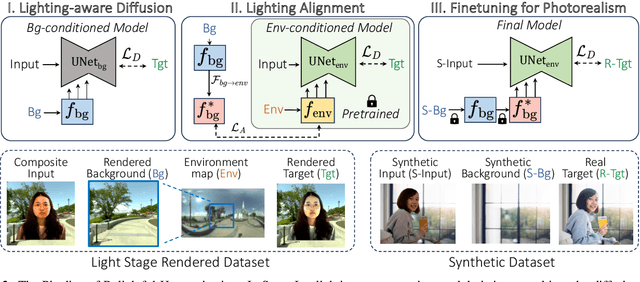

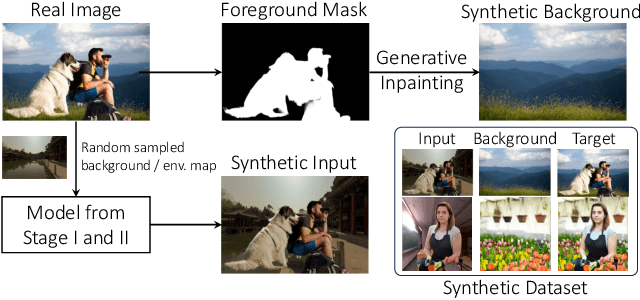
Portrait harmonization aims to composite a subject into a new background, adjusting its lighting and color to ensure harmony with the background scene. Existing harmonization techniques often only focus on adjusting the global color and brightness of the foreground and ignore crucial illumination cues from the background such as apparent lighting direction, leading to unrealistic compositions. We introduce Relightful Harmonization, a lighting-aware diffusion model designed to seamlessly harmonize sophisticated lighting effect for the foreground portrait using any background image. Our approach unfolds in three stages. First, we introduce a lighting representation module that allows our diffusion model to encode lighting information from target image background. Second, we introduce an alignment network that aligns lighting features learned from image background with lighting features learned from panorama environment maps, which is a complete representation for scene illumination. Last, to further boost the photorealism of the proposed method, we introduce a novel data simulation pipeline that generates synthetic training pairs from a diverse range of natural images, which are used to refine the model. Our method outperforms existing benchmarks in visual fidelity and lighting coherence, showing superior generalization in real-world testing scenarios, highlighting its versatility and practicality.
Perceptual Artifacts Localization for Image Synthesis Tasks
Oct 09, 2023

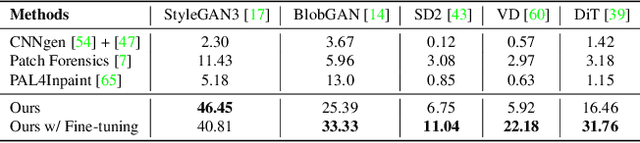
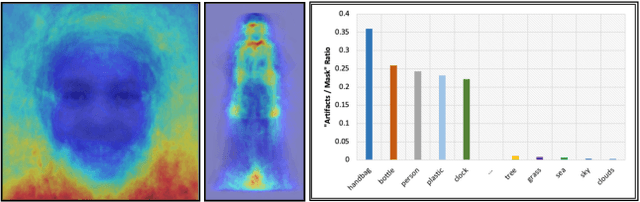
Recent advancements in deep generative models have facilitated the creation of photo-realistic images across various tasks. However, these generated images often exhibit perceptual artifacts in specific regions, necessitating manual correction. In this study, we present a comprehensive empirical examination of Perceptual Artifacts Localization (PAL) spanning diverse image synthesis endeavors. We introduce a novel dataset comprising 10,168 generated images, each annotated with per-pixel perceptual artifact labels across ten synthesis tasks. A segmentation model, trained on our proposed dataset, effectively localizes artifacts across a range of tasks. Additionally, we illustrate its proficiency in adapting to previously unseen models using minimal training samples. We further propose an innovative zoom-in inpainting pipeline that seamlessly rectifies perceptual artifacts in the generated images. Through our experimental analyses, we elucidate several practical downstream applications, such as automated artifact rectification, non-referential image quality evaluation, and abnormal region detection in images. The dataset and code are released.
M-OFDFT: Overcoming the Barrier of Orbital-Free Density Functional Theory for Molecular Systems Using Deep Learning
Sep 28, 2023Orbital-free density functional theory (OFDFT) is a quantum chemistry formulation that has a lower cost scaling than the prevailing Kohn-Sham DFT, which is increasingly desired for contemporary molecular research. However, its accuracy is limited by the kinetic energy density functional, which is notoriously hard to approximate for non-periodic molecular systems. In this work, we propose M-OFDFT, an OFDFT approach capable of solving molecular systems using a deep-learning functional model. We build the essential nonlocality into the model, which is made affordable by the concise density representation as expansion coefficients under an atomic basis. With techniques to address unconventional learning challenges therein, M-OFDFT achieves a comparable accuracy with Kohn-Sham DFT on a wide range of molecules untouched by OFDFT before. More attractively, M-OFDFT extrapolates well to molecules much larger than those in training, which unleashes the appealing scaling for studying large molecules including proteins, representing an advancement of the accuracy-efficiency trade-off frontier in quantum chemistry.