 Add to Chrome
 Add to Firefox
 Add to Edge
Wonder: Video World Model Done Better
Jul 28, 2026
We present Wonder, a general-purpose video world model for real-time, camera-controllable world exploration. Given an image or a conditional video, Wonder constructs a playable world where users can navigate interactively by moving the camera, discovering unseen regions, and revisiting previously observed areas in real time and over a long-term horizon. Achieving this capability requires a system-level co-design of control method, memory mechanism, and training strategy. We introduce a novel camera conditioning with a dense coordinate field whose renderings provide spatially aligned motion and orientation cues, allowing the model to interpret camera motion directly as visual evidence. To support fast and precise memory retrieval over a growing generation context, we propose an efficient sparse attention-based memory mechanism, enabling the model to selectively attend to a small set of relevant context tokens at inference time, regardless of actual context length. We further develop several techniques to rectify the self-forcing-style distillation pipeline, improving the student model's ability to respect control signals, as well as maintaining diverse generation modes and long-term memory from the teacher. Together, these components enable Wonder to synthesize diverse, minute-scale videos at 16 FPS while preserving coherent geometry, appearance, and dynamics across long rollouts. Beyond image-to-video generation, Wonder naturally supports video-conditioned generation, allowing existing dynamic scenes to be re-shot in real time.

MotiMotion: Motion-Controlled Video Generation with Visual Reasoning
May 21, 2026Current motion-controlled image-to-video generation models rigidly follow user-provided trajectories that are often sparse, imprecise, and causally incomplete. Such reliance often yields unnatural or implausible outcomes, especially by missing secondary causal consequences. To address this, we introduce MotiMotion, a novel framework that reformulates motion control as a reasoning-then-generation problem. To encourage causally grounded and commonsense-consistent interactions, we leverage a training-free vision-language reasoner to refine image-space coordinates of primary trajectories and to hallucinate plausible secondary motions. To further improve motion naturalness, we propose a confidence-aware control scheme that modulates guidance strength, enabling the model to closely follow high-confidence plans while correcting artifacts under low-confidence inputs with its internal generative priors. To support systematic evaluation, we curate a new image-to-video benchmark, MotiBench, consisting of interaction-centric scenes where new events are triggered by motion. Both VLM-based evaluation and a human study on MotiBench demonstrate that MotiMotion produces videos with more plausible object behaviors and interaction, and is preferred over existing approaches.
TokenLight: Precise Lighting Control in Images using Attribute Tokens
Apr 16, 2026This paper presents a method for image relighting that enables precise and continuous control over multiple illumination attributes in a photograph. We formulate relighting as a conditional image generation task and introduce attribute tokens to encode distinct lighting factors such as intensity, color, ambient illumination, diffuse level, and 3D light positions. The model is trained on a large-scale synthetic dataset with ground-truth lighting annotations, supplemented by a small set of real captures to enhance realism and generalization. We validate our approach across a variety of relighting tasks, including controlling in-scene lighting fixtures and editing environment illumination using virtual light sources, on synthetic and real images. Our method achieves state-of-the-art quantitative and qualitative performance compared to prior work. Remarkably, without explicit inverse rendering supervision, the model exhibits an inherent understanding of how light interacts with scene geometry, occlusion, and materials, yielding convincing lighting effects even in traditionally challenging scenarios such as placing lights within objects or relighting transparent materials plausibly. Project page: vrroom.github.io/tokenlight/
LightMover: Generative Light Movement with Color and Intensity Controls
Mar 28, 2026We present LightMover, a framework for controllable light manipulation in single images that leverages video diffusion priors to produce physically plausible illumination changes without re-rendering the scene. We formulate light editing as a sequence-to-sequence prediction problem in visual token space: given an image and light-control tokens, the model adjusts light position, color, and intensity together with resulting reflections, shadows, and falloff from a single view. This unified treatment of spatial (movement) and appearance (color, intensity) controls improves both manipulation and illumination understanding. We further introduce an adaptive token-pruning mechanism that preserves spatially informative tokens while compactly encoding non-spatial attributes, reducing control sequence length by 41% while maintaining editing fidelity. To train our framework, we construct a scalable rendering pipeline that generates large numbers of image pairs across varied light positions, colors, and intensities while keeping the scene content consistent with the original image. LightMover enables precise, independent control over light position, color, and intensity, and achieves high PSNR and strong semantic consistency (DINO, CLIP) across different tasks.
FaceCam: Portrait Video Camera Control via Scale-Aware Conditioning
Mar 05, 2026We introduce FaceCam, a system that generates video under customizable camera trajectories for monocular human portrait video input. Recent camera control approaches based on large video-generation models have shown promising progress but often exhibit geometric distortions and visual artifacts on portrait videos due to scale-ambiguous camera representations or 3D reconstruction errors. To overcome these limitations, we propose a face-tailored scale-aware representation for camera transformations that provides deterministic conditioning without relying on 3D priors. We train a video generation model on both multi-view studio captures and in-the-wild monocular videos, and introduce two camera-control data generation strategies: synthetic camera motion and multi-shot stitching, to exploit stationary training cameras while generalizing to dynamic, continuous camera trajectories at inference time. Experiments on Ava-256 dataset and diverse in-the-wild videos demonstrate that FaceCam achieves superior performance in camera controllability, visual quality, identity and motion preservation.
GaSLight: Gaussian Splats for Spatially-Varying Lighting in HDR
Apr 15, 2025We present GaSLight, a method that generates spatially-varying lighting from regular images. Our method proposes using HDR Gaussian Splats as light source representation, marking the first time regular images can serve as light sources in a 3D renderer. Our two-stage process first enhances the dynamic range of images plausibly and accurately by leveraging the priors embedded in diffusion models. Next, we employ Gaussian Splats to model 3D lighting, achieving spatially variant lighting. Our approach yields state-of-the-art results on HDR estimations and their applications in illuminating virtual objects and scenes. To facilitate the benchmarking of images as light sources, we introduce a novel dataset of calibrated and unsaturated HDR to evaluate images as light sources. We assess our method using a combination of this novel dataset and an existing dataset from the literature. The code to reproduce our method will be available upon acceptance.
SynthLight: Portrait Relighting with Diffusion Model by Learning to Re-render Synthetic Faces
Jan 16, 2025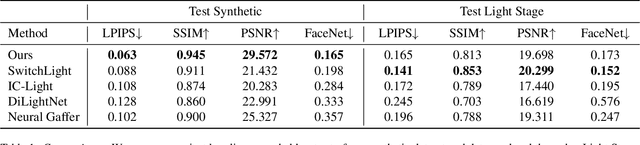
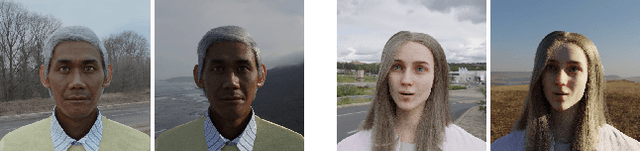
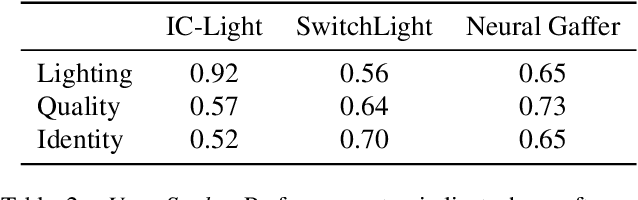
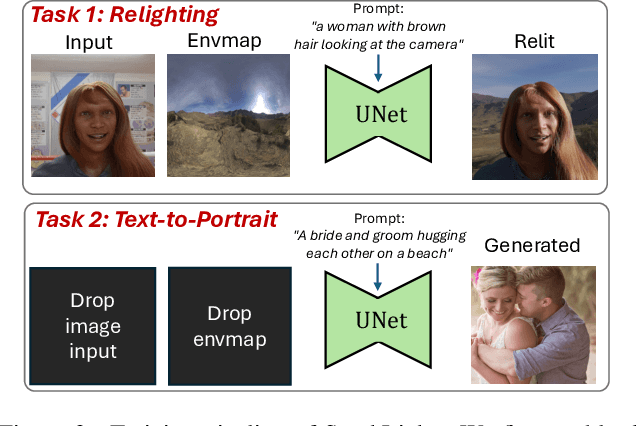
We introduce SynthLight, a diffusion model for portrait relighting. Our approach frames image relighting as a re-rendering problem, where pixels are transformed in response to changes in environmental lighting conditions. Using a physically-based rendering engine, we synthesize a dataset to simulate this lighting-conditioned transformation with 3D head assets under varying lighting. We propose two training and inference strategies to bridge the gap between the synthetic and real image domains: (1) multi-task training that takes advantage of real human portraits without lighting labels; (2) an inference time diffusion sampling procedure based on classifier-free guidance that leverages the input portrait to better preserve details. Our method generalizes to diverse real photographs and produces realistic illumination effects, including specular highlights and cast shadows, while preserving the subject's identity. Our quantitative experiments on Light Stage data demonstrate results comparable to state-of-the-art relighting methods. Our qualitative results on in-the-wild images showcase rich and unprecedented illumination effects. Project Page: \url{https://vrroom.github.io/synthlight/}
FaceLift: Single Image to 3D Head with View Generation and GS-LRM
Dec 23, 2024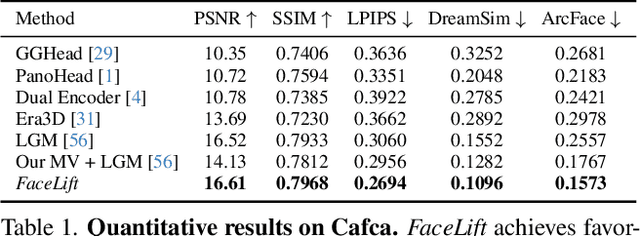
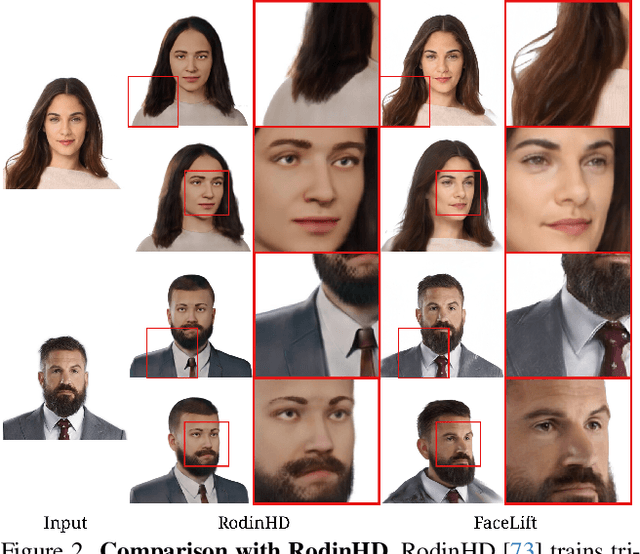
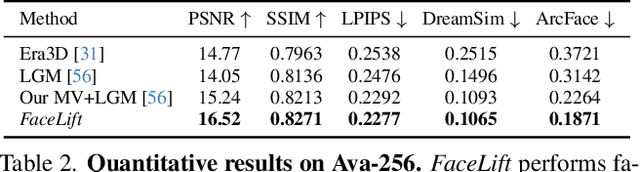
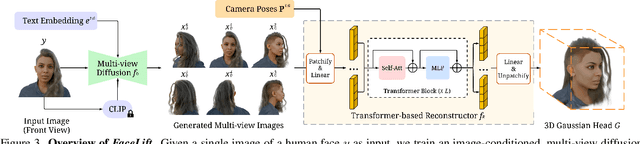
We present FaceLift, a feed-forward approach for rapid, high-quality, 360-degree head reconstruction from a single image. Our pipeline begins by employing a multi-view latent diffusion model that generates consistent side and back views of the head from a single facial input. These generated views then serve as input to a GS-LRM reconstructor, which produces a comprehensive 3D representation using Gaussian splats. To train our system, we develop a dataset of multi-view renderings using synthetic 3D human head as-sets. The diffusion-based multi-view generator is trained exclusively on synthetic head images, while the GS-LRM reconstructor undergoes initial training on Objaverse followed by fine-tuning on synthetic head data. FaceLift excels at preserving identity and maintaining view consistency across views. Despite being trained solely on synthetic data, FaceLift demonstrates remarkable generalization to real-world images. Through extensive qualitative and quantitative evaluations, we show that FaceLift outperforms state-of-the-art methods in 3D head reconstruction, highlighting its practical applicability and robust performance on real-world images. In addition to single image reconstruction, FaceLift supports video inputs for 4D novel view synthesis and seamlessly integrates with 2D reanimation techniques to enable 3D facial animation. Project page: https://weijielyu.github.io/FaceLift.
Free-viewpoint Human Animation with Pose-correlated Reference Selection
Dec 23, 2024
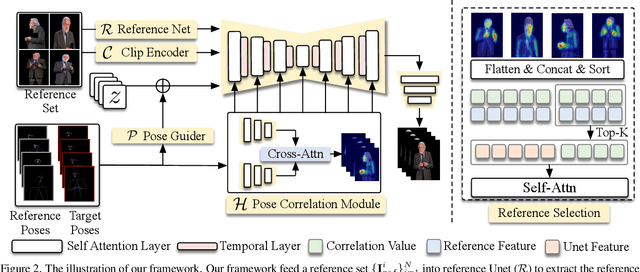
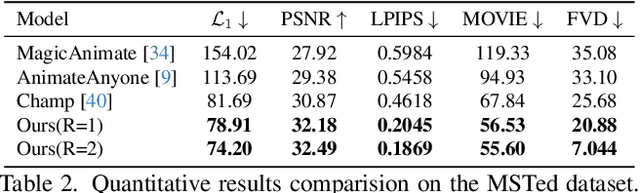
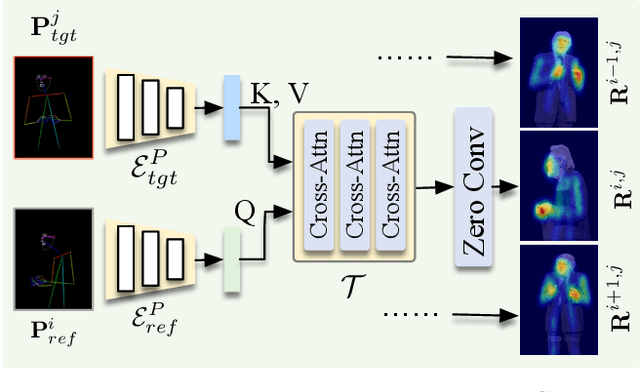
Diffusion-based human animation aims to animate a human character based on a source human image as well as driving signals such as a sequence of poses. Leveraging the generative capacity of diffusion model, existing approaches are able to generate high-fidelity poses, but struggle with significant viewpoint changes, especially in zoom-in/zoom-out scenarios where camera-character distance varies. This limits the applications such as cinematic shot type plan or camera control. We propose a pose-correlated reference selection diffusion network, supporting substantial viewpoint variations in human animation. Our key idea is to enable the network to utilize multiple reference images as input, since significant viewpoint changes often lead to missing appearance details on the human body. To eliminate the computational cost, we first introduce a novel pose correlation module to compute similarities between non-aligned target and source poses, and then propose an adaptive reference selection strategy, utilizing the attention map to identify key regions for animation generation. To train our model, we curated a large dataset from public TED talks featuring varied shots of the same character, helping the model learn synthesis for different perspectives. Our experimental results show that with the same number of reference images, our model performs favorably compared to the current SOTA methods under large viewpoint change. We further show that the adaptive reference selection is able to choose the most relevant reference regions to generate humans under free viewpoints.
MegaSynth: Scaling Up 3D Scene Reconstruction with Synthesized Data
Dec 18, 2024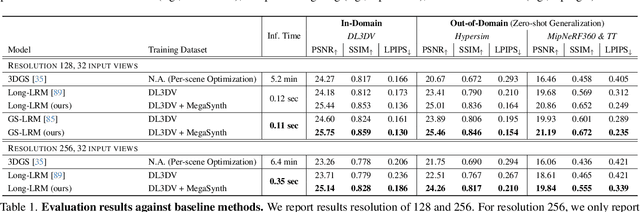
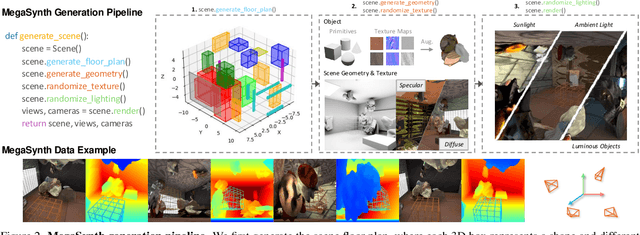
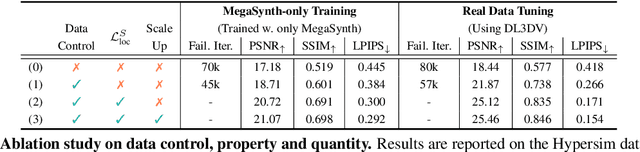
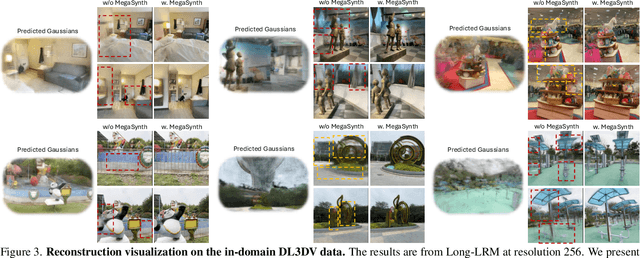
We propose scaling up 3D scene reconstruction by training with synthesized data. At the core of our work is MegaSynth, a procedurally generated 3D dataset comprising 700K scenes - over 50 times larger than the prior real dataset DL3DV - dramatically scaling the training data. To enable scalable data generation, our key idea is eliminating semantic information, removing the need to model complex semantic priors such as object affordances and scene composition. Instead, we model scenes with basic spatial structures and geometry primitives, offering scalability. Besides, we control data complexity to facilitate training while loosely aligning it with real-world data distribution to benefit real-world generalization. We explore training LRMs with both MegaSynth and available real data. Experiment results show that joint training or pre-training with MegaSynth improves reconstruction quality by 1.2 to 1.8 dB PSNR across diverse image domains. Moreover, models trained solely on MegaSynth perform comparably to those trained on real data, underscoring the low-level nature of 3D reconstruction. Additionally, we provide an in-depth analysis of MegaSynth's properties for enhancing model capability, training stability, and generalization.