 Add to Chrome
 Add to Firefox
 Add to Edge
Improving Complex Reasoning over Knowledge Graph with Logic-Aware Curriculum Tuning
May 07, 2024
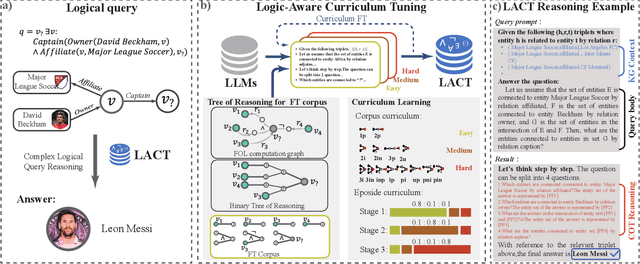
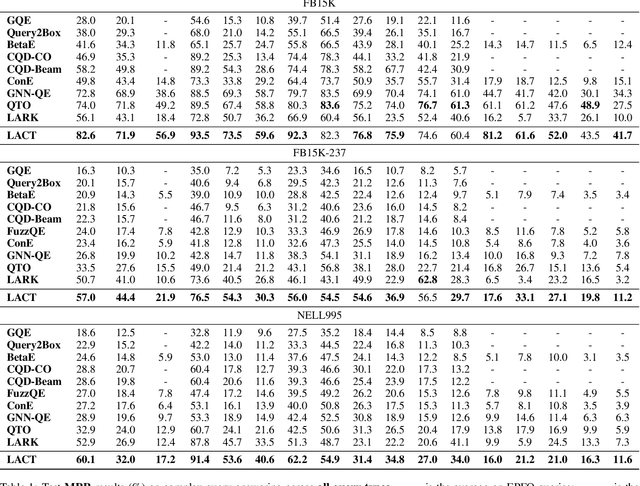
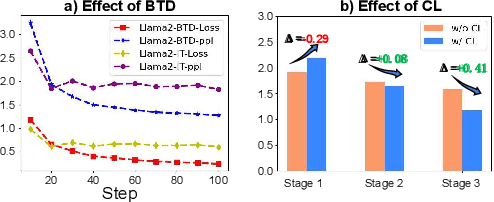
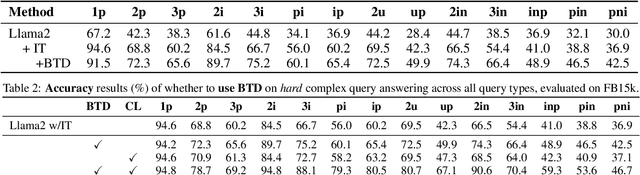
Answering complex logical queries over incomplete knowledge graphs (KGs) is challenging. Most previous works have focused on learning entity/relation embeddings and simulating first-order logic operators with various neural networks. However, they are bottlenecked by the inability to share world knowledge to improve logical reasoning, thus resulting in suboptimal performance. In this paper, we propose a complex logical reasoning schema over knowledge graphs upon large language models (LLMs), containing a curriculum-based logical-aware instruction tuning framework, named LACT. Specifically, we augment the arbitrary first-order logical queries via binary tree decomposition, to stimulate the reasoning capability of LLMs. To address the difficulty gap among different types of complex queries, we design a simple and flexible logic-aware curriculum learning framework. Experiments across widely used datasets demonstrate that LACT has substantial improvements~(brings an average +5.5% MRR score) over advanced methods, achieving the new state-of-the-art. Our code and model will be released at GitHub and huggingface soon.

FREE: Faster and Better Data-Free Meta-Learning
May 02, 2024Data-Free Meta-Learning (DFML) aims to extract knowledge from a collection of pre-trained models without requiring the original data, presenting practical benefits in contexts constrained by data privacy concerns. Current DFML methods primarily focus on the data recovery from these pre-trained models. However, they suffer from slow recovery speed and overlook gaps inherent in heterogeneous pre-trained models. In response to these challenges, we introduce the Faster and Better Data-Free Meta-Learning (FREE) framework, which contains: (i) a meta-generator for rapidly recovering training tasks from pre-trained models; and (ii) a meta-learner for generalizing to new unseen tasks. Specifically, within the module Faster Inversion via Meta-Generator, each pre-trained model is perceived as a distinct task. The meta-generator can rapidly adapt to a specific task in just five steps, significantly accelerating the data recovery. Furthermore, we propose Better Generalization via Meta-Learner and introduce an implicit gradient alignment algorithm to optimize the meta-learner. This is achieved as aligned gradient directions alleviate potential conflicts among tasks from heterogeneous pre-trained models. Empirical experiments on multiple benchmarks affirm the superiority of our approach, marking a notable speed-up (20$\times$) and performance enhancement (1.42\% $\sim$ 4.78\%) in comparison to the state-of-the-art.
3AM: An Ambiguity-Aware Multi-Modal Machine Translation Dataset
Apr 29, 2024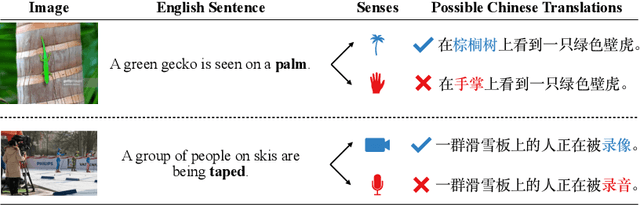
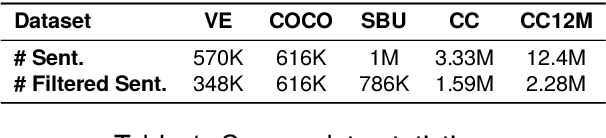
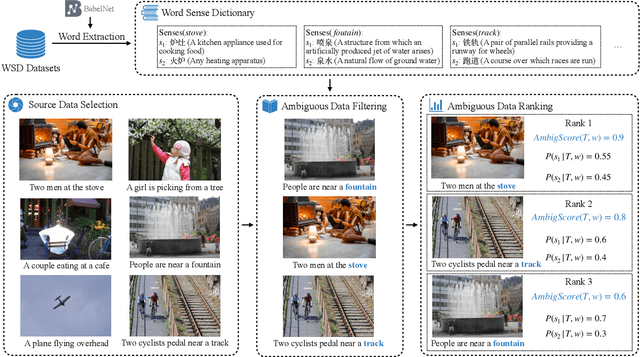

Multimodal machine translation (MMT) is a challenging task that seeks to improve translation quality by incorporating visual information. However, recent studies have indicated that the visual information provided by existing MMT datasets is insufficient, causing models to disregard it and overestimate their capabilities. This issue presents a significant obstacle to the development of MMT research. This paper presents a novel solution to this issue by introducing 3AM, an ambiguity-aware MMT dataset comprising 26,000 parallel sentence pairs in English and Chinese, each with corresponding images. Our dataset is specifically designed to include more ambiguity and a greater variety of both captions and images than other MMT datasets. We utilize a word sense disambiguation model to select ambiguous data from vision-and-language datasets, resulting in a more challenging dataset. We further benchmark several state-of-the-art MMT models on our proposed dataset. Experimental results show that MMT models trained on our dataset exhibit a greater ability to exploit visual information than those trained on other MMT datasets. Our work provides a valuable resource for researchers in the field of multimodal learning and encourages further exploration in this area. The data, code and scripts are freely available at https://github.com/MaxyLee/3AM.
Achieving >97% on GSM8K: Deeply Understanding the Problems Makes LLMs Better Reasoners
Apr 28, 2024
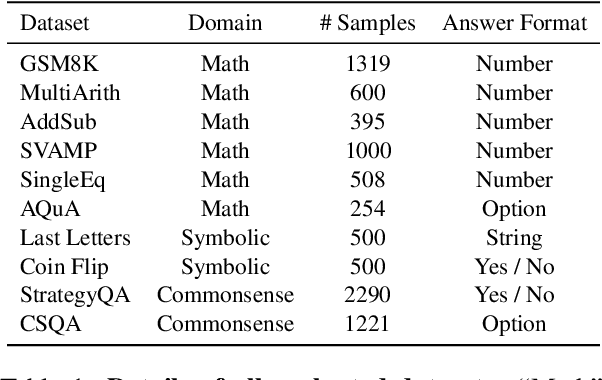

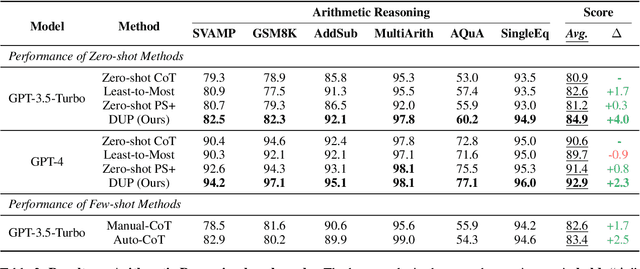
Chain of Thought prompting strategy has enhanced the performance of Large Language Models (LLMs) across various NLP tasks. However, it still has shortcomings when dealing with complex reasoning tasks, including understanding errors, calculation errors and process errors (e.g., missing-step and hallucinations). Subsequently, our in-depth analyses among various error types show that deeply understanding the whole problem is critical in addressing complicated reasoning tasks. Motivated by this, we propose a simple-yet-effective method, namely Deeply Understanding the Problems (DUP), to enhance the LLMs' reasoning abilities. The core of our method is to encourage the LLMs to deeply understand the problems and leverage the key problem-solving information for better reasoning. Extensive experiments on 10 diverse reasoning benchmarks show that our DUP method consistently outperforms the other counterparts by a large margin. More encouragingly, DUP achieves a new SOTA result on the GSM8K benchmark, with an accuracy of 97.1% in a zero-shot setting.
A Survey on Self-Evolution of Large Language Models
Apr 22, 2024

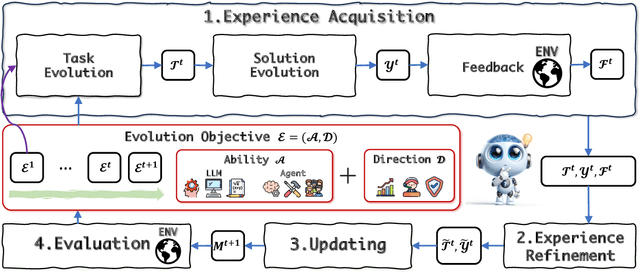

Large language models (LLMs) have significantly advanced in various fields and intelligent agent applications. However, current LLMs that learn from human or external model supervision are costly and may face performance ceilings as task complexity and diversity increase. To address this issue, self-evolution approaches that enable LLM to autonomously acquire, refine, and learn from experiences generated by the model itself are rapidly growing. This new training paradigm inspired by the human experiential learning process offers the potential to scale LLMs towards superintelligence. In this work, we present a comprehensive survey of self-evolution approaches in LLMs. We first propose a conceptual framework for self-evolution and outline the evolving process as iterative cycles composed of four phases: experience acquisition, experience refinement, updating, and evaluation. Second, we categorize the evolution objectives of LLMs and LLM-based agents; then, we summarize the literature and provide taxonomy and insights for each module. Lastly, we pinpoint existing challenges and propose future directions to improve self-evolution frameworks, equipping researchers with critical insights to fast-track the development of self-evolving LLMs.
Learning Feature Inversion for Multi-class Anomaly Detection under General-purpose COCO-AD Benchmark
Apr 16, 2024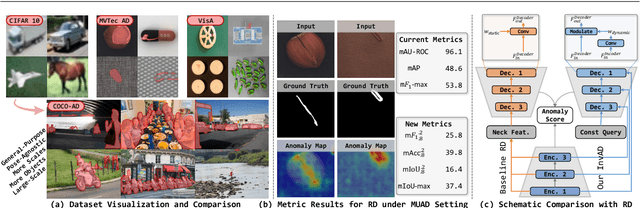

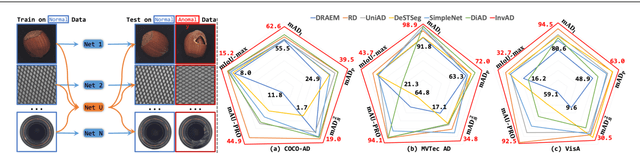

Anomaly detection (AD) is often focused on detecting anomaly areas for industrial quality inspection and medical lesion examination. However, due to the specific scenario targets, the data scale for AD is relatively small, and evaluation metrics are still deficient compared to classic vision tasks, such as object detection and semantic segmentation. To fill these gaps, this work first constructs a large-scale and general-purpose COCO-AD dataset by extending COCO to the AD field. This enables fair evaluation and sustainable development for different methods on this challenging benchmark. Moreover, current metrics such as AU-ROC have nearly reached saturation on simple datasets, which prevents a comprehensive evaluation of different methods. Inspired by the metrics in the segmentation field, we further propose several more practical threshold-dependent AD-specific metrics, ie, m$F_1$$^{.2}_{.8}$, mAcc$^{.2}_{.8}$, mIoU$^{.2}_{.8}$, and mIoU-max. Motivated by GAN inversion's high-quality reconstruction capability, we propose a simple but more powerful InvAD framework to achieve high-quality feature reconstruction. Our method improves the effectiveness of reconstruction-based methods on popular MVTec AD, VisA, and our newly proposed COCO-AD datasets under a multi-class unsupervised setting, where only a single detection model is trained to detect anomalies from different classes. Extensive ablation experiments have demonstrated the effectiveness of each component of our InvAD. Full codes and models are available at https://github.com/zhangzjn/ader.
Object Detectors in the Open Environment: Challenges, Solutions, and Outlook
Apr 09, 2024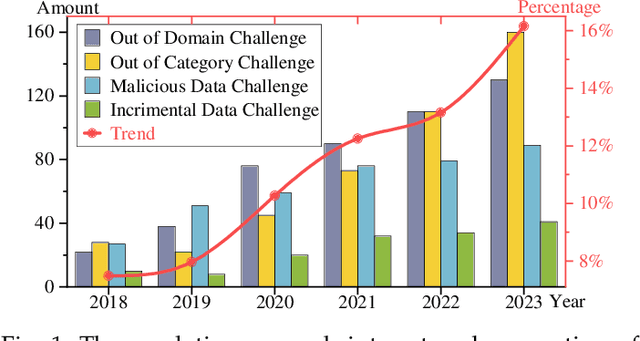
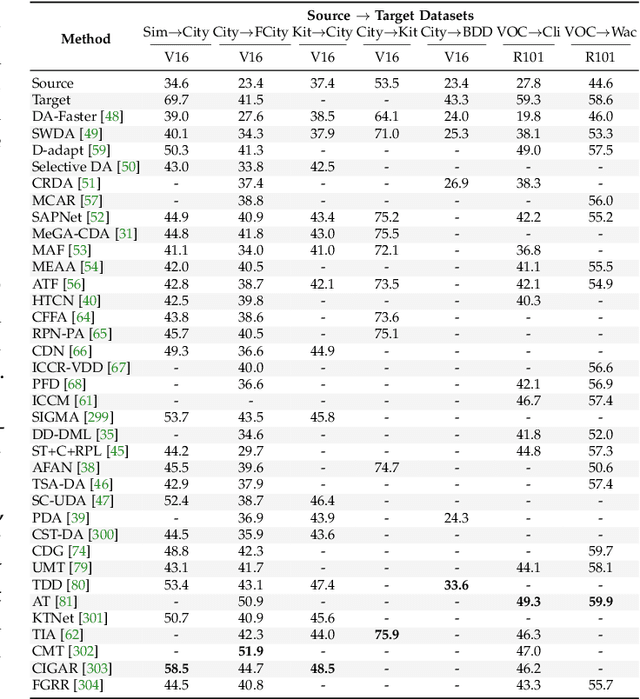
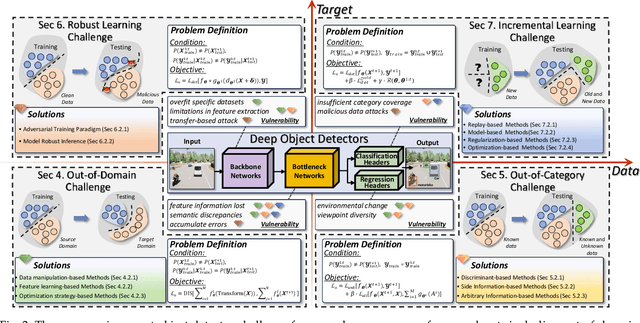
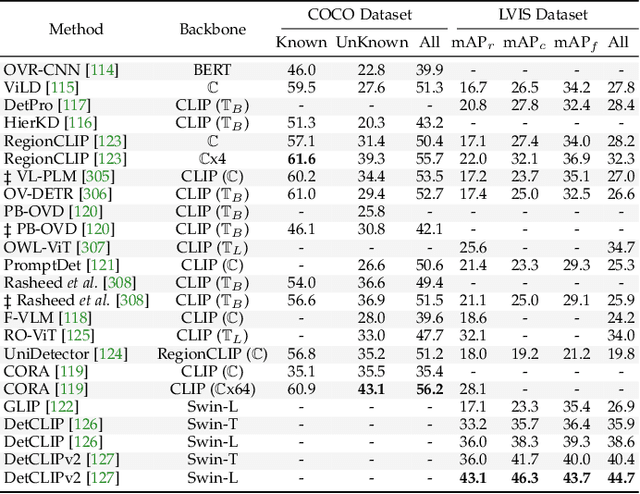
With the emergence of foundation models, deep learning-based object detectors have shown practical usability in closed set scenarios. However, for real-world tasks, object detectors often operate in open environments, where crucial factors (e.g., data distribution, objective) that influence model learning are often changing. The dynamic and intricate nature of the open environment poses novel and formidable challenges to object detectors. Unfortunately, current research on object detectors in open environments lacks a comprehensive analysis of their distinctive characteristics, challenges, and corresponding solutions, which hinders their secure deployment in critical real-world scenarios. This paper aims to bridge this gap by conducting a comprehensive review and analysis of object detectors in open environments. We initially identified limitations of key structural components within the existing detection pipeline and propose the open environment object detector challenge framework that includes four quadrants (i.e., out-of-domain, out-of-category, robust learning, and incremental learning) based on the dimensions of the data / target changes. For each quadrant of challenges in the proposed framework, we present a detailed description and systematic analysis of the overarching goals and core difficulties, systematically review the corresponding solutions, and benchmark their performance over multiple widely adopted datasets. In addition, we engage in a discussion of open problems and potential avenues for future research. This paper aims to provide a fresh, comprehensive, and systematic understanding of the challenges and solutions associated with open-environment object detectors, thus catalyzing the development of more solid applications in real-world scenarios. A project related to this survey can be found at https://github.com/LiangSiyuan21/OEOD_Survey.
Deepfake Generation and Detection: A Benchmark and Survey
Apr 09, 2024


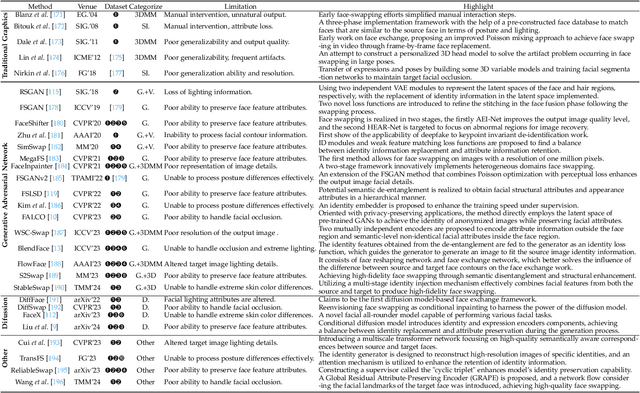
In addition to the advancements in deepfake generation, corresponding detection technologies need to continuously evolve to regulate the potential misuse of deepfakes, such as for privacy invasion and phishing attacks. This survey comprehensively reviews the latest developments in deepfake generation and detection, summarizing and analyzing the current state of the art in this rapidly evolving field. We first unify task definitions, comprehensively introduce datasets and metrics, and discuss the development of generation and detection technology frameworks. Then, we discuss the development of several related sub-fields and focus on researching four mainstream deepfake fields: popular face swap, face reenactment, talking face generation, and facial attribute editing, as well as foreign detection. Subsequently, we comprehensively benchmark representative methods on popular datasets for each field, fully evaluating the latest and influential works published in top conferences/journals. Finally, we analyze the challenges and future research directions of the discussed fields. We closely follow the latest developments in https://github.com/flyingby/Awesome-Deepfake-Generation-and-Detection.
UniMix: Towards Domain Adaptive and Generalizable LiDAR Semantic Segmentation in Adverse Weather
Apr 08, 2024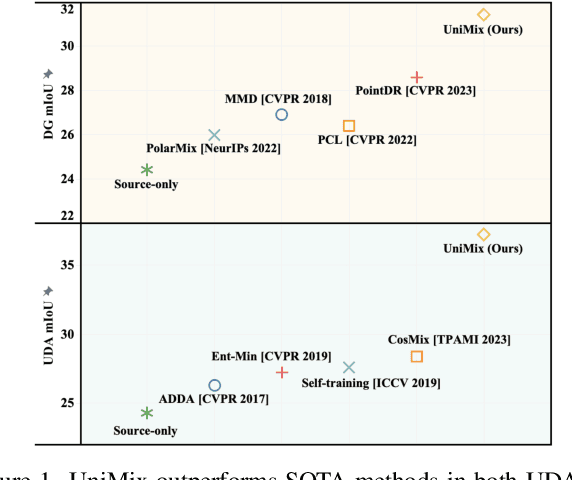
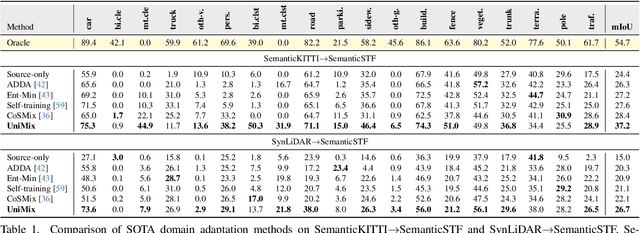
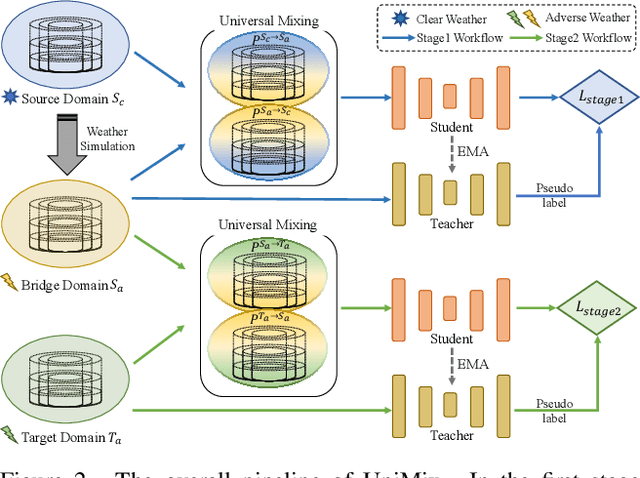
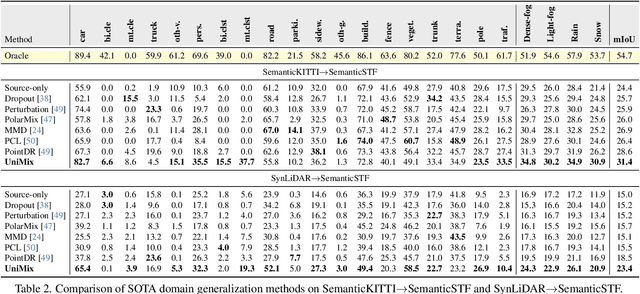
LiDAR semantic segmentation (LSS) is a critical task in autonomous driving and has achieved promising progress. However, prior LSS methods are conventionally investigated and evaluated on datasets within the same domain in clear weather. The robustness of LSS models in unseen scenes and all weather conditions is crucial for ensuring safety and reliability in real applications. To this end, we propose UniMix, a universal method that enhances the adaptability and generalizability of LSS models. UniMix first leverages physically valid adverse weather simulation to construct a Bridge Domain, which serves to bridge the domain gap between the clear weather scenes and the adverse weather scenes. Then, a Universal Mixing operator is defined regarding spatial, intensity, and semantic distributions to create the intermediate domain with mixed samples from given domains. Integrating the proposed two techniques into a teacher-student framework, UniMix efficiently mitigates the domain gap and enables LSS models to learn weather-robust and domain-invariant representations. We devote UniMix to two main setups: 1) unsupervised domain adaption, adapting the model from the clear weather source domain to the adverse weather target domain; 2) domain generalization, learning a model that generalizes well to unseen scenes in adverse weather. Extensive experiments validate the effectiveness of UniMix across different tasks and datasets, all achieving superior performance over state-of-the-art methods. The code will be released.
Take Care of Your Prompt Bias! Investigating and Mitigating Prompt Bias in Factual Knowledge Extraction
Mar 26, 2024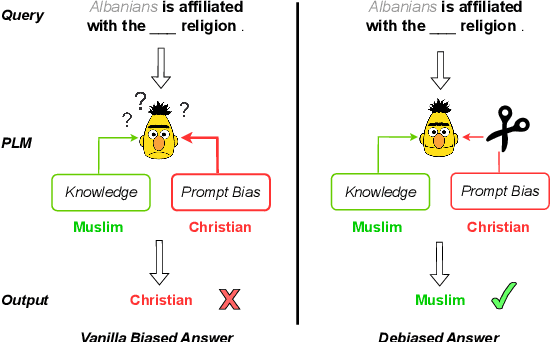


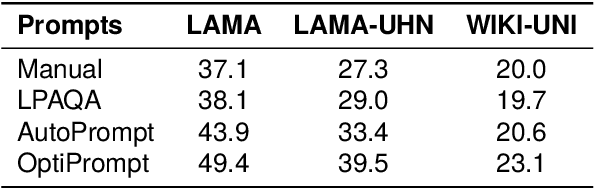
Recent research shows that pre-trained language models (PLMs) suffer from "prompt bias" in factual knowledge extraction, i.e., prompts tend to introduce biases toward specific labels. Prompt bias presents a significant challenge in assessing the factual knowledge within PLMs. Therefore, this paper aims to improve the reliability of existing benchmarks by thoroughly investigating and mitigating prompt bias. We show that: 1) all prompts in the experiments exhibit non-negligible bias, with gradient-based prompts like AutoPrompt and OptiPrompt displaying significantly higher levels of bias; 2) prompt bias can amplify benchmark accuracy unreasonably by overfitting the test datasets, especially on imbalanced datasets like LAMA. Based on these findings, we propose a representation-based approach to mitigate the prompt bias during inference time. Specifically, we first estimate the biased representation using prompt-only querying, and then remove it from the model's internal representations to generate the debiased representations, which are used to produce the final debiased outputs. Experiments across various prompts, PLMs, and benchmarks show that our approach can not only correct the overfitted performance caused by prompt bias, but also significantly improve the prompt retrieval capability (up to 10% absolute performance gain). These results indicate that our approach effectively alleviates prompt bias in knowledge evaluation, thereby enhancing the reliability of benchmark assessments. Hopefully, our plug-and-play approach can be a golden standard to strengthen PLMs toward reliable knowledge bases. Code and data are released in https://github.com/FelliYang/PromptBias.