 Add to Chrome
 Add to Firefox
 Add to Edge
Hitem3D 2.0: Multi-View Guided Native 3D Texture Generation
Apr 10, 2026
Although recent advances have improved the quality of 3D texture generation, existing methods still struggle with incomplete texture coverage, cross-view inconsistency, and misalignment between geometry and texture. To address these limitations, we propose Hitem3D 2.0, a multi-view guided native 3D texture generation framework that enhances texture quality through the integration of 2D multi-view generation priors and native 3D texture representations. Hitem3D 2.0 comprises two key components: a multi-view synthesis framework and a native 3D texture generation model. The multi-view generation is built upon a pre-trained image editing backbone and incorporates plug-and-play modules that explicitly promote geometric alignment, cross-view consistency, and illumination uniformity, thereby enabling the synthesis of high-fidelity multi-view images. Conditioned on the generated views and 3D geometry, the native 3D texture generation model projects multi-view textures onto 3D surfaces while plausibly completing textures in unseen regions. Through the integration of multi-view consistency constraints with native 3D texture modeling, Hitem3D 2.0 significantly improves texture completeness, cross-view coherence, and geometric alignment. Experimental results demonstrate that Hitem3D 2.0 outperforms existing methods in terms of texture detail, fidelity, consistency, coherence, and alignment.

Know3D: Prompting 3D Generation with Knowledge from Vision-Language Models
Mar 24, 2026Recent advances in 3D generation have improved the fidelity and geometric details of synthesized 3D assets. However, due to the inherent ambiguity of single-view observations and the lack of robust global structural priors caused by limited 3D training data, the unseen regions generated by existing models are often stochastic and difficult to control, which may sometimes fail to align with user intentions or produce implausible geometries. In this paper, we propose Know3D, a novel framework that incorporates rich knowledge from multimodal large language models into 3D generative processes via latent hidden-state injection, enabling language-controllable generation of the back-view for 3D assets. We utilize a VLM-diffusion-based model, where the VLM is responsible for semantic understanding and guidance. The diffusion model acts as a bridge that transfers semantic knowledge from the VLM to the 3D generation model. In this way, we successfully bridge the gap between abstract textual instructions and the geometric reconstruction of unobserved regions, transforming the traditionally stochastic back-view hallucination into a semantically controllable process, demonstrating a promising direction for future 3D generation models.
EI-Part: Explode for Completion and Implode for Refinement
Mar 14, 2026Part-level 3D generation is crucial for various downstream applications, including gaming, film production, and industrial design. However, decomposing a 3D shape into geometrically plausible and meaningful components remains a significant challenge. Previous part-based generation methods often struggle to produce well-constructed parts, exhibiting poor structural coherence, geometric implausibility, inaccuracy, or inefficiency. To address these challenges, we introduce EI-Part, a novel framework specifically designed to generate high-quality 3D shapes with components, characterized by strong structural coherence, geometric plausibility, geometric fidelity, and generation efficiency. We propose utilizing distinct representations at different stages: an Explode state for part completion and an Implode state for geometry refinement. This strategy fully leverages spatial resolution, enabling flexible part completion and fine geometric detail generation. To maintain structural coherence between parts, a self-attention mechanism is incorporated in both exploded and imploded states, facilitating effective information perception and feature fusion among components during generation. Extensive experiments on multiple benchmarks demonstrate that EI-Part efficiently produces semantically meaningful and structurally coherent parts with fine-grained geometric details, achieving state-of-the-art performance in part-level 3D generation. Project page: https://cvhadessun.github.io/EI-Part/
Sparc3D: Sparse Representation and Construction for High-Resolution 3D Shapes Modeling
May 21, 2025High-fidelity 3D object synthesis remains significantly more challenging than 2D image generation due to the unstructured nature of mesh data and the cubic complexity of dense volumetric grids. Existing two-stage pipelines-compressing meshes with a VAE (using either 2D or 3D supervision), followed by latent diffusion sampling-often suffer from severe detail loss caused by inefficient representations and modality mismatches introduced in VAE. We introduce Sparc3D, a unified framework that combines a sparse deformable marching cubes representation Sparcubes with a novel encoder Sparconv-VAE. Sparcubes converts raw meshes into high-resolution ($1024^3$) surfaces with arbitrary topology by scattering signed distance and deformation fields onto a sparse cube, allowing differentiable optimization. Sparconv-VAE is the first modality-consistent variational autoencoder built entirely upon sparse convolutional networks, enabling efficient and near-lossless 3D reconstruction suitable for high-resolution generative modeling through latent diffusion. Sparc3D achieves state-of-the-art reconstruction fidelity on challenging inputs, including open surfaces, disconnected components, and intricate geometry. It preserves fine-grained shape details, reduces training and inference cost, and integrates naturally with latent diffusion models for scalable, high-resolution 3D generation.
Hyper3D: Efficient 3D Representation via Hybrid Triplane and Octree Feature for Enhanced 3D Shape Variational Auto-Encoders
Mar 13, 2025Recent 3D content generation pipelines often leverage Variational Autoencoders (VAEs) to encode shapes into compact latent representations, facilitating diffusion-based generation. Efficiently compressing 3D shapes while preserving intricate geometric details remains a key challenge. Existing 3D shape VAEs often employ uniform point sampling and 1D/2D latent representations, such as vector sets or triplanes, leading to significant geometric detail loss due to inadequate surface coverage and the absence of explicit 3D representations in the latent space. Although recent work explores 3D latent representations, their large scale hinders high-resolution encoding and efficient training. Given these challenges, we introduce Hyper3D, which enhances VAE reconstruction through efficient 3D representation that integrates hybrid triplane and octree features. First, we adopt an octree-based feature representation to embed mesh information into the network, mitigating the limitations of uniform point sampling in capturing geometric distributions along the mesh surface. Furthermore, we propose a hybrid latent space representation that integrates a high-resolution triplane with a low-resolution 3D grid. This design not only compensates for the lack of explicit 3D representations but also leverages a triplane to preserve high-resolution details. Experimental results demonstrate that Hyper3D outperforms traditional representations by reconstructing 3D shapes with higher fidelity and finer details, making it well-suited for 3D generation pipelines.
MagicNaming: Consistent Identity Generation by Finding a "Name Space" in T2I Diffusion Models
Dec 19, 2024


Large-scale text-to-image diffusion models, (e.g., DALL-E, SDXL) are capable of generating famous persons by simply referring to their names. Is it possible to make such models generate generic identities as simple as the famous ones, e.g., just use a name? In this paper, we explore the existence of a "Name Space", where any point in the space corresponds to a specific identity. Fortunately, we find some clues in the feature space spanned by text embedding of celebrities' names. Specifically, we first extract the embeddings of celebrities' names in the Laion5B dataset with the text encoder of diffusion models. Such embeddings are used as supervision to learn an encoder that can predict the name (actually an embedding) of a given face image. We experimentally find that such name embeddings work well in promising the generated image with good identity consistency. Note that like the names of celebrities, our predicted name embeddings are disentangled from the semantics of text inputs, making the original generation capability of text-to-image models well-preserved. Moreover, by simply plugging such name embeddings, all variants (e.g., from Civitai) derived from the same base model (i.e., SDXL) readily become identity-aware text-to-image models. Project homepage: \url{https://magicfusion.github.io/MagicNaming/}.
* Accepted by AAAI 2025
Infinite-ID: Identity-preserved Personalization via ID-semantics Decoupling Paradigm
Mar 18, 2024


Drawing on recent advancements in diffusion models for text-to-image generation, identity-preserved personalization has made significant progress in accurately capturing specific identities with just a single reference image. However, existing methods primarily integrate reference images within the text embedding space, leading to a complex entanglement of image and text information, which poses challenges for preserving both identity fidelity and semantic consistency. To tackle this challenge, we propose Infinite-ID, an ID-semantics decoupling paradigm for identity-preserved personalization. Specifically, we introduce identity-enhanced training, incorporating an additional image cross-attention module to capture sufficient ID information while deactivating the original text cross-attention module of the diffusion model. This ensures that the image stream faithfully represents the identity provided by the reference image while mitigating interference from textual input. Additionally, we introduce a feature interaction mechanism that combines a mixed attention module with an AdaIN-mean operation to seamlessly merge the two streams. This mechanism not only enhances the fidelity of identity and semantic consistency but also enables convenient control over the styles of the generated images. Extensive experimental results on both raw photo generation and style image generation demonstrate the superior performance of our proposed method.
PartSeg: Few-shot Part Segmentation via Part-aware Prompt Learning
Aug 24, 2023In this work, we address the task of few-shot part segmentation, which aims to segment the different parts of an unseen object using very few labeled examples. It is found that leveraging the textual space of a powerful pre-trained image-language model (such as CLIP) can be beneficial in learning visual features. Therefore, we develop a novel method termed PartSeg for few-shot part segmentation based on multimodal learning. Specifically, we design a part-aware prompt learning method to generate part-specific prompts that enable the CLIP model to better understand the concept of ``part'' and fully utilize its textual space. Furthermore, since the concept of the same part under different object categories is general, we establish relationships between these parts during the prompt learning process. We conduct extensive experiments on the PartImageNet and Pascal$\_$Part datasets, and the experimental results demonstrated that our proposed method achieves state-of-the-art performance.
Null-text Guidance in Diffusion Models is Secretly a Cartoon-style Creator
May 11, 2023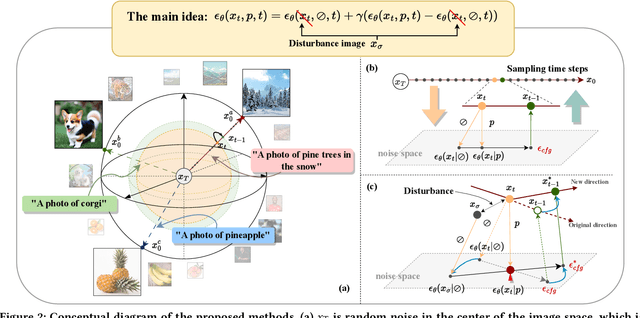
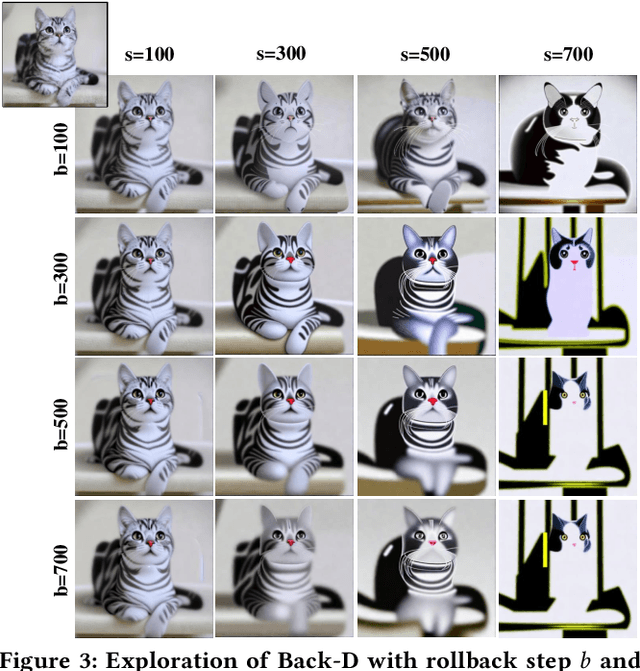
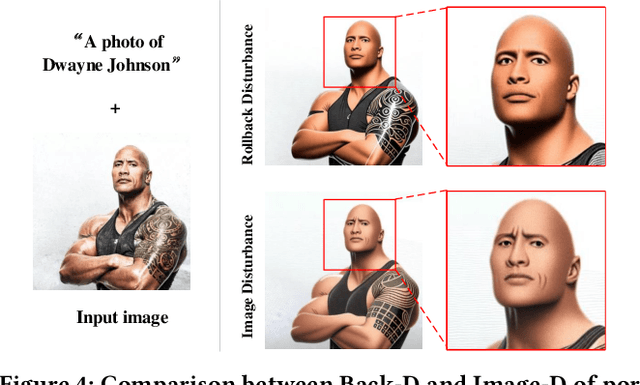
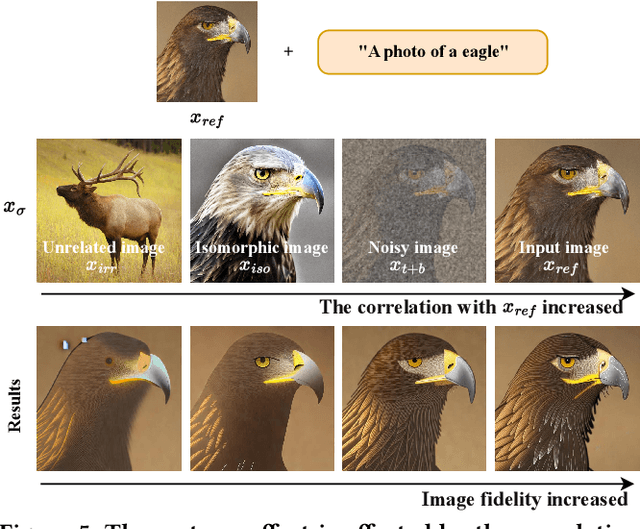
Classifier-free guidance is an effective sampling technique in diffusion models that has been widely adopted. The main idea is to extrapolate the model in the direction of text guidance and away from null-text guidance. In this paper, we demonstrate that null-text guidance in diffusion models is secretly a cartoon-style creator, i.e., the generated images can be efficiently transformed into cartoons by simply perturbing the null-text guidance. Specifically, we proposed two disturbance methods, i.e., Rollback disturbance (Back-D) and Image disturbance (Image-D), to construct misalignment between the noisy images used for predicting null-text guidance and text guidance (subsequently referred to as \textbf{null-text noisy image} and \textbf{text noisy image} respectively) in the sampling process. Back-D achieves cartoonization by altering the noise level of null-text noisy image via replacing $x_t$ with $x_{t+\Delta t}$. Image-D, alternatively, produces high-fidelity, diverse cartoons by defining $x_t$ as a clean input image, which further improves the incorporation of finer image details. Through comprehensive experiments, we delved into the principle of noise disturbing for null-text and uncovered that the efficacy of disturbance depends on the correlation between the null-text noisy image and the source image. Moreover, our proposed techniques, which can generate cartoon images and cartoonize specific ones, are training-free and easily integrated as a plug-and-play component in any classifier-free guided diffusion model. Project page is available at \url{https://nulltextforcartoon.github.io/}.
MagicFusion: Boosting Text-to-Image Generation Performance by Fusing Diffusion Models
Mar 25, 2023The advent of open-source AI communities has produced a cornucopia of powerful text-guided diffusion models that are trained on various datasets. While few explorations have been conducted on ensembling such models to combine their strengths. In this work, we propose a simple yet effective method called Saliency-aware Noise Blending (SNB) that can empower the fused text-guided diffusion models to achieve more controllable generation. Specifically, we experimentally find that the responses of classifier-free guidance are highly related to the saliency of generated images. Thus we propose to trust different models in their areas of expertise by blending the predicted noises of two diffusion models in a saliency-aware manner. SNB is training-free and can be completed within a DDIM sampling process. Additionally, it can automatically align the semantics of two noise spaces without requiring additional annotations such as masks. Extensive experiments show the impressive effectiveness of SNB in various applications. Project page is available at https://magicfusion.github.io/.