 Add to Chrome
 Add to Firefox
 Add to Edge
SkillCAT: Contrastive Assessment and Topology-Aware Skill Self-Evolution for LLM Agents
Jun 11, 2026
Skill self-evolution methods for LLM agents aim to turn execution trajectories into reusable skill documents, but current pipelines typically learn from one trajectory per task, merge candidate skill patches before checking them, and load the full skill corpus before inference. We propose SkillCAT, a training-free framework that separates this process into three stages. Contrastive Causal Extraction (CCE) samples multiple trajectories for each task and compares same-task success/failure pairs to identify evidence that explains outcome differences. Assessment-Augmented Evolution (AAE) replays each candidate patch on source-task clones and keeps only patches that improve or preserve task outcomes before hierarchical skill patch merging. Topology-Aware Task Execution (TTE) compiles the evolved skills into a routable sub-skill topology, so inference loads only the capability nodes relevant to the task. We evaluate SkillCAT on common agent benchmarks, including SpreadsheetBench, WikiTableQuestions, and DocVQA, and further test cross-model and out-of-distribution generalization. Across these settings, SkillCAT raises the average score over baselines by up to 40.40%, demonstrating reliable skill evolution without model training.

ConRAG: Consensus-Driven Multi-View Retrieval for Multi-Hop Question Answering
May 27, 2026Retrieval-augmented generation (RAG) has emerged as a promising paradigm for enhancing large language models (LLMs) on multi-hop question answering (QA), which requires reasoning over evidence from multiple documents. Current multi-hop RAG methods generally focus on either query-side task decomposition or corpus-side knowledge graph construction. Despite their progress, these methods still struggle to achieve satisfactory performance on complex multi-hop QA tasks. To this end, we propose ConRAG, a consensus-driven multi-view RAG framework that effectively boosts LLMs on complex multi-hop QA. The core of ConRAG is to systematically optimize both the query and corpus sides and to leverage multi-view evidence (relation, entity, and text signals) for more accurate retrieval. Extensive experiments on three multi-hop QA benchmarks show that ConRAG consistently outperforms all baselines by a clear margin, e.g., up to +26.9% average performance gains over vanilla RAG, and enables Gemma-4-31B to achieve a new state-of-the-art record on the challenging MuSiQue benchmark.
Better, Faster: Harnessing Self-Improvement in Large Reasoning Models
May 24, 2026Self-improvement training enables the large reasoning models (LRMs) to improve themselves by self-generating reasoning trajectories as training data without external supervision. However, we find that this method often falls short in complex reasoning tasks and even leads to model collapse. Through a series of preliminary analyses, we reveal two problems: (1) data imbalance, where most training samples are simple, but the challenging yet crucial samples are scarce; (2) overthinking, where many undesired samples with redundant reasoning steps are used for self-training. To this end, we propose HSIR, which effectively Harnesses Self-Improvement in large Reasoning models via two simple-yet-effective approaches. Specifically, HSIR introduces a verify-then-exit sampling strategy to mitigate data imbalance by efficiently collecting more accurate solutions for difficult queries, and designs an Intrinsic Diversity score to quantify overthinking and filter out the undesired solutions. We apply HSIR to various post-training paradigms, among which we further propose H-GRPO, an enhanced GRPO algorithm that leverages the intrinsic diversity as an external reward to encourage concise and diverse reasoning via reinforcement learning. Extensive results show that HSIR not only effectively enhances the reasoning performance, i.e., bringing up to +10.9% average performance gains, but also significantly improves the reasoning efficiency by reducing up to 42.4% relative inference overhead.
Learn to Think: Improving Multimodal Reasoning through Vision-Aware Self-Improvement Training
May 12, 2026Post-training with explicit reasoning traces is common to improve the reasoning capabilities of Multimodal Large Language Models (MLLMs). However, acquiring high-quality reasoning traces is often costly and time-consuming. Hence, the self-improvement paradigm has emerged, enabling MLLMs to self-generate reasoning traces for training without external supervision. Despite its effectiveness, we reveal two shortcomings in the self-improvement training of MLLMs: 1) data imbalance, where simple samples are over-trained, but the challenging yet crucial samples are under-trained; 2) language prior bias, where MLLMs overly rely on linguistic priors while neglecting the visual cues. To this end, we propose VISTA, a vision-aware self-improvement training framework for enhancing the multimodal reasoning of MLLMs. Specifically, VISTA first introduces a prefix resampling strategy to reuse the partial correct reasoning traces for efficient data collection, and then designs a vision-aware attention score to quantify the model's focus on visual information. Extensive experiments show that VISTA can be applied to various post-training scenarios, i.e., supervised fine-tuning and preference learning, and effectively enhances the multimodal reasoning performance across various MLLMs and tasks, e.g., bringing up to +13.66% average performance gains for Qwen2.5-VL-3B-Instruct.
Try, Check and Retry: A Divide-and-Conquer Framework for Boosting Long-context Tool-Calling Performance of LLMs
Mar 12, 2026Tool-calling empowers Large Language Models (LLMs) to interact with external environments. However, current methods often struggle to handle massive and noisy candidate tools in long-context tool-calling tasks, limiting their real-world application. To this end, we propose Tool-DC, a Divide-and-Conquer framework for boosting tool-calling performance of LLMs. The core of Tool-DC is to reduce the reasoning difficulty and make full use of self-reflection ability of LLMs via a "Try-Check-Retry" paradigm. Specifically, Tool-DC involves two variants: 1) the training-free Tool-DC (TF), which is plug-and-play and flexible; 2) the training-based Tool-DC (TB), which is more inference-efficient. Extensive experiments show that both Tool-DC methods outperform their counterparts by a clear margin. Tool-DC (TF) brings up to +25.10% average gains against the baseline on BFCL and ACEBench benchmarks, while Tool-DC (TB) enables Qwen2.5-7B to achieve comparable or even better performance than proprietary LLMs, e.g., OpenAI o3 and Claude-Haiku-4.5.
Resolving Knowledge Conflicts in Domain-specific Data Selection: A Case Study on Medical Instruction-tuning
May 28, 2025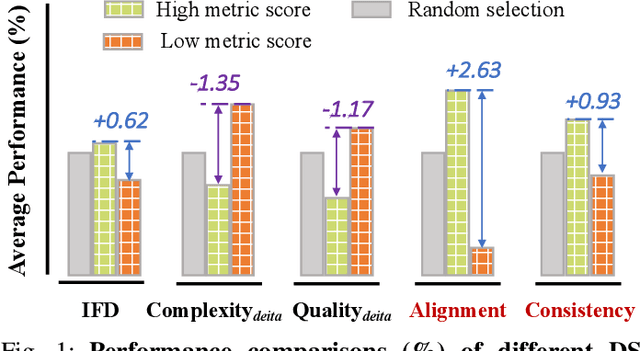
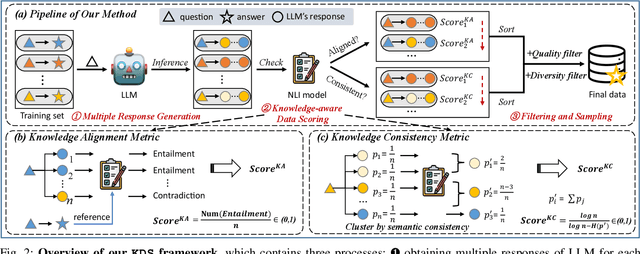
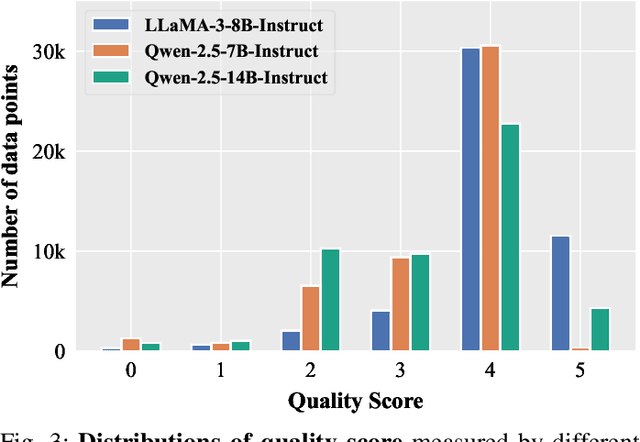
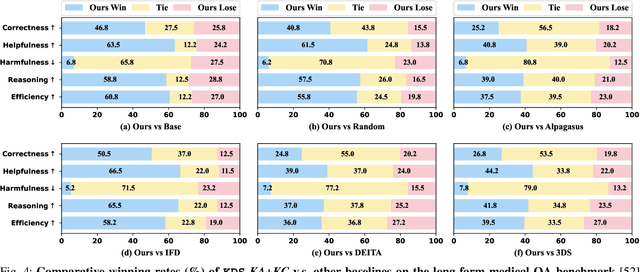
Domain-specific instruction-tuning has become the defacto standard for improving the performance of large language models (LLMs) in specialized applications, e.g., medical question answering. Since the instruction-tuning dataset might contain redundant or low-quality data, data selection (DS) is usually required to maximize the data efficiency. Despite the successes in the general domain, current DS methods often struggle to select the desired data for domain-specific instruction-tuning. One of the main reasons is that they neglect the impact of knowledge conflicts, i.e., the discrepancy between LLMs' pretrained knowledge and context knowledge of instruction data, which could damage LLMs' prior abilities and lead to hallucination. To this end, we propose a simple-yet-effective Knowledge-aware Data Selection (namely KDS) framework to select the domain-specific instruction-tuning data that meets LLMs' actual needs. The core of KDS is to leverage two knowledge-aware metrics for quantitatively measuring knowledge conflicts from two aspects: context-memory knowledge alignment and intra-memory knowledge consistency. By filtering the data with large knowledge conflicts and sampling the high-quality and diverse data, KDS can effectively stimulate the LLMs' abilities and achieve better domain-specific performance. Taking the medical domain as the testbed, we conduct extensive experiments and empirically prove that KDS surpasses the other baselines and brings significant and consistent performance gains among all LLMs. More encouragingly, KDS effectively improves the model generalization and alleviates the hallucination problem.
KaFT: Knowledge-aware Fine-tuning for Boosting LLMs' Domain-specific Question-Answering Performance
May 21, 2025Supervised fine-tuning (SFT) is a common approach to improve the domain-specific question-answering (QA) performance of large language models (LLMs). However, recent literature reveals that due to the conflicts between LLMs' internal knowledge and the context knowledge of training data, vanilla SFT using the full QA training set is usually suboptimal. In this paper, we first design a query diversification strategy for robust conflict detection and then conduct a series of experiments to analyze the impact of knowledge conflict. We find that 1) training samples with varied conflicts contribute differently, where SFT on the data with large conflicts leads to catastrophic performance drops; 2) compared to directly filtering out the conflict data, appropriately applying the conflict data would be more beneficial. Motivated by this, we propose a simple-yet-effective Knowledge-aware Fine-tuning (namely KaFT) approach to effectively boost LLMs' performance. The core of KaFT is to adapt the training weight by assigning different rewards for different training samples according to conflict level. Extensive experiments show that KaFT brings consistent and significant improvements across four LLMs. More analyses prove that KaFT effectively improves the model generalization and alleviates the hallucination.
Learning from Imperfect Data: Towards Efficient Knowledge Distillation of Autoregressive Language Models for Text-to-SQL
Oct 15, 2024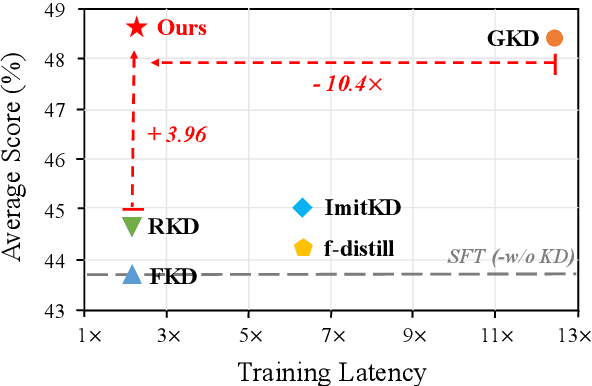

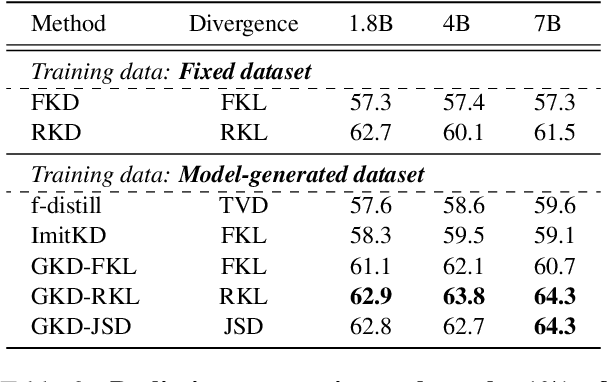

Large Language Models (LLMs) have shown promising performance in text-to-SQL, which involves translating natural language questions into SQL queries. However, current text-to-SQL LLMs are computationally expensive and challenging to deploy in real-world applications, highlighting the importance of compressing them. To achieve this goal, knowledge distillation (KD) is a common approach, which aims to distill the larger teacher model into a smaller student model. While numerous KD methods for autoregressive LLMs have emerged recently, it is still under-explored whether they work well in complex text-to-SQL scenarios. To this end, we conduct a series of analyses and reveal that these KD methods generally fall short in balancing performance and efficiency. In response to this problem, we propose to improve the KD with Imperfect Data, namely KID, which effectively boosts the performance without introducing much training budget. The core of KID is to efficiently mitigate the training-inference mismatch by simulating the cascading effect of inference in the imperfect training data. Extensive experiments on 5 text-to-SQL benchmarks show that, KID can not only achieve consistent and significant performance gains (up to +5.83% average score) across all model types and sizes, but also effectively improve the training efficiency.
Iterative Data Augmentation with Large Language Models for Aspect-based Sentiment Analysis
Jun 29, 2024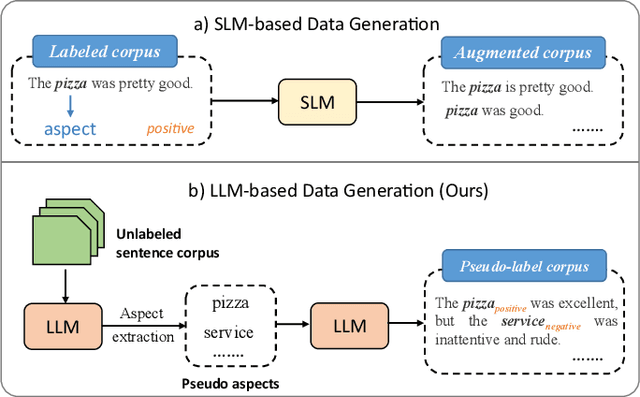
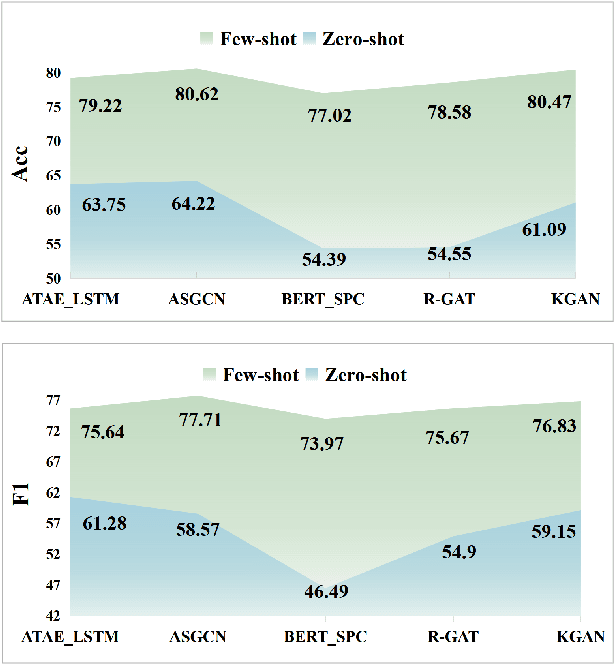
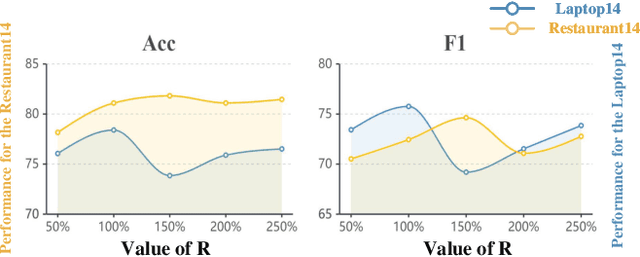
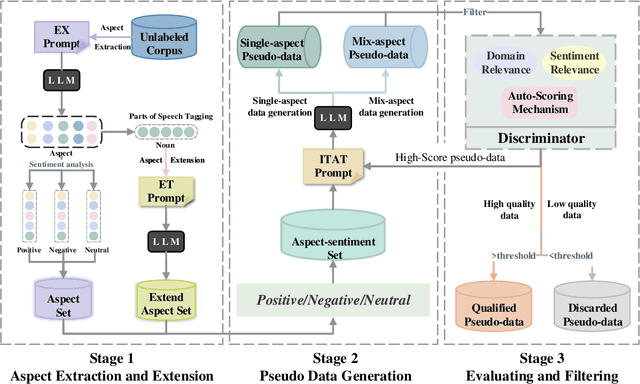
Aspect-based Sentiment Analysis (ABSA) is an important sentiment analysis task, which aims to determine the sentiment polarity towards an aspect in a sentence. Due to the expensive and limited labeled data, data augmentation (DA) has become the standard for improving the performance of ABSA. However, current DA methods usually have some shortcomings: 1) poor fluency and coherence, 2) lack of diversity of generated data, and 3) reliance on some existing labeled data, hindering its applications in real-world scenarios. In response to these problems, we propose a systematic Iterative Data augmentation framework, namely IterD, to boost the performance of ABSA. The core of IterD is to leverage the powerful ability of large language models (LLMs) to iteratively generate more fluent and diverse synthetic labeled data, starting from an unsupervised sentence corpus. Extensive experiments on 4 widely-used ABSA benchmarks show that IterD brings consistent and significant performance gains among 5 baseline ABSA models. More encouragingly, the synthetic data generated by IterD can achieve comparable or even better performance against the manually annotated data.
Achieving >97% on GSM8K: Deeply Understanding the Problems Makes LLMs Better Reasoners
Apr 28, 2024
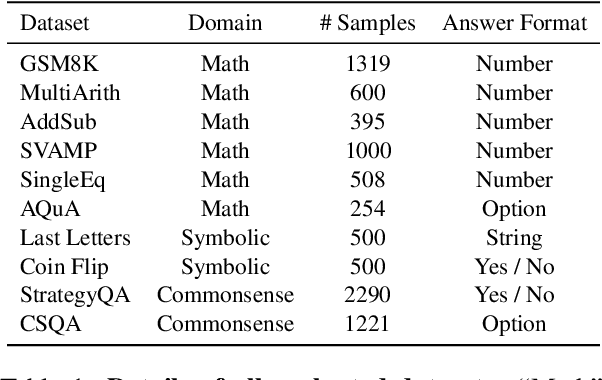

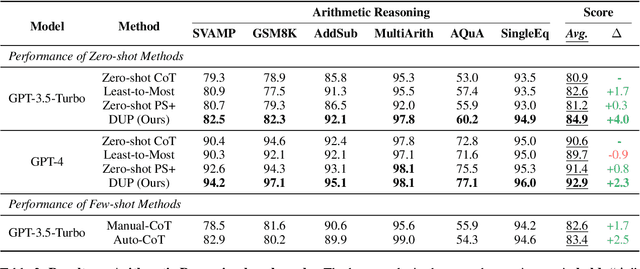
Chain of Thought prompting strategy has enhanced the performance of Large Language Models (LLMs) across various NLP tasks. However, it still has shortcomings when dealing with complex reasoning tasks, including understanding errors, calculation errors and process errors (e.g., missing-step and hallucinations). Subsequently, our in-depth analyses among various error types show that deeply understanding the whole problem is critical in addressing complicated reasoning tasks. Motivated by this, we propose a simple-yet-effective method, namely Deeply Understanding the Problems (DUP), to enhance the LLMs' reasoning abilities. The core of our method is to encourage the LLMs to deeply understand the problems and leverage the key problem-solving information for better reasoning. Extensive experiments on 10 diverse reasoning benchmarks show that our DUP method consistently outperforms the other counterparts by a large margin. More encouragingly, DUP achieves a new SOTA result on the GSM8K benchmark, with an accuracy of 97.1% in a zero-shot setting.