 Add to Chrome
 Add to Firefox
 Add to Edge
Scaling Spatial Intelligence with Multimodal Foundation Models
Nov 17, 2025
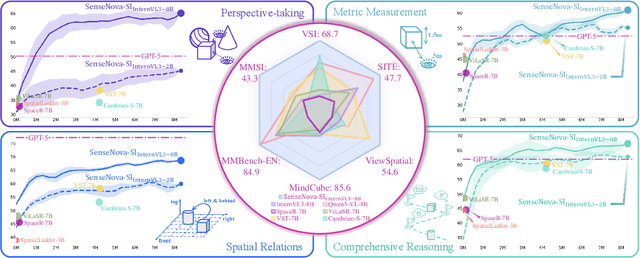
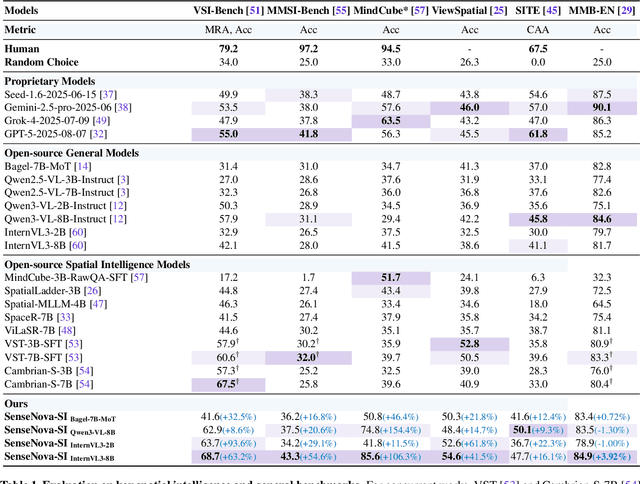
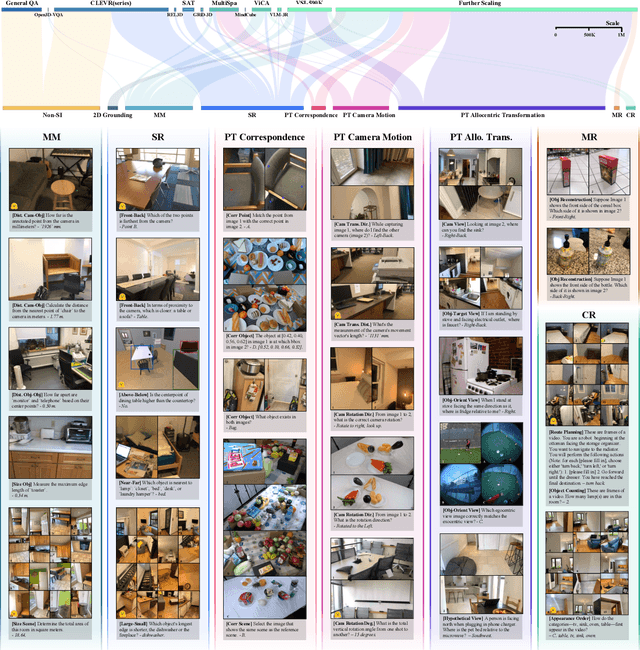
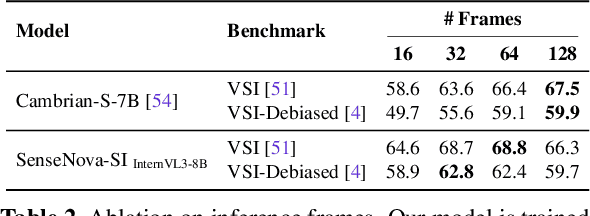
Despite remarkable progress, multimodal foundation models still exhibit surprising deficiencies in spatial intelligence. In this work, we explore scaling up multimodal foundation models to cultivate spatial intelligence within the SenseNova-SI family, built upon established multimodal foundations including visual understanding models (i.e., Qwen3-VL and InternVL3) and unified understanding and generation models (i.e., Bagel). We take a principled approach to constructing high-performing and robust spatial intelligence by systematically curating SenseNova-SI-8M: eight million diverse data samples under a rigorous taxonomy of spatial capabilities. SenseNova-SI demonstrates unprecedented performance across a broad range of spatial intelligence benchmarks: 68.7% on VSI-Bench, 43.3% on MMSI, 85.6% on MindCube, 54.6% on ViewSpatial, and 50.1% on SITE, while maintaining strong general multimodal understanding (e.g., 84.9% on MMBench-En). More importantly, we analyze the impact of data scaling, discuss early signs of emergent generalization capabilities enabled by diverse data training, analyze the risk of overfitting and language shortcuts, present a preliminary study on spatial chain-of-thought reasoning, and validate the potential downstream application. SenseNova-SI is an ongoing project, and this report will be updated continuously. All newly trained multimodal foundation models are publicly released to facilitate further research in this direction.

OmniVGGT: Omni-Modality Driven Visual Geometry Grounded Transformer
Nov 14, 2025General 3D foundation models have started to lead the trend of unifying diverse vision tasks, yet most assume RGB-only inputs and ignore readily available geometric cues (e.g., camera intrinsics, poses, and depth maps). To address this issue, we introduce OmniVGGT, a novel framework that can effectively benefit from an arbitrary number of auxiliary geometric modalities during both training and inference. In our framework, a GeoAdapter is proposed to encode depth and camera intrinsics/extrinsics into a spatial foundation model. It employs zero-initialized convolutions to progressively inject geometric information without disrupting the foundation model's representation space. This design ensures stable optimization with negligible overhead, maintaining inference speed comparable to VGGT even with multiple additional inputs. Additionally, a stochastic multimodal fusion regimen is proposed, which randomly samples modality subsets per instance during training. This enables an arbitrary number of modality inputs during testing and promotes learning robust spatial representations instead of overfitting to auxiliary cues. Comprehensive experiments on monocular/multi-view depth estimation, multi-view stereo, and camera pose estimation demonstrate that OmniVGGT outperforms prior methods with auxiliary inputs and achieves state-of-the-art results even with RGB-only input. To further highlight its practical utility, we integrated OmniVGGT into vision-language-action (VLA) models. The enhanced VLA model by OmniVGGT not only outperforms the vanilla point-cloud-based baseline on mainstream benchmarks, but also effectively leverages accessible auxiliary inputs to achieve consistent gains on robotic tasks.
Simulating the Visual World with Artificial Intelligence: A Roadmap
Nov 11, 2025The landscape of video generation is shifting, from a focus on generating visually appealing clips to building virtual environments that support interaction and maintain physical plausibility. These developments point toward the emergence of video foundation models that function not only as visual generators but also as implicit world models, models that simulate the physical dynamics, agent-environment interactions, and task planning that govern real or imagined worlds. This survey provides a systematic overview of this evolution, conceptualizing modern video foundation models as the combination of two core components: an implicit world model and a video renderer. The world model encodes structured knowledge about the world, including physical laws, interaction dynamics, and agent behavior. It serves as a latent simulation engine that enables coherent visual reasoning, long-term temporal consistency, and goal-driven planning. The video renderer transforms this latent simulation into realistic visual observations, effectively producing videos as a "window" into the simulated world. We trace the progression of video generation through four generations, in which the core capabilities advance step by step, ultimately culminating in a world model, built upon a video generation model, that embodies intrinsic physical plausibility, real-time multimodal interaction, and planning capabilities spanning multiple spatiotemporal scales. For each generation, we define its core characteristics, highlight representative works, and examine their application domains such as robotics, autonomous driving, and interactive gaming. Finally, we discuss open challenges and design principles for next-generation world models, including the role of agent intelligence in shaping and evaluating these systems. An up-to-date list of related works is maintained at this link.
The Quest for Generalizable Motion Generation: Data, Model, and Evaluation
Oct 30, 2025Despite recent advances in 3D human motion generation (MoGen) on standard benchmarks, existing models still face a fundamental bottleneck in their generalization capability. In contrast, adjacent generative fields, most notably video generation (ViGen), have demonstrated remarkable generalization in modeling human behaviors, highlighting transferable insights that MoGen can leverage. Motivated by this observation, we present a comprehensive framework that systematically transfers knowledge from ViGen to MoGen across three key pillars: data, modeling, and evaluation. First, we introduce ViMoGen-228K, a large-scale dataset comprising 228,000 high-quality motion samples that integrates high-fidelity optical MoCap data with semantically annotated motions from web videos and synthesized samples generated by state-of-the-art ViGen models. The dataset includes both text-motion pairs and text-video-motion triplets, substantially expanding semantic diversity. Second, we propose ViMoGen, a flow-matching-based diffusion transformer that unifies priors from MoCap data and ViGen models through gated multimodal conditioning. To enhance efficiency, we further develop ViMoGen-light, a distilled variant that eliminates video generation dependencies while preserving strong generalization. Finally, we present MBench, a hierarchical benchmark designed for fine-grained evaluation across motion quality, prompt fidelity, and generalization ability. Extensive experiments show that our framework significantly outperforms existing approaches in both automatic and human evaluations. The code, data, and benchmark will be made publicly available.
SEE4D: Pose-Free 4D Generation via Auto-Regressive Video Inpainting
Oct 30, 2025Immersive applications call for synthesizing spatiotemporal 4D content from casual videos without costly 3D supervision. Existing video-to-4D methods typically rely on manually annotated camera poses, which are labor-intensive and brittle for in-the-wild footage. Recent warp-then-inpaint approaches mitigate the need for pose labels by warping input frames along a novel camera trajectory and using an inpainting model to fill missing regions, thereby depicting the 4D scene from diverse viewpoints. However, this trajectory-to-trajectory formulation often entangles camera motion with scene dynamics and complicates both modeling and inference. We introduce SEE4D, a pose-free, trajectory-to-camera framework that replaces explicit trajectory prediction with rendering to a bank of fixed virtual cameras, thereby separating camera control from scene modeling. A view-conditional video inpainting model is trained to learn a robust geometry prior by denoising realistically synthesized warped images and to inpaint occluded or missing regions across virtual viewpoints, eliminating the need for explicit 3D annotations. Building on this inpainting core, we design a spatiotemporal autoregressive inference pipeline that traverses virtual-camera splines and extends videos with overlapping windows, enabling coherent generation at bounded per-step complexity. We validate See4D on cross-view video generation and sparse reconstruction benchmarks. Across quantitative metrics and qualitative assessments, our method achieves superior generalization and improved performance relative to pose- or trajectory-conditioned baselines, advancing practical 4D world modeling from casual videos.
IGGT: Instance-Grounded Geometry Transformer for Semantic 3D Reconstruction
Oct 26, 2025Humans naturally perceive the geometric structure and semantic content of a 3D world as intertwined dimensions, enabling coherent and accurate understanding of complex scenes. However, most prior approaches prioritize training large geometry models for low-level 3D reconstruction and treat high-level spatial understanding in isolation, overlooking the crucial interplay between these two fundamental aspects of 3D-scene analysis, thereby limiting generalization and leading to poor performance in downstream 3D understanding tasks. Recent attempts have mitigated this issue by simply aligning 3D models with specific language models, thus restricting perception to the aligned model's capacity and limiting adaptability to downstream tasks. In this paper, we propose InstanceGrounded Geometry Transformer (IGGT), an end-to-end large unified transformer to unify the knowledge for both spatial reconstruction and instance-level contextual understanding. Specifically, we design a 3D-Consistent Contrastive Learning strategy that guides IGGT to encode a unified representation with geometric structures and instance-grounded clustering through only 2D visual inputs. This representation supports consistent lifting of 2D visual inputs into a coherent 3D scene with explicitly distinct object instances. To facilitate this task, we further construct InsScene-15K, a large-scale dataset with high-quality RGB images, poses, depth maps, and 3D-consistent instance-level mask annotations with a novel data curation pipeline.
From Pixels to Words -- Towards Native Vision-Language Primitives at Scale
Oct 16, 2025The edifice of native Vision-Language Models (VLMs) has emerged as a rising contender to typical modular VLMs, shaped by evolving model architectures and training paradigms. Yet, two lingering clouds cast shadows over its widespread exploration and promotion: (-) What fundamental constraints set native VLMs apart from modular ones, and to what extent can these barriers be overcome? (-) How to make research in native VLMs more accessible and democratized, thereby accelerating progress in the field. In this paper, we clarify these challenges and outline guiding principles for constructing native VLMs. Specifically, one native VLM primitive should: (i) effectively align pixel and word representations within a shared semantic space; (ii) seamlessly integrate the strengths of formerly separate vision and language modules; (iii) inherently embody various cross-modal properties that support unified vision-language encoding, aligning, and reasoning. Hence, we launch NEO, a novel family of native VLMs built from first principles, capable of rivaling top-tier modular counterparts across diverse real-world scenarios. With only 390M image-text examples, NEO efficiently develops visual perception from scratch while mitigating vision-language conflicts inside a dense and monolithic model crafted from our elaborate primitives. We position NEO as a cornerstone for scalable and powerful native VLMs, paired with a rich set of reusable components that foster a cost-effective and extensible ecosystem. Our code and models are publicly available at: https://github.com/EvolvingLMMs-Lab/NEO.
RealDPO: Real or Not Real, that is the Preference
Oct 16, 2025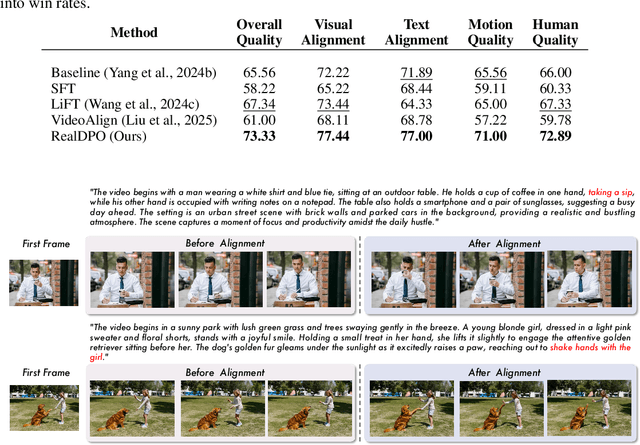
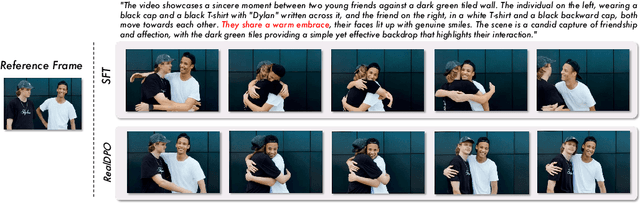
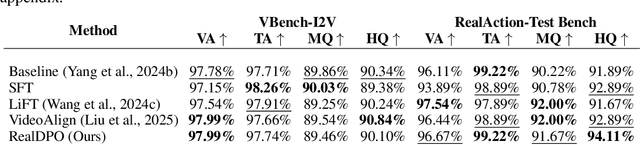
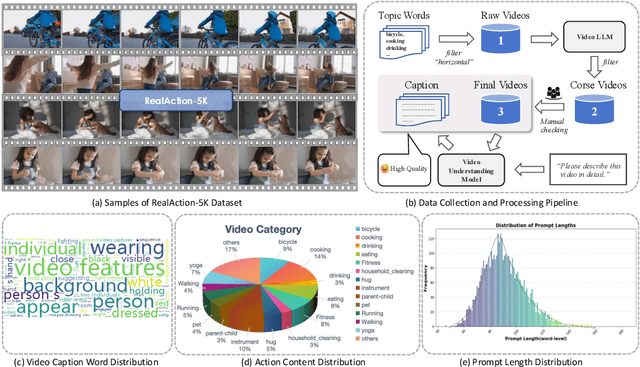
Video generative models have recently achieved notable advancements in synthesis quality. However, generating complex motions remains a critical challenge, as existing models often struggle to produce natural, smooth, and contextually consistent movements. This gap between generated and real-world motions limits their practical applicability. To address this issue, we introduce RealDPO, a novel alignment paradigm that leverages real-world data as positive samples for preference learning, enabling more accurate motion synthesis. Unlike traditional supervised fine-tuning (SFT), which offers limited corrective feedback, RealDPO employs Direct Preference Optimization (DPO) with a tailored loss function to enhance motion realism. By contrasting real-world videos with erroneous model outputs, RealDPO enables iterative self-correction, progressively refining motion quality. To support post-training in complex motion synthesis, we propose RealAction-5K, a curated dataset of high-quality videos capturing human daily activities with rich and precise motion details. Extensive experiments demonstrate that RealDPO significantly improves video quality, text alignment, and motion realism compared to state-of-the-art models and existing preference optimization techniques.
VideoLucy: Deep Memory Backtracking for Long Video Understanding
Oct 14, 2025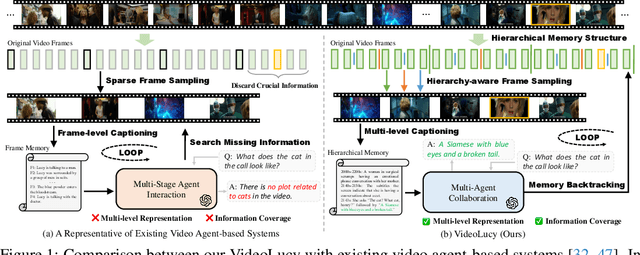
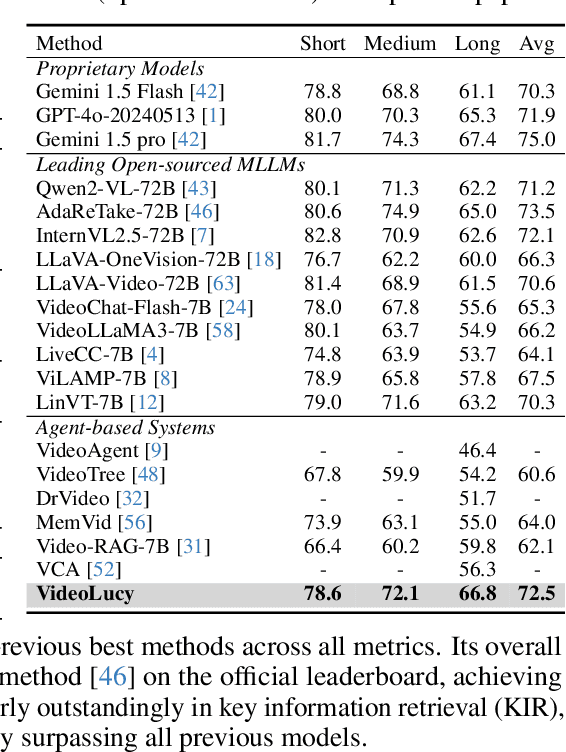
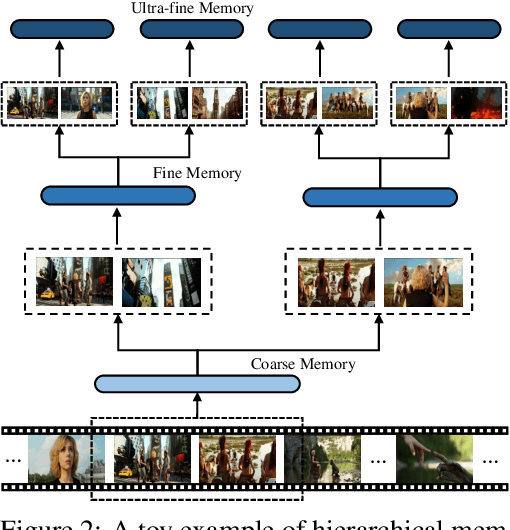
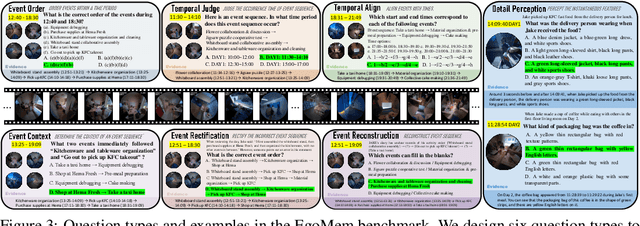
Recent studies have shown that agent-based systems leveraging large language models (LLMs) for key information retrieval and integration have emerged as a promising approach for long video understanding. However, these systems face two major challenges. First, they typically perform modeling and reasoning on individual frames, struggling to capture the temporal context of consecutive frames. Second, to reduce the cost of dense frame-level captioning, they adopt sparse frame sampling, which risks discarding crucial information. To overcome these limitations, we propose VideoLucy, a deep memory backtracking framework for long video understanding. Inspired by the human recollection process from coarse to fine, VideoLucy employs a hierarchical memory structure with progressive granularity. This structure explicitly defines the detail level and temporal scope of memory at different hierarchical depths. Through an agent-based iterative backtracking mechanism, VideoLucy systematically mines video-wide, question-relevant deep memories until sufficient information is gathered to provide a confident answer. This design enables effective temporal understanding of consecutive frames while preserving critical details. In addition, we introduce EgoMem, a new benchmark for long video understanding. EgoMem is designed to comprehensively evaluate a model's ability to understand complex events that unfold over time and capture fine-grained details in extremely long videos. Extensive experiments demonstrate the superiority of VideoLucy. Built on open-source models, VideoLucy significantly outperforms state-of-the-art methods on multiple long video understanding benchmarks, achieving performance even surpassing the latest proprietary models such as GPT-4o. Our code and dataset will be made publicly at https://videolucy.github.io
VChain: Chain-of-Visual-Thought for Reasoning in Video Generation
Oct 06, 2025Recent video generation models can produce smooth and visually appealing clips, but they often struggle to synthesize complex dynamics with a coherent chain of consequences. Accurately modeling visual outcomes and state transitions over time remains a core challenge. In contrast, large language and multimodal models (e.g., GPT-4o) exhibit strong visual state reasoning and future prediction capabilities. To bridge these strengths, we introduce VChain, a novel inference-time chain-of-visual-thought framework that injects visual reasoning signals from multimodal models into video generation. Specifically, VChain contains a dedicated pipeline that leverages large multimodal models to generate a sparse set of critical keyframes as snapshots, which are then used to guide the sparse inference-time tuning of a pre-trained video generator only at these key moments. Our approach is tuning-efficient, introduces minimal overhead and avoids dense supervision. Extensive experiments on complex, multi-step scenarios show that VChain significantly enhances the quality of generated videos.