 Add to Chrome
 Add to Firefox
 Add to Edge
Achieving Text-based Person Retrieval with Any Granularity
Jul 23, 2026
Text-based person retrieval faces a critical but under-explored challenge: the inherent uncertainty of query granularity in real-world scenarios. This paper introduces a new paradigm, Text-based Person Retrieval with Any Granularity, and provides a systematic solution. First, we formalize a five-level granularity spectrum and construct UFine6926-MG, a high-quality multi-grained dataset annotated comprehensively at all granularities via a novel Multi-grained Text Annotation Engine. Second, acknowledging that coarse queries naturally correspond to multiple valid candidates, we propose MG-Eval, a holistic evaluation benchmark with progressively detailed texts and cross-identity labels that reflect real-world semantics, alongside tailored evaluation metrics and protocols. Third, after a comprehensive diagnosis reveals the systemic limitations of existing research, we propose the Cross-modal Multi-grained Aligning and Matching (CMAM) framework. CMAM achieves granularity-aware retrieval through: 1) orthogonal-expert perception to disentangle granularity-specific features; 2) probabilistic alignment to model many-to-many matches under query uncertainty; and 3) granularity-consistent reasoning to steer feature learning via joint cross-modal granularity verification. Experiments demonstrate that CMAM significantly outperforms state-of-the-art methods across all granularity levels. This work establishes a foundational benchmark and a robust baseline, paving the way for more practical person retrieval systems.
* TPAMI-2026 Accepted Paper

Is Nano Banana Pro a Low-Level Vision All-Rounder? A Comprehensive Evaluation on 14 Tasks and 40 Datasets
Dec 19, 2025The rapid evolution of text-to-image generation models has revolutionized visual content creation. While commercial products like Nano Banana Pro have garnered significant attention, their potential as generalist solvers for traditional low-level vision challenges remains largely underexplored. In this study, we investigate the critical question: Is Nano Banana Pro a Low-Level Vision All-Rounder? We conducted a comprehensive zero-shot evaluation across 14 distinct low-level tasks spanning 40 diverse datasets. By utilizing simple textual prompts without fine-tuning, we benchmarked Nano Banana Pro against state-of-the-art specialist models. Our extensive analysis reveals a distinct performance dichotomy: while \textbf{Nano Banana Pro demonstrates superior subjective visual quality}, often hallucinating plausible high-frequency details that surpass specialist models, it lags behind in traditional reference-based quantitative metrics. We attribute this discrepancy to the inherent stochasticity of generative models, which struggle to maintain the strict pixel-level consistency required by conventional metrics. This report identifies Nano Banana Pro as a capable zero-shot contender for low-level vision tasks, while highlighting that achieving the high fidelity of domain specialists remains a significant hurdle.
VideoLucy: Deep Memory Backtracking for Long Video Understanding
Oct 14, 2025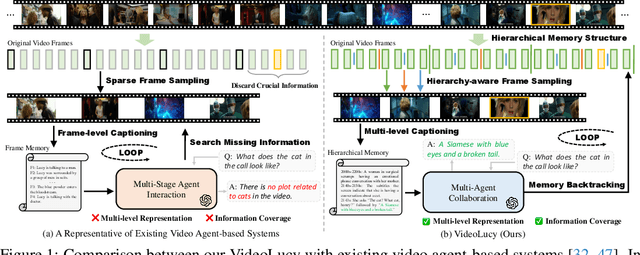
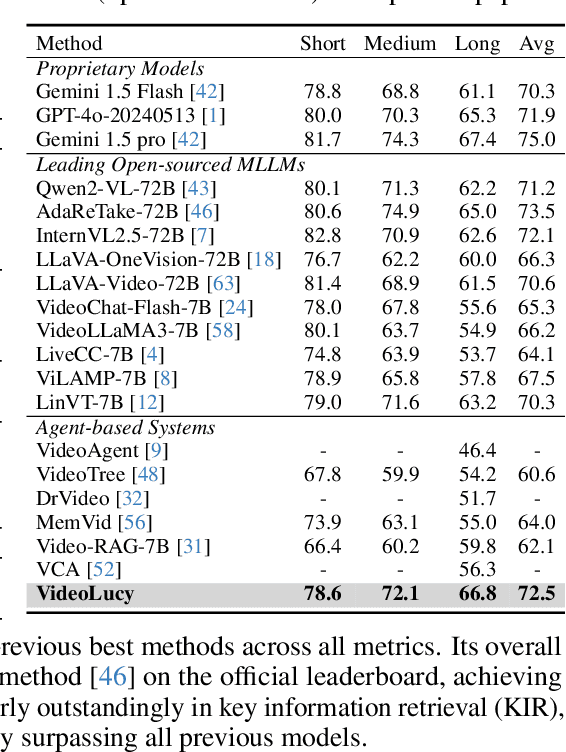
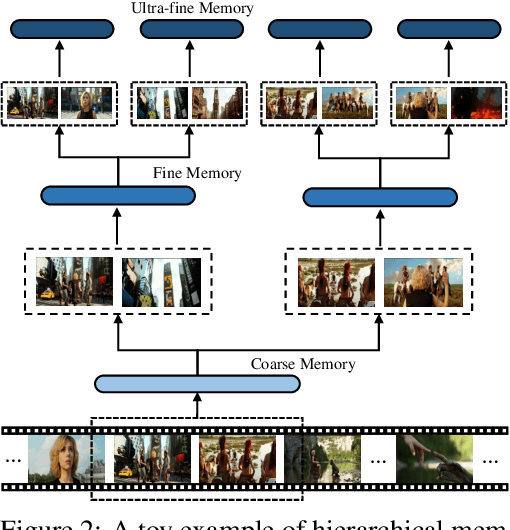
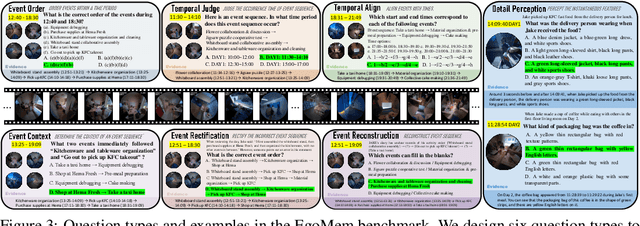
Recent studies have shown that agent-based systems leveraging large language models (LLMs) for key information retrieval and integration have emerged as a promising approach for long video understanding. However, these systems face two major challenges. First, they typically perform modeling and reasoning on individual frames, struggling to capture the temporal context of consecutive frames. Second, to reduce the cost of dense frame-level captioning, they adopt sparse frame sampling, which risks discarding crucial information. To overcome these limitations, we propose VideoLucy, a deep memory backtracking framework for long video understanding. Inspired by the human recollection process from coarse to fine, VideoLucy employs a hierarchical memory structure with progressive granularity. This structure explicitly defines the detail level and temporal scope of memory at different hierarchical depths. Through an agent-based iterative backtracking mechanism, VideoLucy systematically mines video-wide, question-relevant deep memories until sufficient information is gathered to provide a confident answer. This design enables effective temporal understanding of consecutive frames while preserving critical details. In addition, we introduce EgoMem, a new benchmark for long video understanding. EgoMem is designed to comprehensively evaluate a model's ability to understand complex events that unfold over time and capture fine-grained details in extremely long videos. Extensive experiments demonstrate the superiority of VideoLucy. Built on open-source models, VideoLucy significantly outperforms state-of-the-art methods on multiple long video understanding benchmarks, achieving performance even surpassing the latest proprietary models such as GPT-4o. Our code and dataset will be made publicly at https://videolucy.github.io
ReID5o: Achieving Omni Multi-modal Person Re-identification in a Single Model
Jun 11, 2025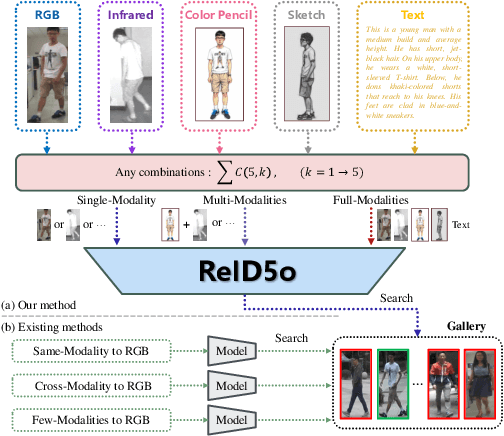
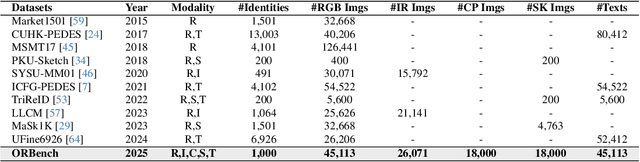
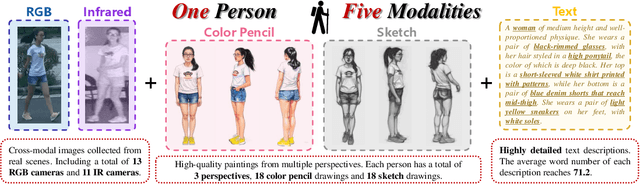
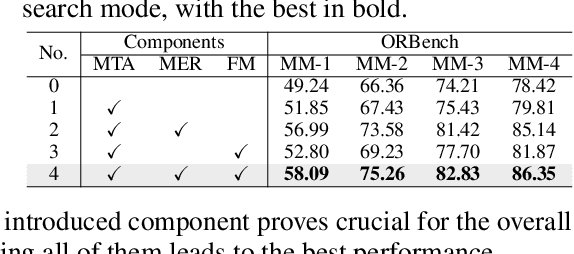
In real-word scenarios, person re-identification (ReID) expects to identify a person-of-interest via the descriptive query, regardless of whether the query is a single modality or a combination of multiple modalities. However, existing methods and datasets remain constrained to limited modalities, failing to meet this requirement. Therefore, we investigate a new challenging problem called Omni Multi-modal Person Re-identification (OM-ReID), which aims to achieve effective retrieval with varying multi-modal queries. To address dataset scarcity, we construct ORBench, the first high-quality multi-modal dataset comprising 1,000 unique identities across five modalities: RGB, infrared, color pencil, sketch, and textual description. This dataset also has significant superiority in terms of diversity, such as the painting perspectives and textual information. It could serve as an ideal platform for follow-up investigations in OM-ReID. Moreover, we propose ReID5o, a novel multi-modal learning framework for person ReID. It enables synergistic fusion and cross-modal alignment of arbitrary modality combinations in a single model, with a unified encoding and multi-expert routing mechanism proposed. Extensive experiments verify the advancement and practicality of our ORBench. A wide range of possible models have been evaluated and compared on it, and our proposed ReID5o model gives the best performance. The dataset and code will be made publicly available at https://github.com/Zplusdragon/ReID5o_ORBench.