 Add to Chrome
 Add to Firefox
 Add to Edge
World-to-Wrist: Task-Conditioned Future Wrist Modeling for Fine-Grained Robot Manipulation
Aug 05, 2026
Vision-language-action (VLA) models often treat main-view and wrist-view observations as parallel visual inputs, overlooking their distinct roles in robot manipulation. Fine-grained manipulation, however, benefits from anticipating how wrist-local interactions may evolve under the global task context. To address this limitation, we present World-to-Wrist VLA (W2-VLA), a VLA model for fine-grained robot manipulation with task-conditioned future wrist modeling. Given current multi-view observations and a task instruction, W2-VLA contextualizes a set of latent modeling tokens as a compact interface between the vision-language model and the wrist predictor. Conditioned on this interface and the observed wrist history, the predictor forecasts future wrist latents, which are transformed into future-aware context for action prediction. In addition, we introduce W2-CoT, a synthesis pipeline that produces structured annotations describing manipulation progress, physical transition cues, and wrist-local evidence. These annotations provide auxiliary supervision that shapes the task-conditioned latent interface. Experiments on LIBERO, RoboTwin 2.0, and real-world manipulation tasks demonstrate improved fine-grained and contact-sensitive manipulation across both single-arm and bimanual settings, while maintaining action-generation rates above 80 Hz.

ResearchStudio-Idea: An Evidence-Grounded Research-Ideation Skill Suite from ML Conference Outcomes
Jul 05, 2026Large language models have made research ideation increasingly accessible, yet effective idea development requires more than generating candidate directions. Researchers must ground a problem in current literature, identify meaningful bottlenecks, differentiate from existing solutions, and evaluate risks before committing to implementation. We present ResearchStudio-Idea as a reusable skill suite for this first mile of research ideation. The suite includes Paper-Search, a standalone multi-source literature search skill; Scoop-Check, a standalone prior-art collision checker for novelty claims; and IdeaSpark, the end-to-end skill that composes evidence grounding, pattern-guided generation, collision retrieval, audit, and idea-card rendering into one workflow. IdeaSpark is constructed from a corpus of 1,947 machine learning conference papers collected from ICLR, ICML, and NeurIPS between 2021 and 2025, including Oral papers, a separately tracked high-citation subset, and rejected submissions. Analysis of these outcomes reveals 31 recurring ideation sub-patterns, consolidated into 15 reusable ideation patterns. Each pattern is operationalized as a structured card containing research contexts, bottleneck types, differentiation strategies, supporting precedents, and common failure modes. Given a research problem and an evidence bundle, IdeaSpark evaluates evidence readiness, reconstructs the surrounding research context, identifies unresolved bottlenecks, selects relevant patterns, instantiates one candidate direction, retrieves potentially conflicting prior work, and performs outcome-informed auditing. This workflow transforms reusable ideation patterns into traceable research proposals. Blind automated-judge evaluations show that IdeaSpark consistently produces stronger research proposals than no-skill and generic-skill baselines while maintaining competitive novelty.
ResearchStudio-Reel: Automate the Last Mile of Research from Paper to Poster, Video, and Blog
Jul 05, 2026Research dissemination, turning a paper into a poster, a talk video, and a blog post, is still a manual last mile. Prior automation treats each artifact in isolation that each re-extract the paper from scratch, usually ship one-way renders the author cannot reopen in PowerPoint or Word, and gates quality on soft VLM-preference scores that plateau while load-bearing sections still read as empty. We argue this last mile is best built as a composition of skills: thin agent-readable contracts that share one upstream extractor and wrap deterministic primitives in a measured-fill loop whose exits are hard pass/fail render gates. We instantiate this as ResearchStudio-Reel, five Claude Code and Codex skills organized into one shared extractor (Paper2Assets), three editable generators (Paper2Poster, Paper2Video, Paper2Blog), and one interactive convergence layer (Paper2Reel). Paper2Assets extracts each paper once into a shared bundle that can be reused by every downstream skill; The three generators produce a print-ready poster, a synchronized talk video, and a bilingual blog that stay factually consistent and round-trip through PowerPoint or Word; Paper2Reel then binds all three into a self-contained HTML viewer whose section-level clicks jump the video, slides, captions, and blog to matching content. On the Paper2Poster benchmark, our posters lead every aesthetic and information sub-criterion against both prior automated systems and single-shot frontier LLMs, surpassing the authors' own on aesthetics under two held-out VLM judges and winning overall on 84% to 93% of papers; capability audits further show that, by uniquely pairing narration-aligned on-slide highlights with a bilingual blog gated by layout-aware DOCX repair, ResearchStudio-Reel is the only pipeline to ship all three editable artifacts. Project is available at https://aka.ms/ResearchStudio
S-Agent: Spatial Tool-Use Elicits Reasoning for Spatial Intelligence
Jun 18, 2026Real-world spatial intelligence requires reasoning over a continuous and evolving 3D world, yet existing VLMs and tool-augmented agents largely remain tied to static, stateless inference from isolated visual observations. We introduce \textbf{\textsc{S-Agent}}, a spatial tool-use agentic paradigm for understanding and reasoning over continuous multi-view images and videos. By formulating spatial reasoning as spatio-temporal evidence accumulation rather than isolated frame-level prediction, \textsc{S-Agent} reshapes spatial perception into scene-centric understanding beyond frame-centric recognition. Specifically, \textsc{S-Agent} casts the VLM as a semantic planner that decides what evidence is needed, while a hierarchy of spatial tools and experts grounds objects in 2D, lifts them into 3D geometric evidence, and aggregates this evidence into high-level spatial knowledge (\textit{e.g.}, counting, measurement, orientation, and relative position). Additionally, a temporal memory mechanism, including Scene Memory for maintaining the evolving scene state and Agent Memory for accumulating reasoning context, enables evidence integration across frames and reasoning steps. Comprehensive experiments on multi-view and video spatial reasoning benchmarks show that \textsc{S-Agent} consistently improves both open-source and closed-source VLMs in a training-free manner. Beyond inference-time augmentation, supervised fine-tuning (SFT) on \textsc{S-Agent}-generated spatial trajectories \textsc{S-300K} yields \textsc{S-Agent-8B}, a compact spatial agent that significantly surpasses similar-scale baselines (e.g., Qwen3-VL-8B) and performs comparably to advanced closed-source models (e.g., GPT-5.4 and Gemini 3).
Demystifying Data Organization for Enhanced LLM Training
May 28, 2026Large Language Models (LLMs) have revolutionized various fields, yet their training efficiency is heavily reliant on effective data curation. While data selection has been widely studied, the strategic data organization for enhanced training remains an underexplored area, particularly since current LLMs are often trained for only one or a few epochs. This paper systematically explores the influence of data organization on LLM training by reusing pre-computed sample-level scores originally generated for data efficiency, thereby incurring minimal additional computational overhead. We identify and formalize four key guidelines for optimizing data organization: Boundary Sharpening, Cyclic Scheduling, Curriculum Continuity, and Local Diversity. Guided by them, we introduce two novel data ordering methods termed STR and SAW. Extensive experiments across different model scales and data sizes, encompassing both pre-training and SFT stages, validate the effectiveness of our summarized guidelines. They also demonstrate the robustness of our proposed data ordering methods in enhancing the stability and performance of LLM training. Github Link: https://github.com/microsoft/data-efficacy/
SpatialBench: Is Your Spatial Foundation Model an All-Round Player?
May 26, 2026While spatial foundation models have demonstrated impressive performance on standard datasets, a critical question remains: are they truly all-round players capable of generalizing robustly across diverse downstream tasks, arbitrary viewpoints, shifting scene domains, varying input densities, and specific hardware constraints? Answering this overarching question requires a holistic assessment, yet current models are mainly evaluated on specific domains for which they were specifically designed or trained. Such evaluations are intrinsically limited by narrow paradigm coverage, limited scene domains, and arbitrary frame sampling, making it fundamentally difficult to assess their true generalization capabilities. To address this gap, we present SpatialBench, a cross-paradigm, domain-diverse benchmark for spatial foundation models with deterministic sampling. SpatialBench features unprecedented scale and rigorous deterministic design, comprising 19 datasets and 546 scenes across 5 diverse spatial domains. It comprehensively evaluates 41 models across 6 paradigms on 5 task suites under 4 different input density settings. Our extensive evaluation reveals that current models are not yet all-round players, and uncovers crucial insights for future advancement. Specifically, we demonstrate that full-context attention maximizes accuracy while bounded-memory strategies unlock long-sequence scalability. Moreover, our empirical evaluations in challenging embodied and egocentric tasks demonstrate that strict domain alignment and high data quality are far more critical to performance than simple dataset scaling. Furthermore, to address the largest data gap identified in our analysis, we go beyond evaluation by introducing a large-scale dataset, DA-Next-5M, and a strong baseline model, DA-Next, pushing the boundaries of spatial representation learning.
OmniVGGT: Omni-Modality Driven Visual Geometry Grounded Transformer
Nov 14, 2025General 3D foundation models have started to lead the trend of unifying diverse vision tasks, yet most assume RGB-only inputs and ignore readily available geometric cues (e.g., camera intrinsics, poses, and depth maps). To address this issue, we introduce OmniVGGT, a novel framework that can effectively benefit from an arbitrary number of auxiliary geometric modalities during both training and inference. In our framework, a GeoAdapter is proposed to encode depth and camera intrinsics/extrinsics into a spatial foundation model. It employs zero-initialized convolutions to progressively inject geometric information without disrupting the foundation model's representation space. This design ensures stable optimization with negligible overhead, maintaining inference speed comparable to VGGT even with multiple additional inputs. Additionally, a stochastic multimodal fusion regimen is proposed, which randomly samples modality subsets per instance during training. This enables an arbitrary number of modality inputs during testing and promotes learning robust spatial representations instead of overfitting to auxiliary cues. Comprehensive experiments on monocular/multi-view depth estimation, multi-view stereo, and camera pose estimation demonstrate that OmniVGGT outperforms prior methods with auxiliary inputs and achieves state-of-the-art results even with RGB-only input. To further highlight its practical utility, we integrated OmniVGGT into vision-language-action (VLA) models. The enhanced VLA model by OmniVGGT not only outperforms the vanilla point-cloud-based baseline on mainstream benchmarks, but also effectively leverages accessible auxiliary inputs to achieve consistent gains on robotic tasks.
Data Efficacy for Language Model Training
Jun 26, 2025Data is fundamental to the training of language models (LM). Recent research has been dedicated to data efficiency, which aims to maximize performance by selecting a minimal or optimal subset of training data. Techniques such as data filtering, sampling, and selection play a crucial role in this area. To complement it, we define Data Efficacy, which focuses on maximizing performance by optimizing the organization of training data and remains relatively underexplored. This work introduces a general paradigm, DELT, for considering data efficacy in LM training, which highlights the significance of training data organization. DELT comprises three components: Data Scoring, Data Selection, and Data Ordering. Among these components, we design Learnability-Quality Scoring (LQS), as a new instance of Data Scoring, which considers both the learnability and quality of each data sample from the gradient consistency perspective. We also devise Folding Ordering (FO), as a novel instance of Data Ordering, which addresses issues such as model forgetting and data distribution bias. Comprehensive experiments validate the data efficacy in LM training, which demonstrates the following: Firstly, various instances of the proposed DELT enhance LM performance to varying degrees without increasing the data scale and model size. Secondly, among these instances, the combination of our proposed LQS for data scoring and Folding for data ordering achieves the most significant improvement. Lastly, data efficacy can be achieved together with data efficiency by applying data selection. Therefore, we believe that data efficacy is a promising foundational area in LM training.
CoSurfGS:Collaborative 3D Surface Gaussian Splatting with Distributed Learning for Large Scene Reconstruction
Dec 23, 20243D Gaussian Splatting (3DGS) has demonstrated impressive performance in scene reconstruction. However, most existing GS-based surface reconstruction methods focus on 3D objects or limited scenes. Directly applying these methods to large-scale scene reconstruction will pose challenges such as high memory costs, excessive time consumption, and lack of geometric detail, which makes it difficult to implement in practical applications. To address these issues, we propose a multi-agent collaborative fast 3DGS surface reconstruction framework based on distributed learning for large-scale surface reconstruction. Specifically, we develop local model compression (LMC) and model aggregation schemes (MAS) to achieve high-quality surface representation of large scenes while reducing GPU memory consumption. Extensive experiments on Urban3d, MegaNeRF, and BlendedMVS demonstrate that our proposed method can achieve fast and scalable high-fidelity surface reconstruction and photorealistic rendering. Our project page is available at \url{https://gyy456.github.io/CoSurfGS}.
Radiant: Large-scale 3D Gaussian Rendering based on Hierarchical Framework
Dec 07, 2024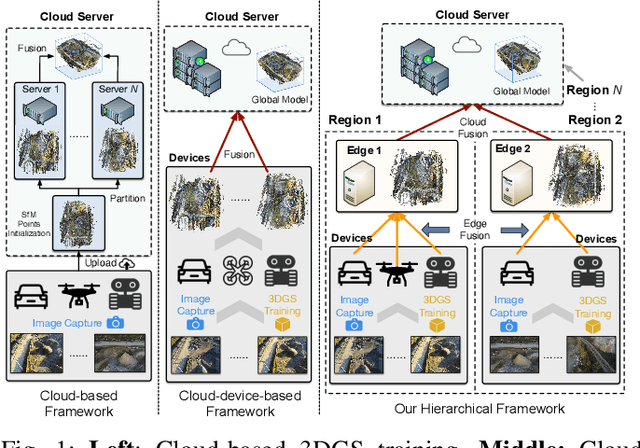
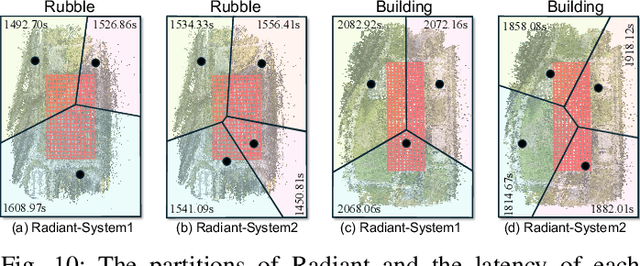
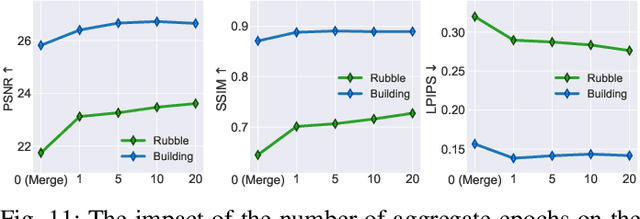
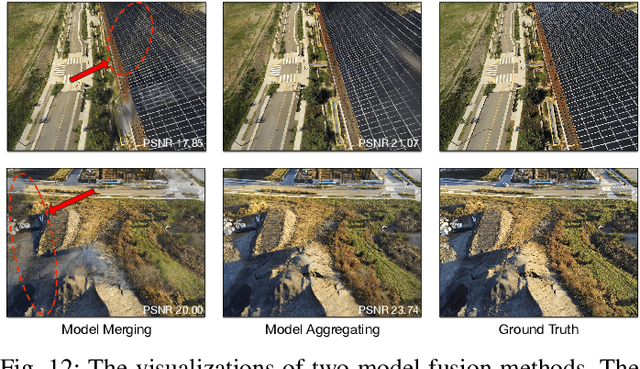
With the advancement of computer vision, the recently emerged 3D Gaussian Splatting (3DGS) has increasingly become a popular scene reconstruction algorithm due to its outstanding performance. Distributed 3DGS can efficiently utilize edge devices to directly train on the collected images, thereby offloading computational demands and enhancing efficiency. However, traditional distributed frameworks often overlook computational and communication challenges in real-world environments, hindering large-scale deployment and potentially posing privacy risks. In this paper, we propose Radiant, a hierarchical 3DGS algorithm designed for large-scale scene reconstruction that considers system heterogeneity, enhancing the model performance and training efficiency. Via extensive empirical study, we find that it is crucial to partition the regions for each edge appropriately and allocate varying camera positions to each device for image collection and training. The core of Radiant is partitioning regions based on heterogeneous environment information and allocating workloads to each device accordingly. Furthermore, we provide a 3DGS model aggregation algorithm that enhances the quality and ensures the continuity of models' boundaries. Finally, we develop a testbed, and experiments demonstrate that Radiant improved reconstruction quality by up to 25.7\% and reduced up to 79.6\% end-to-end latency.