 Add to Chrome
 Add to Firefox
 Add to Edge
Intern-S2-Preview: Scientific Agentic Foundation Model
Aug 13, 2026
Scientific discovery increasingly requires AI systems that can reason over scientific evidence of heterogeneous modalities, interact with scientific tools and environments, and sustain progress across long task horizons. We present Intern-S2-Preview, a series of scientific agentic foundation models designed to support multimodal scientific understanding, reasoning, generation, and long-horizon tasks. The training pipeline begins with scientific multimodal pre-training over rendered scientific documents, interleaved image-text data, and diverse scientific corpora. Starting from the pretrained checkpoint, we apply a unified post-training pipeline consisting of supervised fine-tuning, scalable multi-task reinforcement learning (RL), black- and white-box agentic RL, and on-policy distillation. This pipeline is supported by practical techniques that improve rollout and training stability and efficiency, including partial rollout with off-policy correction, adaptive length regularization, online speculative decoding, robust multi-task optimization, and trace-aware experience assembly for agentic tasks. At the architecture level, Intern-S2-Preview-397B extends time series modelling from efficient long-sequence understanding to numerical forecasting, while Memory Decoder is studied as a separate memory-augmented path for rapid scientific specialization without modifying the frozen 397B backbone. Evaluations across scientific, multimodal, agentic, and general-purpose benchmarks show that Intern-S2-Preview-397B achieves competitive or leading results in multiple settings. The time series modules improve scientific signal understanding and forecasting on SciTS, while the separate Intern-MemDec-4B extension improves the Biology-Instructions average score from 56.92 to 60.32 without modifying the frozen 397B backbone.

Distilling Physical Priors into Streaming World Models
Aug 08, 2026Streaming world models predict future visual states online while maintaining physically coherent dynamics over long horizons. However, their rollouts often violate basic physical constraints. A common approach distills pretrained bidirectional DiTs into few-step causal generators. However, this paradigm suffers from two fundamental limitations: generic bidirectional teachers acquire limited physical priors from visually oriented pretraining, and the limited priors suffer further loss during bidirectional-to-causal distillation. We present PhyS, a three-stage framework for distilling physical priors into streaming world models. To acquire physical priors from real-world interactions, we construct PhyS-120K, a dataset of 120K real-world physical-interaction videos spanning rigid-body dynamics, soft-body deformation, fluid phenomena, and phase transitions. Each video is annotated with structured descriptions of object properties and causal state transitions. Physics-aware supervised fine-tuning injects the physical priors into a bidirectional 14B DiT teacher, which we then distill into a lightweight 1.3B causal DiT for few-step autoregressive streaming generation. Finally, we use online reinforcement learning to incentivize the distilled model to generate physically plausible rollouts and further propose Temporal Credit Routing (TCR) to address temporal credit assignment. TCR evaluates physical consistency over overlapping temporal windows and routes the resulting group-relative advantages to temporally aligned denoising actions. On PhysicsIQ, PhyS improves the Wan2.1-14B teacher by 18.2\% and the Self Forcing, Rolling Forcing, and Causal Forcing by 23.7\%, 14.8\%, and 31.4\%, respectively. Results also improve the physics-aware video benchmarks VideoPhy, VideoPhy2, and PhyGenBench. The dataset, code, and more sample videos are available on our Project Page.
Intern-S1-Pro: Scientific Multimodal Foundation Model at Trillion Scale
Mar 26, 2026We introduce Intern-S1-Pro, the first one-trillion-parameter scientific multimodal foundation model. Scaling to this unprecedented size, the model delivers a comprehensive enhancement across both general and scientific domains. Beyond stronger reasoning and image-text understanding capabilities, its intelligence is augmented with advanced agent capabilities. Simultaneously, its scientific expertise has been vastly expanded to master over 100 specialized tasks across critical science fields, including chemistry, materials, life sciences, and earth sciences. Achieving this massive scale is made possible by the robust infrastructure support of XTuner and LMDeploy, which facilitates highly efficient Reinforcement Learning (RL) training at the 1-trillion parameter level while ensuring strict precision consistency between training and inference. By seamlessly integrating these advancements, Intern-S1-Pro further fortifies the fusion of general and specialized intelligence, working as a Specializable Generalist, demonstrating its position in the top tier of open-source models for general capabilities, while outperforming proprietary models in the depth of specialized scientific tasks.
ScaleEdit-12M: Scaling Open-Source Image Editing Data Generation via Multi-Agent Framework
Mar 21, 2026Instruction-based image editing has emerged as a key capability for unified multimodal models (UMMs), yet constructing large-scale, diverse, and high-quality editing datasets without costly proprietary APIs remains challenging. Previous image editing datasets either rely on closed-source models for annotation, which prevents cost-effective scaling, or employ fixed synthetic editing pipelines, which suffer from limited quality and generalizability. To address these challenges, we propose ScaleEditor, a fully open-source hierarchical multi-agent framework for end-to-end construction of large-scale, high-quality image editing datasets. Our pipeline consists of three key components: source image expansion with world-knowledge infusion, adaptive multi-agent editing instruction-image synthesis, and a task-aware data quality verification mechanism. Using ScaleEditor, we curate ScaleEdit-12M, the largest open-source image editing dataset to date, spanning 23 task families across diverse real and synthetic domains. Fine-tuning UniWorld-V1 and Bagel on ScaleEdit yields consistent gains, improving performance by up to 10.4% on ImgEdit and 35.1% on GEdit for general editing benchmarks and by up to 150.0% on RISE and 26.5% on KRIS-Bench for knowledge-infused benchmarks. These results demonstrate that open-source, agentic pipelines can approach commercial-grade data quality while retaining cost-effectiveness and scalability. Both the framework and dataset will be open-sourced.
InternVL-U: Democratizing Unified Multimodal Models for Understanding, Reasoning, Generation and Editing
Mar 10, 2026Unified multimodal models (UMMs) that integrate understanding, reasoning, generation, and editing face inherent trade-offs between maintaining strong semantic comprehension and acquiring powerful generation capabilities. In this report, we present InternVL-U, a lightweight 4B-parameter UMM that democratizes these capabilities within a unified framework. Guided by the principles of unified contextual modeling and modality-specific modular design with decoupled visual representations, InternVL-U integrates a state-of-the-art Multimodal Large Language Model (MLLM) with a specialized MMDiT-based visual generation head. To further bridge the gap between aesthetic generation and high-level intelligence, we construct a comprehensive data synthesis pipeline targeting high-semantic-density tasks, such as text rendering and scientific reasoning, under a reasoning-centric paradigm that leverages Chain-of-Thought (CoT) to better align abstract user intent with fine-grained visual generation details. Extensive experiments demonstrate that InternVL-U achieves a superior performance - efficiency balance. Despite using only 4B parameters, it consistently outperforms unified baseline models with over 3x larger scales such as BAGEL (14B) on various generation and editing tasks, while retaining strong multimodal understanding and reasoning capabilities.
RealDPO: Real or Not Real, that is the Preference
Oct 16, 2025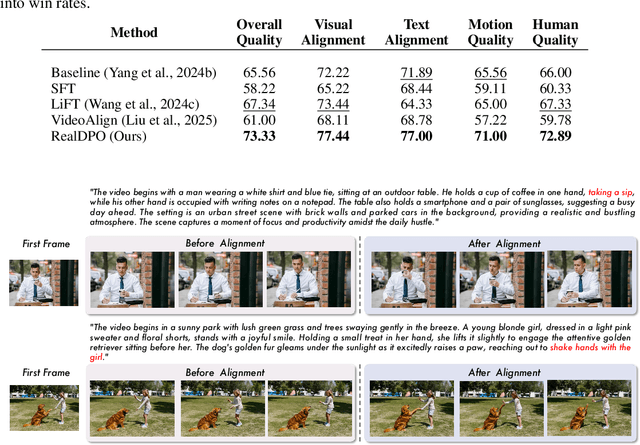
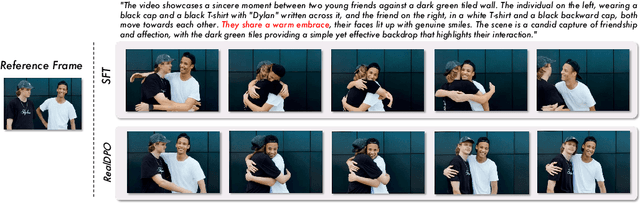
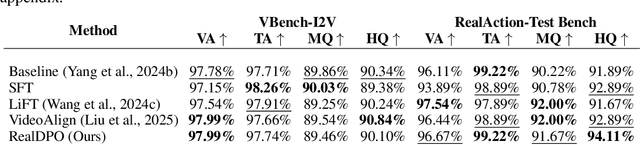
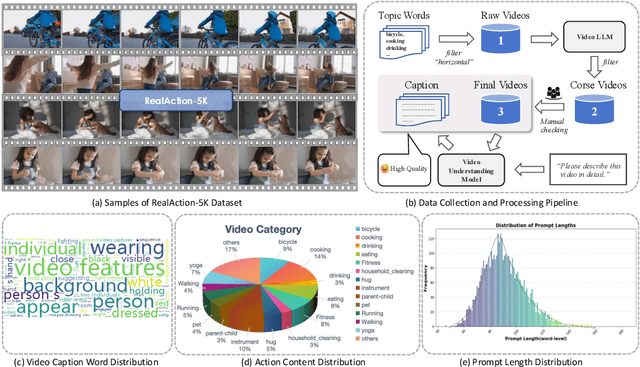
Video generative models have recently achieved notable advancements in synthesis quality. However, generating complex motions remains a critical challenge, as existing models often struggle to produce natural, smooth, and contextually consistent movements. This gap between generated and real-world motions limits their practical applicability. To address this issue, we introduce RealDPO, a novel alignment paradigm that leverages real-world data as positive samples for preference learning, enabling more accurate motion synthesis. Unlike traditional supervised fine-tuning (SFT), which offers limited corrective feedback, RealDPO employs Direct Preference Optimization (DPO) with a tailored loss function to enhance motion realism. By contrasting real-world videos with erroneous model outputs, RealDPO enables iterative self-correction, progressively refining motion quality. To support post-training in complex motion synthesis, we propose RealAction-5K, a curated dataset of high-quality videos capturing human daily activities with rich and precise motion details. Extensive experiments demonstrate that RealDPO significantly improves video quality, text alignment, and motion realism compared to state-of-the-art models and existing preference optimization techniques.
IPDN: Image-enhanced Prompt Decoding Network for 3D Referring Expression Segmentation
Jan 09, 2025


3D Referring Expression Segmentation (3D-RES) aims to segment point cloud scenes based on a given expression. However, existing 3D-RES approaches face two major challenges: feature ambiguity and intent ambiguity. Feature ambiguity arises from information loss or distortion during point cloud acquisition due to limitations such as lighting and viewpoint. Intent ambiguity refers to the model's equal treatment of all queries during the decoding process, lacking top-down task-specific guidance. In this paper, we introduce an Image enhanced Prompt Decoding Network (IPDN), which leverages multi-view images and task-driven information to enhance the model's reasoning capabilities. To address feature ambiguity, we propose the Multi-view Semantic Embedding (MSE) module, which injects multi-view 2D image information into the 3D scene and compensates for potential spatial information loss. To tackle intent ambiguity, we designed a Prompt-Aware Decoder (PAD) that guides the decoding process by deriving task-driven signals from the interaction between the expression and visual features. Comprehensive experiments demonstrate that IPDN outperforms the state-ofthe-art by 1.9 and 4.2 points in mIoU metrics on the 3D-RES and 3D-GRES tasks, respectively.
Exploring Phrase-Level Grounding with Text-to-Image Diffusion Model
Jul 07, 2024Recently, diffusion models have increasingly demonstrated their capabilities in vision understanding. By leveraging prompt-based learning to construct sentences, these models have shown proficiency in classification and visual grounding tasks. However, existing approaches primarily showcase their ability to perform sentence-level localization, leaving the potential for leveraging contextual information for phrase-level understanding largely unexplored. In this paper, we utilize Panoptic Narrative Grounding (PNG) as a proxy task to investigate this capability further. PNG aims to segment object instances mentioned by multiple noun phrases within a given narrative text. Specifically, we introduce the DiffPNG framework, a straightforward yet effective approach that fully capitalizes on the diffusion's architecture for segmentation by decomposing the process into a sequence of localization, segmentation, and refinement steps. The framework initially identifies anchor points using cross-attention mechanisms and subsequently performs segmentation with self-attention to achieve zero-shot PNG. Moreover, we introduce a refinement module based on SAM to enhance the quality of the segmentation masks. Our extensive experiments on the PNG dataset demonstrate that DiffPNG achieves strong performance in the zero-shot PNG task setting, conclusively proving the diffusion model's capability for context-aware, phrase-level understanding. Source code is available at \url{https://github.com/nini0919/DiffPNG}.
SAM as the Guide: Mastering Pseudo-Label Refinement in Semi-Supervised Referring Expression Segmentation
Jun 03, 2024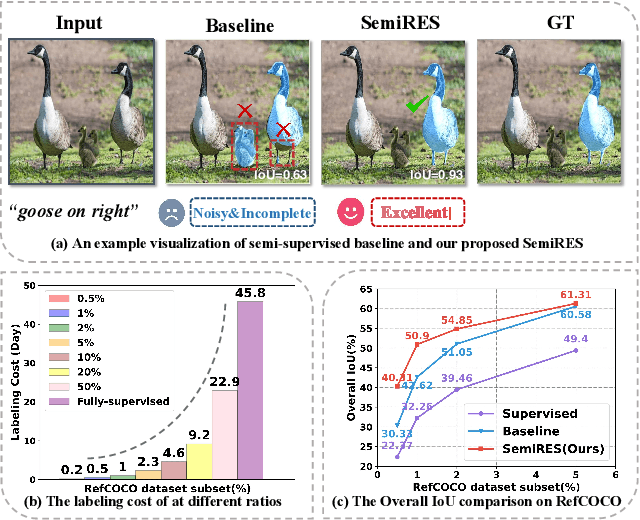
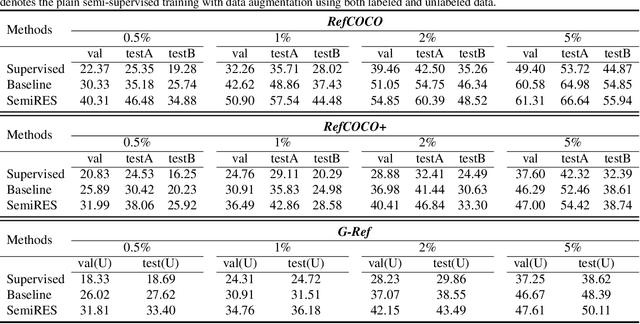
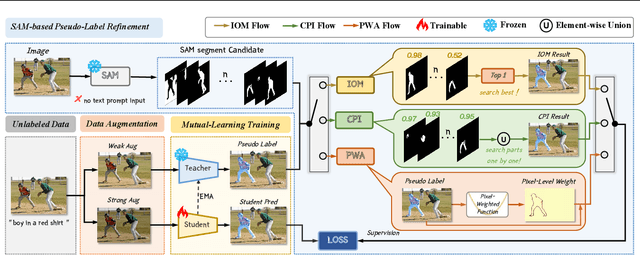
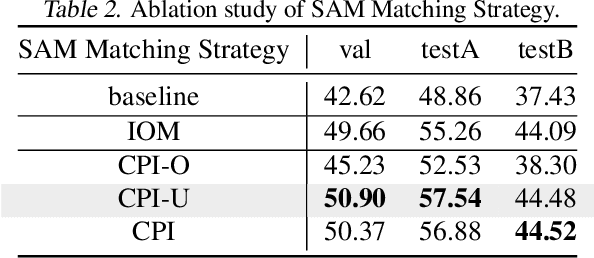
In this paper, we introduce SemiRES, a semi-supervised framework that effectively leverages a combination of labeled and unlabeled data to perform RES. A significant hurdle in applying semi-supervised techniques to RES is the prevalence of noisy pseudo-labels, particularly at the boundaries of objects. SemiRES incorporates the Segment Anything Model (SAM), renowned for its precise boundary demarcation, to improve the accuracy of these pseudo-labels. Within SemiRES, we offer two alternative matching strategies: IoU-based Optimal Matching (IOM) and Composite Parts Integration (CPI). These strategies are designed to extract the most accurate masks from SAM's output, thus guiding the training of the student model with enhanced precision. In instances where a precise mask cannot be matched from the available candidates, we develop the Pixel-Wise Adjustment (PWA) strategy, guiding the student model's training directly by the pseudo-labels. Extensive experiments on three RES benchmarks--RefCOCO, RefCOCO+, and G-Ref reveal its superior performance compared to fully supervised methods. Remarkably, with only 1% labeled data, our SemiRES outperforms the supervised baseline by a large margin, e.g. +18.64% gains on RefCOCO val set. The project code is available at \url{https://github.com/nini0919/SemiRES}.
Semi-Supervised Panoptic Narrative Grounding
Oct 27, 2023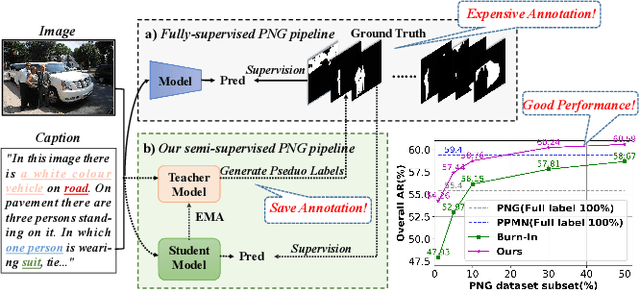
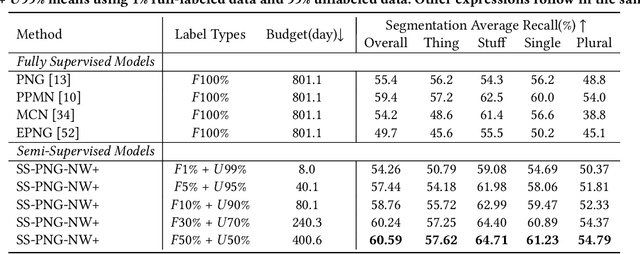
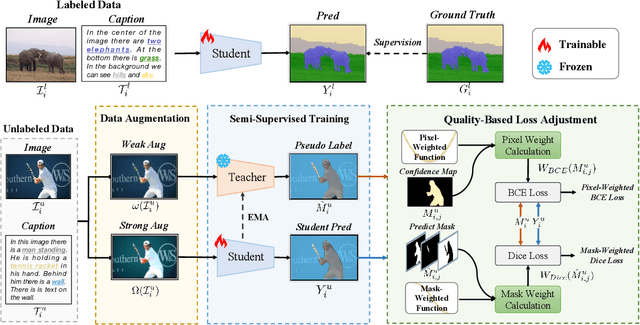
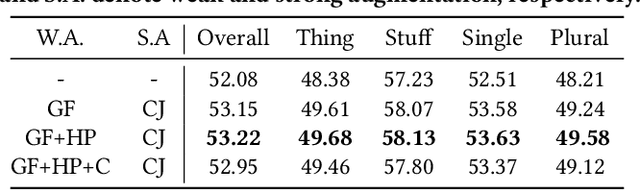
Despite considerable progress, the advancement of Panoptic Narrative Grounding (PNG) remains hindered by costly annotations. In this paper, we introduce a novel Semi-Supervised Panoptic Narrative Grounding (SS-PNG) learning scheme, capitalizing on a smaller set of labeled image-text pairs and a larger set of unlabeled pairs to achieve competitive performance. Unlike visual segmentation tasks, PNG involves one pixel belonging to multiple open-ended nouns. As a result, existing multi-class based semi-supervised segmentation frameworks cannot be directly applied to this task. To address this challenge, we first develop a novel SS-PNG Network (SS-PNG-NW) tailored to the SS-PNG setting. We thoroughly investigate strategies such as Burn-In and data augmentation to determine the optimal generic configuration for the SS-PNG-NW. Additionally, to tackle the issue of imbalanced pseudo-label quality, we propose a Quality-Based Loss Adjustment (QLA) approach to adjust the semi-supervised objective, resulting in an enhanced SS-PNG-NW+. Employing our proposed QLA, we improve BCE Loss and Dice loss at pixel and mask levels, respectively. We conduct extensive experiments on PNG datasets, with our SS-PNG-NW+ demonstrating promising results comparable to fully-supervised models across all data ratios. Remarkably, our SS-PNG-NW+ outperforms fully-supervised models with only 30% and 50% supervision data, exceeding their performance by 0.8% and 1.1% respectively. This highlights the effectiveness of our proposed SS-PNG-NW+ in overcoming the challenges posed by limited annotations and enhancing the applicability of PNG tasks. The source code is available at https://github.com/nini0919/SSPNG.