 Add to Chrome
 Add to Firefox
 Add to Edge
SenseNova-U1: Unifying Multimodal Understanding and Generation with NEO-unify Architecture
May 12, 2026
Recent large vision-language models (VLMs) remain fundamentally constrained by a persistent dichotomy: understanding and generation are treated as distinct problems, leading to fragmented architectures, cascaded pipelines, and misaligned representation spaces. We argue that this divide is not merely an engineering artifact, but a structural limitation that hinders the emergence of native multimodal intelligence. Hence, we introduce SenseNova-U1, a native unified multimodal paradigm built upon NEO-unify, in which understanding and generation evolve as synergistic views of a single underlying process. We launch two native unified variants, SenseNova-U1-8B-MoT and SenseNova-U1-A3B-MoT, built on dense (8B) and mixture-of-experts (30B-A3B) understanding baselines, respectively. Designed from first principles, they rival top-tier understanding-only VLMs across text understanding, vision-language perception, knowledge reasoning, agentic decision-making, and spatial intelligence. Meanwhile, they deliver strong semantic consistency and visual fidelity, excelling in conventional or knowledge-intensive any-to-image (X2I) synthesis, complex text-rich infographic generation, and interleaved vision-language generation, with or without think patterns. Beyond performance, we show detailed model design, data preprocessing, pre-/post-training, and inference strategies to support community research. Last but not least, preliminary evidence demonstrates that our models extend beyond perception and generation, performing strongly in vision-language-action (VLA) and world model (WM) scenarios. This points toward a broader roadmap where models do not translate between modalities, but think and act across them in a native manner. Multimodal AI is no longer about connecting separate systems, but about building a unified one and trusting the necessary capabilities to emerge from within.

MonoArt: Progressive Structural Reasoning for Monocular Articulated 3D Reconstruction
Mar 19, 2026Reconstructing articulated 3D objects from a single image requires jointly inferring object geometry, part structure, and motion parameters from limited visual evidence. A key difficulty lies in the entanglement between motion cues and object structure, which makes direct articulation regression unstable. Existing methods address this challenge through multi-view supervision, retrieval-based assembly, or auxiliary video generation, often sacrificing scalability or efficiency. We present MonoArt, a unified framework grounded in progressive structural reasoning. Rather than predicting articulation directly from image features, MonoArt progressively transforms visual observations into canonical geometry, structured part representations, and motion-aware embeddings within a single architecture. This structured reasoning process enables stable and interpretable articulation inference without external motion templates or multi-stage pipelines. Extensive experiments on PartNet-Mobility demonstrate that OM achieves state-of-the-art performance in both reconstruction accuracy and inference speed. The framework further generalizes to robotic manipulation and articulated scene reconstruction.
Demystifing Video Reasoning
Mar 17, 2026Recent advances in video generation have revealed an unexpected phenomenon: diffusion-based video models exhibit non-trivial reasoning capabilities. Prior work attributes this to a Chain-of-Frames (CoF) mechanism, where reasoning is assumed to unfold sequentially across video frames. In this work, we challenge this assumption and uncover a fundamentally different mechanism. We show that reasoning in video models instead primarily emerges along the diffusion denoising steps. Through qualitative analysis and targeted probing experiments, we find that models explore multiple candidate solutions in early denoising steps and progressively converge to a final answer, a process we term Chain-of-Steps (CoS). Beyond this core mechanism, we identify several emergent reasoning behaviors critical to model performance: (1) working memory, enabling persistent reference; (2) self-correction and enhancement, allowing recovery from incorrect intermediate solutions; and (3) perception before action, where early steps establish semantic grounding and later steps perform structured manipulation. During a diffusion step, we further uncover self-evolved functional specialization within Diffusion Transformers, where early layers encode dense perceptual structure, middle layers execute reasoning, and later layers consolidate latent representations. Motivated by these insights, we present a simple training-free strategy as a proof-of-concept, demonstrating how reasoning can be improved by ensembling latent trajectories from identical models with different random seeds. Overall, our work provides a systematic understanding of how reasoning emerges in video generation models, offering a foundation to guide future research in better exploiting the inherent reasoning dynamics of video models as a new substrate for intelligence.
Scaling Spatial Intelligence with Multimodal Foundation Models
Nov 17, 2025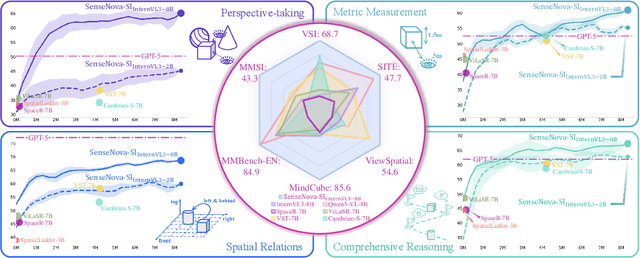
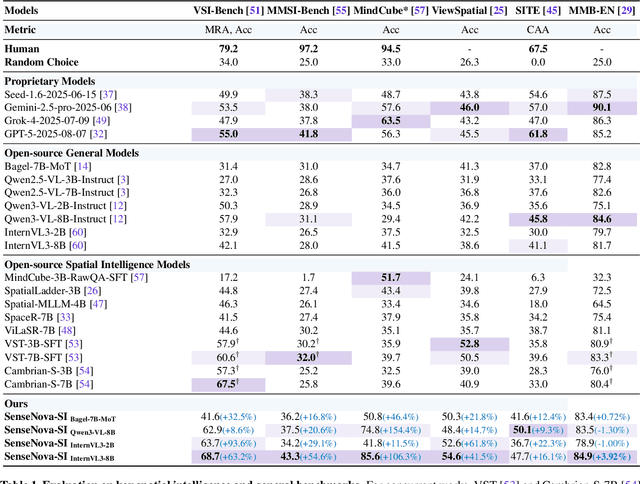
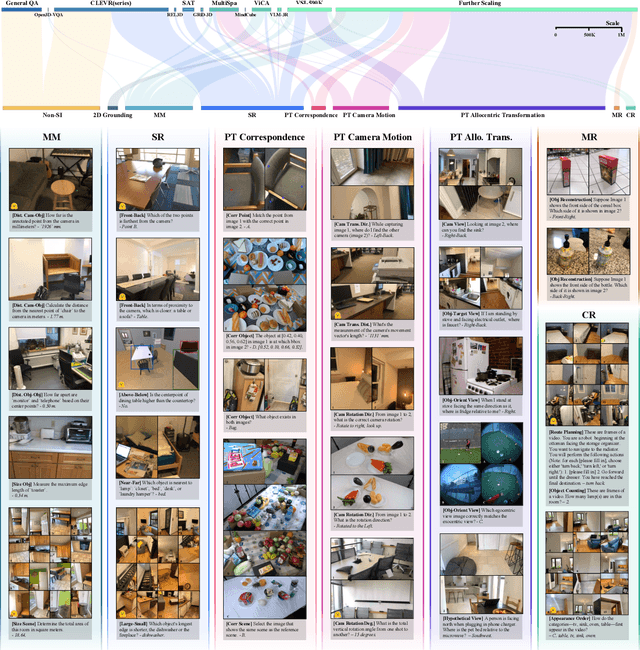
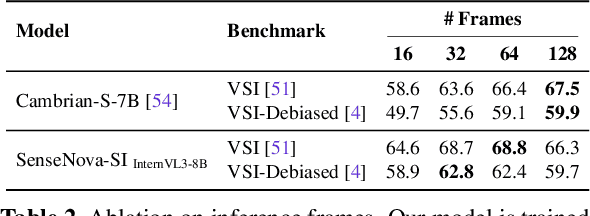
Despite remarkable progress, multimodal foundation models still exhibit surprising deficiencies in spatial intelligence. In this work, we explore scaling up multimodal foundation models to cultivate spatial intelligence within the SenseNova-SI family, built upon established multimodal foundations including visual understanding models (i.e., Qwen3-VL and InternVL3) and unified understanding and generation models (i.e., Bagel). We take a principled approach to constructing high-performing and robust spatial intelligence by systematically curating SenseNova-SI-8M: eight million diverse data samples under a rigorous taxonomy of spatial capabilities. SenseNova-SI demonstrates unprecedented performance across a broad range of spatial intelligence benchmarks: 68.7% on VSI-Bench, 43.3% on MMSI, 85.6% on MindCube, 54.6% on ViewSpatial, and 50.1% on SITE, while maintaining strong general multimodal understanding (e.g., 84.9% on MMBench-En). More importantly, we analyze the impact of data scaling, discuss early signs of emergent generalization capabilities enabled by diverse data training, analyze the risk of overfitting and language shortcuts, present a preliminary study on spatial chain-of-thought reasoning, and validate the potential downstream application. SenseNova-SI is an ongoing project, and this report will be updated continuously. All newly trained multimodal foundation models are publicly released to facilitate further research in this direction.