 Add to Chrome
 Add to Firefox
 Add to Edge
LTM: Large-scale Terrain Model for Wildfire-prone Landscapes
Jul 09, 2026
Accurate 3D terrain maps are essential for emergency response when assessing wildfire hazards. However, wildfire-prone regions often span vast areas where conventional reconstruction methods underperform. Airborne LiDAR systems provide high-resolution terrain data, but they are expensive and infrequently updated. Image-based methods offer a lower-cost alternative, but struggle due to sparse visual features and limited image overlap. We propose a multi-modal reconstruction framework leveraging outdated Digital Elevation Models (DEMs) as geometric priors for image-based 3D reconstruction. Our key innovation is physics-based pixel-pixel alignment between images and DEM data, dramatically reducing computational complexity by eliminating expensive feature matching procedures. To validate our approach, we developed a large-terrain simulator based on a real wildfire-prone area, generating realistic images enabling a comprehensive evaluation. Given posed images and legacy DEMs, our method produces high-fidelity depth maps while maintaining real-time performance. We find significant improvements in reconstruction accuracy and computational efficiency over existing techniques, offering a scalable solution for wildfire response.

UniGP: Taming Diffusion Transformer for Prior-Preserved Unified Generation and Perception
Jun 29, 2026Recent advances in diffusion models have shown impressive performance in controllable image generation and dense prediction tasks. However, existing approaches typically treat diffusion-based controllable generation and dense prediction as separate tasks, overlooking the potential benefits of jointly modeling the heterogeneous distributions. In this work, we introduce UniGP, a framework built upon MMDiT, which unifies controllable generation and dense prediction through simple joint training, without the need for complex task-specific designs or losses, while preserving the backbone's versatile priors. By learning controllable generation and prediction under different conditions, our model effectively captures the joint distribution of image-geometry pairs. UniGP is capable of versatile controllable generation, dense prediction, and joint generation. Specifically, the proposed UniGP consists of DUGP and a unified dataset training strategy. The former, following the principle of Occam's razor, uses only a copied image branch of MMDiT to model dense distributions beyond RGB, while the latter integrates heterogeneous datasets into a unified training framework to jointly model generation and perception tasks. Extensive experiments demonstrate that our unified model surpasses prior unified approaches and performs on par with specialized methods. Furthermore, we demonstrate that multi-task joint training provides complementary benefits: generative priors enrich perceptual details, while perceptual learning improves structural alignment in generation.
SciText2Eq: Assessing LLMs for Explainable Equation Generation for Scientific Creativity
Jun 14, 2026This work investigates the ability of large language models (LLMs) to generate mathematical equations from scientific texts. Prior work faces challenges in unstructured grounding, multi-equation dependency, and humanaligned evaluation. To this end, we construct a dataset of AI research papers, pairing contextual passages with ground-truth equations and variable descriptions. We develop an explainable equation generation workflow and evaluate it across diverse open- and closed-source LLM backbones. We introduce an evaluation protocol combining automatic metrics, LLM-based rubrics, and human judgments to assess accuracy, explainability, and human-LLM alignment. Results indicate that LLMs perform moderately on lexical- and syntactic-based similarity, while struggling with semantic accuracy. Comparisons between LLM-based evaluations and human judgments reveal limited alignment, highlighting challenges in using LLMs to assess equation quality. These findings offer insights for improving equation generation models and developing more reliable evaluation methods for scientific text. We provide code and data for reproducibility.
Cosmos 3: Omnimodal World Models for Physical AI
Jun 01, 2026We introduce Cosmos 3, a family of omnimodal world models designed to jointly process and generate language, image, video, audio, and action sequences within a unified mixture-of-transformers architecture. By supporting highly flexible input-output configurations, Cosmos 3 seamlessly unifies critical modalities for Physical AI -- effectively subsuming vision-language models, video generators, world simulators, and world-action models into a single framework. Our evaluation demonstrates that Cosmos 3 establishes a new state-of-the-art across a diverse suite of understanding and generation tasks, demonstrating omnimodal world models as scalable, general-purpose backbones for embodied agents. Our post-trained Cosmos 3 models were ranked as the best open-source Text-to-Image and Image-to-Video models by Artificial Analysis, and the best policy model by RoboArena at the time the technical report was written. To accelerate open research and deployment in Physical AI, we make our code, model checkpoints, curated synthetic datasets, and evaluation benchmark available under the Linux Foundation's OpenMDW-1.1 https://openmdw.ai/license/1-1/ License at https://github.com/nvidia/cosmos}{github.com/nvidia/cosmos and https://huggingface.co/collections/nvidia/cosmos3 . The project website is available at https://research.nvidia.com/labs/cosmos-lab/cosmos3 .
Unregistered Spectral Image Fusion: Unmixing, Adversarial Learning, and Recoverability
Mar 23, 2026This paper addresses the fusion of a pair of spatially unregistered hyperspectral image (HSI) and multispectral image (MSI) covering roughly overlapping regions. HSIs offer high spectral but low spatial resolution, while MSIs provide the opposite. The goal is to integrate their complementary information to enhance both HSI spatial resolution and MSI spectral resolution. While hyperspectral-multispectral fusion (HMF) has been widely studied, the unregistered setting remains challenging. Many existing methods focus solely on MSI super-resolution, leaving HSI unchanged. Supervised deep learning approaches were proposed for HSI super-resolution, but rely on accurate training data, which is often unavailable. Moreover, theoretical analyses largely address the co-registered case, leaving unregistered HMF poorly understood. In this work, an unsupervised framework is proposed to simultaneously super-resolve both MSI and HSI. The method integrates coupled spectral unmixing for MSI super-resolution with latent-space adversarial learning for HSI super-resolution. Theoretical guarantees on the recoverability of the super-resolution MSI and HSI are established under reasonable generative models -- providing, to our best knowledge, the first such insights for unregistered HMF. The approach is validated on semi-real and real HSI-MSI pairs across diverse conditions.
Interplay: Training Independent Simulators for Reference-Free Conversational Recommendation
Mar 19, 2026Training conversational recommender systems (CRS) requires extensive dialogue data, which is challenging to collect at scale. To address this, researchers have used simulated user-recommender conversations. Traditional simulation approaches often utilize a single large language model (LLM) that generates entire conversations with prior knowledge of the target items, leading to scripted and artificial dialogues. We propose a reference-free simulation framework that trains two independent LLMs, one as the user and one as the conversational recommender. These models interact in real-time without access to predetermined target items, but preference summaries and target attributes, enabling the recommender to genuinely infer user preferences through dialogue. This approach produces more realistic and diverse conversations that closely mirror authentic human-AI interactions. Our reference-free simulators match or exceed existing methods in quality, while offering a scalable solution for generating high-quality conversational recommendation data without constraining conversations to pre-defined target items. We conduct both quantitative and human evaluations to confirm the effectiveness of our reference-free approach.
Taming Score-Based Denoisers in ADMM: A Convergent Plug-and-Play Framework
Mar 10, 2026While score-based generative models have emerged as powerful priors for solving inverse problems, directly integrating them into optimization algorithms such as ADMM remains nontrivial. Two central challenges arise: i) the mismatch between the noisy data manifolds used to train the score functions and the geometry of ADMM iterates, especially due to the influence of dual variables, and ii) the lack of convergence understanding when ADMM is equipped with score-based denoisers. To address the manifold mismatch issue, we propose ADMM plug-and-play (ADMM-PnP) with the AC-DC denoiser, a new framework that embeds a three-stage denoiser into ADMM: (1) auto-correction (AC) via additive Gaussian noise, (2) directional correction (DC) using conditional Langevin dynamics, and (3) score-based denoising. In terms of convergence, we establish two results: first, under proper denoiser parameters, each ADMM iteration is a weakly nonexpansive operator, ensuring high-probability fixed-point $\textit{ball convergence}$ using a constant step size; second, under more relaxed conditions, the AC-DC denoiser is a bounded denoiser, which leads to convergence under an adaptive step size schedule. Experiments on a range of inverse problems demonstrate that our method consistently improves solution quality over a variety of baselines.
DuoGen: Towards General Purpose Interleaved Multimodal Generation
Feb 03, 2026Interleaved multimodal generation enables capabilities beyond unimodal generation models, such as step-by-step instructional guides, visual planning, and generating visual drafts for reasoning. However, the quality of existing interleaved generation models under general instructions remains limited by insufficient training data and base model capacity. We present DuoGen, a general-purpose interleaved generation framework that systematically addresses data curation, architecture design, and evaluation. On the data side, we build a large-scale, high-quality instruction-tuning dataset by combining multimodal conversations rewritten from curated raw websites, and diverse synthetic examples covering everyday scenarios. Architecturally, DuoGen leverages the strong visual understanding of a pretrained multimodal LLM and the visual generation capabilities of a diffusion transformer (DiT) pretrained on video generation, avoiding costly unimodal pretraining and enabling flexible base model selection. A two-stage decoupled strategy first instruction-tunes the MLLM, then aligns DiT with it using curated interleaved image-text sequences. Across public and newly proposed benchmarks, DuoGen outperforms prior open-source models in text quality, image fidelity, and image-context alignment, and also achieves state-of-the-art performance on text-to-image and image editing among unified generation models. Data and code will be released at https://research.nvidia.com/labs/dir/duogen/.
SemanticGen: Video Generation in Semantic Space
Dec 24, 2025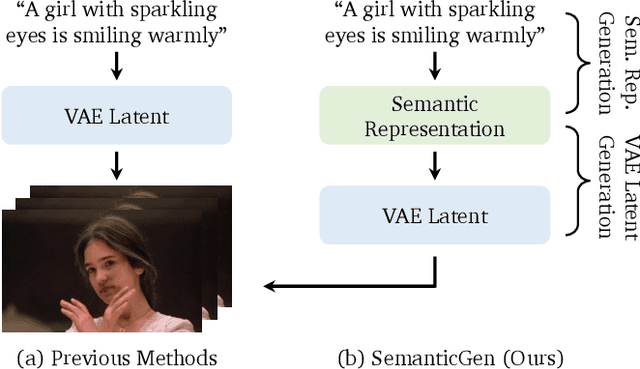
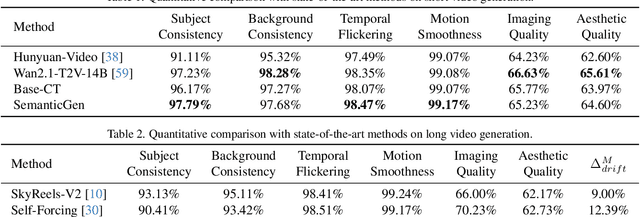
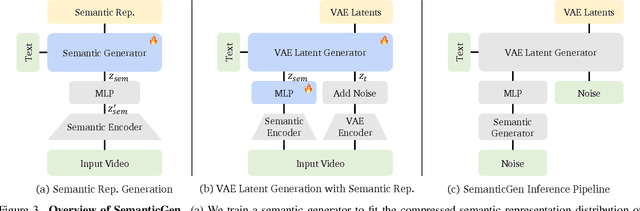

State-of-the-art video generative models typically learn the distribution of video latents in the VAE space and map them to pixels using a VAE decoder. While this approach can generate high-quality videos, it suffers from slow convergence and is computationally expensive when generating long videos. In this paper, we introduce SemanticGen, a novel solution to address these limitations by generating videos in the semantic space. Our main insight is that, due to the inherent redundancy in videos, the generation process should begin in a compact, high-level semantic space for global planning, followed by the addition of high-frequency details, rather than directly modeling a vast set of low-level video tokens using bi-directional attention. SemanticGen adopts a two-stage generation process. In the first stage, a diffusion model generates compact semantic video features, which define the global layout of the video. In the second stage, another diffusion model generates VAE latents conditioned on these semantic features to produce the final output. We observe that generation in the semantic space leads to faster convergence compared to the VAE latent space. Our method is also effective and computationally efficient when extended to long video generation. Extensive experiments demonstrate that SemanticGen produces high-quality videos and outperforms state-of-the-art approaches and strong baselines.
Rethinking Coupled Tensor Analysis for Hyperspectral Super-Resolution: Recoverable Modeling Under Endmember Variability
Dec 22, 2025This work revisits the hyperspectral super-resolution (HSR) problem, i.e., fusing a pair of spatially co-registered hyperspectral (HSI) and multispectral (MSI) images to recover a super-resolution image (SRI) that enhances the spatial resolution of the HSI. Coupled tensor decomposition (CTD)-based methods have gained traction in this domain, offering recoverability guarantees under various assumptions. Existing models such as canonical polyadic decomposition (CPD) and Tucker decomposition provide strong expressive power but lack physical interpretability. The block-term decomposition model with rank-$(L_r, L_r, 1)$ terms (the LL1 model) yields interpretable factors under the linear mixture model (LMM) of spectral images, but LMM assumptions are often violated in practice -- primarily due to nonlinear effects such as endmember variability (EV). To address this, we propose modeling spectral images using a more flexible block-term tensor decomposition with rank-$(L_r, M_r, N_r)$ terms (the LMN model). This modeling choice retains interpretability, subsumes CPD, Tucker, and LL1 as special cases, and robustly accounts for non-ideal effects such as EV, offering a balanced tradeoff between expressiveness and interpretability for HSR. Importantly, under the LMN model for HSI and MSI, recoverability of the SRI can still be established under proper conditions -- providing strong theoretical support. Extensive experiments on synthetic and real datasets further validate the effectiveness and robustness of the proposed method compared with existing CTD-based approaches.