 Add to Chrome
 Add to Firefox
 Add to Edge
Accuracy of Wearable ECG Parameter Calculation Method for Long QT and First-Degree A-V Block Detection: A Multi-Center Real-World Study with External Validations Compared to Standard ECG Machines and Cardiologist Assessments
Feb 21, 2025
In recent years, wearable devices have revolutionized cardiac monitoring by enabling continuous, non-invasive ECG recording in real-world settings. Despite these advances, the accuracy of ECG parameter calculations (PR interval, QRS interval, QT interval, etc.) from wearables remains to be rigorously validated against conventional ECG machines and expert clinician assessments. In this large-scale, multicenter study, we evaluated FeatureDB, a novel algorithm for automated computation of ECG parameters from wearable single-lead signals Three diverse datasets were employed: the AHMU-FH dataset (n=88,874), the CSE dataset (n=106), and the HeartVoice-ECG-lite dataset (n=369) with annotations provided by two experienced cardiologists. FeatureDB demonstrates a statistically significant correlation with key parameters (PR interval, QRS duration, QT interval, and QTc) calculated by standard ECG machines and annotated by clinical doctors. Bland-Altman analysis confirms a high level of agreement.Moreover,FeatureDB exhibited robust diagnostic performance in detecting Long QT syndrome (LQT) and atrioventricular block interval abnormalities (AVBI),with excellent area under the ROC curve (LQT: 0.836, AVBI: 0.861),accuracy (LQT: 0.856, AVBI: 0.845),sensitivity (LQT: 0.815, AVBI: 0.877),and specificity (LQT: 0.856, AVBI: 0.845).This further validates its clinical reliability. These results validate the clinical applicability of FeatureDB for wearable ECG analysis and highlight its potential to bridge the gap between traditional diagnostic methods and emerging wearable technologies.Ultimately,this study supports integrating wearable ECG devices into large-scale cardiovascular disease management and early intervention strategies,and it highlights the potential of wearable ECG technologies to deliver accurate,clinically relevant cardiac monitoring while advancing broader applications in cardiovascular care.

StructFlowBench: A Structured Flow Benchmark for Multi-turn Instruction Following
Feb 20, 2025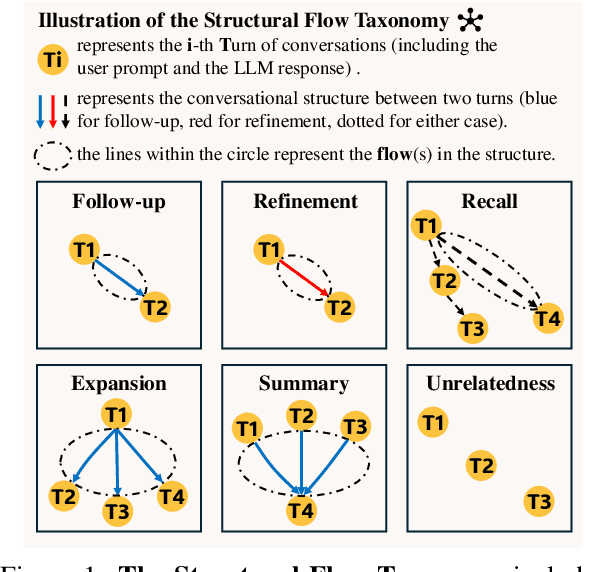
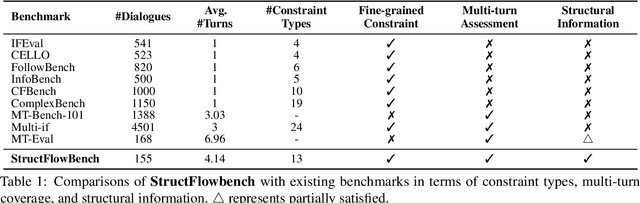
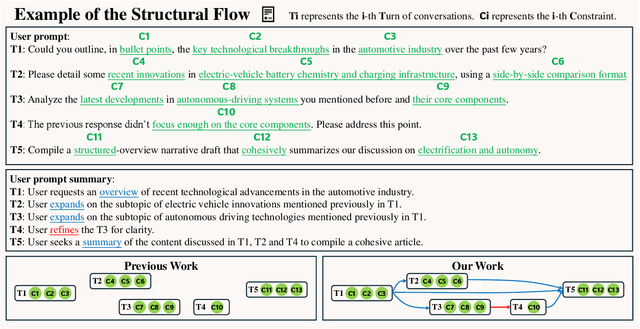
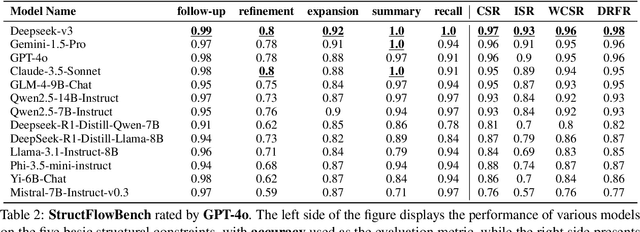
Multi-turn instruction following capability constitutes a core competency of large language models (LLMs) in real-world applications. Existing evaluation benchmarks predominantly focus on fine-grained constraint satisfaction and domain-specific capability assessment, yet overlook the crucial structural dependency between dialogue turns that distinguishes multi-turn from single-turn interactions. This structural dependency not only reflects user intent but also establishes a second dimension for instruction following evaluation beyond constraint satisfaction. To address this gap, we propose StructFlowBench, a multi-turn instruction following benchmark with structural flow modeling. The benchmark innovatively defines a structural flow framework comprising six fundamental inter-turn relationships, which not only introduces novel structural constraints for model evaluation but also serves as generation parameters for creating customized dialogue flows tailored to specific scenarios. Adopting established LLM-based automatic evaluation methodologies, we conduct systematic evaluations of 13 leading open-source and closed-source LLMs. Experimental results reveal significant deficiencies in current models' comprehension of multi-turn dialogue structures. The code is available at \url{https://github.com/MLGroupJLU/StructFlowBench}.
MOLLM: Multi-Objective Large Language Model for Molecular Design -- Optimizing with Experts
Feb 18, 2025Molecular design plays a critical role in advancing fields such as drug discovery, materials science, and chemical engineering. This work introduces the Multi-Objective Large Language Model for Molecular Design (MOLLM), a novel framework that combines domain-specific knowledge with the adaptability of Large Language Models to optimize molecular properties across multiple objectives. Leveraging in-context learning and multi-objective optimization, MOLLM achieves superior efficiency, innovation, and performance, significantly surpassing state-of-the-art (SOTA) methods. Recognizing the substantial impact of initial populations on evolutionary algorithms, we categorize them into three types: best initial, worst initial, and random initial, to ensure the initial molecules are the same for each method across experiments. Our results demonstrate that MOLLM consistently outperforms SOTA models in all of our experiments. We also provide extensive ablation studies to evaluate the superiority of our components.
NatureLM: Deciphering the Language of Nature for Scientific Discovery
Feb 11, 2025


Foundation models have revolutionized natural language processing and artificial intelligence, significantly enhancing how machines comprehend and generate human languages. Inspired by the success of these foundation models, researchers have developed foundation models for individual scientific domains, including small molecules, materials, proteins, DNA, and RNA. However, these models are typically trained in isolation, lacking the ability to integrate across different scientific domains. Recognizing that entities within these domains can all be represented as sequences, which together form the "language of nature", we introduce Nature Language Model (briefly, NatureLM), a sequence-based science foundation model designed for scientific discovery. Pre-trained with data from multiple scientific domains, NatureLM offers a unified, versatile model that enables various applications including: (i) generating and optimizing small molecules, proteins, RNA, and materials using text instructions; (ii) cross-domain generation/design, such as protein-to-molecule and protein-to-RNA generation; and (iii) achieving state-of-the-art performance in tasks like SMILES-to-IUPAC translation and retrosynthesis on USPTO-50k. NatureLM offers a promising generalist approach for various scientific tasks, including drug discovery (hit generation/optimization, ADMET optimization, synthesis), novel material design, and the development of therapeutic proteins or nucleotides. We have developed NatureLM models in different sizes (1 billion, 8 billion, and 46.7 billion parameters) and observed a clear improvement in performance as the model size increases.
SMART: Advancing Scalable Map Priors for Driving Topology Reasoning
Feb 06, 2025Topology reasoning is crucial for autonomous driving as it enables comprehensive understanding of connectivity and relationships between lanes and traffic elements. While recent approaches have shown success in perceiving driving topology using vehicle-mounted sensors, their scalability is hindered by the reliance on training data captured by consistent sensor configurations. We identify that the key factor in scalable lane perception and topology reasoning is the elimination of this sensor-dependent feature. To address this, we propose SMART, a scalable solution that leverages easily available standard-definition (SD) and satellite maps to learn a map prior model, supervised by large-scale geo-referenced high-definition (HD) maps independent of sensor settings. Attributed to scaled training, SMART alone achieves superior offline lane topology understanding using only SD and satellite inputs. Extensive experiments further demonstrate that SMART can be seamlessly integrated into any online topology reasoning methods, yielding significant improvements of up to 28% on the OpenLane-V2 benchmark.
Reveal the Mystery of DPO: The Connection between DPO and RL Algorithms
Feb 05, 2025With the rapid development of Large Language Models (LLMs), numerous Reinforcement Learning from Human Feedback (RLHF) algorithms have been introduced to improve model safety and alignment with human preferences. These algorithms can be divided into two main frameworks based on whether they require an explicit reward (or value) function for training: actor-critic-based Proximal Policy Optimization (PPO) and alignment-based Direct Preference Optimization (DPO). The mismatch between DPO and PPO, such as DPO's use of a classification loss driven by human-preferred data, has raised confusion about whether DPO should be classified as a Reinforcement Learning (RL) algorithm. To address these ambiguities, we focus on three key aspects related to DPO, RL, and other RLHF algorithms: (1) the construction of the loss function; (2) the target distribution at which the algorithm converges; (3) the impact of key components within the loss function. Specifically, we first establish a unified framework named UDRRA connecting these algorithms based on the construction of their loss functions. Next, we uncover their target policy distributions within this framework. Finally, we investigate the critical components of DPO to understand their impact on the convergence rate. Our work provides a deeper understanding of the relationship between DPO, RL, and other RLHF algorithms, offering new insights for improving existing algorithms.
From Uncertain to Safe: Conformal Fine-Tuning of Diffusion Models for Safe PDE Control
Feb 04, 2025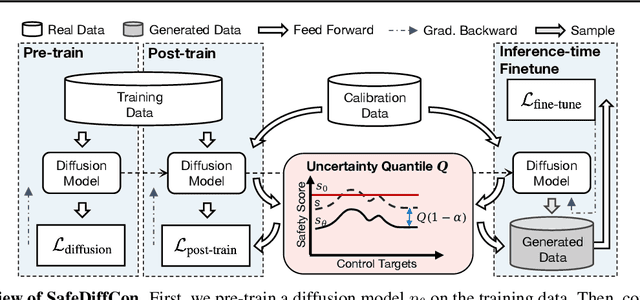
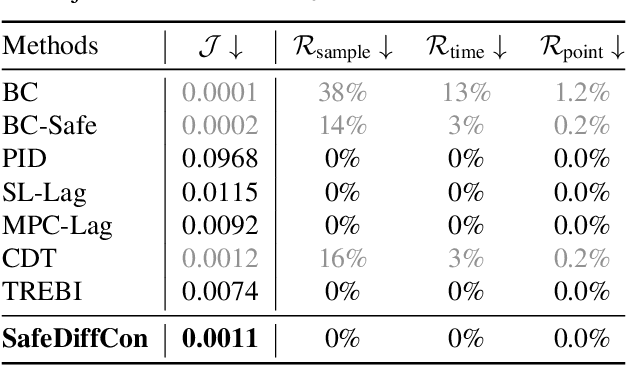
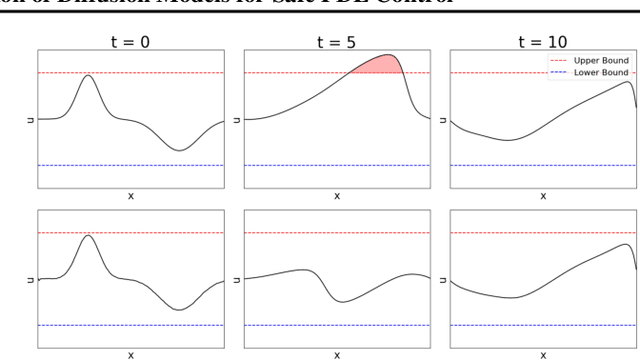
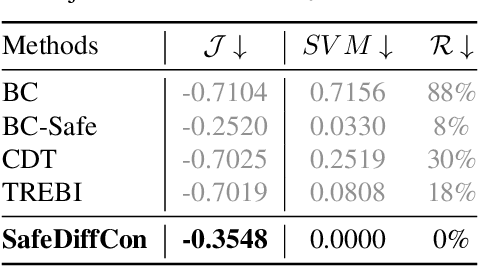
The application of deep learning for partial differential equation (PDE)-constrained control is gaining increasing attention. However, existing methods rarely consider safety requirements crucial in real-world applications. To address this limitation, we propose Safe Diffusion Models for PDE Control (SafeDiffCon), which introduce the uncertainty quantile as model uncertainty quantification to achieve optimal control under safety constraints through both post-training and inference phases. Firstly, our approach post-trains a pre-trained diffusion model to generate control sequences that better satisfy safety constraints while achieving improved control objectives via a reweighted diffusion loss, which incorporates the uncertainty quantile estimated using conformal prediction. Secondly, during inference, the diffusion model dynamically adjusts both its generation process and parameters through iterative guidance and fine-tuning, conditioned on control targets while simultaneously integrating the estimated uncertainty quantile. We evaluate SafeDiffCon on three control tasks: 1D Burgers' equation, 2D incompressible fluid, and controlled nuclear fusion problem. Results demonstrate that SafeDiffCon is the only method that satisfies all safety constraints, whereas other classical and deep learning baselines fail. Furthermore, while adhering to safety constraints, SafeDiffCon achieves the best control performance.
Compliance while resisting: a shear-thickening fluid controller for physical human-robot interaction
Feb 03, 2025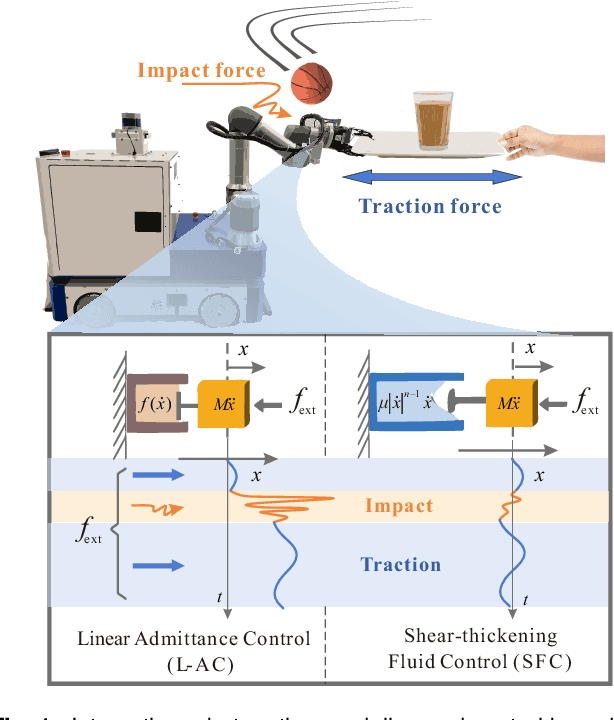
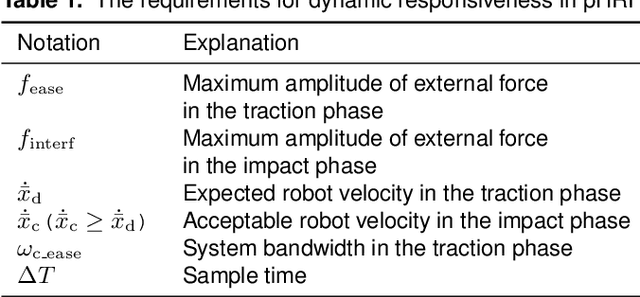
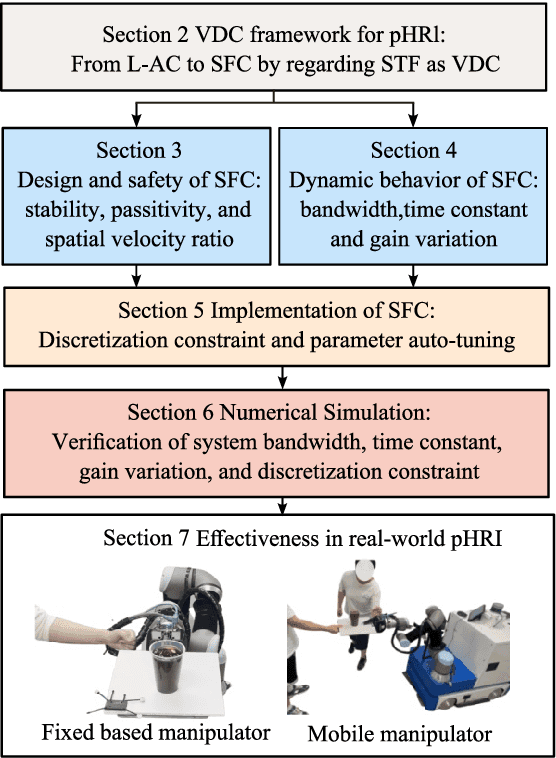
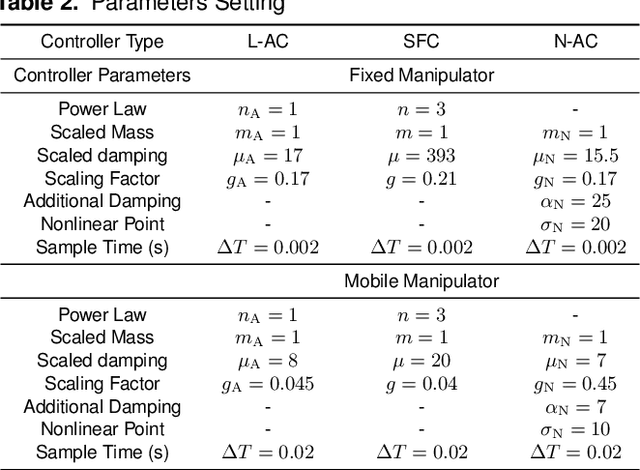
Physical human-robot interaction (pHRI) is widely needed in many fields, such as industrial manipulation, home services, and medical rehabilitation, and puts higher demands on the safety of robots. Due to the uncertainty of the working environment, the pHRI may receive unexpected impact interference, which affects the safety and smoothness of the task execution. The commonly used linear admittance control (L-AC) can cope well with high-frequency small-amplitude noise, but for medium-frequency high-intensity impact, the effect is not as good. Inspired by the solid-liquid phase change nature of shear-thickening fluid, we propose a Shear-thickening Fluid Control (SFC) that can achieve both an easy human-robot collaboration and resistance to impact interference. The SFC's stability, passivity, and phase trajectory are analyzed in detail, the frequency and time domain properties are quantified, and parameter constraints in discrete control and coupled stability conditions are provided. We conducted simulations to compare the frequency and time domain characteristics of L-AC, nonlinear admittance controller (N-AC), and SFC, and validated their dynamic properties. In real-world experiments, we compared the performance of L-AC, N-AC, and SFC in both fixed and mobile manipulators. L-AC exhibits weak resistance to impact. N-AC can resist moderate impacts but not high-intensity ones, and may exhibit self-excited oscillations. In contrast, SFC demonstrated superior impact resistance and maintained stable collaboration, enhancing comfort in cooperative water delivery tasks. Additionally, a case study was conducted in a factory setting, further affirming the SFC's capability in facilitating human-robot collaborative manipulation and underscoring its potential in industrial applications.
Disentangling Length Bias In Preference Learning Via Response-Conditioned Modeling
Feb 02, 2025

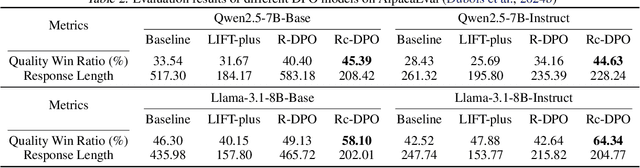
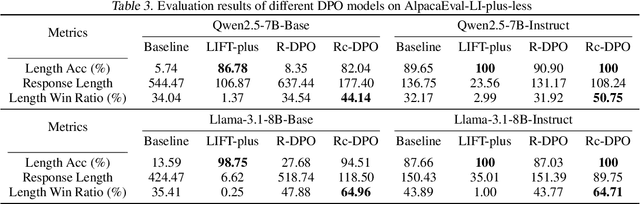
Reinforcement Learning from Human Feedback (RLHF) has achieved considerable success in aligning large language models (LLMs) by modeling human preferences with a learnable reward model and employing a reinforcement learning algorithm to maximize the reward model's scores. However, these reward models are susceptible to exploitation through various superficial confounding factors, with length bias emerging as a particularly significant concern. Moreover, while the pronounced impact of length bias on preference modeling suggests that LLMs possess an inherent sensitivity to length perception, our preliminary investigations reveal that fine-tuned LLMs consistently struggle to adhere to explicit length instructions. To address these two limitations, we propose a novel framework wherein the reward model explicitly differentiates between human semantic preferences and response length requirements. Specifically, we introduce a Response-conditioned Bradley-Terry (Rc-BT) model that enhances the reward model's capability in length bias mitigating and length instruction following, through training on our augmented dataset. Furthermore, we propose the Rc-DPO algorithm to leverage the Rc-BT model for direct policy optimization (DPO) of LLMs, simultaneously mitigating length bias and promoting adherence to length instructions. Extensive evaluations demonstrate that our approach substantially improves both preference modeling and length instruction compliance, with its effectiveness validated across various foundational models and preference datasets.
Thoughts Are All Over the Place: On the Underthinking of o1-Like LLMs
Jan 30, 2025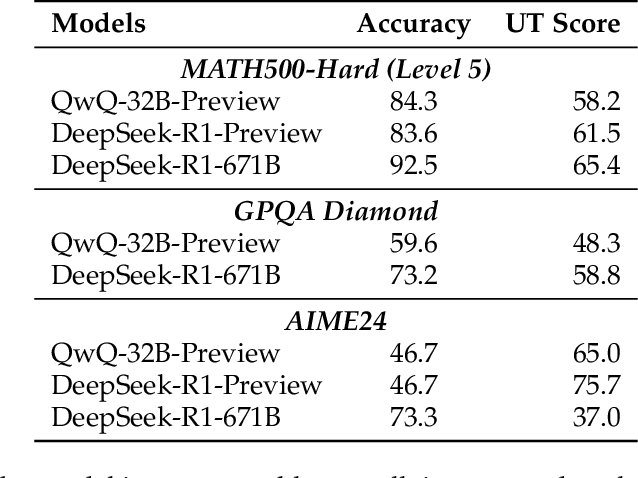
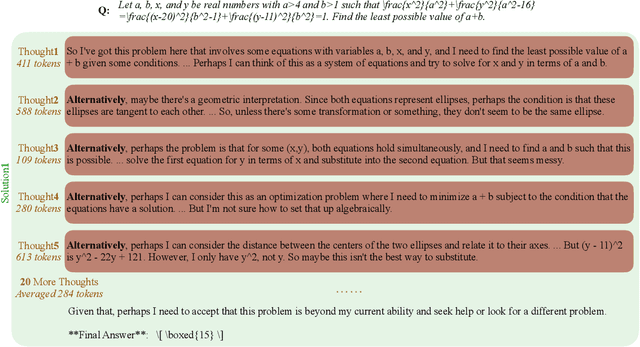
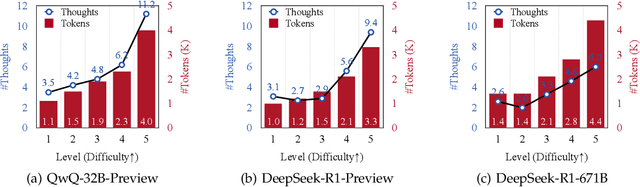
Large language models (LLMs) such as OpenAI's o1 have demonstrated remarkable abilities in complex reasoning tasks by scaling test-time compute and exhibiting human-like deep thinking. However, we identify a phenomenon we term underthinking, where o1-like LLMs frequently switch between different reasoning thoughts without sufficiently exploring promising paths to reach a correct solution. This behavior leads to inadequate depth of reasoning and decreased performance, particularly on challenging mathematical problems. To systematically analyze this issue, we conduct experiments on three challenging test sets and two representative open-source o1-like models, revealing that frequent thought switching correlates with incorrect responses. We introduce a novel metric to quantify underthinking by measuring token efficiency in incorrect answers. To address underthinking, we propose a decoding strategy with thought switching penalty TIP that discourages premature transitions between thoughts, encouraging deeper exploration of each reasoning path. Experimental results demonstrate that our approach improves accuracy across challenging datasets without requiring model fine-tuning. Our findings contribute to understanding reasoning inefficiencies in o1-like LLMs and offer a practical solution to enhance their problem-solving capabilities.