 Add to Chrome
 Add to Firefox
 Add to Edge
Narrative Knowledge Weaver: Narrative-Centric Retrieval-Augmented Reasoning for Long-Form Text Understanding
Jun 04, 2026
Long-form narrative QA requires reasoning over evolving story worlds rather than isolated passages: answers may depend on earlier goals, changing character states, social relations, causal triggers, temporal position, and later consequences. Existing retrieval and graph-augmented generation methods improve evidence access, but their units--chunks, entities, relations, summaries, or tool actions--do not directly encode how evidence functions in a story. We introduce Narrative Knowledge Weaver(NKW), a source-grounded framework that aligns textual evidence, atomic facts, canonical graph structure, entity profiles, interactions, episodes, and storylines. At query time, NKW uses text, graph, and narrative tools with post-retrieval reading skills to assemble evidence and audit actor, scope, polarity, state, and temporal constraints. Across STAGE, FairytaleQA, and QuALITY, NKW is strongest on screenplay-level story-world QA while remaining competitive on more passage-centered benchmarks. Ablations, question-type analyses, graph-asset statistics, and case studies show complementary benefits for character, scene, temporal, causal, and narrative-progression reasoning.

ForeSci: Evaluating LLM Agents for Forward-Looking AI Research Judgment
May 30, 2026AI research often requires decisions before future evidence exists: which bottleneck to attack, which direction to pursue, or where a project should be positioned. We introduce ForeSci, a temporally controlled benchmark for evaluating whether LLM agents can make such forward-looking research judgements from historical evidence. ForeSci contains 500 tasks across four fast-moving AI domains and four decision families. Each task is paired with a cutoff-aligned offline knowledge base; post-cutoff papers are hidden during generation and used only for validation. To avoid random future-event prediction, tasks are derived from pre-cutoff taxonomy branches and evidence signals, and answer-generation backbones are selected to precede the task cutoffs. We evaluate native LLMs, Hybrid RAG, and three research-agent adaptations across four backbones. Results show that explicit evidence organization improves traceability and factual support, but gains depend strongly on the decision family. Diagnostics reveal a recurring evidence-decision decoupling: agents may cite relevant evidence while forecasting the wrong research object. ForeSci turns forward-looking AI research judgement into a controlled benchmark for evaluating research agents as decision-making systems.
SciCustom: A Framework for Custom Evaluation of Scientific Capabilities in Large Language Models
May 19, 2026Large language models (LLMs) are increasingly applied to scientific research, yet existing evaluations often fail to reflect the fine-grained capabilities required in practice. Most benchmarks are manually curated or domain-generic, limiting scalability and alignment with real scientific use cases. In this paper, we propose a new framework named SciCustom to address the problem. It enables the custom construction of benchmarks from large-scale scientific data to evaluate application-specific scientific capabilities in LLMs. SciCustom first organizes scientific knowledge into ontology-grounded knowledge units with controlled granularity and trains a tagger to map large-scale data instances into this knowledge space. Given a custom requirement, relevant knowledge units are identified via voting-based multi-model consensus. These units enable relevance-aware benchmark retrieval via binary search, followed by proxy subset selection and data-grounded benchmark generation for efficient evaluation. Experiments in chemistry and healthcare demonstrate that SciCustom reveals fine-grained differences in LLM scientific capabilities that standard benchmarks overlook, while requiring neither expert annotation nor synthetic question generation. This work provides a scalable and application-aware foundation for benchmarking scientific capabilities in LLMs. The source code is available at https://github.com/yjwtheonly/SciCustom.
CoPA: Benchmarking Personalized Question Answering with Data-Informed Cognitive Factors
Apr 16, 2026While LLMs have demonstrated remarkable potential in Question Answering (QA), evaluating personalization remains a critical bottleneck. Existing paradigms predominantly rely on lexical-level similarity or manual heuristics, often lacking sufficient data-driven validation. We address this by mining Community-Individual Preference Divergence (CIPD), where individual choices override consensus, to distill six key personalization factors as evaluative dimensions. Accordingly, we introduce CoPA, a benchmark with 1,985 user profiles for fine-grained, factor-level assessment. By quantifying the alignment between model outputs and user-specific cognitive preferences inferred from interaction patterns, CoPA provides a more comprehensive and discriminative standard for evaluating personalized QA than generic metrics. The code is available at https://github.com/bjzgcai/CoPA.
MolChord: Structure-Sequence Alignment for Protein-Guided Drug Design
Oct 31, 2025Structure-based drug design (SBDD), which maps target proteins to candidate molecular ligands, is a fundamental task in drug discovery. Effectively aligning protein structural representations with molecular representations, and ensuring alignment between generated drugs and their pharmacological properties, remains a critical challenge. To address these challenges, we propose MolChord, which integrates two key techniques: (1) to align protein and molecule structures with their textual descriptions and sequential representations (e.g., FASTA for proteins and SMILES for molecules), we leverage NatureLM, an autoregressive model unifying text, small molecules, and proteins, as the molecule generator, alongside a diffusion-based structure encoder; and (2) to guide molecules toward desired properties, we curate a property-aware dataset by integrating preference data and refine the alignment process using Direct Preference Optimization (DPO). Experimental results on CrossDocked2020 demonstrate that our approach achieves state-of-the-art performance on key evaluation metrics, highlighting its potential as a practical tool for SBDD.
Trust Region Preference Approximation: A simple and stable reinforcement learning algorithm for LLM reasoning
Apr 06, 2025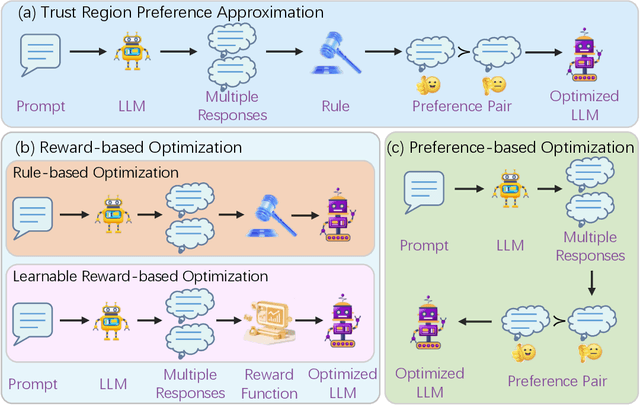
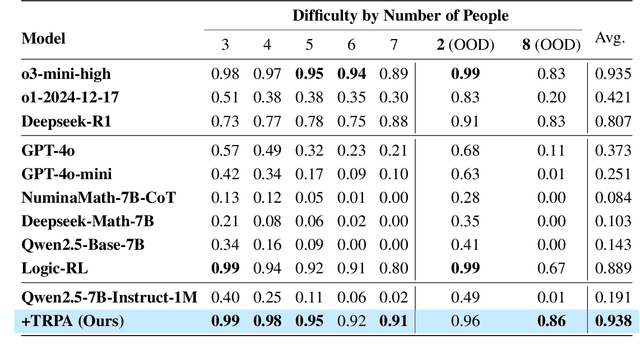
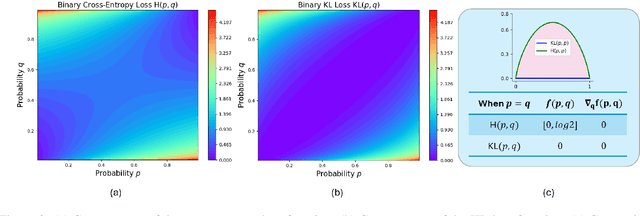
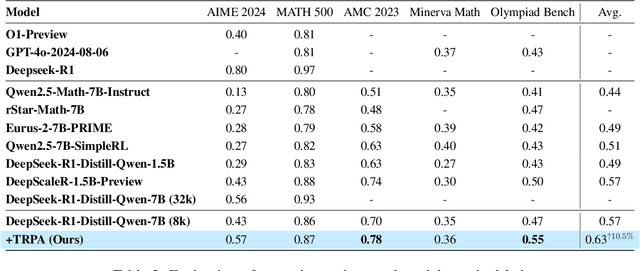
Recently, Large Language Models (LLMs) have rapidly evolved, approaching Artificial General Intelligence (AGI) while benefiting from large-scale reinforcement learning to enhance Human Alignment (HA) and Reasoning. Recent reward-based optimization algorithms, such as Proximal Policy Optimization (PPO) and Group Relative Policy Optimization (GRPO) have achieved significant performance on reasoning tasks, whereas preference-based optimization algorithms such as Direct Preference Optimization (DPO) significantly improve the performance of LLMs on human alignment. However, despite the strong performance of reward-based optimization methods in alignment tasks , they remain vulnerable to reward hacking. Furthermore, preference-based algorithms (such as Online DPO) haven't yet matched the performance of reward-based optimization algorithms (like PPO) on reasoning tasks, making their exploration in this specific area still a worthwhile pursuit. Motivated by these challenges, we propose the Trust Region Preference Approximation (TRPA) algorithm, which integrates rule-based optimization with preference-based optimization for reasoning tasks. As a preference-based algorithm, TRPA naturally eliminates the reward hacking issue. TRPA constructs preference levels using predefined rules, forms corresponding preference pairs, and leverages a novel optimization algorithm for RL training with a theoretical monotonic improvement guarantee. Experimental results demonstrate that TRPA not only achieves competitive performance on reasoning tasks but also exhibits robust stability. The code of this paper are released and updating on https://github.com/XueruiSu/Trust-Region-Preference-Approximation.git.
UniGenX: Unified Generation of Sequence and Structure with Autoregressive Diffusion
Mar 09, 2025Unified generation of sequence and structure for scientific data (e.g., materials, molecules, proteins) is a critical task. Existing approaches primarily rely on either autoregressive sequence models or diffusion models, each offering distinct advantages and facing notable limitations. Autoregressive models, such as GPT, Llama, and Phi-4, have demonstrated remarkable success in natural language generation and have been extended to multimodal tasks (e.g., image, video, and audio) using advanced encoders like VQ-VAE to represent complex modalities as discrete sequences. However, their direct application to scientific domains is challenging due to the high precision requirements and the diverse nature of scientific data. On the other hand, diffusion models excel at generating high-dimensional scientific data, such as protein, molecule, and material structures, with remarkable accuracy. Yet, their inability to effectively model sequences limits their potential as general-purpose multimodal foundation models. To address these challenges, we propose UniGenX, a unified framework that combines autoregressive next-token prediction with conditional diffusion models. This integration leverages the strengths of autoregressive models to ease the training of conditional diffusion models, while diffusion-based generative heads enhance the precision of autoregressive predictions. We validate the effectiveness of UniGenX on material and small molecule generation tasks, achieving a significant leap in state-of-the-art performance for material crystal structure prediction and establishing new state-of-the-art results for small molecule structure prediction, de novo design, and conditional generation. Notably, UniGenX demonstrates significant improvements, especially in handling long sequences for complex structures, showcasing its efficacy as a versatile tool for scientific data generation.
NatureLM: Deciphering the Language of Nature for Scientific Discovery
Feb 11, 2025


Foundation models have revolutionized natural language processing and artificial intelligence, significantly enhancing how machines comprehend and generate human languages. Inspired by the success of these foundation models, researchers have developed foundation models for individual scientific domains, including small molecules, materials, proteins, DNA, and RNA. However, these models are typically trained in isolation, lacking the ability to integrate across different scientific domains. Recognizing that entities within these domains can all be represented as sequences, which together form the "language of nature", we introduce Nature Language Model (briefly, NatureLM), a sequence-based science foundation model designed for scientific discovery. Pre-trained with data from multiple scientific domains, NatureLM offers a unified, versatile model that enables various applications including: (i) generating and optimizing small molecules, proteins, RNA, and materials using text instructions; (ii) cross-domain generation/design, such as protein-to-molecule and protein-to-RNA generation; and (iii) achieving state-of-the-art performance in tasks like SMILES-to-IUPAC translation and retrosynthesis on USPTO-50k. NatureLM offers a promising generalist approach for various scientific tasks, including drug discovery (hit generation/optimization, ADMET optimization, synthesis), novel material design, and the development of therapeutic proteins or nucleotides. We have developed NatureLM models in different sizes (1 billion, 8 billion, and 46.7 billion parameters) and observed a clear improvement in performance as the model size increases.
Exploiting Pre-trained Models for Drug Target Affinity Prediction with Nearest Neighbors
Jul 21, 2024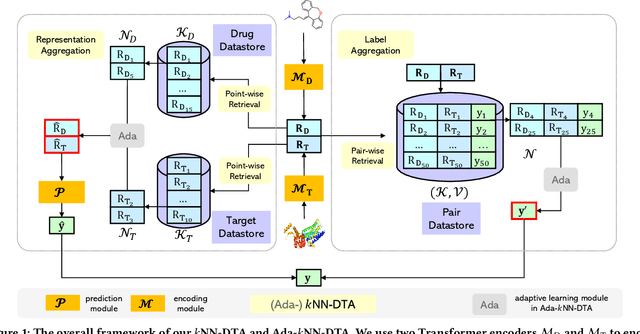
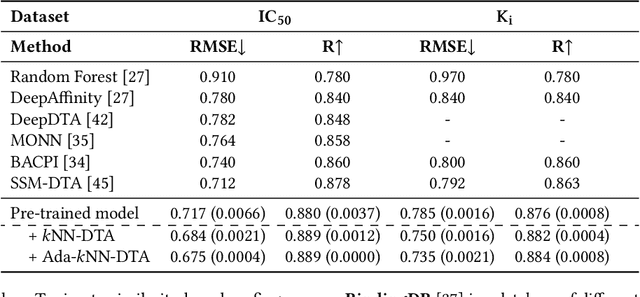
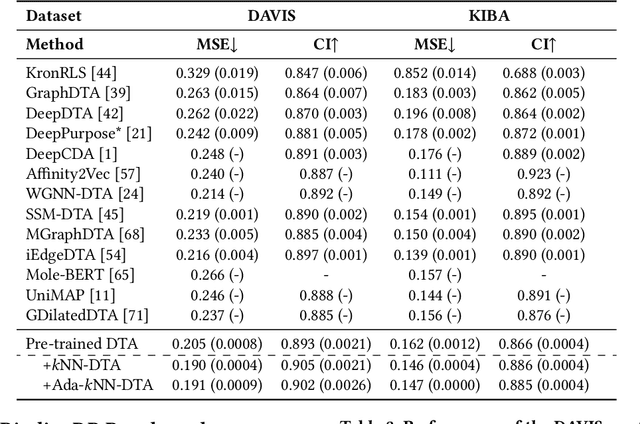
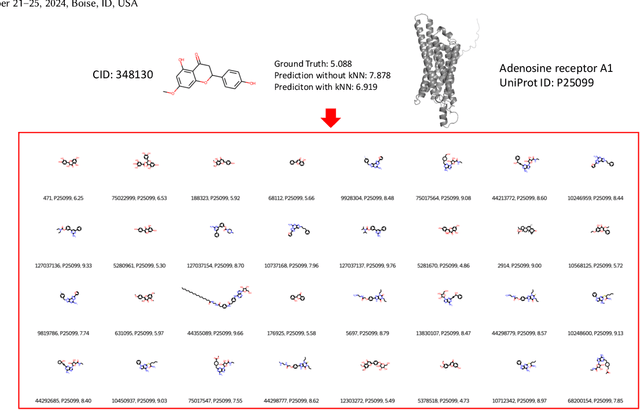
Drug-Target binding Affinity (DTA) prediction is essential for drug discovery. Despite the application of deep learning methods to DTA prediction, the achieved accuracy remain suboptimal. In this work, inspired by the recent success of retrieval methods, we propose $k$NN-DTA, a non-parametric embedding-based retrieval method adopted on a pre-trained DTA prediction model, which can extend the power of the DTA model with no or negligible cost. Different from existing methods, we introduce two neighbor aggregation ways from both embedding space and label space that are integrated into a unified framework. Specifically, we propose a \emph{label aggregation} with \emph{pair-wise retrieval} and a \emph{representation aggregation} with \emph{point-wise retrieval} of the nearest neighbors. This method executes in the inference phase and can efficiently boost the DTA prediction performance with no training cost. In addition, we propose an extension, Ada-$k$NN-DTA, an instance-wise and adaptive aggregation with lightweight learning. Results on four benchmark datasets show that $k$NN-DTA brings significant improvements, outperforming previous state-of-the-art (SOTA) results, e.g, on BindingDB IC$_{50}$ and $K_i$ testbeds, $k$NN-DTA obtains new records of RMSE $\bf{0.684}$ and $\bf{0.750}$. The extended Ada-$k$NN-DTA further improves the performance to be $\bf{0.675}$ and $\bf{0.735}$ RMSE. These results strongly prove the effectiveness of our method. Results in other settings and comprehensive studies/analyses also show the great potential of our $k$NN-DTA approach.
BioT5: Enriching Cross-modal Integration in Biology with Chemical Knowledge and Natural Language Associations
Oct 17, 2023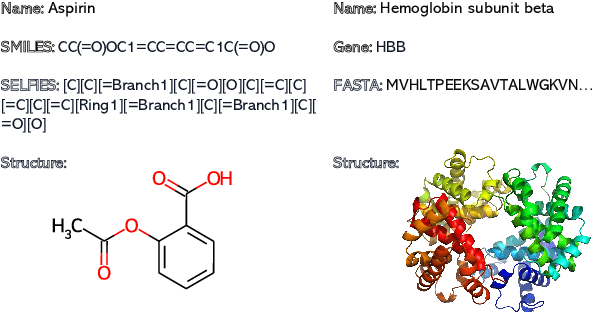
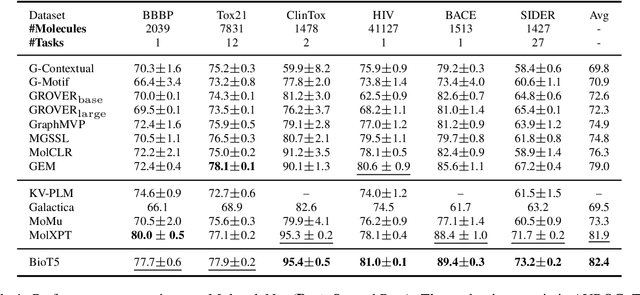
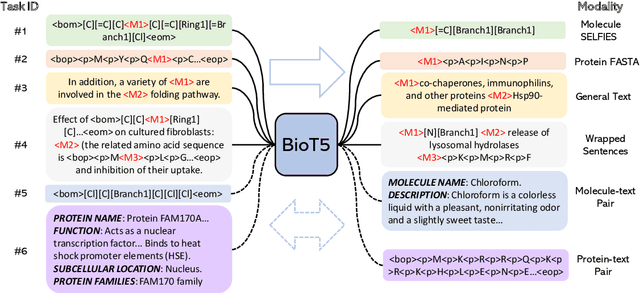
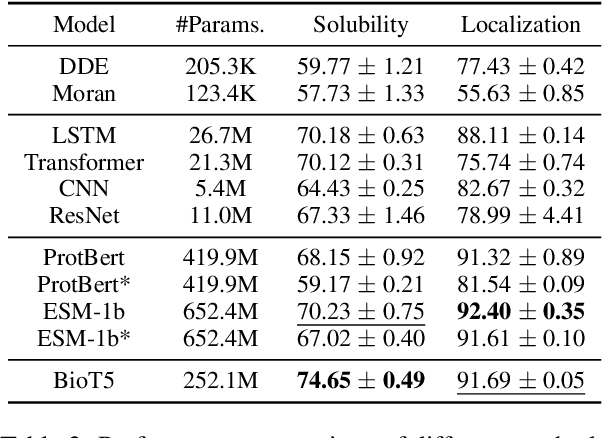
Recent advancements in biological research leverage the integration of molecules, proteins, and natural language to enhance drug discovery. However, current models exhibit several limitations, such as the generation of invalid molecular SMILES, underutilization of contextual information, and equal treatment of structured and unstructured knowledge. To address these issues, we propose $\mathbf{BioT5}$, a comprehensive pre-training framework that enriches cross-modal integration in biology with chemical knowledge and natural language associations. $\mathbf{BioT5}$ utilizes SELFIES for $100%$ robust molecular representations and extracts knowledge from the surrounding context of bio-entities in unstructured biological literature. Furthermore, $\mathbf{BioT5}$ distinguishes between structured and unstructured knowledge, leading to more effective utilization of information. After fine-tuning, BioT5 shows superior performance across a wide range of tasks, demonstrating its strong capability of capturing underlying relations and properties of bio-entities. Our code is available at $\href{https://github.com/QizhiPei/BioT5}{Github}$.