 Add to Chrome
 Add to Firefox
 Add to Edge
Large Models for Time Series and Spatio-Temporal Data: A Survey and Outlook
Oct 20, 2023

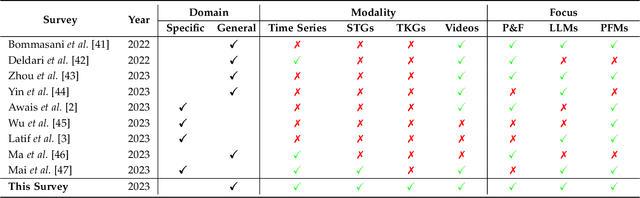

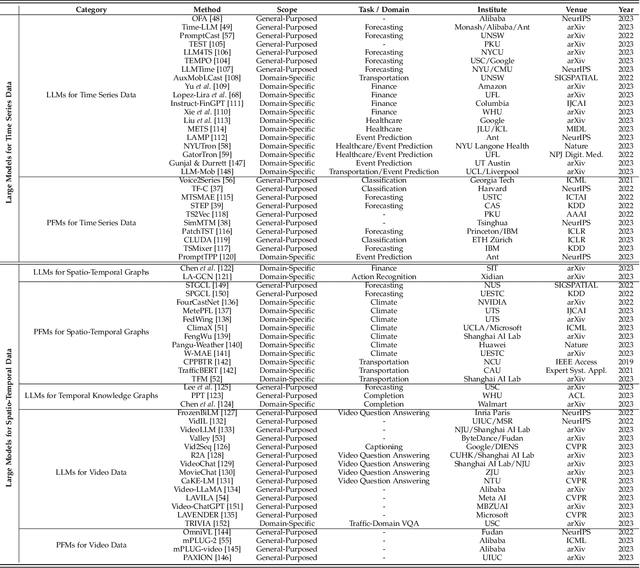
Temporal data, notably time series and spatio-temporal data, are prevalent in real-world applications. They capture dynamic system measurements and are produced in vast quantities by both physical and virtual sensors. Analyzing these data types is vital to harnessing the rich information they encompass and thus benefits a wide range of downstream tasks. Recent advances in large language and other foundational models have spurred increased use of these models in time series and spatio-temporal data mining. Such methodologies not only enable enhanced pattern recognition and reasoning across diverse domains but also lay the groundwork for artificial general intelligence capable of comprehending and processing common temporal data. In this survey, we offer a comprehensive and up-to-date review of large models tailored (or adapted) for time series and spatio-temporal data, spanning four key facets: data types, model categories, model scopes, and application areas/tasks. Our objective is to equip practitioners with the knowledge to develop applications and further research in this underexplored domain. We primarily categorize the existing literature into two major clusters: large models for time series analysis (LM4TS) and spatio-temporal data mining (LM4STD). On this basis, we further classify research based on model scopes (i.e., general vs. domain-specific) and application areas/tasks. We also provide a comprehensive collection of pertinent resources, including datasets, model assets, and useful tools, categorized by mainstream applications. This survey coalesces the latest strides in large model-centric research on time series and spatio-temporal data, underscoring the solid foundations, current advances, practical applications, abundant resources, and future research opportunities.

FedFed: Feature Distillation against Data Heterogeneity in Federated Learning
Oct 08, 2023

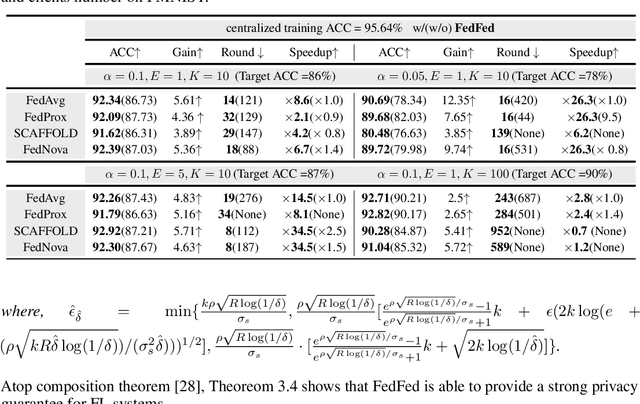

Federated learning (FL) typically faces data heterogeneity, i.e., distribution shifting among clients. Sharing clients' information has shown great potentiality in mitigating data heterogeneity, yet incurs a dilemma in preserving privacy and promoting model performance. To alleviate the dilemma, we raise a fundamental question: \textit{Is it possible to share partial features in the data to tackle data heterogeneity?} In this work, we give an affirmative answer to this question by proposing a novel approach called {\textbf{Fed}erated \textbf{Fe}ature \textbf{d}istillation} (FedFed). Specifically, FedFed partitions data into performance-sensitive features (i.e., greatly contributing to model performance) and performance-robust features (i.e., limitedly contributing to model performance). The performance-sensitive features are globally shared to mitigate data heterogeneity, while the performance-robust features are kept locally. FedFed enables clients to train models over local and shared data. Comprehensive experiments demonstrate the efficacy of FedFed in promoting model performance.
* 32 pages
Spatio-Temporal Contrastive Self-Supervised Learning for POI-level Crowd Flow Inference
Sep 12, 2023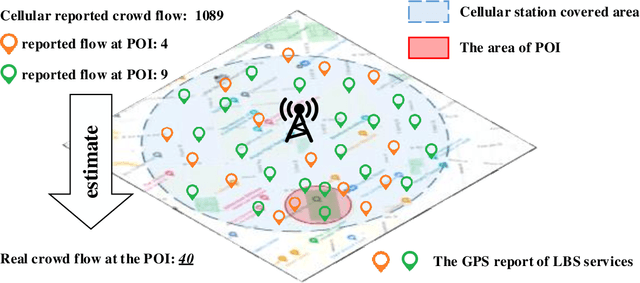
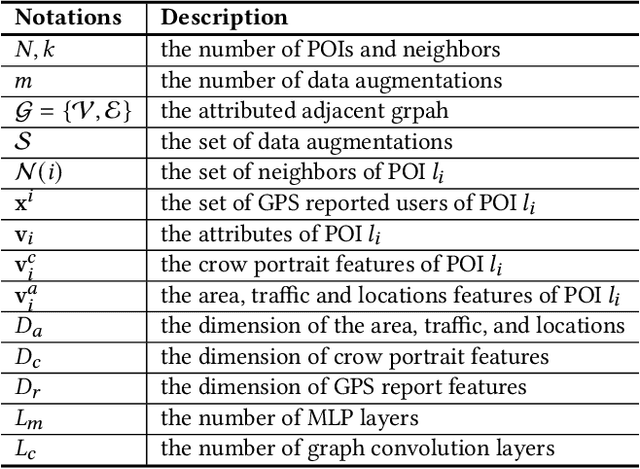
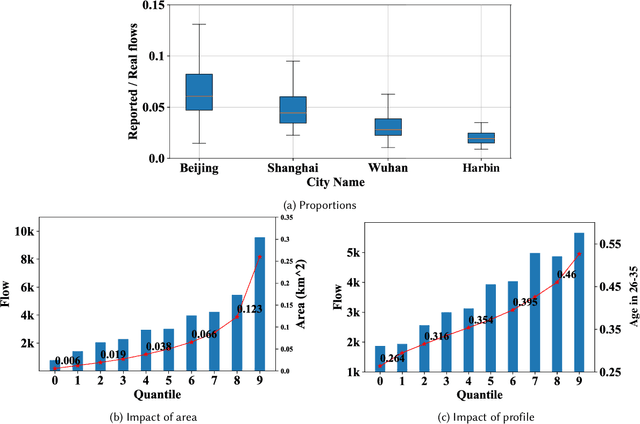
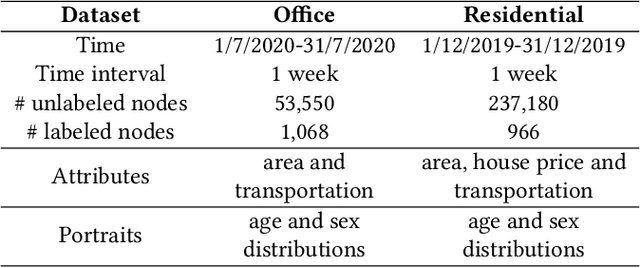
Accurate acquisition of crowd flow at Points of Interest (POIs) is pivotal for effective traffic management, public service, and urban planning. Despite this importance, due to the limitations of urban sensing techniques, the data quality from most sources is inadequate for monitoring crowd flow at each POI. This renders the inference of accurate crowd flow from low-quality data a critical and challenging task. The complexity is heightened by three key factors: 1) The scarcity and rarity of labeled data, 2) The intricate spatio-temporal dependencies among POIs, and 3) The myriad correlations between precise crowd flow and GPS reports. To address these challenges, we recast the crowd flow inference problem as a self-supervised attributed graph representation learning task and introduce a novel Contrastive Self-learning framework for Spatio-Temporal data (CSST). Our approach initiates with the construction of a spatial adjacency graph founded on the POIs and their respective distances. We then employ a contrastive learning technique to exploit large volumes of unlabeled spatio-temporal data. We adopt a swapped prediction approach to anticipate the representation of the target subgraph from similar instances. Following the pre-training phase, the model is fine-tuned with accurate crowd flow data. Our experiments, conducted on two real-world datasets, demonstrate that the CSST pre-trained on extensive noisy data consistently outperforms models trained from scratch.
UNISOUND System for VoxCeleb Speaker Recognition Challenge 2023
Aug 24, 2023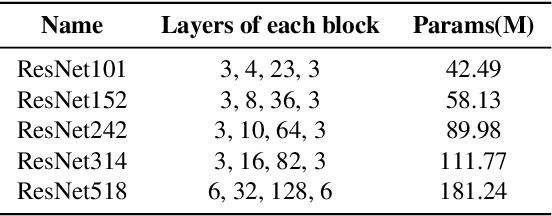
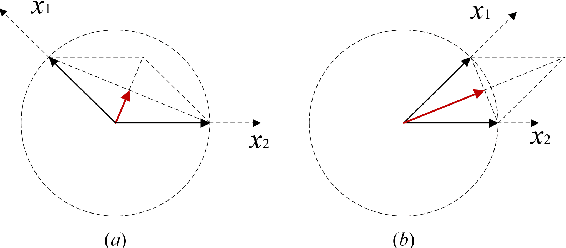
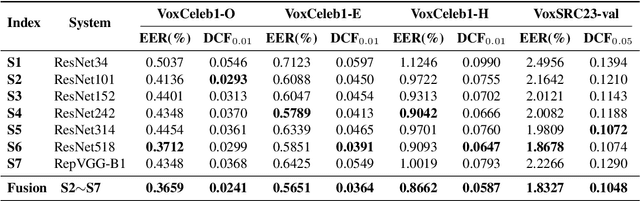
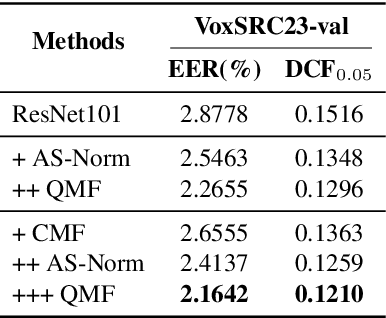
This report describes the UNISOUND submission for Track1 and Track2 of VoxCeleb Speaker Recognition Challenge 2023 (VoxSRC 2023). We submit the same system on Track 1 and Track 2, which is trained with only VoxCeleb2-dev. Large-scale ResNet and RepVGG architectures are developed for the challenge. We propose a consistency-aware score calibration method, which leverages the stability of audio voiceprints in similarity score by a Consistency Measure Factor (CMF). CMF brings a huge performance boost in this challenge. Our final system is a fusion of six models and achieves the first place in Track 1 and second place in Track 2 of VoxSRC 2023. The minDCF of our submission is 0.0855 and the EER is 1.5880%.
Correlation-aware Spatial-Temporal Graph Learning for Multivariate Time-series Anomaly Detection
Jul 17, 2023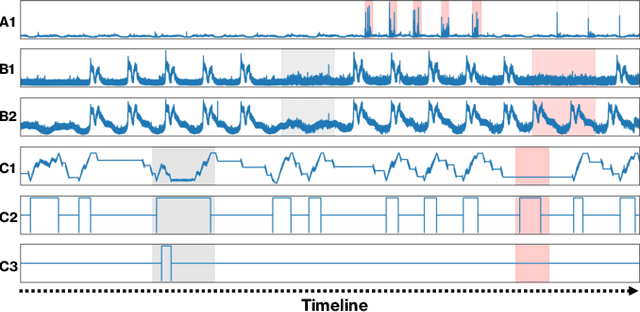
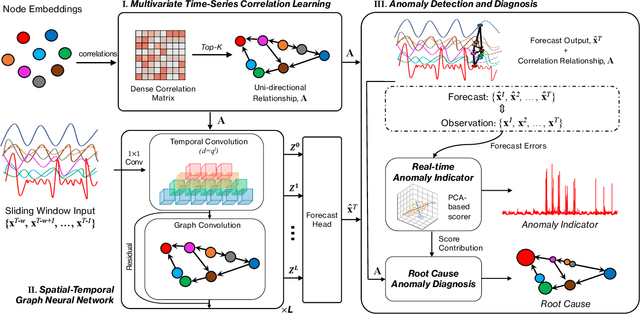
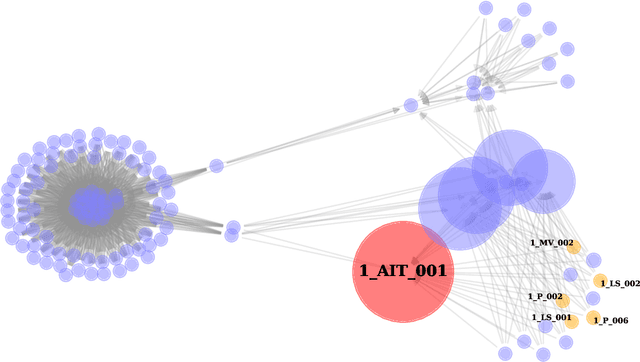
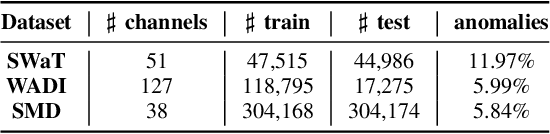
Multivariate time-series anomaly detection is critically important in many applications, including retail, transportation, power grid, and water treatment plants. Existing approaches for this problem mostly employ either statistical models which cannot capture the non-linear relations well or conventional deep learning models (e.g., CNN and LSTM) that do not explicitly learn the pairwise correlations among variables. To overcome these limitations, we propose a novel method, correlation-aware spatial-temporal graph learning (termed CST-GL), for time series anomaly detection. CST-GL explicitly captures the pairwise correlations via a multivariate time series correlation learning module based on which a spatial-temporal graph neural network (STGNN) can be developed. Then, by employing a graph convolution network that exploits one- and multi-hop neighbor information, our STGNN component can encode rich spatial information from complex pairwise dependencies between variables. With a temporal module that consists of dilated convolutional functions, the STGNN can further capture long-range dependence over time. A novel anomaly scoring component is further integrated into CST-GL to estimate the degree of an anomaly in a purely unsupervised manner. Experimental results demonstrate that CST-GL can detect anomalies effectively in general settings as well as enable early detection across different time delays.
End-to-end 2D-3D Registration between Image and LiDAR Point Cloud for Vehicle Localization
Jun 20, 2023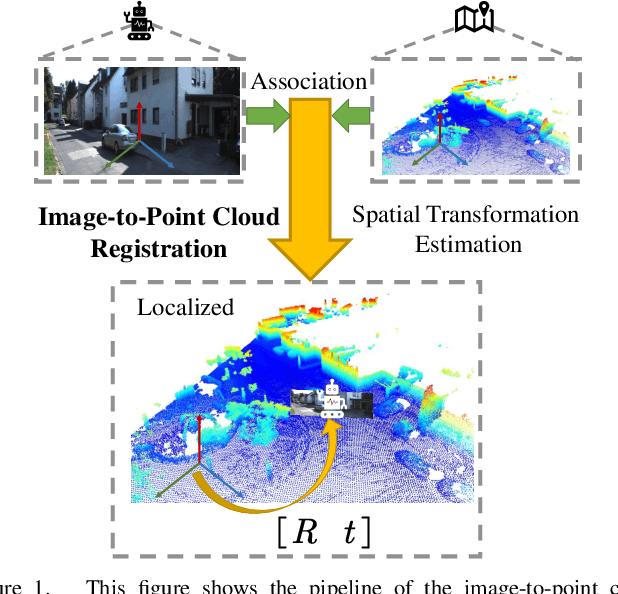
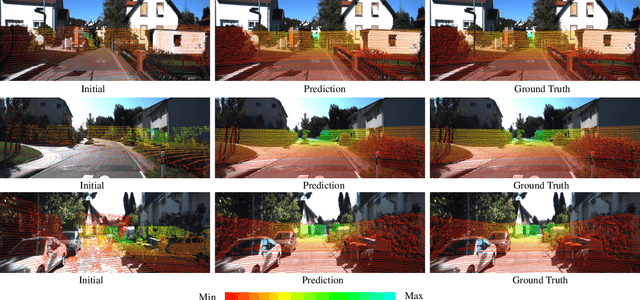
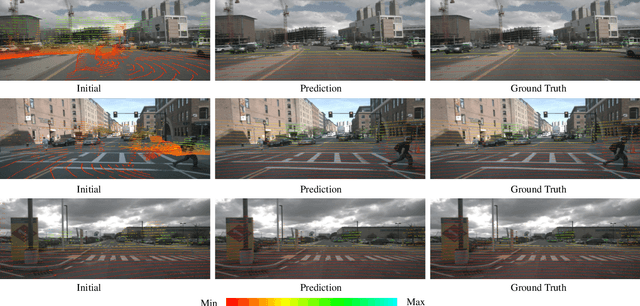
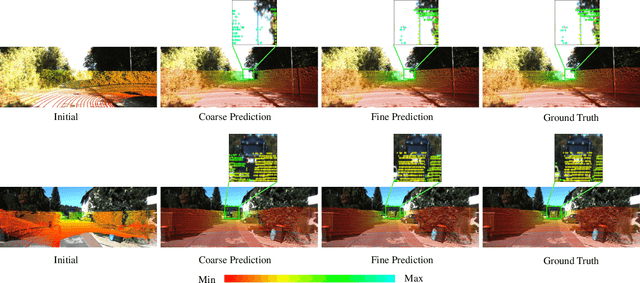
Robot localization using a previously built map is essential for a variety of tasks including highly accurate navigation and mobile manipulation. A popular approach to robot localization is based on image-to-point cloud registration, which combines illumination-invariant LiDAR-based mapping with economical image-based localization. However, the recent works for image-to-point cloud registration either divide the registration into separate modules or project the point cloud to the depth image to register the RGB and depth images. In this paper, we present I2PNet, a novel end-to-end 2D-3D registration network. I2PNet directly registers the raw 3D point cloud with the 2D RGB image using differential modules with a unique target. The 2D-3D cost volume module for differential 2D-3D association is proposed to bridge feature extraction and pose regression. 2D-3D cost volume module implicitly constructs the soft point-to-pixel correspondence on the intrinsic-independent normalized plane of the pinhole camera model. Moreover, we introduce an outlier mask prediction module to filter the outliers in the 2D-3D association before pose regression. Furthermore, we propose the coarse-to-fine 2D-3D registration architecture to increase localization accuracy. We conduct extensive localization experiments on the KITTI Odometry and nuScenes datasets. The results demonstrate that I2PNet outperforms the state-of-the-art by a large margin. In addition, I2PNet has a higher efficiency than the previous works and can perform the localization in real-time. Moreover, we extend the application of I2PNet to the camera-LiDAR online calibration and demonstrate that I2PNet outperforms recent approaches on the online calibration task.
Finding the Missing-half: Graph Complementary Learning for Homophily-prone and Heterophily-prone Graphs
Jun 13, 2023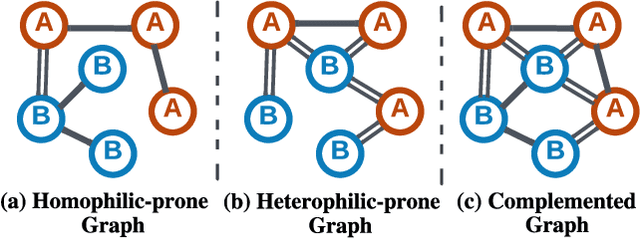
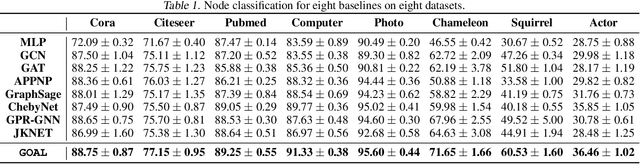
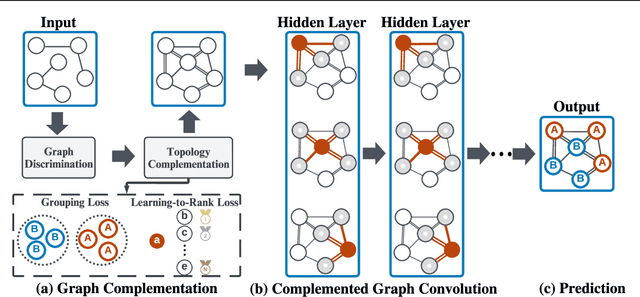
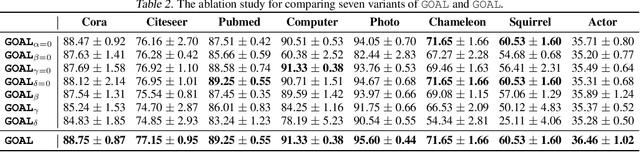
Real-world graphs generally have only one kind of tendency in their connections. These connections are either homophily-prone or heterophily-prone. While graphs with homophily-prone edges tend to connect nodes with the same class (i.e., intra-class nodes), heterophily-prone edges tend to build relationships between nodes with different classes (i.e., inter-class nodes). Existing GNNs only take the original graph during training. The problem with this approach is that it forgets to take into consideration the ``missing-half" structural information, that is, heterophily-prone topology for homophily-prone graphs and homophily-prone topology for heterophily-prone graphs. In our paper, we introduce Graph cOmplementAry Learning, namely GOAL, which consists of two components: graph complementation and complemented graph convolution. The first component finds the missing-half structural information for a given graph to complement it. The complemented graph has two sets of graphs including both homophily- and heterophily-prone topology. In the latter component, to handle complemented graphs, we design a new graph convolution from the perspective of optimisation. The experiment results show that GOAL consistently outperforms all baselines in eight real-world datasets.
Graph Neural Processes for Spatio-Temporal Extrapolation
May 30, 2023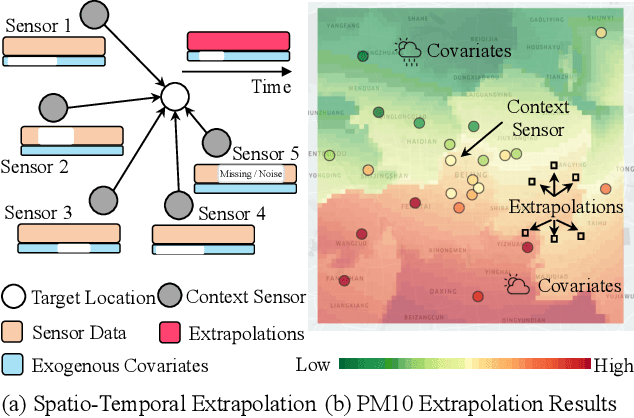
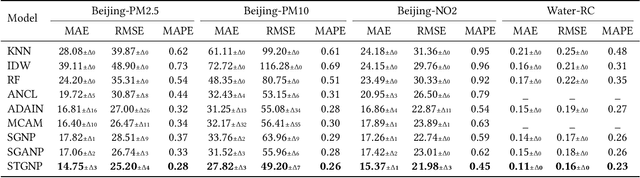
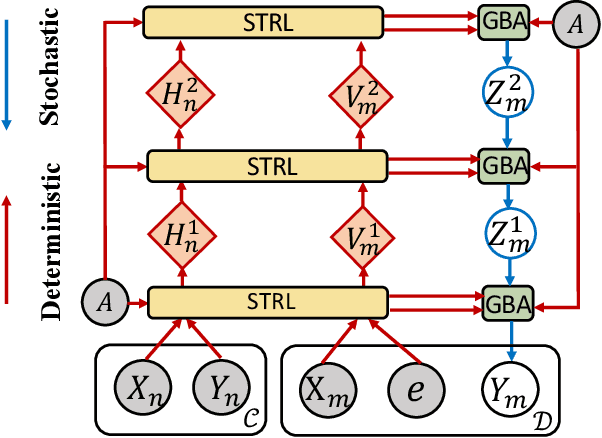
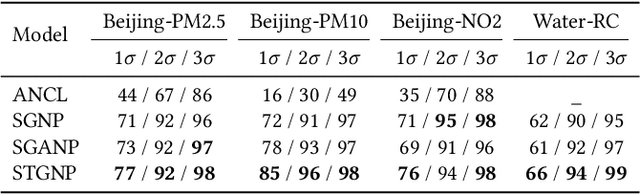
We study the task of spatio-temporal extrapolation that generates data at target locations from surrounding contexts in a graph. This task is crucial as sensors that collect data are sparsely deployed, resulting in a lack of fine-grained information due to high deployment and maintenance costs. Existing methods either use learning-based models like Neural Networks or statistical approaches like Gaussian Processes for this task. However, the former lacks uncertainty estimates and the latter fails to capture complex spatial and temporal correlations effectively. To address these issues, we propose Spatio-Temporal Graph Neural Processes (STGNP), a neural latent variable model which commands these capabilities simultaneously. Specifically, we first learn deterministic spatio-temporal representations by stacking layers of causal convolutions and cross-set graph neural networks. Then, we learn latent variables for target locations through vertical latent state transitions along layers and obtain extrapolations. Importantly during the transitions, we propose Graph Bayesian Aggregation (GBA), a Bayesian graph aggregator that aggregates contexts considering uncertainties in context data and graph structure. Extensive experiments show that STGNP has desirable properties such as uncertainty estimates and strong learning capabilities, and achieves state-of-the-art results by a clear margin.
Crossing the Reality Gap in Tactile-Based Learning
May 23, 2023Tactile sensors are believed to be essential in robotic manipulation, and prior works often rely on experts to reason the sensor feedback and design a controller. With the recent advancement in data-driven approaches, complicated manipulation can be realised, but an accurate and efficient tactile simulation is necessary for policy training. To this end, we present an approach to model a commonly used pressure sensor array in simulation and to train a tactile-based manipulation policy with sim-to-real transfer in mind. Each taxel in our model is represented as a mass-spring-damper system, in which the parameters are iteratively identified as plausible ranges. This allows a policy to be trained with domain randomisation which improves its robustness to different environments. Then, we introduce encoders to further align the critical tactile features in a latent space. Finally, our experiments answer questions on tactile-based manipulation, tactile modelling and sim-to-real performance.
Road Planning for Slums via Deep Reinforcement Learning
May 22, 2023Millions of slum dwellers suffer from poor accessibility to urban services due to inadequate road infrastructure within slums, and road planning for slums is critical to the sustainable development of cities. Existing re-blocking or heuristic methods are either time-consuming which cannot generalize to different slums, or yield sub-optimal road plans in terms of accessibility and construction costs. In this paper, we present a deep reinforcement learning based approach to automatically layout roads for slums. We propose a generic graph model to capture the topological structure of a slum, and devise a novel graph neural network to select locations for the planned roads. Through masked policy optimization, our model can generate road plans that connect places in a slum at minimal construction costs. Extensive experiments on real-world slums in different countries verify the effectiveness of our model, which can significantly improve accessibility by 14.3% against existing baseline methods. Further investigations on transferring across different tasks demonstrate that our model can master road planning skills in simple scenarios and adapt them to much more complicated ones, indicating the potential of applying our model in real-world slum upgrading.