 Add to Chrome
 Add to Firefox
 Add to Edge
JarvisHub: An Open Harness for Canvas-Native Multimodal Creative Agents
Jul 26, 2026
Creative AI is moving from single-step asset generation toward long-horizon multimodal production. Although recent generative models can synthesize high-quality images, videos, audio clips, UI elements, storyboards, slides, and other creative assets, real-world creative work requires more than isolated prompt-output interactions. It involves references, drafts, alternatives, edits, failed attempts, version relations, tool actions, evaluation signals, and human feedback, which together form an evolving project state. Existing prompt-based, chat-based, and node-based generation systems only partially support this state, as they often discard intermediate context, rely on linear conversations, or require manually specified workflows. Recent commercial systems indicate a shift toward agent-assisted creative production, but their closed architectures make it difficult to study how agents represent context, choose tools, revise artifacts, recover from failures, and maintain consistency over time. To address this gap, we introduce JarvisHub, a canvas-native creative agent harness for long-horizon multimodal creation. JarvisHub treats an editable canvas as the user workspace, the agent's external memory, action space, and shared project state, representing multimodal artifacts, dependencies, versions, and feedback as typed canvas nodes and links. Through a three-layer architecture of canvas state, protocol bridge, and agent runtime, JarvisHub enables agents to act within an inspectable and editable creative state. This design moves creative agents beyond isolated tool use toward sustained, human-steerable creative automation, where agents can progressively plan, generate, revise, and organize multimodal projects while users remain able to inspect, guide, and intervene throughout the process.

DRNOISE: Benchmarking Deep Research Agents in Misleading Evidence Environments
Jul 19, 2026Deep research agents increasingly operate over the open web, where relevant records coexist with redundant summaries, outdated reports, and misleading documents. Existing evaluations offer limited insight into whether agents preserve sound evidential standards when an ordinary-looking false document is deliberately seeded into a searchable environment and offers a direct shortcut to a conflicting answer. We introduce DRNOISE, a 100-task benchmark for answer recovery under misleading evidence. Each task has a unique gold answer supported by two corroborating indirect record chains; the paired noisy condition adds one plausible document that states a conflicting answer directly. The benchmark spans ten families of evidence operations. Across agents with strong clean-task performance, this single intervention causes 66-88 percentage-point accuracy drops. Trace analyses identify verification inertia as the dominant failure mode: agents often retrieve truthful records but stop before completing and reconciling the evidence chain, instead deferring to the answer-like document. Generic verification prompts reduce but do not close this gap. The setting is especially relevant to open-web deployment, where plausible falsehoods arrive through ordinary-looking pages rather than explicit attacks. Reliable deep research therefore requires more than retrieval and citation; it requires active reconciliation of direct claims with record-level evidence.
Zero2Skill: Bootstrapping Robot Skills through Autonomous Data Collection, Training, and Deployment
Jul 16, 2026Autonomous data collection governs the volume and quality of real-world trajectories for manipulation policy learning. Existing pipelines reduce human effort via self-resetting, VLM verification, or language-guided correction, yet episode-scoped fixes must be reissued whenever the same failure recurs, so oversight cost grows with session length rather than with the number of distinct problems. We present Zero2Skill, a human-robot symbiotic agentic system in which corrections are retained and reused across rounds. The collection loop collects, verifies, and resets autonomously, pausing for a remote operator only when a phase exhausts an explicit retry budget. An LLM parser maps each natural-language utterance to a structured adjustment stored in Corrective Memory, so addressed failure modes typically need not be corrected again under the same conditions. On a real-robot desktop-clearing testbed, Zero2Skill matches teleoperation episode success while reducing human working time to 16%. Language corrections improve verifier-human agreement in all four evaluated settings and raise average single-attempt success from 12.5% to 47.5% (arm-selection: 20.0% to 50.0%). Policies fine-tuned on Zero2Skill data match teleoperation-trained policy success at a fraction of collection human cost.
A Control Theory of Predictability in Latent World Models
Jul 11, 2026Latent world models are trained to predict future states in a learned representation and are then deployed inside a planner that selects actions by simulating them forward. Current practice adopts the prediction error, the single- or multi-step rollout loss on held-out data, as the training and model-selection objective, on the assumption that a lower prediction error yields better control. We show that this assumption is unreliable for a structural reason: a planner does not query the model on the training distribution but on the states that its candidate actions reach, which generally leave the data manifold, so an error averaged over the data cannot by itself govern control. We therefore reframe the objective as the discrepancy between the predicted and the true plan-cost at the plan the planner commits to, and prove that the planner's suboptimality is bounded by twice this discrepancy, whereas the data-averaged prediction error neither bounds nor tracks it. Under a linear-control premise the discrepancy separates into two terms. The first is a small on-manifold residual, on which the predicted and true dynamics agree and which a spectral tax prices through the non-normality of the latent transition operator. The second is an off-manifold divergence, on which an action carries the state off the manifold and the two dynamics diverge; this divergence is the binding term and is bounded by no data-averaged error. Synthetic operators confirm the pricing formulas, and latent model-predictive control experiments confirm the decoupling: across seeds, the single-step validation error is essentially uncorrelated with control success, whereas a fidelity score on the planner-reachable measure tracks it.
Conditional Equivalence of DPO and RLHF: Implicit Assumption, Failure Modes, and Provable Alignment
May 20, 2026Direct Preference Optimization (DPO) has emerged as a popular alternative to Reinforcement Learning from Human Feedback (RLHF), offering theoretical equivalence with simpler implementation. We prove this equivalence is conditional rather than universal, depending on an implicit assumption frequently violated in practice: the RLHF-optimal policy must prefer human-preferred responses. When this assumption fails, DPO optimizes relative advantage over the reference policy rather than absolute alignment with human preferences, leading to pathological convergence where policies decrease DPO loss while preferring dispreferred responses. We characterize when this assumption is violated, show the existence of an undesirable solution space, and prove that DPO and RLHF optimize fundamentally different objectives in such cases. To address this, we introduce Constrained Preference Optimization (CPO), augmenting RLHF with constraints for provable alignment. We further provide a geometric interpretation through soft margin ranking, revealing that DPO implements margin ranking with potentially negative targets. Our theoretical analysis establishes when DPOs' guarantees hold and provides solutions preserving simplicity with provable alignment. Comprehensive experiments on standard benchmarks demonstrate that CPO achieves state-of-the-art performance. Code is available at: https://github.com/visitworld123/CPO.
Shaping Schema via Language Representation as the Next Frontier for LLM Intelligence Expanding
May 10, 2026Although natural language is the default medium for Large Language Models (LLMs), its limited expressive capacity creates a profound bottleneck for complex problem-solving. While recent advancements in AI have relied heavily on scaling, merely internalizing knowledge does not guarantee its effective application. Defining language representation as the linguistic and symbolic constructs used to map and model the real world, this paper argues that shaping schemas through advanced language representation is the next frontier for expanding LLM intelligence. We posit that an LLM's knowledge activation and organization -- its schema -- depends heavily on the structural and symbolic sophistication of the language used to represent a given task. This paper contributes both a formalization of this claim and the empirical evidence to support it. With a new formalization, we present multiple lines of evidence to support our position: Firstly, we review recent empirical practices and emerging methodologies that demonstrate the substantial performance gains achievable through deliberate language representation design, even without modifying model parameters or scale. Secondly, we conduct controlled experiments showing that LLM performance and its internal feature activations vary under different language representations of the same underlying task. Together, these findings highlight language representation design as a promising direction for future research.
ClawNet: Human-Symbiotic Agent Network for Cross-User Autonomous Cooperation
Apr 21, 2026Current AI agent frameworks have made remarkable progress in automating individual tasks, yet all existing systems serve a single user. Human productivity rests on the social and organizational relationships through which people coordinate, negotiate, and delegate. When agents move beyond performing tasks for one person to representing that person in collaboration with others, the infrastructure for cross-user agent collaboration is entirely absent, let alone the governance mechanisms needed to secure it. We argue that the next frontier for AI agents lies not in stronger individual capability, but in the digitization of human collaborative relationships. To this end, we propose a human-symbiotic agent paradigm. Each user owns a permanently bound agent system that collaborates on the owner's behalf, forming a network whose nodes are humans rather than agents. This paradigm rests on three governance primitives. A layered identity architecture separates a Manager Agent from multiple context-specific Identity Agents; the Manager Agent holds global knowledge but is architecturally isolated from external communication. Scoped authorization enforces per-identity access control and escalates boundary violations to the owner. Action-level accountability logs every operation against its owner's identity and authorization, ensuring full auditability. We instantiate this paradigm in ClawNet, an identity-governed agent collaboration framework that enforces identity binding and authorization verification through a central orchestrator, enabling multiple users to collaborate securely through their respective agents.
FedRG: Unleashing the Representation Geometry for Federated Learning with Noisy Clients
Mar 20, 2026Federated learning (FL) suffers from performance degradation due to the inevitable presence of noisy annotations in distributed scenarios. Existing approaches have advanced in distinguishing noisy samples from the dataset for label correction by leveraging loss values. However, noisy samples recognition relying on scalar loss lacks reliability for FL under heterogeneous scenarios. In this paper, we rethink this paradigm from a representation perspective and propose \method~(\textbf{Fed}erated under \textbf{R}epresentation \textbf{G}emometry), which follows \textbf{the principle of ``representation geometry priority''} to recognize noisy labels. Firstly, \method~creates label-agnostic spherical representations by using self-supervision. It then iteratively fits a spherical von Mises-Fisher (vMF) mixture model to this geometry using previously identified clean samples to capture semantic clusters. This geometric evidence is integrated with a semantic-label soft mapping mechanism to derive a distribution divergence between the label-free and annotated label-conditioned feature space, which robustly identifies noisy samples and updates the vMF mixture model with the newly separated clean dataset. Lastly, we employ an additional personalized noise absorption matrix on noisy labels to achieve robust optimization. Extensive experimental results demonstrate that \method~significantly outperforms state-of-the-art methods for FL with data heterogeneity under diverse noisy clients scenarios.
MemFly: On-the-Fly Memory Optimization via Information Bottleneck
Feb 08, 2026Long-term memory enables large language model agents to tackle complex tasks through historical interactions. However, existing frameworks encounter a fundamental dilemma between compressing redundant information efficiently and maintaining precise retrieval for downstream tasks. To bridge this gap, we propose MemFly, a framework grounded in information bottleneck principles that facilitates on-the-fly memory evolution for LLMs. Our approach minimizes compression entropy while maximizing relevance entropy via a gradient-free optimizer, constructing a stratified memory structure for efficient storage. To fully leverage MemFly, we develop a hybrid retrieval mechanism that seamlessly integrates semantic, symbolic, and topological pathways, incorporating iterative refinement to handle complex multi-hop queries. Comprehensive experiments demonstrate that MemFly substantially outperforms state-of-the-art baselines in memory coherence, response fidelity, and accuracy.
MimicDreamer: Aligning Human and Robot Demonstrations for Scalable VLA Training
Sep 26, 2025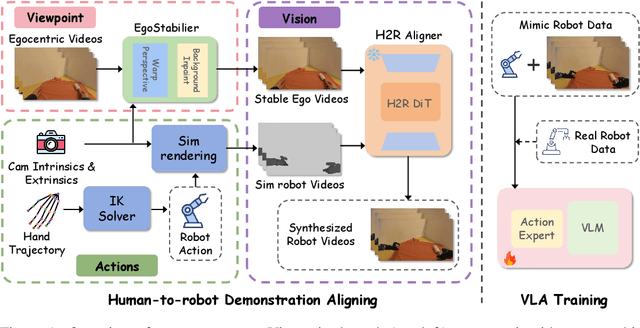

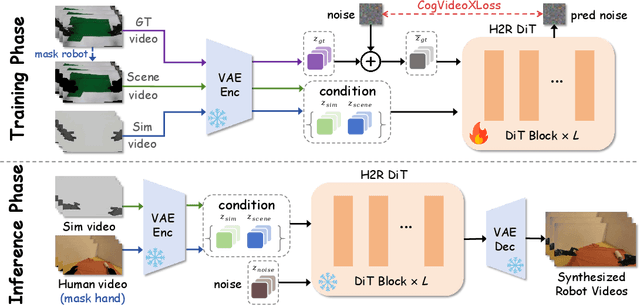
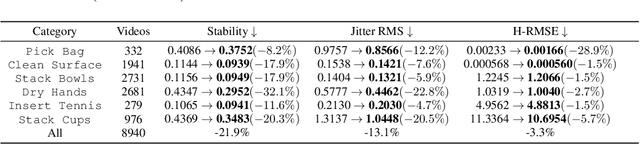
Vision Language Action (VLA) models derive their generalization capability from diverse training data, yet collecting embodied robot interaction data remains prohibitively expensive. In contrast, human demonstration videos are far more scalable and cost-efficient to collect, and recent studies confirm their effectiveness in training VLA models. However, a significant domain gap persists between human videos and robot-executed videos, including unstable camera viewpoints, visual discrepancies between human hands and robotic arms, and differences in motion dynamics. To bridge this gap, we propose MimicDreamer, a framework that turns fast, low-cost human demonstrations into robot-usable supervision by jointly aligning vision, viewpoint, and actions to directly support policy training. For visual alignment, we propose H2R Aligner, a video diffusion model that generates high-fidelity robot demonstration videos by transferring motion from human manipulation footage. For viewpoint stabilization, EgoStabilizer is proposed, which canonicalizes egocentric videos via homography and inpaints occlusions and distortions caused by warping. For action alignment, we map human hand trajectories to the robot frame and apply a constrained inverse kinematics solver to produce feasible, low-jitter joint commands with accurate pose tracking. Empirically, VLA models trained purely on our synthesized human-to-robot videos achieve few-shot execution on real robots. Moreover, scaling training with human data significantly boosts performance compared to models trained solely on real robot data; our approach improves the average success rate by 14.7\% across six representative manipulation tasks.