 Add to Chrome
 Add to Firefox
 Add to Edge
DEFLECT: Delay-Robust Execution via Flow-matching Likelihood-Estimated Counterfactual Tuning for VLA Policies
May 19, 2026
Vision-Language-Action (VLA) policies are typically deployed with asynchronous inference: the robot executes a previously predicted action chunk while the model computes the next one. This creates a prediction-execution misalignment: the chunk is conditioned on the observation taken before inference began, but executes in a physical state that has already drifted forward by several control steps; naive asynchronous rollover collapses from 89% to under 1% on Kinetix as the inference cycle covers up to seven control steps. We introduce DEFLECT, a fully offline post-training refinement that applies as a near drop-in upgrade to existing async-VLA stacks by converting latency itself into a label-free preference signal: counterfactual fresh/stale action pairs are constructed from a frozen reference policy and scored under the deployment-time conditioning via an implicit flow-matching likelihood-ratio surrogate, with no human labels, reward models, or online rollouts. DEFLECT substantially extends the usable delay envelope of async VLA control, with +6.4 success-rate gain in the high-latency regime (5-7 control steps), +4.6 when transferred to a real-scale VLA at the longest delay, and consistent improvements on two real-robot tasks (a bimanual conveyor pick-and-place and a reactive whack-a-mole).

End-to-end 2D-3D Registration between Image and LiDAR Point Cloud for Vehicle Localization
Jun 20, 2023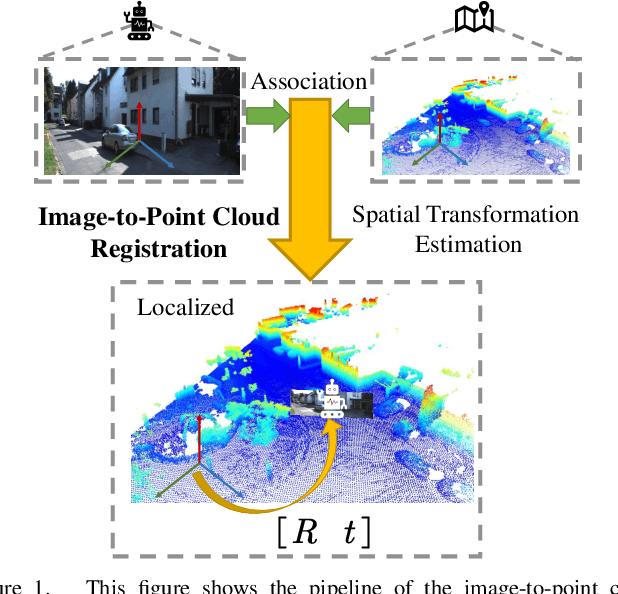
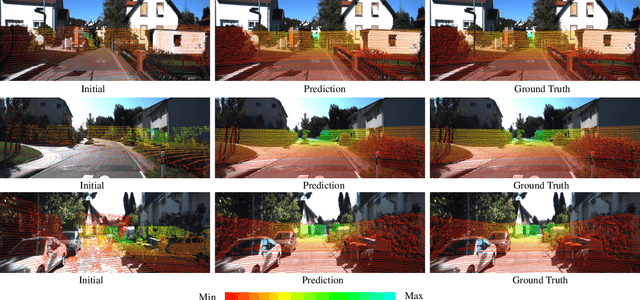
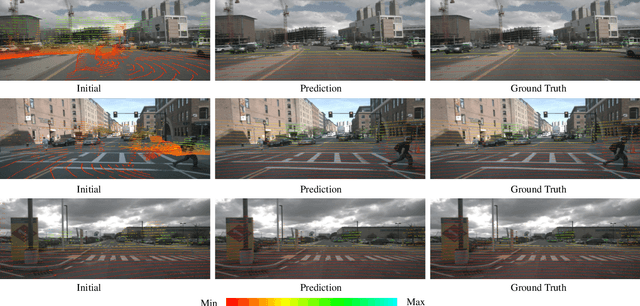
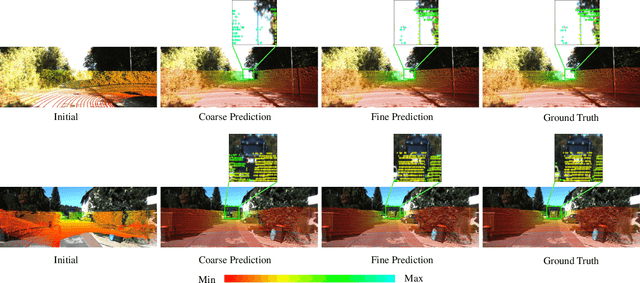
Robot localization using a previously built map is essential for a variety of tasks including highly accurate navigation and mobile manipulation. A popular approach to robot localization is based on image-to-point cloud registration, which combines illumination-invariant LiDAR-based mapping with economical image-based localization. However, the recent works for image-to-point cloud registration either divide the registration into separate modules or project the point cloud to the depth image to register the RGB and depth images. In this paper, we present I2PNet, a novel end-to-end 2D-3D registration network. I2PNet directly registers the raw 3D point cloud with the 2D RGB image using differential modules with a unique target. The 2D-3D cost volume module for differential 2D-3D association is proposed to bridge feature extraction and pose regression. 2D-3D cost volume module implicitly constructs the soft point-to-pixel correspondence on the intrinsic-independent normalized plane of the pinhole camera model. Moreover, we introduce an outlier mask prediction module to filter the outliers in the 2D-3D association before pose regression. Furthermore, we propose the coarse-to-fine 2D-3D registration architecture to increase localization accuracy. We conduct extensive localization experiments on the KITTI Odometry and nuScenes datasets. The results demonstrate that I2PNet outperforms the state-of-the-art by a large margin. In addition, I2PNet has a higher efficiency than the previous works and can perform the localization in real-time. Moreover, we extend the application of I2PNet to the camera-LiDAR online calibration and demonstrate that I2PNet outperforms recent approaches on the online calibration task.