 Add to Chrome
 Add to Firefox
 Add to Edge
Seeing Further and Wider: Joint Spatio-Temporal Enlargement for Micro-Video Popularity Prediction
Apr 22, 2026
Micro-video popularity prediction (MVPP) aims to forecast the future popularity of videos on online media, which is essential for applications such as content recommendation and traffic allocation. In real-world scenarios, it is critical for MVPP approaches to understand both the temporal dynamics of a given video (temporal) and its historical relevance to other videos (spatial). However, existing approaches sufer from limitations in both dimensions: temporally, they rely on sparse short-range sampling that restricts content perception; spatially, they depend on flat retrieval memory with limited capacity and low efficiency, hindering scalable knowledge utilization. To overcome these limitations, we propose a unified framework that achieves joint spatio-temporal enlargement, enabling precise perception of extremely long video sequences while supporting a scalable memory bank that can infinitely expand to incorporate all relevant historical videos. Technically, we employ a Temporal Enlargement driven by a frame scoring module that extracts highlight cues from video frames through two complementary pathways: sparse sampling and dense perception. Their outputs are adaptively fused to enable robust long-sequence content understanding. For Spatial Enlargement, we construct a Topology-Aware Memory Bank that hierarchically clusters historically relevant content based on topological relationships. Instead of directly expanding memory capacity, we update the encoder features of the corresponding clusters when incorporating new videos, enabling unbounded historical association without unbounded storage growth. Extensive experiments on three widely used MVPP benchmarks demonstrate that our method consistently outperforms 11 strong baselines across mainstream metrics, achieving robust improvements in both prediction accuracy and ranking consistency.

Hypergraph-State Collaborative Reasoning for Multi-Object Tracking
Apr 14, 2026Motion reasoning serves as the cornerstone of multi-object tracking (MOT), as it enables consistent association of targets across frames. However, existing motion estimation approaches face two major limitations: (1) instability caused by noisy or probabilistic predictions, and (2) vulnerability under occlusion, where trajectories often fragment once visual cues disappear. To overcome these issues, we propose a collaborative reasoning framework that enhances motion estimation through joint inference among multiple correlated objects. By allowing objects with similar motion states to mutually constrain and refine each other, our framework stabilizes noisy trajectories and infers plausible motion continuity even when target is occluded. To realize this concept, we design HyperSSM, an architecture that integrates Hypergraph computation and a State Space Model (SSM) for unified spatial-temporal reasoning. The Hypergraph module captures spatial motion correlations through dynamic hyperedges, while the SSM enforces temporal smoothness via structured state transitions. This synergistic design enables simultaneous optimization of spatial consensus and temporal coherence, resulting in robust and stable motion estimation. Extensive experiments on four mainstream and diverse benchmarks(MOT17, MOT20, DanceTrack, and SportsMOT) covering various motion patterns and scene complexities, demonstrate that our approach achieves state-of-the-art performance across a wide range of tracking scenarios.
Spectrally Distilled Representations Aligned with Instruction-Augmented LLMs for Satellite Imagery
Feb 26, 2026Vision-language foundation models (VLFMs) promise zero-shot and retrieval understanding for Earth observation. While operational satellite systems often lack full multi-spectral coverage, making RGB-only inference highly desirable for scalable deployment, the adoption of VLFMs for satellite imagery remains hindered by two factors: (1) multi-spectral inputs are informative but difficult to exploit consistently due to band redundancy and misalignment; and (2) CLIP-style text encoders limit semantic expressiveness and weaken fine-grained alignment. We present SATtxt, a spectrum-aware VLFM that operates with RGB inputs only at inference while retaining spectral cues learned during training. Our framework comprises two stages. First, Spectral Representation Distillation transfers spectral priors from a frozen multi-spectral teacher to an RGB student via a lightweight projector. Second, Spectrally Grounded Alignment with Instruction-Augmented LLMs bridges the distilled visual space and an expressive LLM embedding space. Across EuroSAT, BigEarthNet, and ForestNet, SATtxt improves zero-shot classification on average by 4.2%, retrieval by 5.9%, and linear probing by 2.7% over baselines, showing an efficient path toward spectrum-aware vision-language learning for Earth observation. Project page: https://ikhado.github.io/sattxt/
HyperFusion: Hierarchical Multimodal Ensemble Learning for Social Media Popularity Prediction
Jul 01, 2025Social media popularity prediction plays a crucial role in content optimization, marketing strategies, and user engagement enhancement across digital platforms. However, predicting post popularity remains challenging due to the complex interplay between visual, textual, temporal, and user behavioral factors. This paper presents HyperFusion, a hierarchical multimodal ensemble learning framework for social media popularity prediction. Our approach employs a three-tier fusion architecture that progressively integrates features across abstraction levels: visual representations from CLIP encoders, textual embeddings from transformer models, and temporal-spatial metadata with user characteristics. The framework implements a hierarchical ensemble strategy combining CatBoost, TabNet, and custom multi-layer perceptrons. To address limited labeled data, we propose a two-stage training methodology with pseudo-labeling and iterative refinement. We introduce novel cross-modal similarity measures and hierarchical clustering features that capture inter-modal dependencies. Experimental results demonstrate that HyperFusion achieves competitive performance on the SMP challenge dataset. Our team achieved third place in the SMP Challenge 2025 (Image Track). The source code is available at https://anonymous.4open.science/r/SMPDImage.
MVP: Winning Solution to SMP Challenge 2025 Video Track
Jul 01, 2025Social media platforms serve as central hubs for content dissemination, opinion expression, and public engagement across diverse modalities. Accurately predicting the popularity of social media videos enables valuable applications in content recommendation, trend detection, and audience engagement. In this paper, we present Multimodal Video Predictor (MVP), our winning solution to the Video Track of the SMP Challenge 2025. MVP constructs expressive post representations by integrating deep video features extracted from pretrained models with user metadata and contextual information. The framework applies systematic preprocessing techniques, including log-transformations and outlier removal, to improve model robustness. A gradient-boosted regression model is trained to capture complex patterns across modalities. Our approach ranked first in the official evaluation of the Video Track, demonstrating its effectiveness and reliability for multimodal video popularity prediction on social platforms. The source code is available at https://anonymous.4open.science/r/SMPDVideo.
SF2T: Self-supervised Fragment Finetuning of Video-LLMs for Fine-Grained Understanding
Apr 10, 2025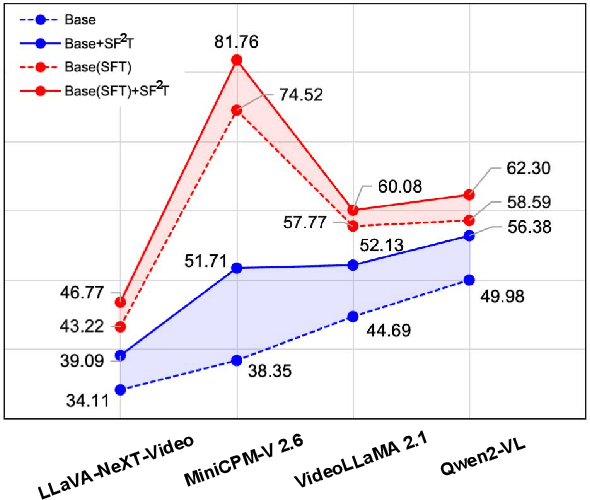
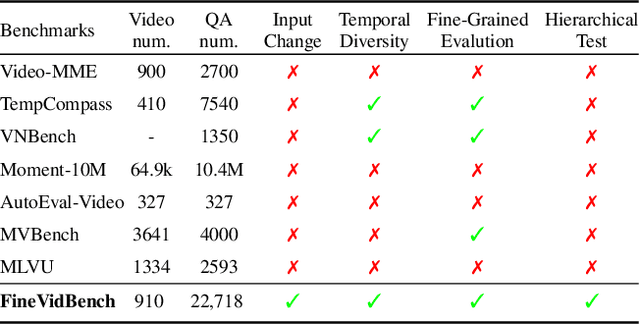
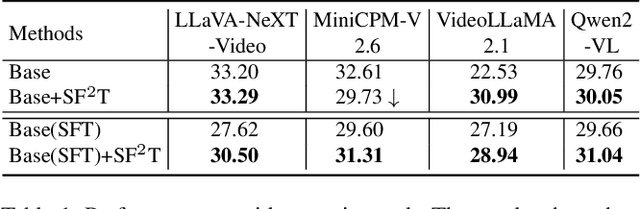
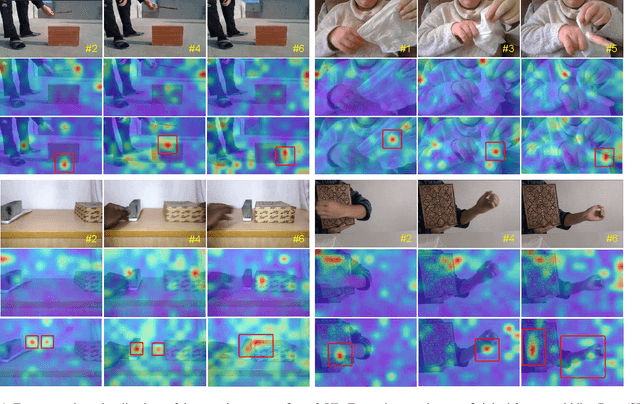
Video-based Large Language Models (Video-LLMs) have witnessed substantial advancements in recent years, propelled by the advancement in multi-modal LLMs. Although these models have demonstrated proficiency in providing the overall description of videos, they struggle with fine-grained understanding, particularly in aspects such as visual dynamics and video details inquiries. To tackle these shortcomings, we find that fine-tuning Video-LLMs on self-supervised fragment tasks, greatly improve their fine-grained video understanding abilities. Hence we propose two key contributions:(1) Self-Supervised Fragment Fine-Tuning (SF$^2$T), a novel effortless fine-tuning method, employs the rich inherent characteristics of videos for training, while unlocking more fine-grained understanding ability of Video-LLMs. Moreover, it relieves researchers from labor-intensive annotations and smartly circumvents the limitations of natural language, which often fails to capture the complex spatiotemporal variations in videos; (2) A novel benchmark dataset, namely FineVidBench, for rigorously assessing Video-LLMs' performance at both the scene and fragment levels, offering a comprehensive evaluation of their capabilities. We assessed multiple models and validated the effectiveness of SF$^2$T on them. Experimental results reveal that our approach improves their ability to capture and interpret spatiotemporal details.
FairStream: Fair Multimedia Streaming Benchmark for Reinforcement Learning Agents
Oct 28, 2024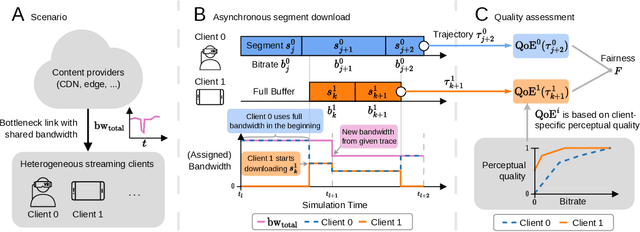
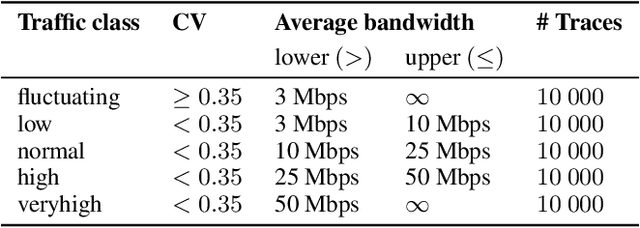
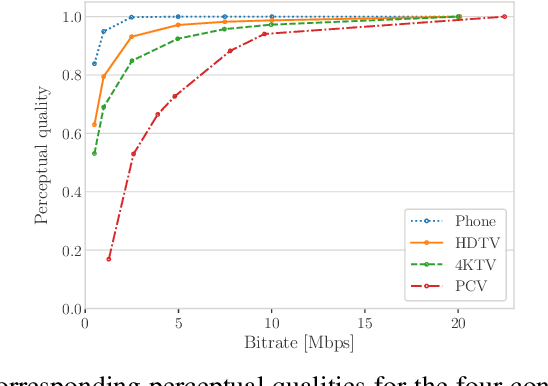
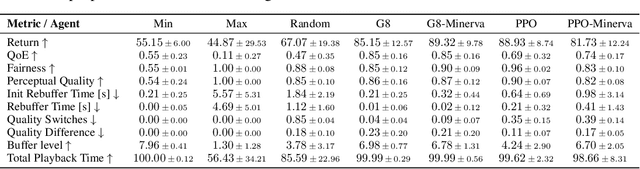
Multimedia streaming accounts for the majority of traffic in today's internet. Mechanisms like adaptive bitrate streaming control the bitrate of a stream based on the estimated bandwidth, ideally resulting in smooth playback and a good Quality of Experience (QoE). However, selecting the optimal bitrate is challenging under volatile network conditions. This motivated researchers to train Reinforcement Learning (RL) agents for multimedia streaming. The considered training environments are often simplified, leading to promising results with limited applicability. Additionally, the QoE fairness across multiple streams is seldom considered by recent RL approaches. With this work, we propose a novel multi-agent environment that comprises multiple challenges of fair multimedia streaming: partial observability, multiple objectives, agent heterogeneity and asynchronicity. We provide and analyze baseline approaches across five different traffic classes to gain detailed insights into the behavior of the considered agents, and show that the commonly used Proximal Policy Optimization (PPO) algorithm is outperformed by a simple greedy heuristic. Future work includes the adaptation of multi-agent RL algorithms and further expansions of the environment.
Autogenic Language Embedding for Coherent Point Tracking
Jul 30, 2024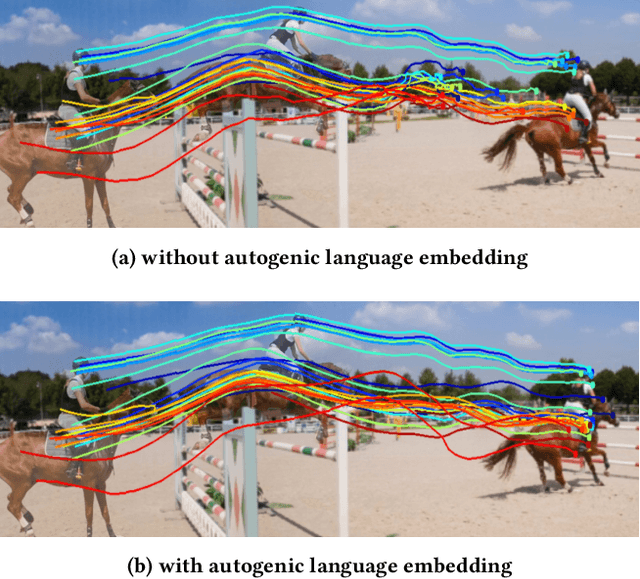
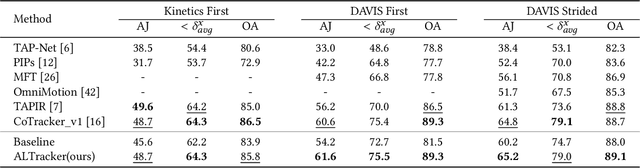
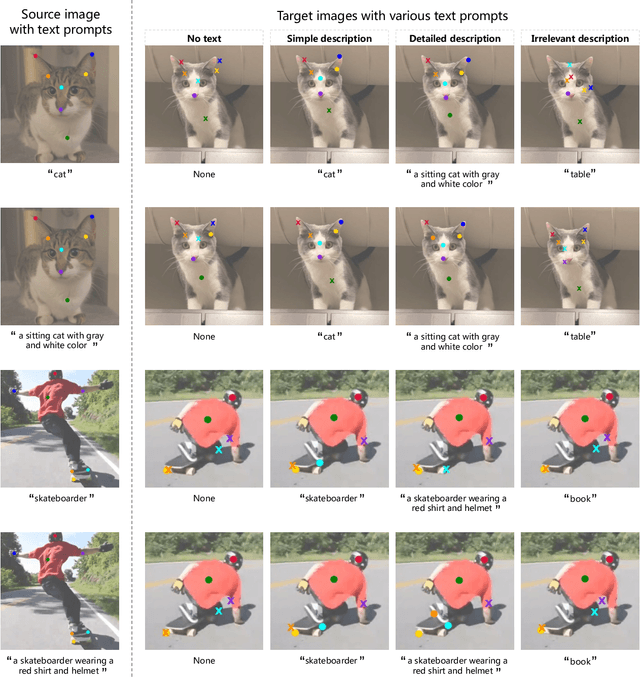

Point tracking is a challenging task in computer vision, aiming to establish point-wise correspondence across long video sequences. Recent advancements have primarily focused on temporal modeling techniques to improve local feature similarity, often overlooking the valuable semantic consistency inherent in tracked points. In this paper, we introduce a novel approach leveraging language embeddings to enhance the coherence of frame-wise visual features related to the same object. Our proposed method, termed autogenic language embedding for visual feature enhancement, strengthens point correspondence in long-term sequences. Unlike existing visual-language schemes, our approach learns text embeddings from visual features through a dedicated mapping network, enabling seamless adaptation to various tracking tasks without explicit text annotations. Additionally, we introduce a consistency decoder that efficiently integrates text tokens into visual features with minimal computational overhead. Through enhanced visual consistency, our approach significantly improves tracking trajectories in lengthy videos with substantial appearance variations. Extensive experiments on widely-used tracking benchmarks demonstrate the superior performance of our method, showcasing notable enhancements compared to trackers relying solely on visual cues.
Graph Spatiotemporal Process for Multivariate Time Series Anomaly Detection with Missing Values
Jan 11, 2024

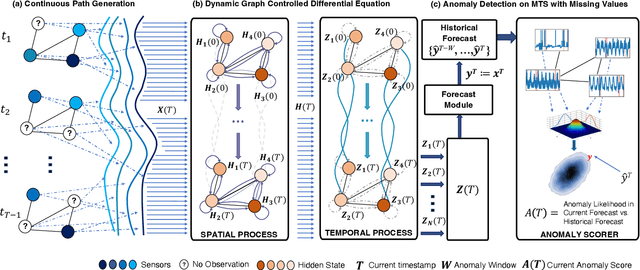

The detection of anomalies in multivariate time series data is crucial for various practical applications, including smart power grids, traffic flow forecasting, and industrial process control. However, real-world time series data is usually not well-structured, posting significant challenges to existing approaches: (1) The existence of missing values in multivariate time series data along variable and time dimensions hinders the effective modeling of interwoven spatial and temporal dependencies, resulting in important patterns being overlooked during model training; (2) Anomaly scoring with irregularly-sampled observations is less explored, making it difficult to use existing detectors for multivariate series without fully-observed values. In this work, we introduce a novel framework called GST-Pro, which utilizes a graph spatiotemporal process and anomaly scorer to tackle the aforementioned challenges in detecting anomalies on irregularly-sampled multivariate time series. Our approach comprises two main components. First, we propose a graph spatiotemporal process based on neural controlled differential equations. This process enables effective modeling of multivariate time series from both spatial and temporal perspectives, even when the data contains missing values. Second, we present a novel distribution-based anomaly scoring mechanism that alleviates the reliance on complete uniform observations. By analyzing the predictions of the graph spatiotemporal process, our approach allows anomalies to be easily detected. Our experimental results show that the GST-Pro method can effectively detect anomalies in time series data and outperforms state-of-the-art methods, regardless of whether there are missing values present in the data. Our code is available: https://github.com/huankoh/GST-Pro.
Correlation-aware Spatial-Temporal Graph Learning for Multivariate Time-series Anomaly Detection
Jul 17, 2023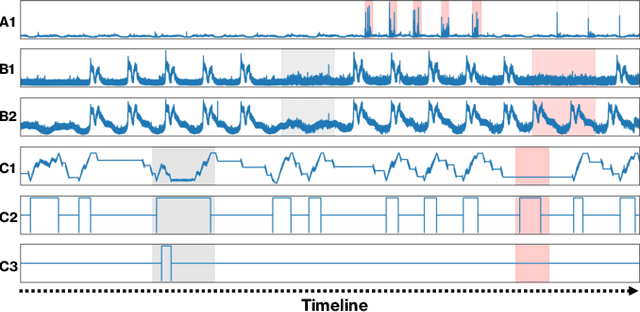
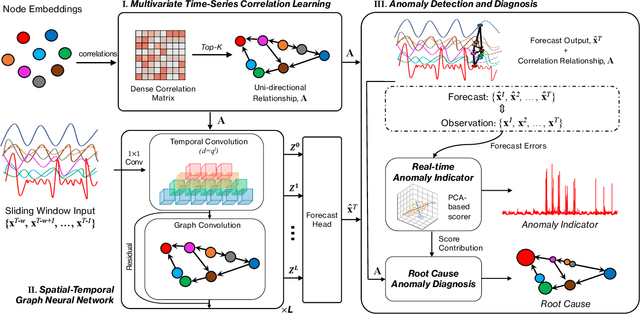
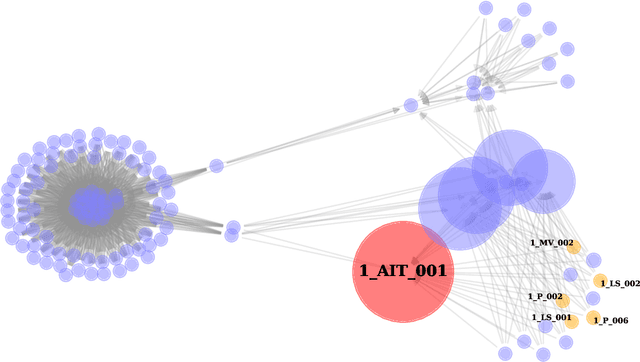
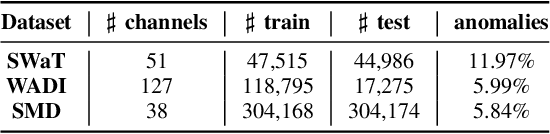
Multivariate time-series anomaly detection is critically important in many applications, including retail, transportation, power grid, and water treatment plants. Existing approaches for this problem mostly employ either statistical models which cannot capture the non-linear relations well or conventional deep learning models (e.g., CNN and LSTM) that do not explicitly learn the pairwise correlations among variables. To overcome these limitations, we propose a novel method, correlation-aware spatial-temporal graph learning (termed CST-GL), for time series anomaly detection. CST-GL explicitly captures the pairwise correlations via a multivariate time series correlation learning module based on which a spatial-temporal graph neural network (STGNN) can be developed. Then, by employing a graph convolution network that exploits one- and multi-hop neighbor information, our STGNN component can encode rich spatial information from complex pairwise dependencies between variables. With a temporal module that consists of dilated convolutional functions, the STGNN can further capture long-range dependence over time. A novel anomaly scoring component is further integrated into CST-GL to estimate the degree of an anomaly in a purely unsupervised manner. Experimental results demonstrate that CST-GL can detect anomalies effectively in general settings as well as enable early detection across different time delays.