 Add to Chrome
 Add to Firefox
 Add to Edge
Offline-Online Curriculum RL for Multimodal Reasoning
Jul 26, 2026
Multimodal large language models exhibit capabilities on reasoning tasks, yet often produce flawed intermediate steps while yielding correct final answers. This behavior undermines interpretability and reliability, suggesting reliance on spurious shortcuts rather than faithful reasoning. Although efforts have explored step-level supervision, distinguishing decisive steps from redundant ones remains challenging. We propose $O^2$-CritiCuRL, a novel curriculum reinforcement learning framework that introduces critical-step awareness through an iterative offline-online paradigm. In the offline stage, $O^2$-CritiCuRL conducts multi-rollout analysis over step-annotated trajectories to estimate step-level importance, allowing the framework to distill critical reasoning steps and filter out redundant ones. In the online stage, we employ a progressive step-level reinforcement learning strategy, where truncated chains guide the model to infer missing steps and refine its reasoning, thereby sharpening its focus on critical steps and overcoming the limitations of static supervision. Extensive experiments on multimodal reasoning benchmarks show that our method achieves state-of-the-art performance while delivering superior training and inference efficiency. Code is available at https://github.com/kk0013/CritiCuRL.

Efficient Online LLM Watermark Detection via Rao-Blackwellized E-Processes
Jul 24, 2026As large language models (LLMs) are increasingly deployed, reliable and efficient mechanisms for distinguishing AI-generated text from human-written content have become essential. Statistical watermarking has emerged as a promising solution, yet most existing methods are typically fixed-horizon procedures, precluding valid early stopping in streaming generation. In this paper, we develop an efficient online watermark detection framework with anytime-valid inference based on Rao-Blackwellized e-processes, enabling recursive token-level evidence updates without storing the full history. In particular, we instantiate the framework for the Gumbel-max watermark and reduce the original token-level dependence testing problem to a pivot-induced sequential testing problem with an explicit null distribution. Theoretically, we prove anytime-valid Type I error control under arbitrary optional stopping and establish positive asymptotic log-growth under watermarking, implying consistency of the proposed stopping rules. Simulations and experiments on real LLM-generated text demonstrate efficient online detection with rigorous anytime-valid guarantees.
Coarse-to-Fine: A Hybrid Self-Supervised Method for Non-rigid 3D Shape Matching
Jun 25, 2026Non-rigid 3D shape matching is a fundamental task in computer vision and graphics. In this paper, we propose a hybrid self-supervised method based on a coarse-to-fine strategy, which ensures consistency between the coarse mapping and the refined correspondence produced by our refinement module. The architecture features a dual-branch design, consisting of two symmetric functional map learning streams: one based on the Laplacian basis and the other utilizing the elastic basis. Extensive experiments show that our approach not only maintains computational efficiency, but also achieves state-of-the-art performance across a variety of challenging scenarios, including non-isometric deformations and topological noise. Finally, we rigorously demonstrate that contrastive energies promote feature discrimination. Furthermore, integrating these energies with existing methods yields consistent improvements, validating the overall efficacy of our approach. Our code is available at https://github.com/LuoFeifan77/Coarse-to-Fine-Hybrid-Self-Supervised-Matching.
Distill: Uncovering the True Intent behind Human-Robot Communication
May 14, 2026As robots become increasingly integrated into everyday environments, intuitive communication paradigms such as natural language and end-user programming have become indispensable for specifying autonomous robot behavior. However, these mechanisms are ineffective at fully capturing user intent: natural language is imprecise and ambiguous, whereas end-user programming can be overly specific. As a result, understanding what users truly mean when they interact with robots remains a central challenge for human-AI communication systems. To address this issue, we propose the Distill approach for human-robot communication interfaces. Given a task specification provided by the user, Distill (1) removes unnecessary steps; (2) generalizes the meaning behind individual steps; and (3) relaxes ordering constraints between steps. We implemented Distill on a web interface and, through a crowdsourcing study, demonstrated its ability to elicit and refine user intent from initial task specifications.
Robust Sequential Experimental Design for A/B Testing
May 13, 2026Experimental design has emerged as a powerful approach for improving the sample efficiency of A/B testing, yet existing designs rely critically on correctly specified models. We study robust sequential experimental design under model misspecification and develop a unified framework that covers both contextual bandit and dynamic settings. Theoretically, we prove that our design bounds the worst-case mean squared error of the estimated treatment effect. Empirically, we demonstrate the effectiveness of the proposed approach using synthetic and real-world datasets from a leading technology company.
Learning Perturbations to Extrapolate Your LLM
May 13, 2026Recent advancements in large language models demonstrate that injecting perturbations can substantially enhance extrapolation performance. However, current approaches often rely on discrete perturbations with fixed designs, which limits their flexibility. In this work, we propose a framework where token prefixes are perturbed by a learnable transformation of a continuous latent vector within an embedding space. To overcome the challenge of an intractable marginal likelihood, we derive unbiased estimating equations for model parameters and optimize them via stochastic gradient descent. We establish the statistical properties of the resulting estimator in over-parameterized regimes. Empirical evaluations on both synthetic and real-world datasets demonstrate that our proposal yields significant gains in out-of-domain settings over a range of state-of-the-art baseline methods.
Riemannian Motion Generation: A Unified Framework for Human Motion Representation and Generation via Riemannian Flow Matching
Mar 16, 2026Human motion generation is often learned in Euclidean spaces, although valid motions follow structured non-Euclidean geometry. We present Riemannian Motion Generation (RMG), a unified framework that represents motion on a product manifold and learns dynamics via Riemannian flow matching. RMG factorizes motion into several manifold factors, yielding a scale-free representation with intrinsic normalization, and uses geodesic interpolation, tangent-space supervision, and manifold-preserving ODE integration for training and sampling. On HumanML3D, RMG achieves state-of-the-art FID in the HumanML3D format (0.043) and ranks first on all reported metrics under the MotionStreamer format. On MotionMillion, it also surpasses strong baselines (FID 5.6, R@1 0.86). Ablations show that the compact $\mathscr{T}+\mathscr{R}$ (translation + rotations) representation is the most stable and effective, highlighting geometry-aware modeling as a practical and scalable route to high-fidelity motion generation.
Designing Time Series Experiments in A/B Testing with Transformer Reinforcement Learning
Feb 02, 2026A/B testing has become a gold standard for modern technological companies to conduct policy evaluation. Yet, its application to time series experiments, where policies are sequentially assigned over time, remains challenging. Existing designs suffer from two limitations: (i) they do not fully leverage the entire history for treatment allocation; (ii) they rely on strong assumptions to approximate the objective function (e.g., the mean squared error of the estimated treatment effect) for optimizing the design. We first establish an impossibility theorem showing that failure to condition on the full history leads to suboptimal designs, due to the dynamic dependencies in time series experiments. To address both limitations simultaneously, we next propose a transformer reinforcement learning (RL) approach which leverages transformers to condition allocation on the entire history and employs RL to directly optimize the MSE without relying on restrictive assumptions. Empirical evaluations on synthetic data, a publicly available dispatch simulator, and a real-world ridesharing dataset demonstrate that our proposal consistently outperforms existing designs.
Systematic validation of time-resolved diffuse optical simulators via non-contact SPAD-based measurements
Nov 17, 2025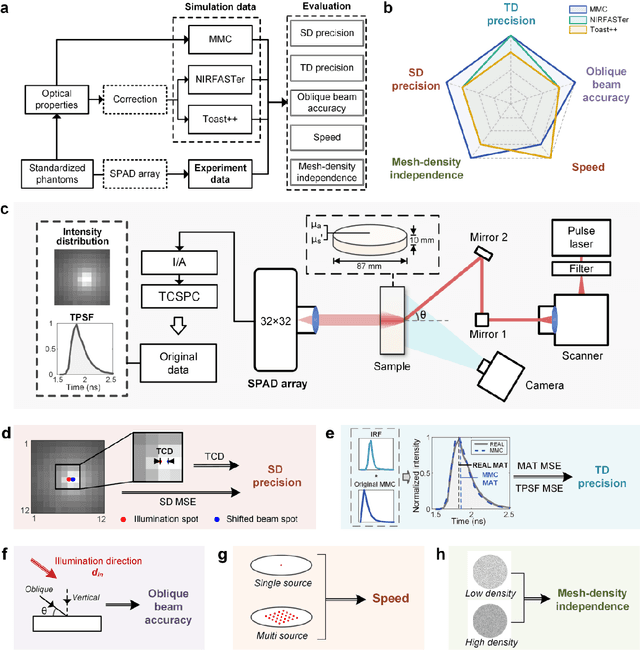
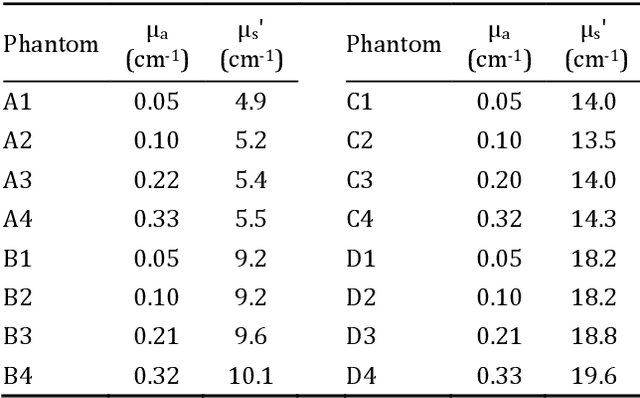
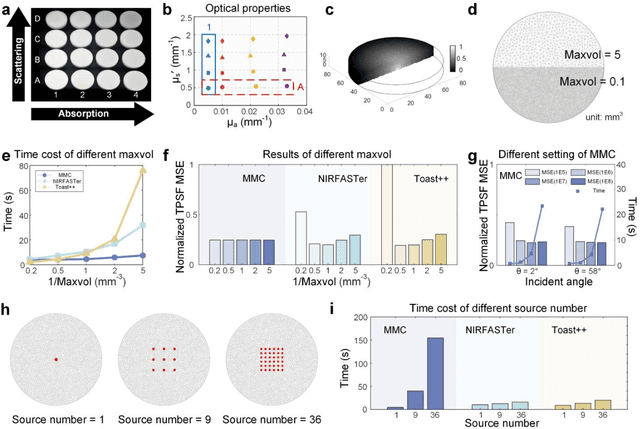
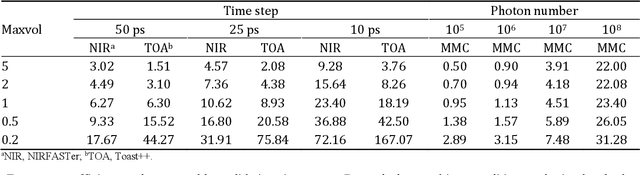
Objective: Time-domain diffuse optical imaging (DOI) requires accurate forward models for photon propagation in scattering media. However, existing simulators lack comprehensive experimental validation, especially for non-contact configurations with oblique illumination. This study rigorously evaluates three widely used open-source simulators, including MMC, NIRFASTer, and Toast++, using time-resolved experimental data. Approach: All simulations employed a unified mesh and point-source illumination. Virtual source correction was applied to FEM solvers for oblique incidence. A time-resolved DOI system with a 32 $\times$ 32 single-photon avalanche diode (SPAD) array acquired transmission-mode data from 16 standardized phantoms with varying absorption coefficient $μ_a$ and reduced scattering coefficient $μ_s'$. The simulation results were quantified across five metrics: spatial-domain (SD) precision, time-domain (TD) precision, oblique beam accuracy, computational speed, and mesh-density independence. Results: Among three simulators, MMC achieves superior accuracy in SD and TD metrics, and shows robustness across all optical properties. NIRFASTer and Toast++ demonstrate comparable overall performance. In general, MMC is optimal for accuracy-critical TD-DOI applications, while NIRFASTer and Toast++ suit scenarios prioritizing speed with sufficiently large $μ_s'$. Besides, virtual source correction is essential for non-contact FEM modeling, which reduced average errors by > 34% in large-angle scenarios. Significance: This work provides benchmarked guidelines for simulator selection during the development phase of next-generation TD-DOI systems. Our work represents the first study to systematically validate TD simulators against SPAD array-based data under clinically relevant non-contact conditions, bridging a critical gap in biomedical optical simulation standards.
Knowledge-Augmented Question Error Correction for Chinese Question Answer System with QuestionRAG
Nov 05, 2025Input errors in question-answering (QA) systems often lead to incorrect responses. Large language models (LLMs) struggle with this task, frequently failing to interpret user intent (misinterpretation) or unnecessarily altering the original question's structure (over-correction). We propose QuestionRAG, a framework that tackles these problems. To address misinterpretation, it enriches the input with external knowledge (e.g., search results, related entities). To prevent over-correction, it uses reinforcement learning (RL) to align the model's objective with precise correction, not just paraphrasing. Our results demonstrate that knowledge augmentation is critical for understanding faulty questions. Furthermore, RL-based alignment proves significantly more effective than traditional supervised fine-tuning (SFT), boosting the model's ability to follow instructions and generalize. By integrating these two strategies, QuestionRAG unlocks the full potential of LLMs for the question correction task.