 Add to Chrome
 Add to Firefox
 Add to Edge
EmbodiedBrain: Expanding Performance Boundaries of Task Planning for Embodied Intelligence
Oct 23, 2025
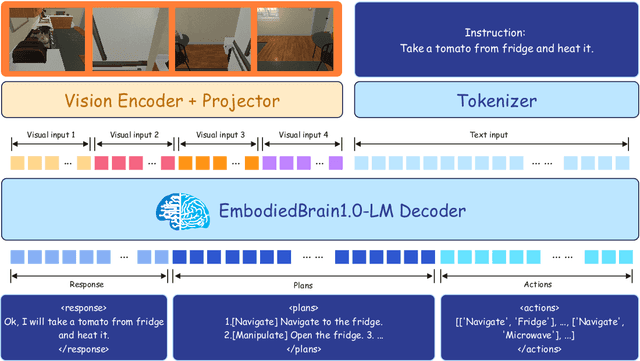
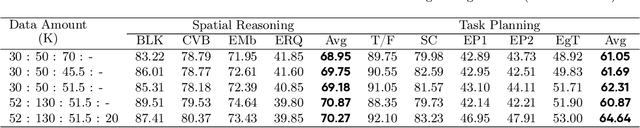
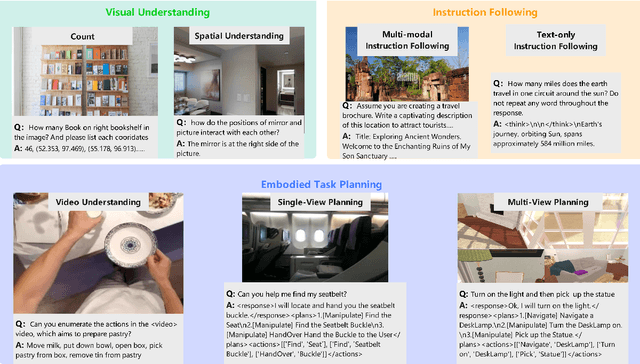
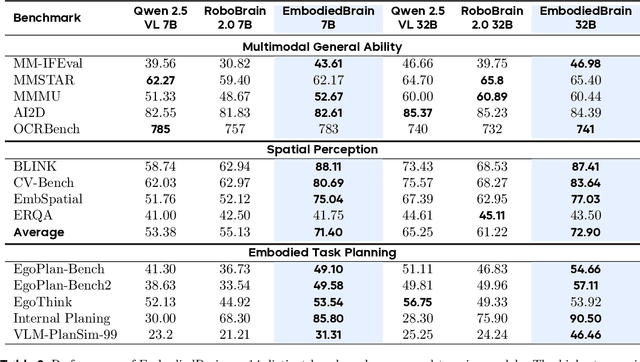
The realization of Artificial General Intelligence (AGI) necessitates Embodied AI agents capable of robust spatial perception, effective task planning, and adaptive execution in physical environments. However, current large language models (LLMs) and multimodal LLMs (MLLMs) for embodied tasks suffer from key limitations, including a significant gap between model design and agent requirements, an unavoidable trade-off between real-time latency and performance, and the use of unauthentic, offline evaluation metrics. To address these challenges, we propose EmbodiedBrain, a novel vision-language foundation model available in both 7B and 32B parameter sizes. Our framework features an agent-aligned data structure and employs a powerful training methodology that integrates large-scale Supervised Fine-Tuning (SFT) with Step-Augumented Group Relative Policy Optimization (Step-GRPO), which boosts long-horizon task success by integrating preceding steps as Guided Precursors. Furthermore, we incorporate a comprehensive reward system, including a Generative Reward Model (GRM) accelerated at the infrastructure level, to improve training efficiency. For enable thorough validation, we establish a three-part evaluation system encompassing General, Planning, and End-to-End Simulation Benchmarks, highlighted by the proposal and open-sourcing of a novel, challenging simulation environment. Experimental results demonstrate that EmbodiedBrain achieves superior performance across all metrics, establishing a new state-of-the-art for embodied foundation models. Towards paving the way for the next generation of generalist embodied agents, we open-source all of our data, model weight, and evaluating methods, which are available at https://zterobot.github.io/EmbodiedBrain.github.io.

LiRA: Linguistic Robust Anchoring for Cross-lingual Large Language Models
Oct 16, 2025As large language models (LLMs) rapidly advance, performance on high-resource languages (e.g., English, Chinese) is nearing saturation, yet remains substantially lower for low-resource languages (e.g., Urdu, Thai) due to limited training data, machine-translation noise, and unstable cross-lingual alignment. We introduce LiRA (Linguistic Robust Anchoring for Large Language Models), a training framework that robustly improves cross-lingual representations under low-resource conditions while jointly strengthening retrieval and reasoning. LiRA comprises two modules: (i) Arca (Anchored Representation Composition Architecture), which anchors low-resource languages to an English semantic space via anchor-based alignment and multi-agent collaborative encoding, preserving geometric stability in a shared embedding space; and (ii) LaSR (Language-coupled Semantic Reasoner), which adds a language-aware lightweight reasoning head with consistency regularization on top of Arca's multilingual representations, unifying the training objective to enhance cross-lingual understanding, retrieval, and reasoning robustness. We further construct and release a multilingual product retrieval dataset covering five Southeast Asian and two South Asian languages. Experiments across low-resource benchmarks (cross-lingual retrieval, semantic similarity, and reasoning) show consistent gains and robustness under few-shot and noise-amplified settings; ablations validate the contribution of both Arca and LaSR. Code will be released on GitHub and the dataset on Hugging Face.
DCMIL: A Progressive Representation Learning Model of Whole Slide Images for Cancer Prognosis Analysis
Oct 16, 2025The burgeoning discipline of computational pathology shows promise in harnessing whole slide images (WSIs) to quantify morphological heterogeneity and develop objective prognostic modes for human cancers. However, progress is impeded by the computational bottleneck of gigapixel-size inputs and the scarcity of dense manual annotations. Current methods often overlook fine-grained information across multi-magnification WSIs and variations in tumor microenvironments. Here, we propose an easy-to-hard progressive representation learning model, termed dual-curriculum contrastive multi-instance learning (DCMIL), to efficiently process WSIs for cancer prognosis. The model does not rely on dense annotations and enables the direct transformation of gigapixel-size WSIs into outcome predictions. Extensive experiments on twelve cancer types (5,954 patients, 12.54 million tiles) demonstrate that DCMIL outperforms standard WSI-based prognostic models. Additionally, DCMIL identifies fine-grained prognosis-salient regions, provides robust instance uncertainty estimation, and captures morphological differences between normal and tumor tissues, with the potential to generate new biological insights. All codes have been made publicly accessible at https://github.com/tuuuc/DCMIL.
Synergistic Integration and Discrepancy Resolution of Contextualized Knowledge for Personalized Recommendation
Oct 16, 2025The integration of large language models (LLMs) into recommendation systems has revealed promising potential through their capacity to extract world knowledge for enhanced reasoning capabilities. However, current methodologies that adopt static schema-based prompting mechanisms encounter significant limitations: (1) they employ universal template structures that neglect the multi-faceted nature of user preference diversity; (2) they implement superficial alignment between semantic knowledge representations and behavioral feature spaces without achieving comprehensive latent space integration. To address these challenges, we introduce CoCo, an end-to-end framework that dynamically constructs user-specific contextual knowledge embeddings through a dual-mechanism approach. Our method realizes profound integration of semantic and behavioral latent dimensions via adaptive knowledge fusion and contradiction resolution modules. Experimental evaluations across diverse benchmark datasets and an enterprise-level e-commerce platform demonstrate CoCo's superiority, achieving a maximum 8.58% improvement over seven cutting-edge methods in recommendation accuracy. The framework's deployment on a production advertising system resulted in a 1.91% sales growth, validating its practical effectiveness. With its modular design and model-agnostic architecture, CoCo provides a versatile solution for next-generation recommendation systems requiring both knowledge-enhanced reasoning and personalized adaptation.
DisorientLiDAR: Physical Attacks on LiDAR-based Localization
Sep 16, 2025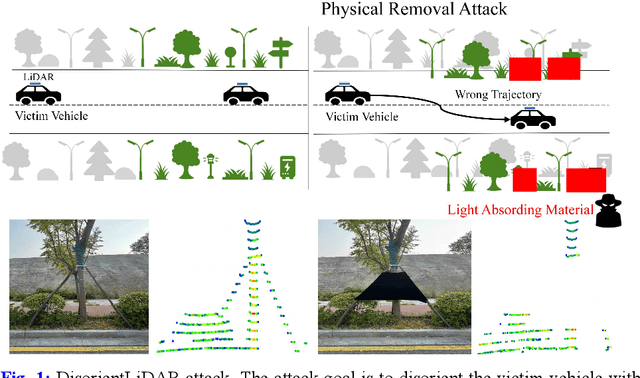
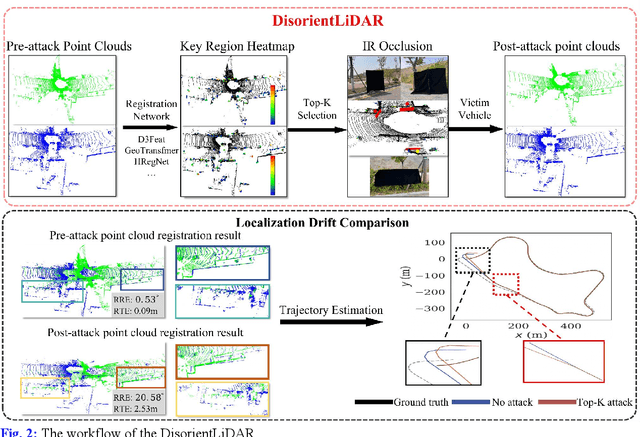
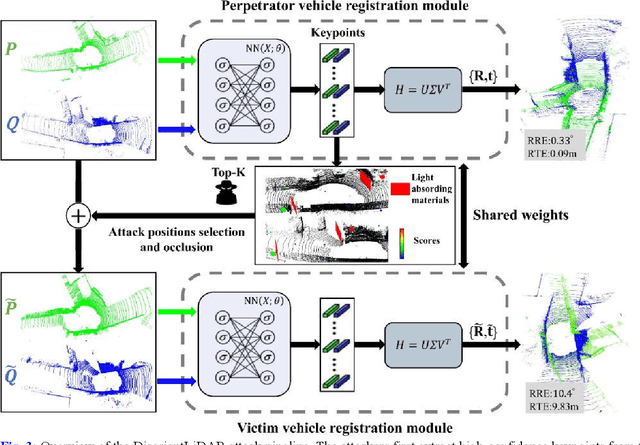
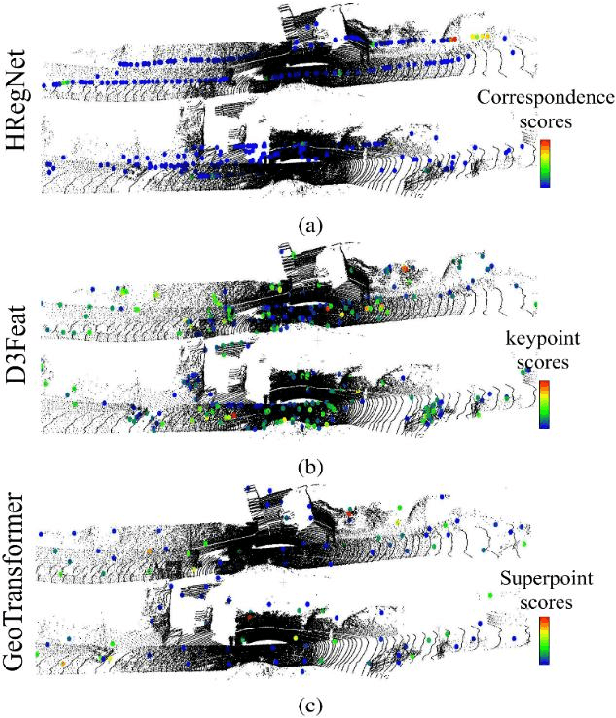
Deep learning models have been shown to be susceptible to adversarial attacks with visually imperceptible perturbations. Even this poses a serious security challenge for the localization of self-driving cars, there has been very little exploration of attack on it, as most of adversarial attacks have been applied to 3D perception. In this work, we propose a novel adversarial attack framework called DisorientLiDAR targeting LiDAR-based localization. By reverse-engineering localization models (e.g., feature extraction networks), adversaries can identify critical keypoints and strategically remove them, thereby disrupting LiDAR-based localization. Our proposal is first evaluated on three state-of-the-art point-cloud registration models (HRegNet, D3Feat, and GeoTransformer) using the KITTI dataset. Experimental results demonstrate that removing regions containing Top-K keypoints significantly degrades their registration accuracy. We further validate the attack's impact on the Autoware autonomous driving platform, where hiding merely a few critical regions induces noticeable localization drift. Finally, we extended our attacks to the physical world by hiding critical regions with near-infrared absorptive materials, thereby successfully replicate the attack effects observed in KITTI data. This step has been closer toward the realistic physical-world attack that demonstrate the veracity and generality of our proposal.
FPI-Det: a face--phone Interaction Dataset for phone-use detection and understanding
Sep 11, 2025The widespread use of mobile devices has created new challenges for vision systems in safety monitoring, workplace productivity assessment, and attention management. Detecting whether a person is using a phone requires not only object recognition but also an understanding of behavioral context, which involves reasoning about the relationship between faces, hands, and devices under diverse conditions. Existing generic benchmarks do not fully capture such fine-grained human--device interactions. To address this gap, we introduce the FPI-Det, containing 22{,}879 images with synchronized annotations for faces and phones across workplace, education, transportation, and public scenarios. The dataset features extreme scale variation, frequent occlusions, and varied capture conditions. We evaluate representative YOLO and DETR detectors, providing baseline results and an analysis of performance across object sizes, occlusion levels, and environments. Source code and dataset is available at https://github.com/KvCgRv/FPI-Det.
Object-level Correlation for Few-Shot Segmentation
Sep 09, 2025Few-shot semantic segmentation (FSS) aims to segment objects of novel categories in the query images given only a few annotated support samples. Existing methods primarily build the image-level correlation between the support target object and the entire query image. However, this correlation contains the hard pixel noise, \textit{i.e.}, irrelevant background objects, that is intractable to trace and suppress, leading to the overfitting of the background. To address the limitation of this correlation, we imitate the biological vision process to identify novel objects in the object-level information. Target identification in the general objects is more valid than in the entire image, especially in the low-data regime. Inspired by this, we design an Object-level Correlation Network (OCNet) by establishing the object-level correlation between the support target object and query general objects, which is mainly composed of the General Object Mining Module (GOMM) and Correlation Construction Module (CCM). Specifically, GOMM constructs the query general object feature by learning saliency and high-level similarity cues, where the general objects include the irrelevant background objects and the target foreground object. Then, CCM establishes the object-level correlation by allocating the target prototypes to match the general object feature. The generated object-level correlation can mine the query target feature and suppress the hard pixel noise for the final prediction. Extensive experiments on PASCAL-${5}^{i}$ and COCO-${20}^{i}$ show that our model achieves the state-of-the-art performance.
Estimated Informed Anytime Search for Sampling-Based Planning via Adaptive Sampler
Aug 29, 2025Path planning in robotics often involves solving continuously valued, high-dimensional problems. Popular informed approaches include graph-based searches, such as A*, and sampling-based methods, such as Informed RRT*, which utilize informed set and anytime strategies to expedite path optimization incrementally. Informed sampling-based planners define informed sets as subsets of the problem domain based on the current best solution cost. However, when no solution is found, these planners re-sample and explore the entire configuration space, which is time-consuming and computationally expensive. This article introduces Multi-Informed Trees (MIT*), a novel planner that constructs estimated informed sets based on prior admissible solution costs before finding the initial solution, thereby accelerating the initial convergence rate. Moreover, MIT* employs an adaptive sampler that dynamically adjusts the sampling strategy based on the exploration process. Furthermore, MIT* utilizes length-related adaptive sparse collision checks to guide lazy reverse search. These features enhance path cost efficiency and computation times while ensuring high success rates in confined scenarios. Through a series of simulations and real-world experiments, it is confirmed that MIT* outperforms existing single-query, sampling-based planners for problems in R^4 to R^16 and has been successfully applied to real-world robot manipulation tasks. A video showcasing our experimental results is available at: https://youtu.be/30RsBIdexTU
Deep Fuzzy Optimization for Batch-Size and Nearest Neighbors in Optimal Robot Motion Planning
Aug 28, 2025Efficient motion planning algorithms are essential in robotics. Optimizing essential parameters, such as batch size and nearest neighbor selection in sampling-based methods, can enhance performance in the planning process. However, existing approaches often lack environmental adaptability. Inspired by the method of the deep fuzzy neural networks, this work introduces Learning-based Informed Trees (LIT*), a sampling-based deep fuzzy learning-based planner that dynamically adjusts batch size and nearest neighbor parameters to obstacle distributions in the configuration spaces. By encoding both global and local ratios via valid and invalid states, LIT* differentiates between obstacle-sparse and obstacle-dense regions, leading to lower-cost paths and reduced computation time. Experimental results in high-dimensional spaces demonstrate that LIT* achieves faster convergence and improved solution quality. It outperforms state-of-the-art single-query, sampling-based planners in environments ranging from R^8 to R^14 and is successfully validated on a dual-arm robot manipulation task. A video showcasing our experimental results is available at: https://youtu.be/NrNs9zebWWk
Elliptical K-Nearest Neighbors -- Path Optimization via Coulomb's Law and Invalid Vertices in C-space Obstacles
Aug 27, 2025Path planning has long been an important and active research area in robotics. To address challenges in high-dimensional motion planning, this study introduces the Force Direction Informed Trees (FDIT*), a sampling-based planner designed to enhance speed and cost-effectiveness in pathfinding. FDIT* builds upon the state-of-the-art informed sampling planner, the Effort Informed Trees (EIT*), by capitalizing on often-overlooked information in invalid vertices. It incorporates principles of physical force, particularly Coulomb's law. This approach proposes the elliptical $k$-nearest neighbors search method, enabling fast convergence navigation and avoiding high solution cost or infeasible paths by exploring more problem-specific search-worthy areas. It demonstrates benefits in search efficiency and cost reduction, particularly in confined, high-dimensional environments. It can be viewed as an extension of nearest neighbors search techniques. Fusing invalid vertex data with physical dynamics facilitates force-direction-based search regions, resulting in an improved convergence rate to the optimum. FDIT* outperforms existing single-query, sampling-based planners on the tested problems in R^4 to R^16 and has been demonstrated on a real-world mobile manipulation task.