 Add to Chrome
 Add to Firefox
 Add to Edge
WAM-TTT: Steering World-Action Models by Watching Human Play at Test Time
Jul 08, 2026
Steering robot foundation models (RFMs) toward new task variants or user-preferred behaviors remains challenging, often requiring additional robot demonstrations, task-specific fine-tuning, or long-context conditioning. We present WAM-TTT, a test-time training framework for steering world action models from raw human videos. Rather than treating human videos as trajectories to imitate, WAM-TTT absorbs them into a lightweight adaptive memory inside a frozen WAM through self-supervised video prediction. To make this memory useful for control, we introduce a meta-training stage that aligns human demonstrations with robot behaviors using paired human-robot data and a key--value memory reconstruction objective. At test time, only unlabeled human videos are required to adapt the memory, while the pretrained WAM remains frozen. This enables efficient and reusable steering without robot actions, human-side annotations, or task-specific fine-tuning, while preserving the generalization ability of the foundation model. Extensive experiments show that WAM-TTT consistently outperforms in-context human-video conditioning baselines across diverse manipulation tasks and generalization settings.

Closing the Feedback Loop: From Experience Extraction to Insight Governance in Verbal Reinforcement Learning
Jun 16, 2026Training-free verbal reinforcement learning enables LLM agents to learn from world feedback -- objective signals such as dynamic task outcomes, market returns, or demand forecasts -- by extracting verbal rules from experience and injecting them as context, updating the agent's behavior without parameter changes. However, in non-stationary environments these agents face a retention-forgetting dilemma: retaining stale insights causes negative transfer, while discarding them causes catastrophic forgetting when conditions recur. We identify four requirements for navigating this dilemma -- outcome-driven evaluation, persistent structured evidence, non-monotonic knowledge lifecycle, and compositional governance -- and show that existing methods invest heavily in experience extraction while underinvesting in insight governance. We propose a three-layer architecture -- rules, evidence, and skills -- connected by a feedback-driven curation loop that closes the governance gap. Rules capture distilled experience from world outcomes; evidence logs track each rule's reliability across episodes; skills govern which rules to apply, how to resolve conflicts, and when to abstain. On financial forecasting as a case study, where world feedback is naturally abundant, noisy, and non-stationary, we show that the same accumulated experience either degrades performance below the zero-shot baseline or dramatically improves accuracy and risk-adjusted returns, depending on whether the curation loop is present.
Slack More, Predict Better: Proximal Relaxation for Probabilistic Latent Variable Model-based Soft Sensors
Mar 12, 2026Nonlinear Probabilistic Latent Variable Models (NPLVMs) are a cornerstone of soft sensor modeling due to their capacity for uncertainty delineation. However, conventional NPLVMs are trained using amortized variational inference, where neural networks parameterize the variational posterior. While facilitating model implementation, this parameterization converts the distributional optimization problem within an infinite-dimensional function space to parameter optimization within a finite-dimensional parameter space, which introduces an approximation error gap, thereby degrading soft sensor modeling accuracy. To alleviate this issue, we introduce KProxNPLVM, a novel NPLVM that pivots to relaxing the objective itself and improving the NPLVM's performance. Specifically, we first prove the approximation error induced by the conventional approach. Based on this, we design the Wasserstein distance as the proximal operator to relax the learning objective, yielding a new variational inference strategy derived from solving this relaxed optimization problem. Based on this foundation, we provide a rigorous derivation of KProxNPLVM's optimization implementation, prove the convergence of our algorithm can finally sidestep the approximation error, and propose the KProxNPLVM by summarizing the abovementioned content. Finally, extensive experiments on synthetic and real-world industrial datasets are conducted to demonstrate the efficacy of the proposed KProxNPLVM.
COMETS: Coordinated Multi-Destination Video Transmission with In-Network Rate Adaptation
Jan 26, 2026Large-scale video streaming events attract millions of simultaneous viewers, stressing existing delivery infrastructures. Client-driven adaptation reacts slowly to shared congestion, while server-based coordination introduces scalability bottlenecks and single points of failure. We present COMETS, a coordinated multi-destination video transmission framework that leverages information-centric networking principles such as request aggregation and in-network state awareness to enable scalable, fair, and adaptive rate control. COMETS introduces a novel range-interest protocol and distributed in-network decision process that aligns video quality across receiver groups while minimizing redundant transmissions. To achieve this, we develop a lightweight distributed optimization framework that guides per-hop quality adaptation without centralized control. Extensive emulation shows that COMETS consistently improves bandwidth utilization, fairness, and user-perceived quality of experience over DASH, MoQ, and ICN baselines, particularly under high concurrency. The results highlight COMETS as a practical, deployable approach for next-generation scalable video delivery.
* Accepted to appear in IEEE Transactions on Multimedia (2026)
DexterCap: An Affordable and Automated System for Capturing Dexterous Hand-Object Manipulation
Jan 09, 2026Capturing fine-grained hand-object interactions is challenging due to severe self-occlusion from closely spaced fingers and the subtlety of in-hand manipulation motions. Existing optical motion capture systems rely on expensive camera setups and extensive manual post-processing, while low-cost vision-based methods often suffer from reduced accuracy and reliability under occlusion. To address these challenges, we present DexterCap, a low-cost optical capture system for dexterous in-hand manipulation. DexterCap uses dense, character-coded marker patches to achieve robust tracking under severe self-occlusion, together with an automated reconstruction pipeline that requires minimal manual effort. With DexterCap, we introduce DexterHand, a dataset of fine-grained hand-object interactions covering diverse manipulation behaviors and objects, from simple primitives to complex articulated objects such as a Rubik's Cube. We release the dataset and code to support future research on dexterous hand-object interaction.
MIRNet: Integrating Constrained Graph-Based Reasoning with Pre-training for Diagnostic Medical Imaging
Nov 13, 2025Automated interpretation of medical images demands robust modeling of complex visual-semantic relationships while addressing annotation scarcity, label imbalance, and clinical plausibility constraints. We introduce MIRNet (Medical Image Reasoner Network), a novel framework that integrates self-supervised pre-training with constrained graph-based reasoning. Tongue image diagnosis is a particularly challenging domain that requires fine-grained visual and semantic understanding. Our approach leverages self-supervised masked autoencoder (MAE) to learn transferable visual representations from unlabeled data; employs graph attention networks (GAT) to model label correlations through expert-defined structured graphs; enforces clinical priors via constraint-aware optimization using KL divergence and regularization losses; and mitigates imbalance using asymmetric loss (ASL) and boosting ensembles. To address annotation scarcity, we also introduce TongueAtlas-4K, a comprehensive expert-curated benchmark comprising 4,000 images annotated with 22 diagnostic labels--representing the largest public dataset in tongue analysis. Validation shows our method achieves state-of-the-art performance. While optimized for tongue diagnosis, the framework readily generalizes to broader diagnostic medical imaging tasks.
Come Together, But Not Right Now: A Progressive Strategy to Boost Low-Rank Adaptation
Jun 06, 2025Low-rank adaptation (LoRA) has emerged as a leading parameter-efficient fine-tuning technique for adapting large foundation models, yet it often locks adapters into suboptimal minima near their initialization. This hampers model generalization and limits downstream operators such as adapter merging and pruning. Here, we propose CoTo, a progressive training strategy that gradually increases adapters' activation probability over the course of fine-tuning. By stochastically deactivating adapters, CoTo encourages more balanced optimization and broader exploration of the loss landscape. We provide a theoretical analysis showing that CoTo promotes layer-wise dropout stability and linear mode connectivity, and we adopt a cooperative-game approach to quantify each adapter's marginal contribution. Extensive experiments demonstrate that CoTo consistently boosts single-task performance, enhances multi-task merging accuracy, improves pruning robustness, and reduces training overhead, all while remaining compatible with diverse LoRA variants. Code is available at https://github.com/zwebzone/coto.
Open the Eyes of MPNN: Vision Enhances MPNN in Link Prediction
May 13, 2025Message-passing graph neural networks (MPNNs) and structural features (SFs) are cornerstones for the link prediction task. However, as a common and intuitive mode of understanding, the potential of visual perception has been overlooked in the MPNN community. For the first time, we equip MPNNs with vision structural awareness by proposing an effective framework called Graph Vision Network (GVN), along with a more efficient variant (E-GVN). Extensive empirical results demonstrate that with the proposed frameworks, GVN consistently benefits from the vision enhancement across seven link prediction datasets, including challenging large-scale graphs. Such improvements are compatible with existing state-of-the-art (SOTA) methods and GVNs achieve new SOTA results, thereby underscoring a promising novel direction for link prediction.
Consensus Entropy: Harnessing Multi-VLM Agreement for Self-Verifying and Self-Improving OCR
Apr 16, 2025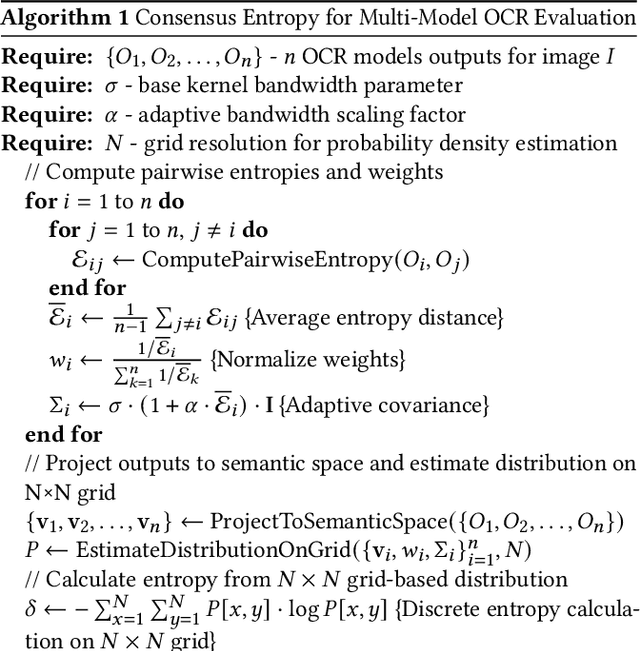
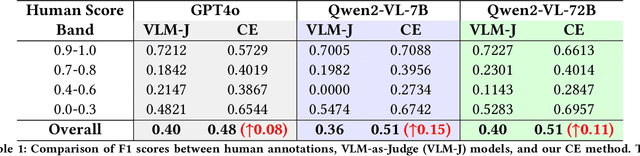
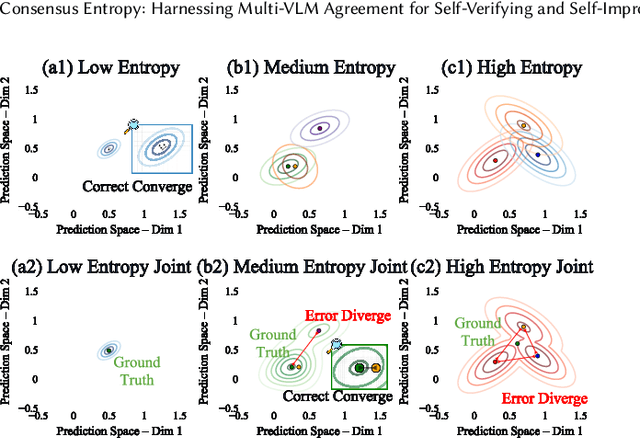

The Optical Character Recognition (OCR) task is important for evaluating Vision-Language Models (VLMs) and providing high-quality data sources for LLM training data. While state-of-the-art VLMs show improved average OCR accuracy, they still struggle with sample-level quality degradation and lack reliable automatic detection of low-quality outputs. We introduce Consensus Entropy (CE), a training-free post-inference method that quantifies OCR uncertainty by aggregating outputs from multiple VLMs. Our approach exploits a key insight: correct VLM OCR predictions converge in output space while errors diverge. We develop a lightweight multi-model framework that effectively identifies problematic samples, selects the best outputs and combines model strengths. Experiments across multiple OCR benchmarks and VLMs demonstrate that CE outperforms VLM-as-judge approaches and single-model baselines at the same cost and achieves state-of-the-art results across multiple metrics. For instance, our solution demonstrates: achieving 15.2% higher F1 scores than VLM-as-judge methods in quality verification, delivering 6.0% accuracy gains on mathematical calculation tasks, and requiring rephrasing only 7.3% of inputs while maintaining overall performance. Notably, the entire process requires neither training nor supervision while maintaining plug-and-play functionality throughout.
A Dual-Agent Adversarial Framework for Robust Generalization in Deep Reinforcement Learning
Jan 29, 2025
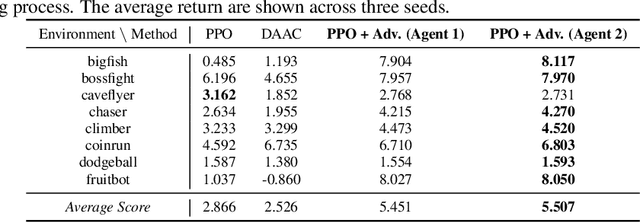
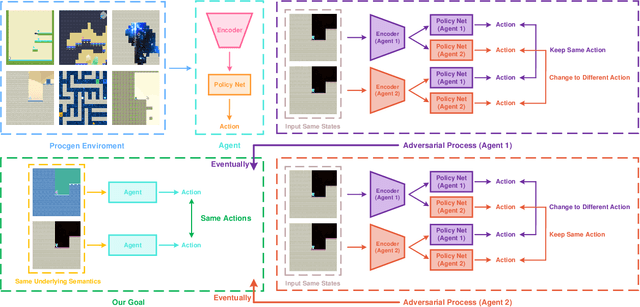
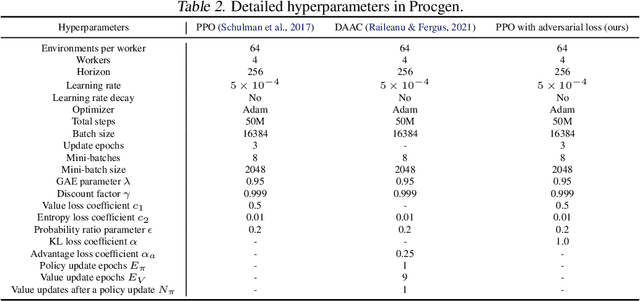
Recently, empowered with the powerful capabilities of neural networks, reinforcement learning (RL) has successfully tackled numerous challenging tasks. However, while these models demonstrate enhanced decision-making abilities, they are increasingly prone to overfitting. For instance, a trained RL model often fails to generalize to even minor variations of the same task, such as a change in background color or other minor semantic differences. To address this issue, we propose a dual-agent adversarial policy learning framework, which allows agents to spontaneously learn the underlying semantics without introducing any human prior knowledge. Specifically, our framework involves a game process between two agents: each agent seeks to maximize the impact of perturbing on the opponent's policy by producing representation differences for the same state, while maintaining its own stability against such perturbations. This interaction encourages agents to learn generalizable policies, capable of handling irrelevant features from the high-dimensional observations. Extensive experimental results on the Procgen benchmark demonstrate that the adversarial process significantly improves the generalization performance of both agents, while also being applied to various RL algorithms, e.g., Proximal Policy Optimization (PPO). With the adversarial framework, the RL agent outperforms the baseline methods by a significant margin, especially in hard-level tasks, marking a significant step forward in the generalization capabilities of deep reinforcement learning.