 Add to Chrome
 Add to Firefox
 Add to Edge
Denoise First, Orthogonalize Later: Understanding Momentum in Muon via Spectral Filtering
Jun 03, 2026
Muon has recently demonstrated strong empirical performance in large language model training, but the theoretical role of momentum in Muon remains unclear. Existing analyses of Muon either remove momentum to study spectral updates in isolation, or retain momentum without explaining why it improves empirical performance. Our work bridges this gap by showing momentum in Muon acts as a spectral filter. Under a structured signal-plus-perturbation gradient model, we prove that momentum suppresses perturbations while preserving the dominant signal, thereby enlarging the spectral gap between them. This enlarged gap stabilizes the singular subspaces of the matrix passed to Muon's orthogonalization step, making the resulting update more reliable. We further show that applying momentum before orthogonalization achieves provably stronger alignment with the signal component of the gradient than either reversing this order or simply removing momentum. Experiments across diverse tasks, including LLM pretraining, support our theoretical analysis. More broadly, our theory offers a starting point for understanding the benefits of momentum in other matrix-based optimizers.

PEFT-Arena: Understanding Parameter-Efficient Finetuning from a Stability-Plasticity Perspective
May 27, 2026Parameter-efficient finetuning (PEFT) has become the standard approach for adapting large language models, yet evaluations largely emphasize downstream accuracy while overlooking the retention of pretrained capabilities. We argue that PEFT should be assessed through the stability-plasticity dilemma: the trade-off between target-task adaptation and resistance to forgetting. We introduce PEFT-Arena, a benchmark that jointly measures downstream performance and general capability retention. Across methods, we find distinct stability-plasticity profiles; under comparable parameter budgets, orthogonal finetuning achieves the most favorable Pareto frontier. To explain these differences, we analyze PEFT updates from two geometric perspectives. In weight space, spectral analysis reveals how parameterizations interact with the pretrained singular-value structure. In activation space, retention metrics show whether finetuning preserves or distorts general-capability representations, with forgetting linked to non-isometric representation distortion. Finally, an analysis shows that final SFT checkpoints often overshoot a better target-retention operating point. Inspired by this, we present case studies of a post-hoc improvement with path-wise rewinding.
Pion: A Spectrum-Preserving Optimizer via Orthogonal Equivalence Transformation
May 12, 2026We introduce Pion, a spectrum-preserving optimizer for large language model (LLM) training based on orthogonal equivalence transformation. Unlike additive optimizers such as Adam and Muon, Pion updates each weight matrix through left and right orthogonal transformations, preserving its singular values throughout training. This yields an optimization mechanism that modulates the geometry of weight matrices while keeping their spectral norm fixed. We derive the Pion update rule, systematically examine its design choices, and analyze its convergence behavior along with several key properties. Empirical results show that Pion offers a stable and competitive alternative to standard optimizers for both LLM pretraining and finetuning.
Rethinking Easy-to-Hard: Limits of Curriculum Learning in Post-Training for Deductive Reasoning
Mar 28, 2026Curriculum learning (CL), motivated by the intuition that learning in increasing order of difficulty should ease generalization, is commonly adopted both in pre-training and post-training of large language models (LLMs). The intuition of CL is particularly compelling for compositional reasoning, where complex problems are built from elementary inference rules; however, the actual impact of CL on such tasks remains largely underexplored. We present a systematic empirical study of CL for post-training of LLMs, using synthetic arithmetic and logical benchmarks where difficulty is characterized by reasoning complexity rather than surface-level proxies. Surprisingly, across multiple model families and curriculum schedules, we find no robust advantage in difficulty-based sequencing over standard random sampling in either accuracy or response length. These findings persist across both supervised fine-tuning (SFT) and reinforcement learning (RL) methods. Our study suggests that, in the context of deductive reasoning, the specific ordering of training examples plays a negligible role in achieving compositional generalization, challenging the practical utility of curriculum-based post-training.
Streaming Autoregressive Video Generation via Diagonal Distillation
Mar 11, 2026Large pretrained diffusion models have significantly enhanced the quality of generated videos, and yet their use in real-time streaming remains limited. Autoregressive models offer a natural framework for sequential frame synthesis but require heavy computation to achieve high fidelity. Diffusion distillation can compress these models into efficient few-step variants, but existing video distillation approaches largely adapt image-specific methods that neglect temporal dependencies. These techniques often excel in image generation but underperform in video synthesis, exhibiting reduced motion coherence, error accumulation over long sequences, and a latency-quality trade-off. We identify two factors that result in these limitations: insufficient utilization of temporal context during step reduction and implicit prediction of subsequent noise levels in next-chunk prediction (i.e., exposure bias). To address these issues, we propose Diagonal Distillation, which operates orthogonally to existing approaches and better exploits temporal information across both video chunks and denoising steps. Central to our approach is an asymmetric generation strategy: more steps early, fewer steps later. This design allows later chunks to inherit rich appearance information from thoroughly processed early chunks, while using partially denoised chunks as conditional inputs for subsequent synthesis. By aligning the implicit prediction of subsequent noise levels during chunk generation with the actual inference conditions, our approach mitigates error propagation and reduces oversaturation in long-range sequences. We further incorporate implicit optical flow modeling to preserve motion quality under strict step constraints. Our method generates a 5-second video in 2.61 seconds (up to 31 FPS), achieving a 277.3x speedup over the undistilled model.
POET-X: Memory-efficient LLM Training by Scaling Orthogonal Transformation
Mar 05, 2026Efficient and stable training of large language models (LLMs) remains a core challenge in modern machine learning systems. To address this challenge, Reparameterized Orthogonal Equivalence Training (POET), a spectrum-preserving framework that optimizes each weight matrix through orthogonal equivalence transformation, has been proposed. Although POET provides strong training stability, its original implementation incurs high memory consumption and computational overhead due to intensive matrix multiplications. To overcome these limitations, we introduce POET-X, a scalable and memory-efficient variant that performs orthogonal equivalence transformations with significantly reduced computational cost. POET-X maintains the generalization and stability benefits of POET while achieving substantial improvements in throughput and memory efficiency. In our experiments, POET-X enables the pretraining of billion-parameter LLMs on a single Nvidia H100 GPU, and in contrast, standard optimizers such as AdamW run out of memory under the same settings.
Rigidity-Aware Geometric Pretraining for Protein Design and Conformational Ensembles
Mar 02, 2026Generative models have recently advanced $\textit{de novo}$ protein design by learning the statistical regularities of natural structures. However, current approaches face three key limitations: (1) Existing methods cannot jointly learn protein geometry and design tasks, where pretraining can be a solution; (2) Current pretraining methods mostly rely on local, non-rigid atomic representations for property prediction downstream tasks, limiting global geometric understanding for protein generation tasks; and (3) Existing approaches have yet to effectively model the rich dynamic and conformational information of protein structures. To overcome these issues, we introduce $\textbf{RigidSSL}$ ($\textit{Rigidity-Aware Self-Supervised Learning}$), a geometric pretraining framework that front-loads geometry learning prior to generative finetuning. Phase I (RigidSSL-Perturb) learns geometric priors from 432K structures from the AlphaFold Protein Structure Database with simulated perturbations. Phase II (RigidSSL-MD) refines these representations on 1.3K molecular dynamics trajectories to capture physically realistic transitions. Underpinning both phases is a bi-directional, rigidity-aware flow matching objective that jointly optimizes translational and rotational dynamics to maximize mutual information between conformations. Empirically, RigidSSL variants improve designability by up to 43\% while enhancing novelty and diversity in unconditional generation. Furthermore, RigidSSL-Perturb improves the success rate by 5.8\% in zero-shot motif scaffolding and RigidSSL-MD captures more biophysically realistic conformational ensembles in G protein-coupled receptor modeling. The code is available at: https://github.com/ZhanghanNi/RigidSSL.git.
Orthogonal Model Merging
Feb 05, 2026Merging finetuned Large Language Models (LLMs) has become increasingly important for integrating diverse capabilities into a single unified model. However, prevailing model merging methods rely on linear arithmetic in Euclidean space, which often destroys the intrinsic geometric properties of pretrained weights, such as hyperspherical energy. To address this, we propose Orthogonal Model Merging (OrthoMerge), a method that performs merging operations on the Riemannian manifold formed by the orthogonal group to preserve the geometric structure of the model's weights. By mapping task-specific orthogonal matrices learned by Orthogonal Finetuning (OFT) to the Lie algebra, OrthoMerge enables a principled yet efficient integration that takes into account both the direction and intensity of adaptations. In addition to directly leveraging orthogonal matrices obtained by OFT, we further extend this approach to general models finetuned with non-OFT methods (i.e., low-rank finetuning, full finetuning) via an Orthogonal-Residual Decoupling strategy. This technique extracts the orthogonal components of expert models by solving the orthogonal Procrustes problem, which are then merged on the manifold of the orthogonal group, while the remaining linear residuals are processed through standard additive merging. Extensive empirical results demonstrate the effectiveness of OrthoMerge in mitigating catastrophic forgetting and maintaining model performance across diverse tasks.
Agentic Design of Compositional Machines
Oct 16, 2025The design of complex machines stands as both a marker of human intelligence and a foundation of engineering practice. Given recent advances in large language models (LLMs), we ask whether they, too, can learn to create. We approach this question through the lens of compositional machine design: a task in which machines are assembled from standardized components to meet functional demands like locomotion or manipulation in a simulated physical environment. To support this investigation, we introduce BesiegeField, a testbed built on the machine-building game Besiege, which enables part-based construction, physical simulation and reward-driven evaluation. Using BesiegeField, we benchmark state-of-the-art LLMs with agentic workflows and identify key capabilities required for success, including spatial reasoning, strategic assembly, and instruction-following. As current open-source models fall short, we explore reinforcement learning (RL) as a path to improvement: we curate a cold-start dataset, conduct RL finetuning experiments, and highlight open challenges at the intersection of language, machine design, and physical reasoning.
Symbolic Graphics Programming with Large Language Models
Sep 05, 2025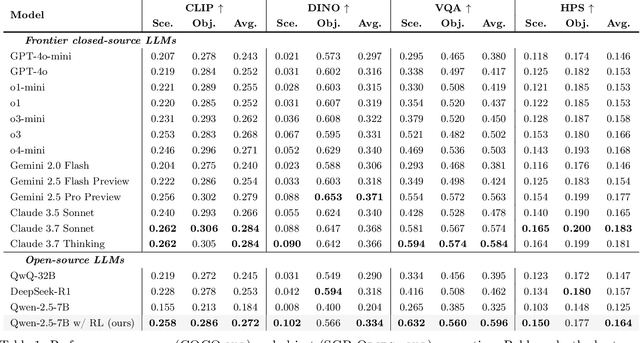
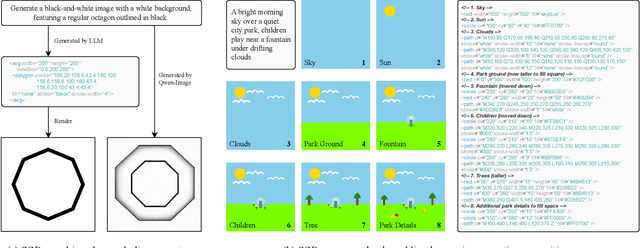
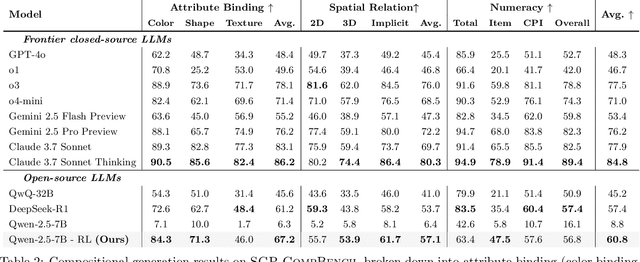
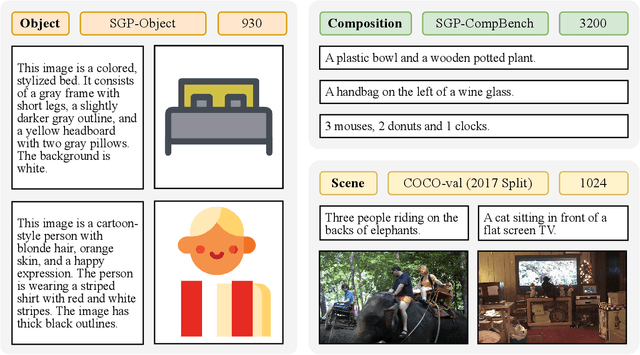
Large language models (LLMs) excel at program synthesis, yet their ability to produce symbolic graphics programs (SGPs) that render into precise visual content remains underexplored. We study symbolic graphics programming, where the goal is to generate an SGP from a natural-language description. This task also serves as a lens into how LLMs understand the visual world by prompting them to generate images rendered from SGPs. Among various SGPs, our paper sticks to scalable vector graphics (SVGs). We begin by examining the extent to which LLMs can generate SGPs. To this end, we introduce SGP-GenBench, a comprehensive benchmark covering object fidelity, scene fidelity, and compositionality (attribute binding, spatial relations, numeracy). On SGP-GenBench, we discover that frontier proprietary models substantially outperform open-source models, and performance correlates well with general coding capabilities. Motivated by this gap, we aim to improve LLMs' ability to generate SGPs. We propose a reinforcement learning (RL) with verifiable rewards approach, where a format-validity gate ensures renderable SVG, and a cross-modal reward aligns text and the rendered image via strong vision encoders (e.g., SigLIP for text-image and DINO for image-image). Applied to Qwen-2.5-7B, our method substantially improves SVG generation quality and semantics, achieving performance on par with frontier systems. We further analyze training dynamics, showing that RL induces (i) finer decomposition of objects into controllable primitives and (ii) contextual details that improve scene coherence. Our results demonstrate that symbolic graphics programming offers a precise and interpretable lens on cross-modal grounding.