 Add to Chrome
 Add to Firefox
 Add to Edge
DarkDiff: Advancing Low-Light Raw Enhancement by Retasking Diffusion Models for Camera ISP
May 29, 2025
High-quality photography in extreme low-light conditions is challenging but impactful for digital cameras. With advanced computing hardware, traditional camera image signal processor (ISP) algorithms are gradually being replaced by efficient deep networks that enhance noisy raw images more intelligently. However, existing regression-based models often minimize pixel errors and result in oversmoothing of low-light photos or deep shadows. Recent work has attempted to address this limitation by training a diffusion model from scratch, yet those models still struggle to recover sharp image details and accurate colors. We introduce a novel framework to enhance low-light raw images by retasking pre-trained generative diffusion models with the camera ISP. Extensive experiments demonstrate that our method outperforms the state-of-the-art in perceptual quality across three challenging low-light raw image benchmarks.

SpatialSplat: Efficient Semantic 3D from Sparse Unposed Images
May 29, 2025A major breakthrough in 3D reconstruction is the feedforward paradigm to generate pixel-wise 3D points or Gaussian primitives from sparse, unposed images. To further incorporate semantics while avoiding the significant memory and storage costs of high-dimensional semantic features, existing methods extend this paradigm by associating each primitive with a compressed semantic feature vector. However, these methods have two major limitations: (a) the naively compressed feature compromises expressiveness, affecting the model's ability to capture fine-grained semantics, and (b) the pixel-wise primitive prediction introduces redundancy in overlapping areas, causing unnecessary memory overhead. To this end, we introduce \textbf{SpatialSplat}, a feedforward framework that produces redundancy-aware Gaussians and capitalizes on a dual-field semantic representation. Particularly, with the insight that primitives within the same instance exhibit high semantic consistency, we decompose the semantic representation into a coarse feature field that encodes uncompressed semantics with minimal primitives, and a fine-grained yet low-dimensional feature field that captures detailed inter-instance relationships. Moreover, we propose a selective Gaussian mechanism, which retains only essential Gaussians in the scene, effectively eliminating redundant primitives. Our proposed Spatialsplat learns accurate semantic information and detailed instances prior with more compact 3D Gaussians, making semantic 3D reconstruction more applicable. We conduct extensive experiments to evaluate our method, demonstrating a remarkable 60\% reduction in scene representation parameters while achieving superior performance over state-of-the-art methods. The code will be made available for future investigation.
AnchorAttention: Difference-Aware Sparse Attention with Stripe Granularity
May 29, 2025Large Language Models (LLMs) with extended context lengths face significant computational challenges during the pre-filling phase, primarily due to the quadratic complexity of self-attention. Existing methods typically employ dynamic pattern matching and block-sparse low-level implementations. However, their reliance on local information for pattern identification fails to capture global contexts, and the coarse granularity of blocks leads to persistent internal sparsity, resulting in suboptimal accuracy and efficiency. To address these limitations, we propose \textbf{AnchorAttention}, a difference-aware, dynamic sparse attention mechanism that efficiently identifies critical attention regions at a finer stripe granularity while adapting to global contextual information, achieving superior speed and accuracy. AnchorAttention comprises three key components: (1) \textbf{Pattern-based Anchor Computation}, leveraging the commonalities present across all inputs to rapidly compute a set of near-maximum scores as the anchor; (2) \textbf{Difference-aware Stripe Sparsity Identification}, performing difference-aware comparisons with the anchor to quickly obtain discrete coordinates of significant regions in a stripe-like sparsity pattern; (3) \textbf{Fine-grained Sparse Computation}, replacing the traditional contiguous KV block loading approach with simultaneous discrete KV position loading to maximize sparsity rates while preserving full hardware computational potential. With its finer-grained sparsity strategy, \textbf{AnchorAttention} achieves higher sparsity rates at the same recall level, significantly reducing computation time. Compared to previous state-of-the-art methods, at a text length of 128k, it achieves a speedup of 1.44$\times$ while maintaining higher recall rates.
Adversarial Semantic and Label Perturbation Attack for Pedestrian Attribute Recognition
May 29, 2025Pedestrian Attribute Recognition (PAR) is an indispensable task in human-centered research and has made great progress in recent years with the development of deep neural networks. However, the potential vulnerability and anti-interference ability have still not been fully explored. To bridge this gap, this paper proposes the first adversarial attack and defense framework for pedestrian attribute recognition. Specifically, we exploit both global- and patch-level attacks on the pedestrian images, based on the pre-trained CLIP-based PAR framework. It first divides the input pedestrian image into non-overlapping patches and embeds them into feature embeddings using a projection layer. Meanwhile, the attribute set is expanded into sentences using prompts and embedded into attribute features using a pre-trained CLIP text encoder. A multi-modal Transformer is adopted to fuse the obtained vision and text tokens, and a feed-forward network is utilized for attribute recognition. Based on the aforementioned PAR framework, we adopt the adversarial semantic and label-perturbation to generate the adversarial noise, termed ASL-PAR. We also design a semantic offset defense strategy to suppress the influence of adversarial attacks. Extensive experiments conducted on both digital domains (i.e., PETA, PA100K, MSP60K, RAPv2) and physical domains fully validated the effectiveness of our proposed adversarial attack and defense strategies for the pedestrian attribute recognition. The source code of this paper will be released on https://github.com/Event-AHU/OpenPAR.
Agentic Robot: A Brain-Inspired Framework for Vision-Language-Action Models in Embodied Agents
May 29, 2025Long-horizon robotic manipulation poses significant challenges for autonomous systems, requiring extended reasoning, precise execution, and robust error recovery across complex sequential tasks. Current approaches, whether based on static planning or end-to-end visuomotor policies, suffer from error accumulation and lack effective verification mechanisms during execution, limiting their reliability in real-world scenarios. We present Agentic Robot, a brain-inspired framework that addresses these limitations through Standardized Action Procedures (SAP)--a novel coordination protocol governing component interactions throughout manipulation tasks. Drawing inspiration from Standardized Operating Procedures (SOPs) in human organizations, SAP establishes structured workflows for planning, execution, and verification phases. Our architecture comprises three specialized components: (1) a large reasoning model that decomposes high-level instructions into semantically coherent subgoals, (2) a vision-language-action executor that generates continuous control commands from real-time visual inputs, and (3) a temporal verifier that enables autonomous progression and error recovery through introspective assessment. This SAP-driven closed-loop design supports dynamic self-verification without external supervision. On the LIBERO benchmark, Agentic Robot achieves state-of-the-art performance with an average success rate of 79.6\%, outperforming SpatialVLA by 6.1\% and OpenVLA by 7.4\% on long-horizon tasks. These results demonstrate that SAP-driven coordination between specialized components enhances both performance and interpretability in sequential manipulation, suggesting significant potential for reliable autonomous systems. Project Github: https://agentic-robot.github.io.
SCIZOR: A Self-Supervised Approach to Data Curation for Large-Scale Imitation Learning
May 28, 2025Imitation learning advances robot capabilities by enabling the acquisition of diverse behaviors from human demonstrations. However, large-scale datasets used for policy training often introduce substantial variability in quality, which can negatively impact performance. As a result, automatically curating datasets by filtering low-quality samples to improve quality becomes essential. Existing robotic curation approaches rely on costly manual annotations and perform curation at a coarse granularity, such as the dataset or trajectory level, failing to account for the quality of individual state-action pairs. To address this, we introduce SCIZOR, a self-supervised data curation framework that filters out low-quality state-action pairs to improve the performance of imitation learning policies. SCIZOR targets two complementary sources of low-quality data: suboptimal data, which hinders learning with undesirable actions, and redundant data, which dilutes training with repetitive patterns. SCIZOR leverages a self-supervised task progress predictor for suboptimal data to remove samples lacking task progression, and a deduplication module operating on joint state-action representation for samples with redundant patterns. Empirically, we show that SCIZOR enables imitation learning policies to achieve higher performance with less data, yielding an average improvement of 15.4% across multiple benchmarks. More information is available at: https://ut-austin-rpl.github.io/SCIZOR/
MoPFormer: Motion-Primitive Transformer for Wearable-Sensor Activity Recognition
May 27, 2025Human Activity Recognition (HAR) with wearable sensors is challenged by limited interpretability, which significantly impacts cross-dataset generalization. To address this challenge, we propose Motion-Primitive Transformer (MoPFormer), a novel self-supervised framework that enhances interpretability by tokenizing inertial measurement unit signals into semantically meaningful motion primitives and leverages a Transformer architecture to learn rich temporal representations. MoPFormer comprises two-stages. first stage is to partition multi-channel sensor streams into short segments and quantizing them into discrete "motion primitive" codewords, while the second stage enriches those tokenized sequences through a context-aware embedding module and then processes them with a Transformer encoder. The proposed MoPFormer can be pre-trained using a masked motion-modeling objective that reconstructs missing primitives, enabling it to develop robust representations across diverse sensor configurations. Experiments on six HAR benchmarks demonstrate that MoPFormer not only outperforms state-of-the-art methods but also successfully generalizes across multiple datasets. Most importantly, the learned motion primitives significantly enhance both interpretability and cross-dataset performance by capturing fundamental movement patterns that remain consistent across similar activities regardless of dataset origin.
Evaluating and Steering Modality Preferences in Multimodal Large Language Model
May 27, 2025Multimodal large language models (MLLMs) have achieved remarkable performance on complex tasks with multimodal context. However, it is still understudied whether they exhibit modality preference when processing multimodal contexts. To study this question, we first build a \textbf{MC\textsuperscript{2}} benchmark under controlled evidence conflict scenarios to systematically evaluate modality preference, which is the tendency to favor one modality over another when making decisions based on multimodal conflicting evidence. Our extensive evaluation reveals that all 18 tested MLLMs generally demonstrate clear modality bias, and modality preference can be influenced by external interventions. An in-depth analysis reveals that the preference direction can be captured within the latent representations of MLLMs. Built on this, we propose a probing and steering method based on representation engineering to explicitly control modality preference without additional fine-tuning or carefully crafted prompts. Our method effectively amplifies modality preference toward a desired direction and applies to downstream tasks such as hallucination mitigation and multimodal machine translation, yielding promising improvements.
Latent label distribution grid representation for modeling uncertainty
May 27, 2025Although \textbf{L}abel \textbf{D}istribution \textbf{L}earning (LDL) has promising representation capabilities for characterizing the polysemy of an instance, the complexity and high cost of the label distribution annotation lead to inexact in the construction of the label space. The existence of a large number of inexact labels generates a label space with uncertainty, which misleads the LDL algorithm to yield incorrect decisions. To alleviate this problem, we model the uncertainty of label distributions by constructing a \textbf{L}atent \textbf{L}abel \textbf{D}istribution \textbf{G}rid (LLDG) to form a low-noise representation space. Specifically, we first construct a label correlation matrix based on the differences between labels, and then expand each value of the matrix into a vector that obeys a Gaussian distribution, thus building a LLDG to model the uncertainty of the label space. Finally, the LLDG is reconstructed by the LLDG-Mixer to generate an accurate label distribution. Note that we enforce a customized low-rank scheme on this grid, which assumes that the label relations may be noisy and it needs to perform noise-reduction with the help of a Tucker reconstruction technique. Furthermore, we attempt to evaluate the effectiveness of the LLDG by considering its generation as an upstream task to achieve the classification of the objects. Extensive experimental results show that our approach performs competitively on several benchmarks.
HaloGS: Loose Coupling of Compact Geometry and Gaussian Splats for 3D Scenes
May 26, 2025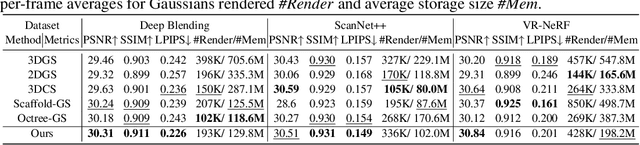
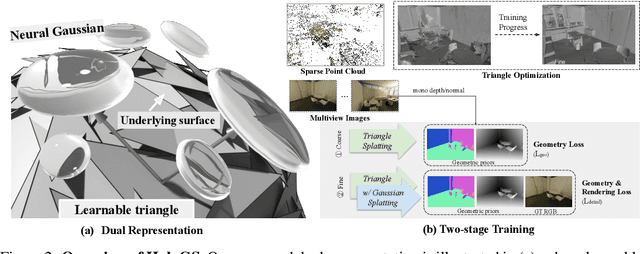
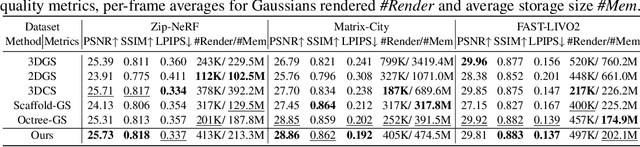
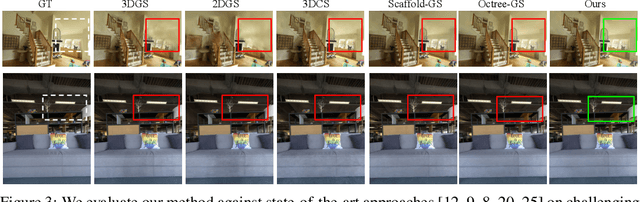
High fidelity 3D reconstruction and rendering hinge on capturing precise geometry while preserving photo realistic detail. Most existing methods either fuse these goals into a single cumbersome model or adopt hybrid schemes whose uniform primitives lead to a trade off between efficiency and fidelity. In this paper, we introduce HaloGS, a dual representation that loosely couples coarse triangles for geometry with Gaussian primitives for appearance, motivated by the lightweight classic geometry representations and their proven efficiency in real world applications. Our design yields a compact yet expressive model capable of photo realistic rendering across both indoor and outdoor environments, seamlessly adapting to varying levels of scene complexity. Experiments on multiple benchmark datasets demonstrate that our method yields both compact, accurate geometry and high fidelity renderings, especially in challenging scenarios where robust geometric structure make a clear difference.