 Add to Chrome
 Add to Firefox
 Add to Edge
Communication-Efficient Personalized Federal Graph Learning via Low-Rank Decomposition
Dec 18, 2024
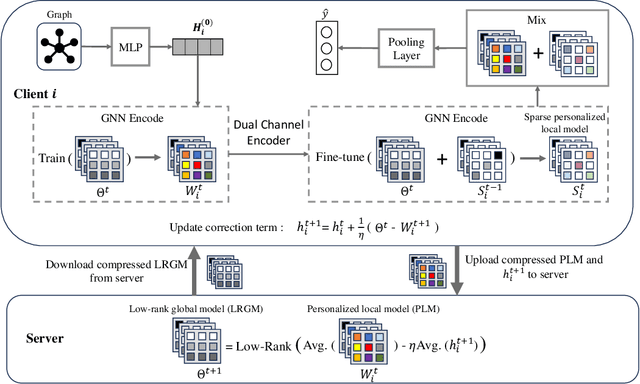
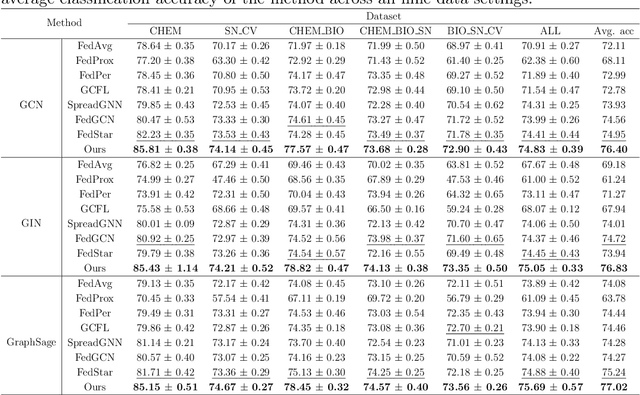
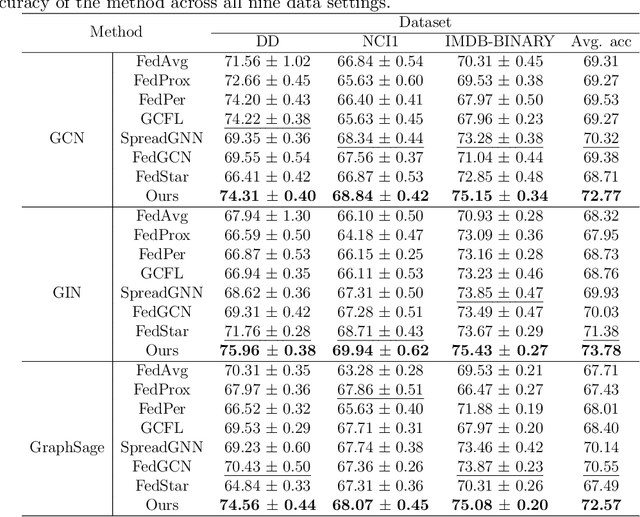
Federated graph learning (FGL) has gained significant attention for enabling heterogeneous clients to process their private graph data locally while interacting with a centralized server, thus maintaining privacy. However, graph data on clients are typically non-IID, posing a challenge for a single model to perform well across all clients. Another major bottleneck of FGL is the high cost of communication. To address these challenges, we propose a communication-efficient personalized federated graph learning algorithm, CEFGL. Our method decomposes the model parameters into low-rank generic and sparse private models. We employ a dual-channel encoder to learn sparse local knowledge in a personalized manner and low-rank global knowledge in a shared manner. Additionally, we perform multiple local stochastic gradient descent iterations between communication phases and integrate efficient compression techniques into the algorithm. The advantage of CEFGL lies in its ability to capture common and individual knowledge more precisely. By utilizing low-rank and sparse parameters along with compression techniques, CEFGL significantly reduces communication complexity. Extensive experiments demonstrate that our method achieves optimal classification accuracy in a variety of heterogeneous environments across sixteen datasets. Specifically, compared to the state-of-the-art method FedStar, the proposed method (with GIN as the base model) improves accuracy by 5.64\% on cross-datasets setting CHEM, reduces communication bits by a factor of 18.58, and reduces the communication time by a factor of 1.65.

InstructSeg: Unifying Instructed Visual Segmentation with Multi-modal Large Language Models
Dec 18, 2024Boosted by Multi-modal Large Language Models (MLLMs), text-guided universal segmentation models for the image and video domains have made rapid progress recently. However, these methods are often developed separately for specific domains, overlooking the similarities in task settings and solutions across these two areas. In this paper, we define the union of referring segmentation and reasoning segmentation at both the image and video levels as Instructed Visual Segmentation (IVS). Correspondingly, we propose InstructSeg, an end-to-end segmentation pipeline equipped with MLLMs for IVS. Specifically, we employ an object-aware video perceiver to extract temporal and object information from reference frames, facilitating comprehensive video understanding. Additionally, we introduce vision-guided multi-granularity text fusion to better integrate global and detailed text information with fine-grained visual guidance. By leveraging multi-task and end-to-end training, InstructSeg demonstrates superior performance across diverse image and video segmentation tasks, surpassing both segmentation specialists and MLLM-based methods with a single model. Our code is available at https://github.com/congvvc/InstructSeg.
ColorFlow: Retrieval-Augmented Image Sequence Colorization
Dec 16, 2024Automatic black-and-white image sequence colorization while preserving character and object identity (ID) is a complex task with significant market demand, such as in cartoon or comic series colorization. Despite advancements in visual colorization using large-scale generative models like diffusion models, challenges with controllability and identity consistency persist, making current solutions unsuitable for industrial application.To address this, we propose ColorFlow, a three-stage diffusion-based framework tailored for image sequence colorization in industrial applications. Unlike existing methods that require per-ID finetuning or explicit ID embedding extraction, we propose a novel robust and generalizable Retrieval Augmented Colorization pipeline for colorizing images with relevant color references. Our pipeline also features a dual-branch design: one branch for color identity extraction and the other for colorization, leveraging the strengths of diffusion models. We utilize the self-attention mechanism in diffusion models for strong in-context learning and color identity matching. To evaluate our model, we introduce ColorFlow-Bench, a comprehensive benchmark for reference-based colorization. Results show that ColorFlow outperforms existing models across multiple metrics, setting a new standard in sequential image colorization and potentially benefiting the art industry. We release our codes and models on our project page: https://zhuang2002.github.io/ColorFlow/.
Visual Object Tracking across Diverse Data Modalities: A Review
Dec 13, 2024

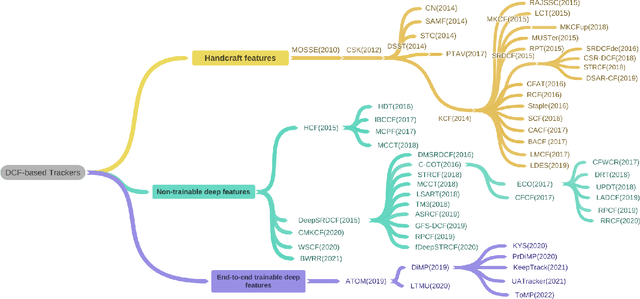

Visual Object Tracking (VOT) is an attractive and significant research area in computer vision, which aims to recognize and track specific targets in video sequences where the target objects are arbitrary and class-agnostic. The VOT technology could be applied in various scenarios, processing data of diverse modalities such as RGB, thermal infrared and point cloud. Besides, since no one sensor could handle all the dynamic and varying environments, multi-modal VOT is also investigated. This paper presents a comprehensive survey of the recent progress of both single-modal and multi-modal VOT, especially the deep learning methods. Specifically, we first review three types of mainstream single-modal VOT, including RGB, thermal infrared and point cloud tracking. In particular, we conclude four widely-used single-modal frameworks, abstracting their schemas and categorizing the existing inheritors. Then we summarize four kinds of multi-modal VOT, including RGB-Depth, RGB-Thermal, RGB-LiDAR and RGB-Language. Moreover, the comparison results in plenty of VOT benchmarks of the discussed modalities are presented. Finally, we provide recommendations and insightful observations, inspiring the future development of this fast-growing literature.
Diffusion-Enhanced Test-time Adaptation with Text and Image Augmentation
Dec 12, 2024Existing test-time prompt tuning (TPT) methods focus on single-modality data, primarily enhancing images and using confidence ratings to filter out inaccurate images. However, while image generation models can produce visually diverse images, single-modality data enhancement techniques still fail to capture the comprehensive knowledge provided by different modalities. Additionally, we note that the performance of TPT-based methods drops significantly when the number of augmented images is limited, which is not unusual given the computational expense of generative augmentation. To address these issues, we introduce IT3A, a novel test-time adaptation method that utilizes a pre-trained generative model for multi-modal augmentation of each test sample from unknown new domains. By combining augmented data from pre-trained vision and language models, we enhance the ability of the model to adapt to unknown new test data. Additionally, to ensure that key semantics are accurately retained when generating various visual and text enhancements, we employ cosine similarity filtering between the logits of the enhanced images and text with the original test data. This process allows us to filter out some spurious augmentation and inadequate combinations. To leverage the diverse enhancements provided by the generation model across different modals, we have replaced prompt tuning with an adapter for greater flexibility in utilizing text templates. Our experiments on the test datasets with distribution shifts and domain gaps show that in a zero-shot setting, IT3A outperforms state-of-the-art test-time prompt tuning methods with a 5.50% increase in accuracy.
* Accepted by International Journal of Computer Vision
EMOv2: Pushing 5M Vision Model Frontier
Dec 09, 2024
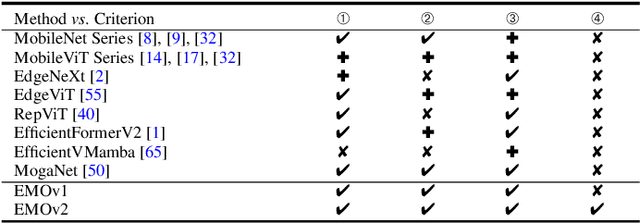


This work focuses on developing parameter-efficient and lightweight models for dense predictions while trading off parameters, FLOPs, and performance. Our goal is to set up the new frontier of the 5M magnitude lightweight model on various downstream tasks. Inverted Residual Block (IRB) serves as the infrastructure for lightweight CNNs, but no counterparts have been recognized by attention-based design. Our work rethinks the lightweight infrastructure of efficient IRB and practical components in Transformer from a unified perspective, extending CNN-based IRB to attention-based models and abstracting a one-residual Meta Mobile Block (MMBlock) for lightweight model design. Following neat but effective design criterion, we deduce a modern Improved Inverted Residual Mobile Block (i2RMB) and improve a hierarchical Efficient MOdel (EMOv2) with no elaborate complex structures. Considering the imperceptible latency for mobile users when downloading models under 4G/5G bandwidth and ensuring model performance, we investigate the performance upper limit of lightweight models with a magnitude of 5M. Extensive experiments on various vision recognition, dense prediction, and image generation tasks demonstrate the superiority of our EMOv2 over state-of-the-art methods, e.g., EMOv2-1M/2M/5M achieve 72.3, 75.8, and 79.4 Top-1 that surpass equal-order CNN-/Attention-based models significantly. At the same time, EMOv2-5M equipped RetinaNet achieves 41.5 mAP for object detection tasks that surpasses the previous EMO-5M by +2.6. When employing the more robust training recipe, our EMOv2-5M eventually achieves 82.9 Top-1 accuracy, which elevates the performance of 5M magnitude models to a new level. Code is available at https://github.com/zhangzjn/EMOv2.
Class Balance Matters to Active Class-Incremental Learning
Dec 09, 2024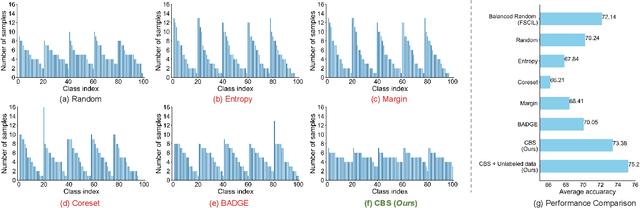
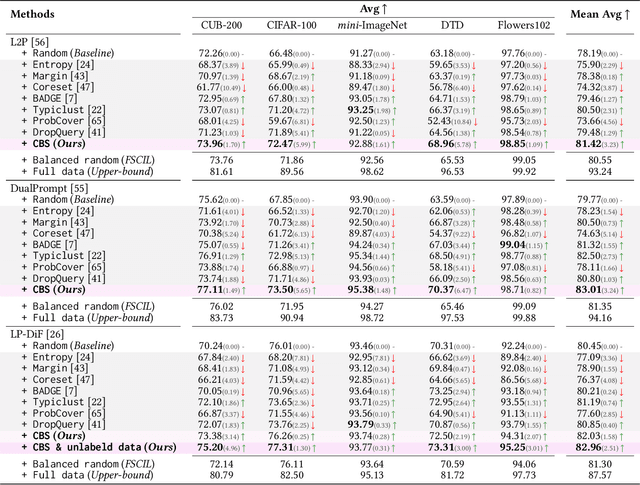

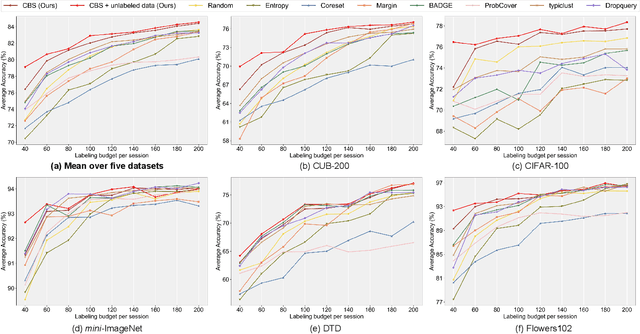
Few-Shot Class-Incremental Learning has shown remarkable efficacy in efficient learning new concepts with limited annotations. Nevertheless, the heuristic few-shot annotations may not always cover the most informative samples, which largely restricts the capability of incremental learner. We aim to start from a pool of large-scale unlabeled data and then annotate the most informative samples for incremental learning. Based on this premise, this paper introduces the Active Class-Incremental Learning (ACIL). The objective of ACIL is to select the most informative samples from the unlabeled pool to effectively train an incremental learner, aiming to maximize the performance of the resulting model. Note that vanilla active learning algorithms suffer from class-imbalanced distribution among annotated samples, which restricts the ability of incremental learning. To achieve both class balance and informativeness in chosen samples, we propose Class-Balanced Selection (CBS) strategy. Specifically, we first cluster the features of all unlabeled images into multiple groups. Then for each cluster, we employ greedy selection strategy to ensure that the Gaussian distribution of the sampled features closely matches the Gaussian distribution of all unlabeled features within the cluster. Our CBS can be plugged and played into those CIL methods which are based on pretrained models with prompts tunning technique. Extensive experiments under ACIL protocol across five diverse datasets demonstrate that CBS outperforms both random selection and other SOTA active learning approaches. Code is publicly available at https://github.com/1170300714/CBS.
DynamicControl: Adaptive Condition Selection for Improved Text-to-Image Generation
Dec 04, 2024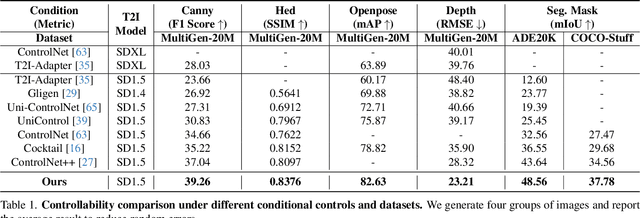
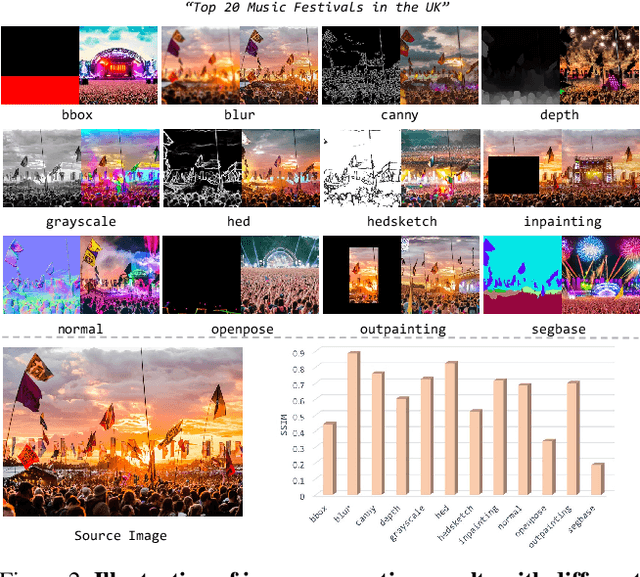
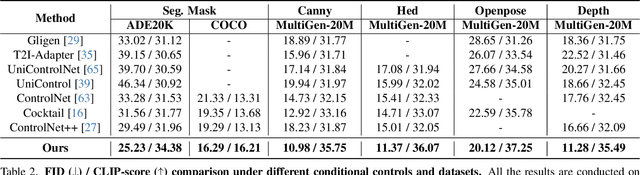
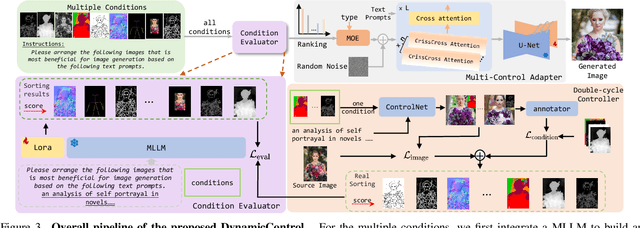
To enhance the controllability of text-to-image diffusion models, current ControlNet-like models have explored various control signals to dictate image attributes. However, existing methods either handle conditions inefficiently or use a fixed number of conditions, which does not fully address the complexity of multiple conditions and their potential conflicts. This underscores the need for innovative approaches to manage multiple conditions effectively for more reliable and detailed image synthesis. To address this issue, we propose a novel framework, DynamicControl, which supports dynamic combinations of diverse control signals, allowing adaptive selection of different numbers and types of conditions. Our approach begins with a double-cycle controller that generates an initial real score sorting for all input conditions by leveraging pre-trained conditional generation models and discriminative models. This controller evaluates the similarity between extracted conditions and input conditions, as well as the pixel-level similarity with the source image. Then, we integrate a Multimodal Large Language Model (MLLM) to build an efficient condition evaluator. This evaluator optimizes the ordering of conditions based on the double-cycle controller's score ranking. Our method jointly optimizes MLLMs and diffusion models, utilizing MLLMs' reasoning capabilities to facilitate multi-condition text-to-image (T2I) tasks. The final sorted conditions are fed into a parallel multi-control adapter, which learns feature maps from dynamic visual conditions and integrates them to modulate ControlNet, thereby enhancing control over generated images. Through both quantitative and qualitative comparisons, DynamicControl demonstrates its superiority over existing methods in terms of controllability, generation quality and composability under various conditional controls.
Predictive Models in Sequential Recommendations: Bridging Performance Laws with Data Quality Insights
Dec 03, 2024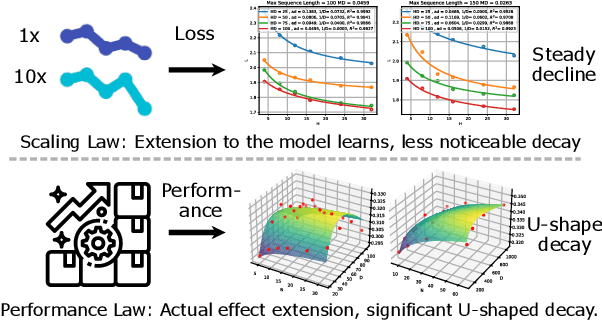

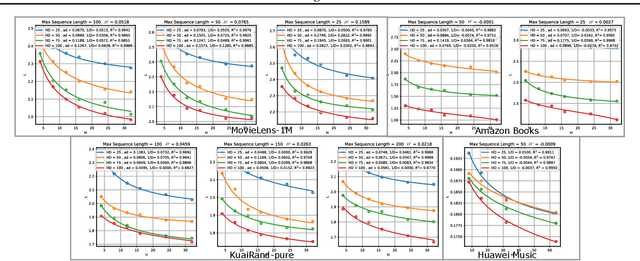
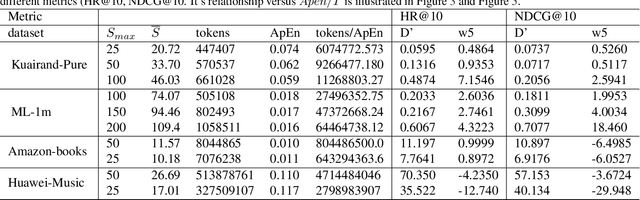
Sequential Recommendation (SR) plays a critical role in predicting users' sequential preferences. Despite its growing prominence in various industries, the increasing scale of SR models incurs substantial computational costs and unpredictability, challenging developers to manage resources efficiently. Under this predicament, Scaling Laws have achieved significant success by examining the loss as models scale up. However, there remains a disparity between loss and model performance, which is of greater concern in practical applications. Moreover, as data continues to expand, it incorporates repetitive and inefficient data. In response, we introduce the Performance Law for SR models, which aims to theoretically investigate and model the relationship between model performance and data quality. Specifically, we first fit the HR and NDCG metrics to transformer-based SR models. Subsequently, we propose Approximate Entropy (ApEn) to assess data quality, presenting a more nuanced approach compared to traditional data quantity metrics. Our method enables accurate predictions across various dataset scales and model sizes, demonstrating a strong correlation in large SR models and offering insights into achieving optimal performance for any given model configuration.
Explainable and Interpretable Multimodal Large Language Models: A Comprehensive Survey
Dec 03, 2024


The rapid development of Artificial Intelligence (AI) has revolutionized numerous fields, with large language models (LLMs) and computer vision (CV) systems driving advancements in natural language understanding and visual processing, respectively. The convergence of these technologies has catalyzed the rise of multimodal AI, enabling richer, cross-modal understanding that spans text, vision, audio, and video modalities. Multimodal large language models (MLLMs), in particular, have emerged as a powerful framework, demonstrating impressive capabilities in tasks like image-text generation, visual question answering, and cross-modal retrieval. Despite these advancements, the complexity and scale of MLLMs introduce significant challenges in interpretability and explainability, essential for establishing transparency, trustworthiness, and reliability in high-stakes applications. This paper provides a comprehensive survey on the interpretability and explainability of MLLMs, proposing a novel framework that categorizes existing research across three perspectives: (I) Data, (II) Model, (III) Training \& Inference. We systematically analyze interpretability from token-level to embedding-level representations, assess approaches related to both architecture analysis and design, and explore training and inference strategies that enhance transparency. By comparing various methodologies, we identify their strengths and limitations and propose future research directions to address unresolved challenges in multimodal explainability. This survey offers a foundational resource for advancing interpretability and transparency in MLLMs, guiding researchers and practitioners toward developing more accountable and robust multimodal AI systems.