 Add to Chrome
 Add to Firefox
 Add to Edge
LRM-Zero: Training Large Reconstruction Models with Synthesized Data
Jun 13, 2024
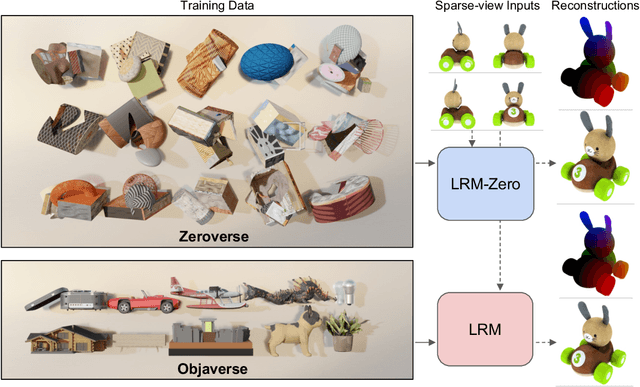
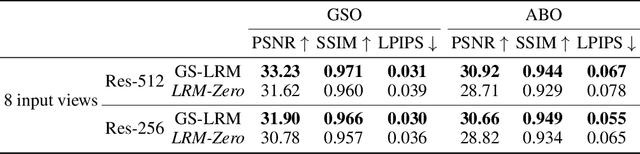
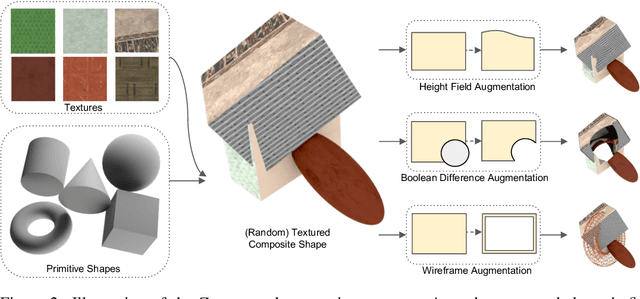
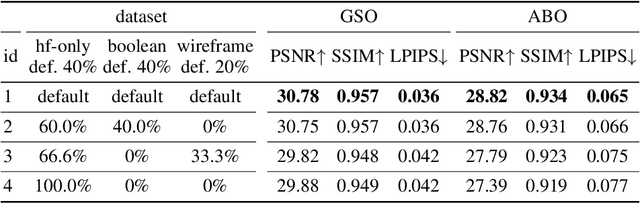
We present LRM-Zero, a Large Reconstruction Model (LRM) trained entirely on synthesized 3D data, achieving high-quality sparse-view 3D reconstruction. The core of LRM-Zero is our procedural 3D dataset, Zeroverse, which is automatically synthesized from simple primitive shapes with random texturing and augmentations (e.g., height fields, boolean differences, and wireframes). Unlike previous 3D datasets (e.g., Objaverse) which are often captured or crafted by humans to approximate real 3D data, Zeroverse completely ignores realistic global semantics but is rich in complex geometric and texture details that are locally similar to or even more intricate than real objects. We demonstrate that our LRM-Zero, trained with our fully synthesized Zeroverse, can achieve high visual quality in the reconstruction of real-world objects, competitive with models trained on Objaverse. We also analyze several critical design choices of Zeroverse that contribute to LRM-Zero's capability and training stability. Our work demonstrates that 3D reconstruction, one of the core tasks in 3D vision, can potentially be addressed without the semantics of real-world objects. The Zeroverse's procedural synthesis code and interactive visualization are available at: https://desaixie.github.io/lrm-zero/.

Non-Asymptotic Analysis for Single-Loop Actor-Critic with Compatible Function Approximation
Jun 03, 2024Actor-critic (AC) is a powerful method for learning an optimal policy in reinforcement learning, where the critic uses algorithms, e.g., temporal difference (TD) learning with function approximation, to evaluate the current policy and the actor updates the policy along an approximate gradient direction using information from the critic. This paper provides the \textit{tightest} non-asymptotic convergence bounds for both the AC and natural AC (NAC) algorithms. Specifically, existing studies show that AC converges to an $\epsilon+\varepsilon_{\text{critic}}$ neighborhood of stationary points with the best known sample complexity of $\mathcal{O}(\epsilon^{-2})$ (up to a log factor), and NAC converges to an $\epsilon+\varepsilon_{\text{critic}}+\sqrt{\varepsilon_{\text{actor}}}$ neighborhood of the global optimum with the best known sample complexity of $\mathcal{O}(\epsilon^{-3})$, where $\varepsilon_{\text{critic}}$ is the approximation error of the critic and $\varepsilon_{\text{actor}}$ is the approximation error induced by the insufficient expressive power of the parameterized policy class. This paper analyzes the convergence of both AC and NAC algorithms with compatible function approximation. Our analysis eliminates the term $\varepsilon_{\text{critic}}$ from the error bounds while still achieving the best known sample complexities. Moreover, we focus on the challenging single-loop setting with a single Markovian sample trajectory. Our major technical novelty lies in analyzing the stochastic bias due to policy-dependent and time-varying compatible function approximation in the critic, and handling the non-ergodicity of the MDP due to the single Markovian sample trajectory. Numerical results are also provided in the appendix.
Multi-Modal UAV Detection, Classification and Tracking Algorithm -- Technical Report for CVPR 2024 UG2 Challenge
May 26, 2024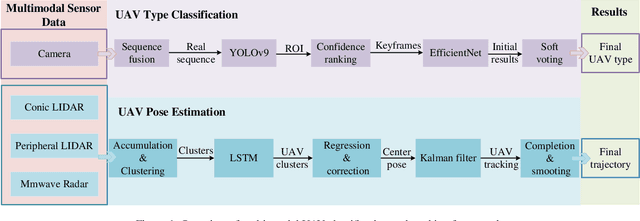
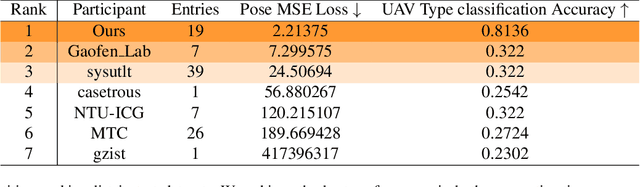


This technical report presents the 1st winning model for UG2+, a task in CVPR 2024 UAV Tracking and Pose-Estimation Challenge. This challenge faces difficulties in drone detection, UAV-type classification and 2D/3D trajectory estimation in extreme weather conditions with multi-modal sensor information, including stereo vision, various Lidars, Radars, and audio arrays. Leveraging this information, we propose a multi-modal UAV detection, classification, and 3D tracking method for accurate UAV classification and tracking. A novel classification pipeline which incorporates sequence fusion, region of interest (ROI) cropping, and keyframe selection is proposed. Our system integrates cutting-edge classification techniques and sophisticated post-processing steps to boost accuracy and robustness. The designed pose estimation pipeline incorporates three modules: dynamic points analysis, a multi-object tracker, and trajectory completion techniques. Extensive experiments have validated the effectiveness and precision of our approach. In addition, we also propose a novel dataset pre-processing method and conduct a comprehensive ablation study for our design. We finally achieved the best performance in the classification and tracking of the MMUAD dataset. The code and configuration of our method are available at https://github.com/dtc111111/Multi-Modal-UAV.
MM-Retinal: Knowledge-Enhanced Foundational Pretraining with Fundus Image-Text Expertise
May 20, 2024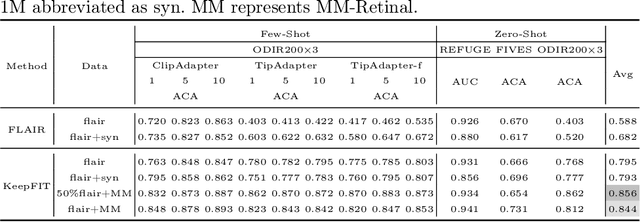

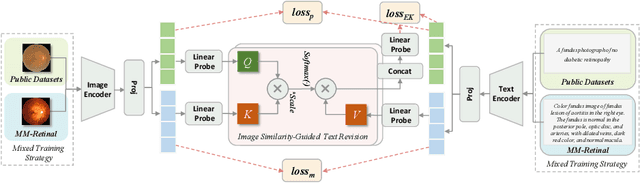
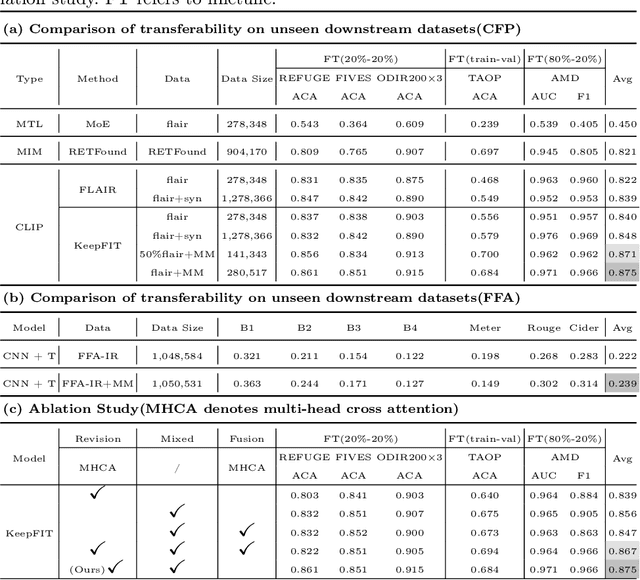
Current fundus image analysis models are predominantly built for specific tasks relying on individual datasets. The learning process is usually based on data-driven paradigm without prior knowledge, resulting in poor transferability and generalizability. To address this issue, we propose MM-Retinal, a multi-modal dataset that encompasses high-quality image-text pairs collected from professional fundus diagram books. Moreover, enabled by MM-Retinal, we present a novel Knowledge-enhanced foundational pretraining model which incorporates Fundus Image-Text expertise, called KeepFIT. It is designed with image similarity-guided text revision and mixed training strategy to infuse expert knowledge. Our proposed fundus foundation model achieves state-of-the-art performance across six unseen downstream tasks and holds excellent generalization ability in zero-shot and few-shot scenarios. MM-Retinal and KeepFIT are available at https://github.com/lxirich/MM-Retinal.
Team Samsung-RAL: Technical Report for 2024 RoboDrive Challenge-Robust Map Segmentation Track
May 17, 2024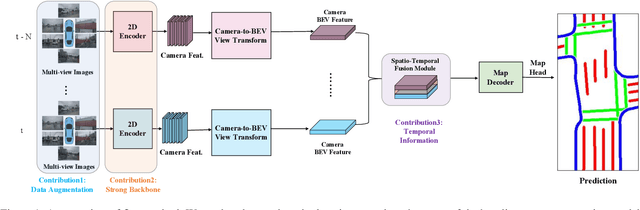

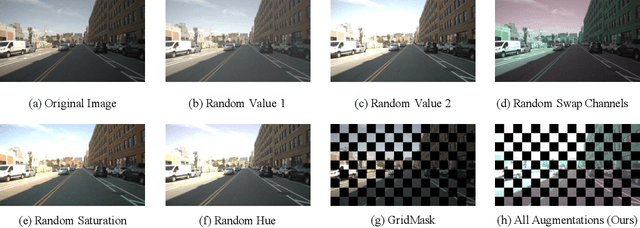

In this report, we describe the technical details of our submission to the 2024 RoboDrive Challenge Robust Map Segmentation Track. The Robust Map Segmentation track focuses on the segmentation of complex driving scene elements in BEV maps under varied driving conditions. Semantic map segmentation provides abundant and precise static environmental information crucial for autonomous driving systems' planning and navigation. While current methods excel in ideal circumstances, e.g., clear daytime conditions and fully functional sensors, their resilience to real-world challenges like adverse weather and sensor failures remains unclear, raising concerns about system safety. In this paper, we explored several methods to improve the robustness of the map segmentation task. The details are as follows: 1) Robustness analysis of utilizing temporal information; 2) Robustness analysis of utilizing different backbones; and 3) Data Augmentation to boost corruption robustness. Based on the evaluation results, we draw several important findings including 1) The temporal fusion module is effective in improving the robustness of the map segmentation model; 2) A strong backbone is effective for improving the corruption robustness; and 3) Some data augmentation methods are effective in improving the robustness of map segmentation models. These novel findings allowed us to achieve promising results in the 2024 RoboDrive Challenge-Robust Map Segmentation Track.
The RoboDrive Challenge: Drive Anytime Anywhere in Any Condition
May 14, 2024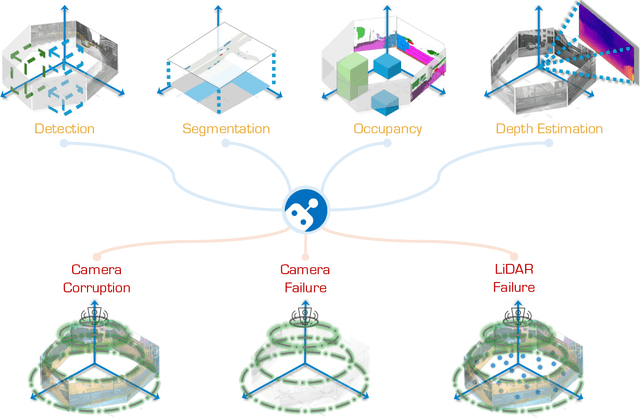


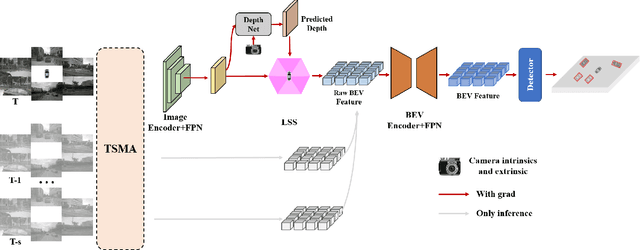
In the realm of autonomous driving, robust perception under out-of-distribution conditions is paramount for the safe deployment of vehicles. Challenges such as adverse weather, sensor malfunctions, and environmental unpredictability can severely impact the performance of autonomous systems. The 2024 RoboDrive Challenge was crafted to propel the development of driving perception technologies that can withstand and adapt to these real-world variabilities. Focusing on four pivotal tasks -- BEV detection, map segmentation, semantic occupancy prediction, and multi-view depth estimation -- the competition laid down a gauntlet to innovate and enhance system resilience against typical and atypical disturbances. This year's challenge consisted of five distinct tracks and attracted 140 registered teams from 93 institutes across 11 countries, resulting in nearly one thousand submissions evaluated through our servers. The competition culminated in 15 top-performing solutions, which introduced a range of innovative approaches including advanced data augmentation, multi-sensor fusion, self-supervised learning for error correction, and new algorithmic strategies to enhance sensor robustness. These contributions significantly advanced the state of the art, particularly in handling sensor inconsistencies and environmental variability. Participants, through collaborative efforts, pushed the boundaries of current technologies, showcasing their potential in real-world scenarios. Extensive evaluations and analyses provided insights into the effectiveness of these solutions, highlighting key trends and successful strategies for improving the resilience of driving perception systems. This challenge has set a new benchmark in the field, providing a rich repository of techniques expected to guide future research in this field.
Granite Code Models: A Family of Open Foundation Models for Code Intelligence
May 07, 2024

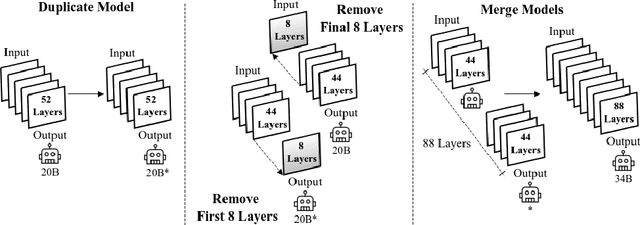

Large Language Models (LLMs) trained on code are revolutionizing the software development process. Increasingly, code LLMs are being integrated into software development environments to improve the productivity of human programmers, and LLM-based agents are beginning to show promise for handling complex tasks autonomously. Realizing the full potential of code LLMs requires a wide range of capabilities, including code generation, fixing bugs, explaining and documenting code, maintaining repositories, and more. In this work, we introduce the Granite series of decoder-only code models for code generative tasks, trained with code written in 116 programming languages. The Granite Code models family consists of models ranging in size from 3 to 34 billion parameters, suitable for applications ranging from complex application modernization tasks to on-device memory-constrained use cases. Evaluation on a comprehensive set of tasks demonstrates that Granite Code models consistently reaches state-of-the-art performance among available open-source code LLMs. The Granite Code model family was optimized for enterprise software development workflows and performs well across a range of coding tasks (e.g. code generation, fixing and explanation), making it a versatile all around code model. We release all our Granite Code models under an Apache 2.0 license for both research and commercial use.
IMU-Aided Event-based Stereo Visual Odometry
May 07, 2024


Direct methods for event-based visual odometry solve the mapping and camera pose tracking sub-problems by establishing implicit data association in a way that the generative model of events is exploited. The main bottlenecks faced by state-of-the-art work in this field include the high computational complexity of mapping and the limited accuracy of tracking. In this paper, we improve our previous direct pipeline \textit{Event-based Stereo Visual Odometry} in terms of accuracy and efficiency. To speed up the mapping operation, we propose an efficient strategy of edge-pixel sampling according to the local dynamics of events. The mapping performance in terms of completeness and local smoothness is also improved by combining the temporal stereo results and the static stereo results. To circumvent the degeneracy issue of camera pose tracking in recovering the yaw component of general 6-DoF motion, we introduce as a prior the gyroscope measurements via pre-integration. Experiments on publicly available datasets justify our improvement. We release our pipeline as an open-source software for future research in this field.
DMesh: A Differentiable Representation for General Meshes
Apr 20, 2024We present a differentiable representation, DMesh, for general 3D triangular meshes. DMesh considers both the geometry and connectivity information of a mesh. In our design, we first get a set of convex tetrahedra that compactly tessellates the domain based on Weighted Delaunay Triangulation (WDT), and formulate probability of faces to exist on our desired mesh in a differentiable manner based on the WDT. This enables DMesh to represent meshes of various topology in a differentiable way, and allows us to reconstruct the mesh under various observations, such as point cloud and multi-view images using gradient-based optimization. The source code and full paper is available at: https://sonsang.github.io/dmesh-project.
End-to-End Mesh Optimization of a Hybrid Deep Learning Black-Box PDE Solver
Apr 17, 2024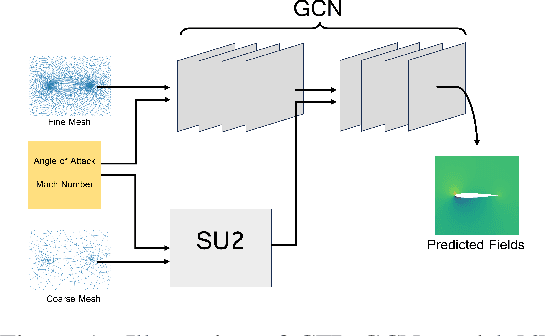
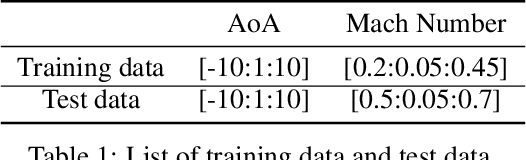
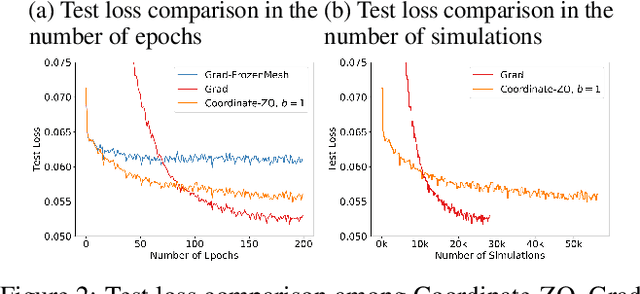
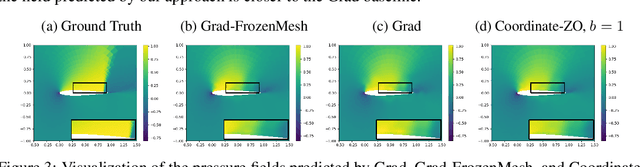
Deep learning has been widely applied to solve partial differential equations (PDEs) in computational fluid dynamics. Recent research proposed a PDE correction framework that leverages deep learning to correct the solution obtained by a PDE solver on a coarse mesh. However, end-to-end training of such a PDE correction model over both solver-dependent parameters such as mesh parameters and neural network parameters requires the PDE solver to support automatic differentiation through the iterative numerical process. Such a feature is not readily available in many existing solvers. In this study, we explore the feasibility of end-to-end training of a hybrid model with a black-box PDE solver and a deep learning model for fluid flow prediction. Specifically, we investigate a hybrid model that integrates a black-box PDE solver into a differentiable deep graph neural network. To train this model, we use a zeroth-order gradient estimator to differentiate the PDE solver via forward propagation. Although experiments show that the proposed approach based on zeroth-order gradient estimation underperforms the baseline that computes exact derivatives using automatic differentiation, our proposed method outperforms the baseline trained with a frozen input mesh to the solver. Moreover, with a simple warm-start on the neural network parameters, we show that models trained by these zeroth-order algorithms achieve an accelerated convergence and improved generalization performance.