 Add to Chrome
 Add to Firefox
 Add to Edge
Fino1: On the Transferability of Reasoning Enhanced LLMs to Finance
Feb 12, 2025
Recent advancements in large language models (LLMs) have shown strong general reasoning abilities, yet their effectiveness in financial reasoning remains underexplored. In this study, we comprehensively evaluate 16 powerful reasoning and general LLMs on three complex financial tasks involving financial text, tabular data, and equations, assessing numerical reasoning, tabular interpretation, financial terminology comprehension, long-context processing, and equation-based problem solving. Our results show that while better datasets and pretraining improve financial reasoning, general enhancements like CoT fine-tuning do not always yield consistent gains. Moreover, all reasoning strategies face challenges in improving performance on long-context and multi-table tasks. To address these limitations, we develop a financial reasoning-enhanced model based on Llama-3.1-8B-Instruct, by CoT fine-tuning and reinforcement learning with domain-specific reasoning paths. Even with simple fine-tuning with one financial dataset, our model achieves a consistent 10% performance improvement across tasks, surpassing all 8B models and even Llama3-70B-Instruct and Llama3.1-70B-Instruct on average. Our results highlight the need for domain-specific adaptations in financial tasks, emphasizing future directions such as multi-table reasoning, long-context processing, and financial terminology comprehension. All our datasets, models, and codes are publicly available. Furthermore, we introduce a leaderboard for benchmarking future datasets and models.

Semi-Supervised Vision-Centric 3D Occupancy World Model for Autonomous Driving
Feb 11, 2025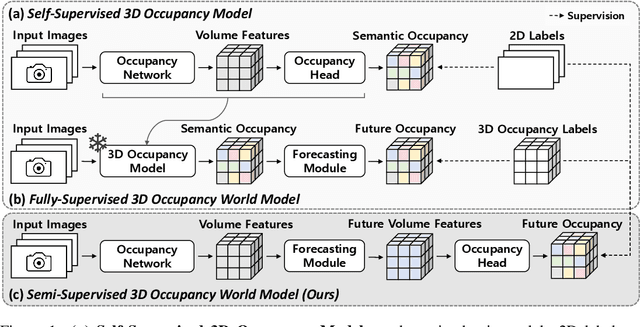
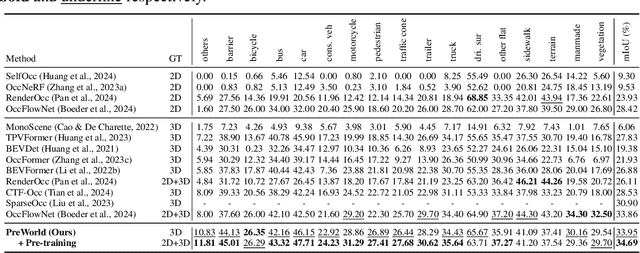
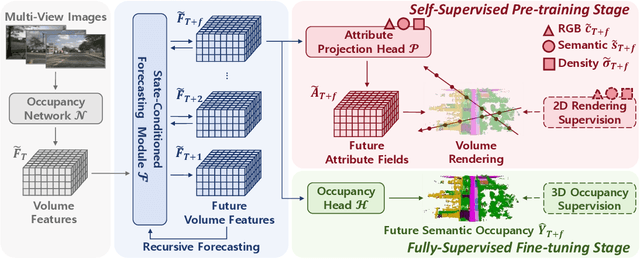
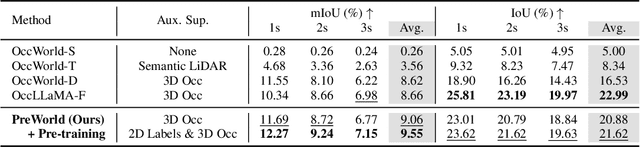
Understanding world dynamics is crucial for planning in autonomous driving. Recent methods attempt to achieve this by learning a 3D occupancy world model that forecasts future surrounding scenes based on current observation. However, 3D occupancy labels are still required to produce promising results. Considering the high annotation cost for 3D outdoor scenes, we propose a semi-supervised vision-centric 3D occupancy world model, PreWorld, to leverage the potential of 2D labels through a novel two-stage training paradigm: the self-supervised pre-training stage and the fully-supervised fine-tuning stage. Specifically, during the pre-training stage, we utilize an attribute projection head to generate different attribute fields of a scene (e.g., RGB, density, semantic), thus enabling temporal supervision from 2D labels via volume rendering techniques. Furthermore, we introduce a simple yet effective state-conditioned forecasting module to recursively forecast future occupancy and ego trajectory in a direct manner. Extensive experiments on the nuScenes dataset validate the effectiveness and scalability of our method, and demonstrate that PreWorld achieves competitive performance across 3D occupancy prediction, 4D occupancy forecasting and motion planning tasks.
A Survey on Video Analytics in Cloud-Edge-Terminal Collaborative Systems
Feb 10, 2025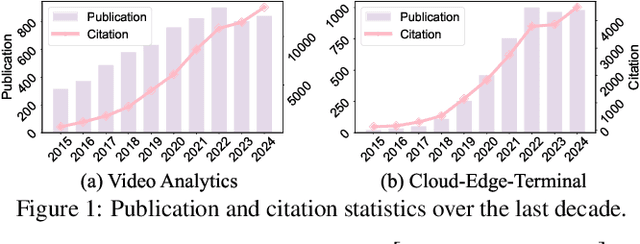
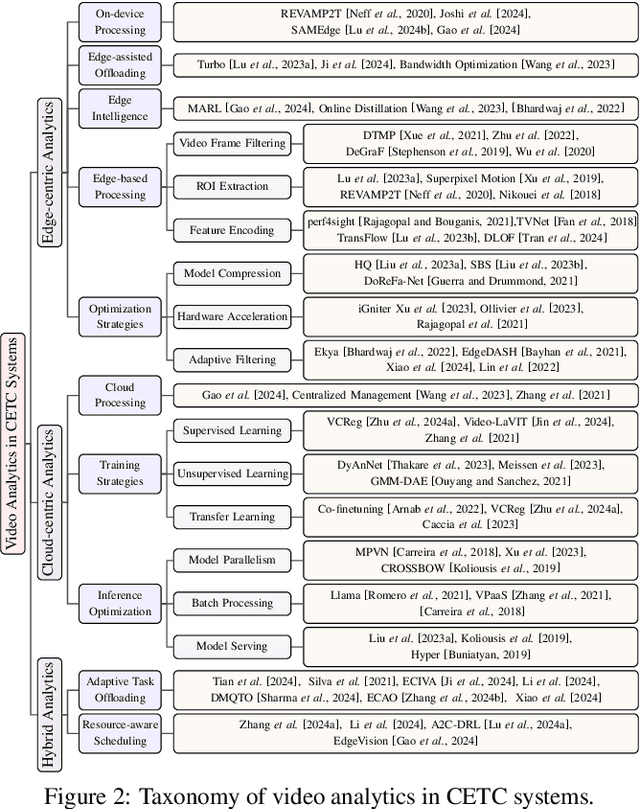
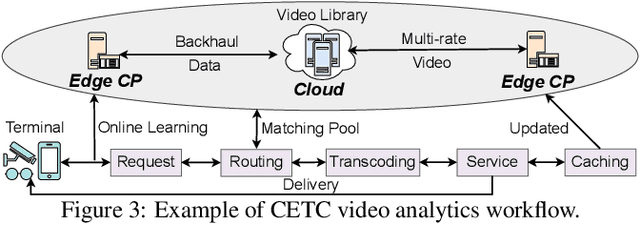
The explosive growth of video data has driven the development of distributed video analytics in cloud-edge-terminal collaborative (CETC) systems, enabling efficient video processing, real-time inference, and privacy-preserving analysis. Among multiple advantages, CETC systems can distribute video processing tasks and enable adaptive analytics across cloud, edge, and terminal devices, leading to breakthroughs in video surveillance, autonomous driving, and smart cities. In this survey, we first analyze fundamental architectural components, including hierarchical, distributed, and hybrid frameworks, alongside edge computing platforms and resource management mechanisms. Building upon these foundations, edge-centric approaches emphasize on-device processing, edge-assisted offloading, and edge intelligence, while cloud-centric methods leverage powerful computational capabilities for complex video understanding and model training. Our investigation also covers hybrid video analytics incorporating adaptive task offloading and resource-aware scheduling techniques that optimize performance across the entire system. Beyond conventional approaches, recent advances in large language models and multimodal integration reveal both opportunities and challenges in platform scalability, data protection, and system reliability. Future directions also encompass explainable systems, efficient processing mechanisms, and advanced video analytics, offering valuable insights for researchers and practitioners in this dynamic field.
Rethinking Diffusion Posterior Sampling: From Conditional Score Estimator to Maximizing a Posterior
Jan 31, 2025Recent advancements in diffusion models have been leveraged to address inverse problems without additional training, and Diffusion Posterior Sampling (DPS) (Chung et al., 2022a) is among the most popular approaches. Previous analyses suggest that DPS accomplishes posterior sampling by approximating the conditional score. While in this paper, we demonstrate that the conditional score approximation employed by DPS is not as effective as previously assumed, but rather aligns more closely with the principle of maximizing a posterior (MAP). This assertion is substantiated through an examination of DPS on 512x512 ImageNet images, revealing that: 1) DPS's conditional score estimation significantly diverges from the score of a well-trained conditional diffusion model and is even inferior to the unconditional score; 2) The mean of DPS's conditional score estimation deviates significantly from zero, rendering it an invalid score estimation; 3) DPS generates high-quality samples with significantly lower diversity. In light of the above findings, we posit that DPS more closely resembles MAP than a conditional score estimator, and accordingly propose the following enhancements to DPS: 1) we explicitly maximize the posterior through multi-step gradient ascent and projection; 2) we utilize a light-weighted conditional score estimator trained with only 100 images and 8 GPU hours. Extensive experimental results indicate that these proposed improvements significantly enhance DPS's performance. The source code for these improvements is provided in https://github.com/tongdaxu/Rethinking-Diffusion-Posterior-Sampling-From-Conditional-Score-Estimator-to-Maximizing-a-Posterior.
IROAM: Improving Roadside Monocular 3D Object Detection Learning from Autonomous Vehicle Data Domain
Jan 30, 2025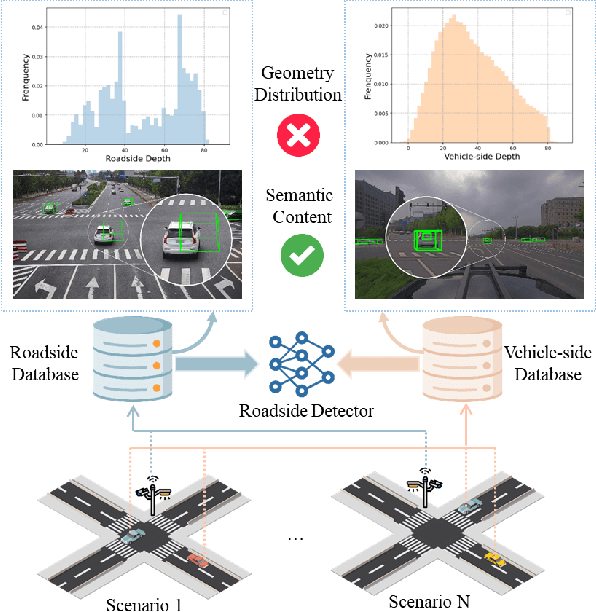
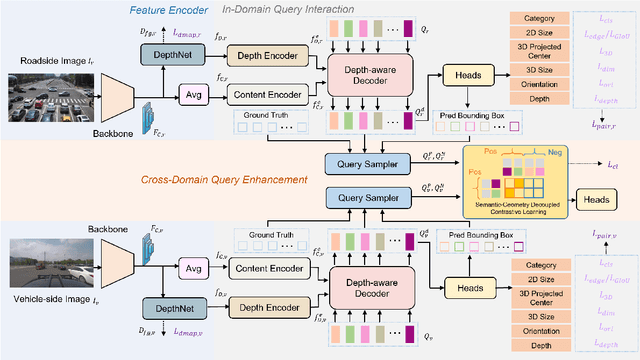
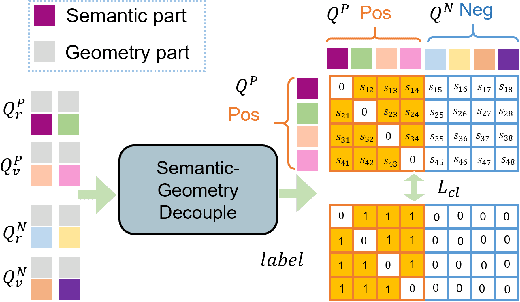
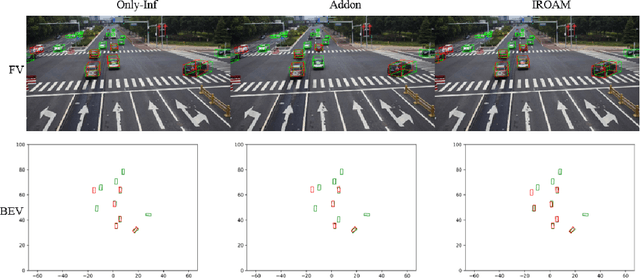
In autonomous driving, The perception capabilities of the ego-vehicle can be improved with roadside sensors, which can provide a holistic view of the environment. However, existing monocular detection methods designed for vehicle cameras are not suitable for roadside cameras due to viewpoint domain gaps. To bridge this gap and Improve ROAdside Monocular 3D object detection, we propose IROAM, a semantic-geometry decoupled contrastive learning framework, which takes vehicle-side and roadside data as input simultaneously. IROAM has two significant modules. In-Domain Query Interaction module utilizes a transformer to learn content and depth information for each domain and outputs object queries. Cross-Domain Query Enhancement To learn better feature representations from two domains, Cross-Domain Query Enhancement decouples queries into semantic and geometry parts and only the former is used for contrastive learning. Experiments demonstrate the effectiveness of IROAM in improving roadside detector's performance. The results validate that IROAM has the capabilities to learn cross-domain information.
In-Context Meta LoRA Generation
Jan 30, 2025
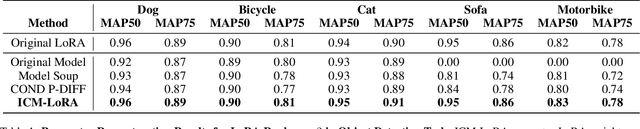

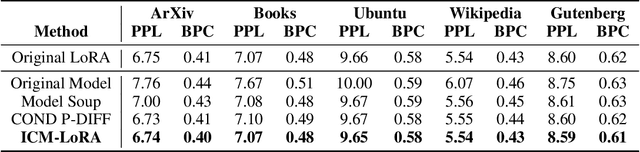
Low-rank Adaptation (LoRA) has demonstrated remarkable capabilities for task specific fine-tuning. However, in scenarios that involve multiple tasks, training a separate LoRA model for each one results in considerable inefficiency in terms of storage and inference. Moreover, existing parameter generation methods fail to capture the correlations among these tasks, making multi-task LoRA parameter generation challenging. To address these limitations, we propose In-Context Meta LoRA (ICM-LoRA), a novel approach that efficiently achieves task-specific customization of large language models (LLMs). Specifically, we use training data from all tasks to train a tailored generator, Conditional Variational Autoencoder (CVAE). CVAE takes task descriptions as inputs and produces task-aware LoRA weights as outputs. These LoRA weights are then merged with LLMs to create task-specialized models without the need for additional fine-tuning. Furthermore, we utilize in-context meta-learning for knowledge enhancement and task mapping, to capture the relationship between tasks and parameter distributions. As a result, our method achieves more accurate LoRA parameter generation for diverse tasks using CVAE. ICM-LoRA enables more accurate LoRA parameter reconstruction than current parameter reconstruction methods and is useful for implementing task-specific enhancements of LoRA parameters. At the same time, our method occupies 283MB, only 1\% storage compared with the original LoRA.
A Holistically Point-guided Text Framework for Weakly-Supervised Camouflaged Object Detection
Jan 10, 2025
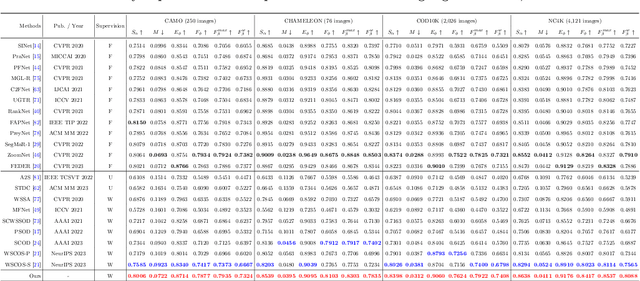
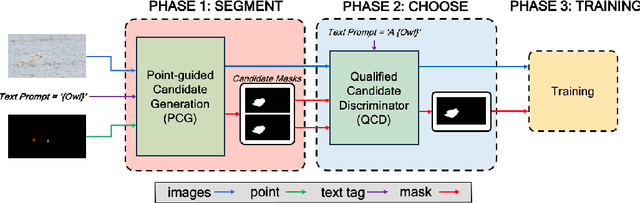
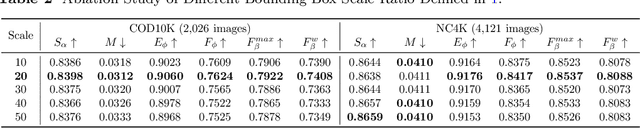
Weakly-Supervised Camouflaged Object Detection (WSCOD) has gained popularity for its promise to train models with weak labels to segment objects that visually blend into their surroundings. Recently, some methods using sparsely-annotated supervision shown promising results through scribbling in WSCOD, while point-text supervision remains underexplored. Hence, this paper introduces a novel holistically point-guided text framework for WSCOD by decomposing into three phases: segment, choose, train. Specifically, we propose Point-guided Candidate Generation (PCG), where the point's foreground serves as a correction for the text path to explicitly correct and rejuvenate the loss detection object during the mask generation process (SEGMENT). We also introduce a Qualified Candidate Discriminator (QCD) to choose the optimal mask from a given text prompt using CLIP (CHOOSE), and employ the chosen pseudo mask for training with a self-supervised Vision Transformer (TRAIN). Additionally, we developed a new point-supervised dataset (P2C-COD) and a text-supervised dataset (T-COD). Comprehensive experiments on four benchmark datasets demonstrate our method outperforms state-of-the-art methods by a large margin, and also outperforms some existing fully-supervised camouflaged object detection methods.
BASIC: Semi-supervised Multi-organ Segmentation with Balanced Subclass Regularization and Semantic-conflict Penalty
Jan 07, 2025
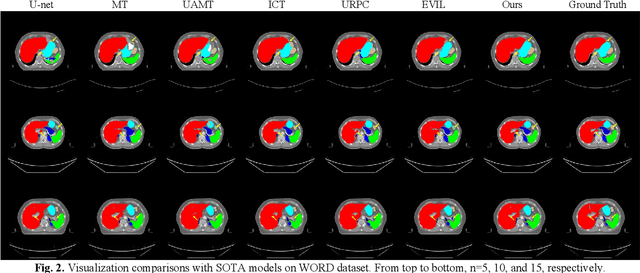
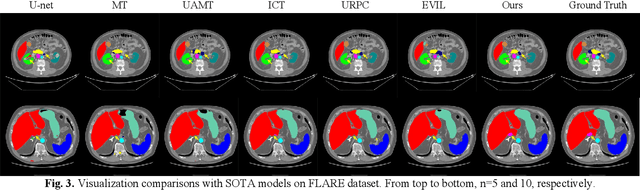
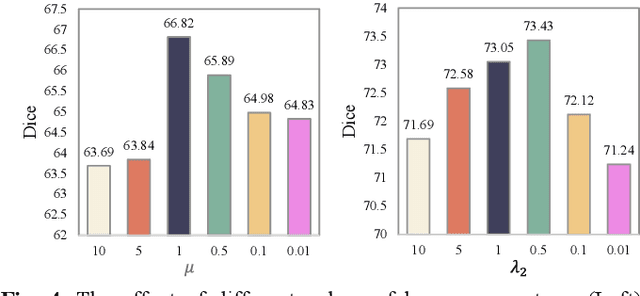
Semi-supervised learning (SSL) has shown notable potential in relieving the heavy demand of dense prediction tasks on large-scale well-annotated datasets, especially for the challenging multi-organ segmentation (MoS). However, the prevailing class-imbalance problem in MoS caused by the substantial variations in organ size exacerbates the learning difficulty of the SSL network. To address this issue, in this paper, we propose an innovative semi-supervised network with BAlanced Subclass regularIzation and semantic-Conflict penalty mechanism (BASIC) to effectively learn the unbiased knowledge for semi-supervised MoS. Concretely, we construct a novel auxiliary subclass segmentation (SCS) task based on priorly generated balanced subclasses, thus deeply excavating the unbiased information for the main MoS task with the fashion of multi-task learning. Additionally, based on a mean teacher framework, we elaborately design a balanced subclass regularization to utilize the teacher predictions of SCS task to supervise the student predictions of MoS task, thus effectively transferring unbiased knowledge to the MoS subnetwork and alleviating the influence of the class-imbalance problem. Considering the similar semantic information inside the subclasses and their corresponding original classes (i.e., parent classes), we devise a semantic-conflict penalty mechanism to give heavier punishments to the conflicting SCS predictions with wrong parent classes and provide a more accurate constraint to the MoS predictions. Extensive experiments conducted on two publicly available datasets, i.e., the WORD dataset and the MICCAI FLARE 2022 dataset, have verified the superior performance of our proposed BASIC compared to other state-of-the-art methods.
Explicit vs. Implicit: Investigating Social Bias in Large Language Models through Self-Reflection
Jan 04, 2025Large Language Models (LLMs) have been shown to exhibit various biases and stereotypes in their generated content. While extensive research has investigated bias in LLMs, prior work has predominantly focused on explicit bias, leaving the more nuanced implicit biases largely unexplored. This paper presents a systematic framework grounded in social psychology theories to investigate and compare explicit and implicit biases in LLMs. We propose a novel "self-reflection" based evaluation framework that operates in two phases: first measuring implicit bias through simulated psychological assessment methods, then evaluating explicit bias by prompting LLMs to analyze their own generated content. Through extensive experiments on state-of-the-art LLMs across multiple social dimensions, we demonstrate that LLMs exhibit a substantial inconsistency between explicit and implicit biases, where explicit biases manifest as mild stereotypes while implicit biases show strong stereotypes. Furthermore, we investigate the underlying factors contributing to this explicit-implicit bias inconsistency. Our experiments examine the effects of training data scale, model parameters, and alignment techniques. Results indicate that while explicit bias diminishes with increased training data and model size, implicit bias exhibits a contrasting upward trend. Notably, contemporary alignment methods (e.g., RLHF, DPO) effectively suppress explicit bias but show limited efficacy in mitigating implicit bias. These findings suggest that while scaling up models and alignment training can address explicit bias, the challenge of implicit bias requires novel approaches beyond current methodologies.
DreamDrive: Generative 4D Scene Modeling from Street View Images
Jan 03, 2025


Synthesizing photo-realistic visual observations from an ego vehicle's driving trajectory is a critical step towards scalable training of self-driving models. Reconstruction-based methods create 3D scenes from driving logs and synthesize geometry-consistent driving videos through neural rendering, but their dependence on costly object annotations limits their ability to generalize to in-the-wild driving scenarios. On the other hand, generative models can synthesize action-conditioned driving videos in a more generalizable way but often struggle with maintaining 3D visual consistency. In this paper, we present DreamDrive, a 4D spatial-temporal scene generation approach that combines the merits of generation and reconstruction, to synthesize generalizable 4D driving scenes and dynamic driving videos with 3D consistency. Specifically, we leverage the generative power of video diffusion models to synthesize a sequence of visual references and further elevate them to 4D with a novel hybrid Gaussian representation. Given a driving trajectory, we then render 3D-consistent driving videos via Gaussian splatting. The use of generative priors allows our method to produce high-quality 4D scenes from in-the-wild driving data, while neural rendering ensures 3D-consistent video generation from the 4D scenes. Extensive experiments on nuScenes and street view images demonstrate that DreamDrive can generate controllable and generalizable 4D driving scenes, synthesize novel views of driving videos with high fidelity and 3D consistency, decompose static and dynamic elements in a self-supervised manner, and enhance perception and planning tasks for autonomous driving.