 Add to Chrome
 Add to Firefox
 Add to Edge
Continual Learning with Elastic Regularization and Synthetic Replay for Federated MLLM Fine-Tuning
Jul 13, 2026
Federated fine-tuning of Multimodal Large Language Models (MLLMs) across distributed networks enables privacy-sensitive adaptation to evolving data streams, yet a fundamental obstacle prevents robust deployment in dynamic environments: catastrophic forgetting, wherein sequential task updates erase previously acquired knowledge across visual, linguistic, and cross-modal representations. Addressing this challenge is especially critical for autonomous networked AI operating in safety-sensitive domains, such as content moderation, where reliable retention of prior knowledge underpins system integrity. To overcome this, we propose Federated Continual Multimodal Learning (FedCMM), a framework that embeds continual-learning safeguards into the federated optimization loop at three complementary levels. At the parameter level, modality-aware elastic weight consolidation computes separate Fisher information matrices for the vision encoder, language backbone, and cross-modal projector, providing granular, asymmetry-aware protection against modality-specific forgetting. At the data level, each client trains a lightweight local generative replay module to synthesize raw-data-free embedding-level multimodal replay tuples without any raw data sharing. At the aggregation level, Task-similarity-aware gradient aggregation autonomously filters and reweights client updates by gradient cosine similarity, suppressing conflicting directions and stabilizing the global learning trajectory. Extensive experiments on two benchmarks demonstrate that FedCMM consistently outperforms recent baselines on accuracy and backward transfer, confirming that holistic, modality-aware optimization enables robust evolutive adaptation across heterogeneous networked AI deployments.

A Very Big Video Reasoning Suite
Feb 24, 2026Rapid progress in video models has largely focused on visual quality, leaving their reasoning capabilities underexplored. Video reasoning grounds intelligence in spatiotemporally consistent visual environments that go beyond what text can naturally capture, enabling intuitive reasoning over spatiotemporal structure such as continuity, interaction, and causality. However, systematically studying video reasoning and its scaling behavior is hindered by the lack of large-scale training data. To address this gap, we introduce the Very Big Video Reasoning (VBVR) Dataset, an unprecedentedly large-scale resource spanning 200 curated reasoning tasks following a principled taxonomy and over one million video clips, approximately three orders of magnitude larger than existing datasets. We further present VBVR-Bench, a verifiable evaluation framework that moves beyond model-based judging by incorporating rule-based, human-aligned scorers, enabling reproducible and interpretable diagnosis of video reasoning capabilities. Leveraging the VBVR suite, we conduct one of the first large-scale scaling studies of video reasoning and observe early signs of emergent generalization to unseen reasoning tasks. Together, VBVR lays a foundation for the next stage of research in generalizable video reasoning. The data, benchmark toolkit, and models are publicly available at https://video-reason.com/ .
A Survey on Video Analytics in Cloud-Edge-Terminal Collaborative Systems
Feb 10, 2025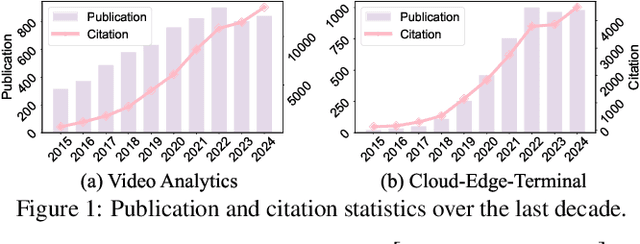
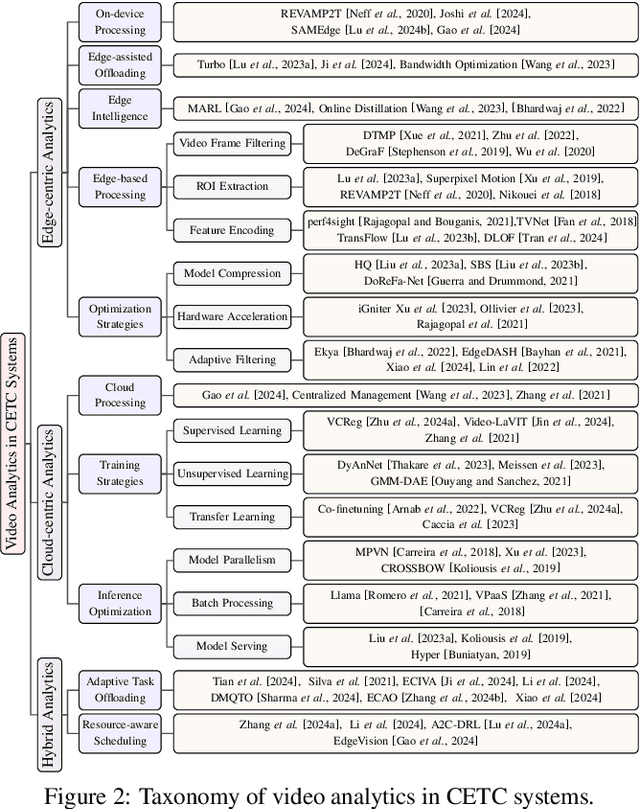
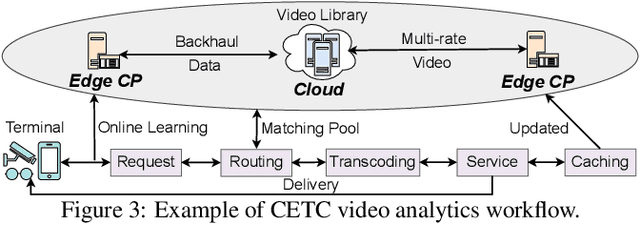
The explosive growth of video data has driven the development of distributed video analytics in cloud-edge-terminal collaborative (CETC) systems, enabling efficient video processing, real-time inference, and privacy-preserving analysis. Among multiple advantages, CETC systems can distribute video processing tasks and enable adaptive analytics across cloud, edge, and terminal devices, leading to breakthroughs in video surveillance, autonomous driving, and smart cities. In this survey, we first analyze fundamental architectural components, including hierarchical, distributed, and hybrid frameworks, alongside edge computing platforms and resource management mechanisms. Building upon these foundations, edge-centric approaches emphasize on-device processing, edge-assisted offloading, and edge intelligence, while cloud-centric methods leverage powerful computational capabilities for complex video understanding and model training. Our investigation also covers hybrid video analytics incorporating adaptive task offloading and resource-aware scheduling techniques that optimize performance across the entire system. Beyond conventional approaches, recent advances in large language models and multimodal integration reveal both opportunities and challenges in platform scalability, data protection, and system reliability. Future directions also encompass explainable systems, efficient processing mechanisms, and advanced video analytics, offering valuable insights for researchers and practitioners in this dynamic field.