 Add to Chrome
 Add to Firefox
 Add to Edge
MambaRaw: Selective State Space Modeling for Efficient 4K Raw Image Reconstruction
Jun 23, 2026
In-camera JPEG previews are ubiquitous in raw image formats and provide an sRGB reference at negligible storage cost. Although existing metadata-based reconstruction frameworks can exploit this side information when recovering raw images, their context models often become computationally expensive especially at high resolution, eg, 4K raw image, given that attention mechanisms scale quadratically with feature maps, hindering its practical application. To address these limitations, we propose MambaRaw, a JPEG-conditioned metadata-based raw image reconstruction framework that uses State Space Models (SSMs) to estimate entropy parameters efficiently. Our key contribution comprises a Spatial-Energy Coupled Context Modeling mechanism with two lightweight modules: (1) TileMambaBlock, which performs Mamba-style selective scanning only on information-dense tiles to improve the efficiency; and (2) Energy-Aware Refinement (EAR), an identity-initialized residual module that enhance feature representation to match the long-tail energy distribution of raw signals. Extensive experiments on three camera datasets (Sony, Olympus, Samsung) show consistent improvements over strong metadata-based baselines and set a new state of the art for JPEG-guided raw reconstruction with great efficiency. Notably, at low metadata bitrates, MambaRaw increases PSNR by 1.2--1.4 dB and reduces end-to-end coding latency by about 9%. Code is released at https://github.com/Peizeli1/MambaRaw.

Looped World Models
Jun 16, 2026Current world models face a fundamental tension: faithful long-horizon simulation demands deep computation, but deeper models are expensive to deploy and prone to compounding errors. We resolve this by introducing Looped World Models (LoopWM), which are the first looped architectures for world modelling. Our method iteratively refines latent environment states through a parameter-shared transformer block. This yield up to 100x parameter efficiency over conventional approaches with adaptive computation that automatically scales depth to match the complexity of each prediction step. Orthogonal to scaling model size and training data, LoopWM establishes iterative latent depth as a new scaling axis for world simulation, which might significantly push the community forward.
Training-Free Image Editing with Visual Context Integration and Concept Alignment
Apr 06, 2026In image editing, it is essential to incorporate a context image to convey the user's precise requirements, such as subject appearance or image style. Existing training-based visual context-aware editing methods incur data collection effort and training cost. On the other hand, the training-free alternatives are typically established on diffusion inversion, which struggles with consistency and flexibility. In this work, we propose VicoEdit, a training-free and inversion-free method to inject the visual context into the pretrained text-prompted editing model. More specifically, VicoEdit directly transforms the source image into the target one based on the visual context, thereby eliminating the need for inversion that can lead to deviated trajectories. Moreover, we design a posterior sampling approach guided by concept alignment to enhance the editing consistency. Empirical results demonstrate that our training-free method achieves even better editing performance than the state-of-the-art training-based models.
RAWIC: Bit-Depth Adaptive Lossless Raw Image Compression
Mar 30, 2026Raw images preserve linear sensor measurements and high bit-depth information crucial for advanced vision tasks and photography applications, yet their storage remains challenging due to large file sizes, varying bit depths, and sensor-dependent characteristics. Existing learned lossless compression methods mainly target 8-bit sRGB images, while raw reconstruction approaches are inherently lossy and rely on camera-specific assumptions. To address these challenges, we introduce RAWIC, a bit-depth-adaptive learned lossless compression framework for Bayer-pattern raw images. We first convert single-channel Bayer data into a four-channel RGGB format and partition it into patches. For each patch, we compute its bit depth and use it as auxiliary input to guide compression. A bit-depth-adaptive entropy model is then designed to estimate patch distributions conditioned on their bit depths. This architecture enables a single model to handle raw images from diverse cameras and bit depths. Experiments show that RAWIC consistently surpasses traditional lossless codecs, achieving an average 7.7% bitrate reduction over JPEG-XL. Our code is available at https://github.com/chunbaobao/RAWIC.
Parallax to Align Them All: An OmniParallax Attention Mechanism for Distributed Multi-View Image Compression
Mar 04, 2026Multi-view image compression (MIC) aims to achieve high compression efficiency by exploiting inter-image correlations, playing a crucial role in 3D applications. As a subfield of MIC, distributed multi-view image compression (DMIC) offers performance comparable to MIC while eliminating the need for inter-view information at the encoder side. However, existing methods in DMIC typically treat all images equally, overlooking the varying degrees of correlation between different views during decoding, which leads to suboptimal coding performance. To address this limitation, we propose a novel $\textbf{OmniParallax Attention Mechanism}$ (OPAM), which is a general mechanism for explicitly modeling correlations and aligned features between arbitrary pairs of information sources. Building upon OPAM, we propose a Parallax Multi Information Fusion Module (PMIFM) to adaptively integrate information from different sources. PMIFM is incorporated into both the joint decoder and the entropy model to construct our end-to-end DMIC framework, $\textbf{ParaHydra}$. Extensive experiments demonstrate that $\textbf{ParaHydra}$ is $\textbf{the first DMIC method}$ to significantly surpass state-of-the-art MIC codecs, while maintaining low computational overhead. Performance gains become more pronounced as the number of input views increases. Compared with LDMIC, $\textbf{ParaHydra}$ achieves bitrate savings of $\textbf{19.72%}$ on WildTrack(3) and up to $\textbf{24.18%}$ on WildTrack(6), while significantly improving coding efficiency (as much as $\textbf{65}\times$ in decoding and $\textbf{34}\times$ in encoding).
Benchmarking and Enhancing VLM for Compressed Image Understanding
Dec 24, 2025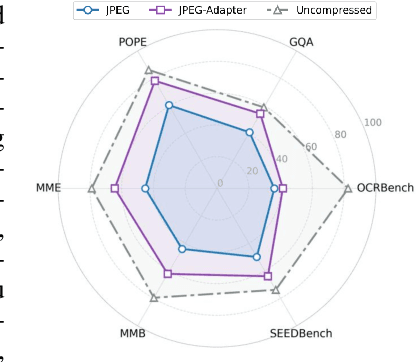

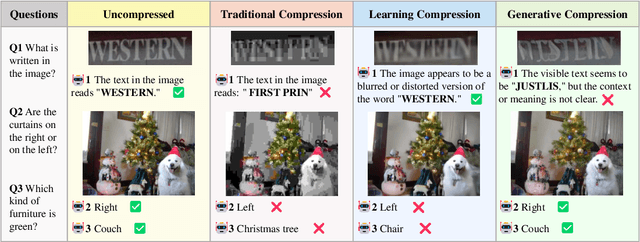
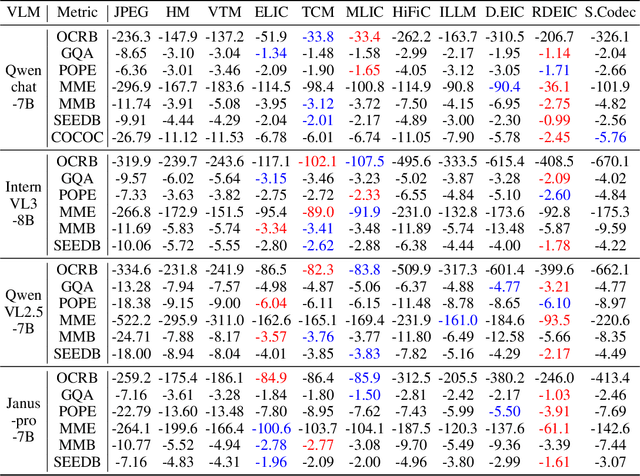
With the rapid development of Vision-Language Models (VLMs) and the growing demand for their applications, efficient compression of the image inputs has become increasingly important. Existing VLMs predominantly digest and understand high-bitrate compressed images, while their ability to interpret low-bitrate compressed images has yet to be explored by far. In this paper, we introduce the first comprehensive benchmark to evaluate the ability of VLM against compressed images, varying existing widely used image codecs and diverse set of tasks, encompassing over one million compressed images in our benchmark. Next, we analyse the source of performance gap, by categorising the gap from a) the information loss during compression and b) generalisation failure of VLM. We visualize these gaps with concrete examples and identify that for compressed images, only the generalization gap can be mitigated. Finally, we propose a universal VLM adaptor to enhance model performance on images compressed by existing codecs. Consequently, we demonstrate that a single adaptor can improve VLM performance across images with varying codecs and bitrates by 10%-30%. We believe that our benchmark and enhancement method provide valuable insights and contribute toward bridging the gap between VLMs and compressed images.
GaussianImage++: Boosted Image Representation and Compression with 2D Gaussian Splatting
Dec 22, 2025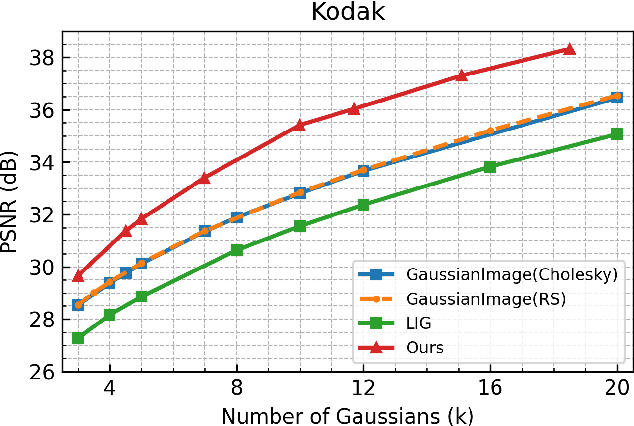
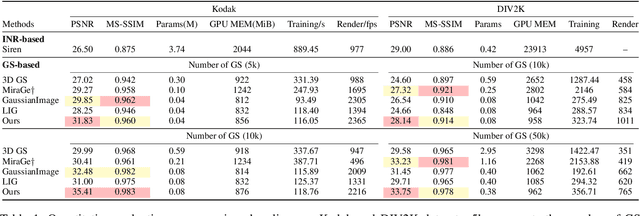
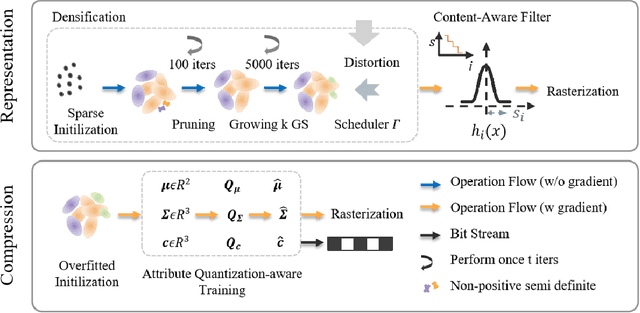

Implicit neural representations (INRs) have achieved remarkable success in image representation and compression, but they require substantial training time and memory. Meanwhile, recent 2D Gaussian Splatting (GS) methods (\textit{e.g.}, GaussianImage) offer promising alternatives through efficient primitive-based rendering. However, these methods require excessive Gaussian primitives to maintain high visual fidelity. To exploit the potential of GS-based approaches, we present GaussianImage++, which utilizes limited Gaussian primitives to achieve impressive representation and compression performance. Firstly, we introduce a distortion-driven densification mechanism. It progressively allocates Gaussian primitives according to signal intensity. Secondly, we employ context-aware Gaussian filters for each primitive, which assist in the densification to optimize Gaussian primitives based on varying image content. Thirdly, we integrate attribute-separated learnable scalar quantizers and quantization-aware training, enabling efficient compression of primitive attributes. Experimental results demonstrate the effectiveness of our method. In particular, GaussianImage++ outperforms GaussianImage and INRs-based COIN in representation and compression performance while maintaining real-time decoding and low memory usage.
Optimizing Input of Denoising Score Matching is Biased Towards Higher Score Norm
Nov 13, 2025Many recent works utilize denoising score matching to optimize the conditional input of diffusion models. In this workshop paper, we demonstrate that such optimization breaks the equivalence between denoising score matching and exact score matching. Furthermore, we show that this bias leads to higher score norm. Additionally, we observe a similar bias when optimizing the data distribution using a pre-trained diffusion model. Finally, we discuss the wide range of works across different domains that are affected by this bias, including MAR for auto-regressive generation, PerCo for image compression, and DreamFusion for text to 3D generation.
Generative AI Meets 6G and Beyond: Diffusion Models for Semantic Communications
Nov 11, 2025Semantic communications mark a paradigm shift from bit-accurate transmission toward meaning-centric communication, essential as wireless systems approach theoretical capacity limits. The emergence of generative AI has catalyzed generative semantic communications, where receivers reconstruct content from minimal semantic cues by leveraging learned priors. Among generative approaches, diffusion models stand out for their superior generation quality, stable training dynamics, and rigorous theoretical foundations. However, the field currently lacks systematic guidance connecting diffusion techniques to communication system design, forcing researchers to navigate disparate literatures. This article provides the first comprehensive tutorial on diffusion models for generative semantic communications. We present score-based diffusion foundations and systematically review three technical pillars: conditional diffusion for controllable generation, efficient diffusion for accelerated inference, and generalized diffusion for cross-domain adaptation. In addition, we introduce an inverse problem perspective that reformulates semantic decoding as posterior inference, bridging semantic communications with computational imaging. Through analysis of human-centric, machine-centric, and agent-centric scenarios, we illustrate how diffusion models enable extreme compression while maintaining semantic fidelity and robustness. By bridging generative AI innovations with communication system design, this article aims to establish diffusion models as foundational components of next-generation wireless networks and beyond.
V-Shuffle: Zero-Shot Style Transfer via Value Shuffle
Nov 09, 2025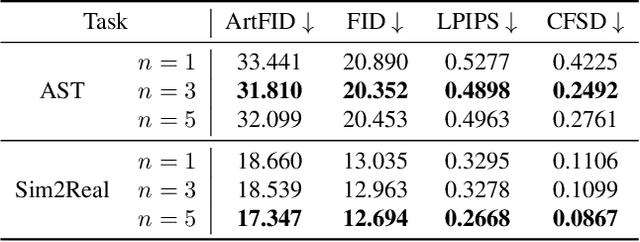
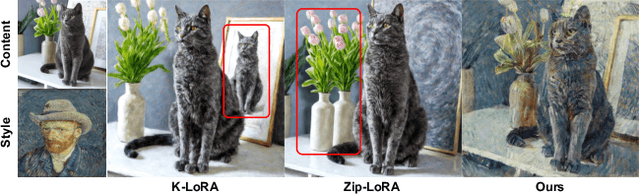
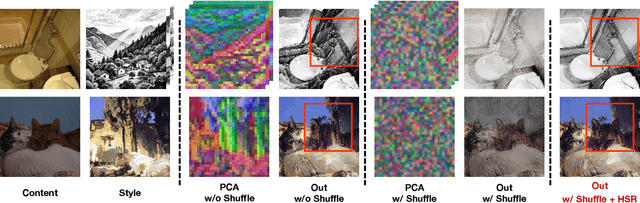
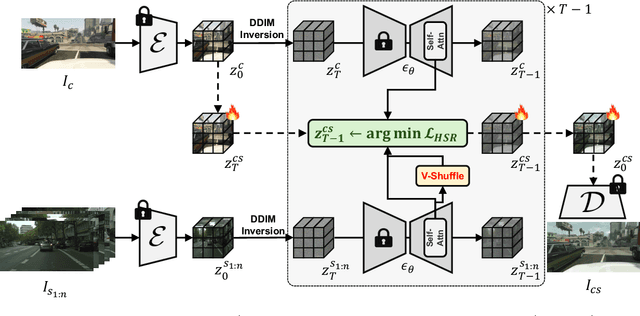
Attention injection-based style transfer has achieved remarkable progress in recent years. However, existing methods often suffer from content leakage, where the undesired semantic content of the style image mistakenly appears in the stylized output. In this paper, we propose V-Shuffle, a zero-shot style transfer method that leverages multiple style images from the same style domain to effectively navigate the trade-off between content preservation and style fidelity. V-Shuffle implicitly disrupts the semantic content of the style images by shuffling the value features within the self-attention layers of the diffusion model, thereby preserving low-level style representations. We further introduce a Hybrid Style Regularization that complements these low-level representations with high-level style textures to enhance style fidelity. Empirical results demonstrate that V-Shuffle achieves excellent performance when utilizing multiple style images. Moreover, when applied to a single style image, V-Shuffle outperforms previous state-of-the-art methods.