 Add to Chrome
 Add to Firefox
 Add to Edge
EBench: Elemental Diagnosis of Generalist Mobile Manipulation Policies
Jun 16, 2026
We present EBench, a simulation benchmark that diagnoses generalist mobile manipulation policies beyond a single success-rate scalar. EBench comprises 26 diverse and challenging manipulation tasks annotated along 5 capability dimensions and 4 generalization dimensions. We evaluate state-of-the-art generalist manipulation models including $π_0$, $π_{0.5}$, XVLA, and InternVLA-A1, and reveal that models with near success rates exhibit strikingly different capability profiles: $π_{0.5}$ achieves the highest test success rate and the best train--test retention, whereas InternVLA-A1 dominates mobile manipulation but collapses on dexterous tasks, and XVLA exhibits strengths on a disjoint set of atomic skills compared to other policies. Beyond capability profiling, EBench analyzes the generalization ability from 4 representative perspectives, identifying the impact of different distribution shift factors. The results reveal strengths and weaknesses of models behind an overall score. We hope this benchmark offers a broad set of diagnostic signals to guide iteration on generalist manipulation models.

Trans2Occ: Voxel Occupancy Estimation and Grasp for Transparent Objects from Simulation to Reality
Jun 01, 2026Transparent objects remain challenging for robotic perception due to unreliable depth sensing caused by refraction and reflection. While prior approaches rely on multi-view reconstruction or depth completion, they are often difficult to scale or deploy in real-world robotic systems. In this paper, we present a practical framework for transparent object perception and manipulation based on single-view RGB input. Our approach predicts voxel-space occupancy directly from a single image, providing a geometry-aware representation that supports downstream robotic grasping. To enable large-scale training, we construct a simulation pipeline that generates paired RGB images and voxel occupancy annotations under diverse materials and lighting conditions. We demonstrate that the predicted occupancy representation is robust to domain shifts and transfers effectively from simulation to real-world robotic setups without fine-tuning. A simple rule-based grasping strategy built on top of the occupancy further achieves reliable grasp performance on transparent objects. Extensive experiments in both simulation and real-world environments show that our framework provides accurate 3D understanding and enables practical manipulation of transparent objects. These results suggest that single-view occupancy prediction offers a scalable and effective solution for transparent object perception in robotics.
ClothTransformer: Unified Latent-Space Transformers for Scalable Cloth Simulation
May 27, 2026Unified and scalable Transformers have recently achieved remarkable success in modeling diverse phenomena traditionally associated with computer graphics, such as 3D visual effects, rendering processes, and motion in videos. In this work, we take a step further by investigating whether modern Transformer techniques can tackle the challenging task of cloth simulation. To this end, we present ClothTransformer, a framework that reformulates cloth simulation as autoregressive sequence modeling in a learned latent space. Existing neural cloth simulators are largely specialized to single scenarios, intrinsically coupled to the mesh discretization, and lack robust collision handling. Our approach addresses these limitations through three contributions: (1) a unified Transformer architecture that handles diverse scenarios -- body-driven garments, robotic manipulation, and free-fall collisions -- under a single model and achieves approximately $4$--$9{\times}$ lower error than prior state-of-the-art methods across all scenarios; (2) a scalable latent-space formulation that compresses arbitrary-resolution meshes into a fixed-size set of latent tokens, making temporal dynamics computation independent of mesh resolution; and (3) a diverse-scenario high-fidelity penetration-free dataset of ${\sim}$493.4k frames spanning all three settings, which enables a differentiable Continuous Collision Detection (CCD) module to suppress penetration artifacts.
Code-as-Room: Generating 3D Rooms from Top-Down View Images via Agentic Code Synthesis
May 18, 2026Designing realistic and functional 3D indoor rooms is essential for a wide range of applications, including interior design, virtual reality, gaming, and embodied AI. While recent MLLM-based approaches have shown great potential for 3D room synthesis from textual descriptions or reference images, text-based methods struggle to capture precise spatial information, and existing image-conditioned agents suffer from instability and infinite looping when tasked with holistic room generation from top-down views. To address these limitations, we propose Code-as-Room, an MLLM-based agentic framework equipped with a structured execution harness, which represents 3D rooms with Blender codes. Given a top-down room image, the framework parses the reference image to extract scene elements and their spatial relationships, and synthesizes executable Blender code for geometry, materials, and lighting in a principled, multi-stage pipeline. A cross-stage memory module is maintained throughout to mitigate context forgetting inherent to existing agent-based frameworks. We further introduce a dedicated benchmark for code-based 3D room synthesis, encompassing various evaluation protocols. Based on our benchmark, comprehensive comparisons against existing agent-based methods are conducted to validate the effectiveness of our proposed execution harness.
EgoSim: Egocentric World Simulator for Embodied Interaction Generation
Apr 01, 2026We introduce EgoSim, a closed-loop egocentric world simulator that generates spatially consistent interaction videos and persistently updates the underlying 3D scene state for continuous simulation. Existing egocentric simulators either lack explicit 3D grounding, causing structural drift under viewpoint changes, or treat the scene as static, failing to update world states across multi-stage interactions. EgoSim addresses both limitations by modeling 3D scenes as updatable world states. We generate embodiment interactions via a Geometry-action-aware Observation Simulation model, with spatial consistency from an Interaction-aware State Updating module. To overcome the critical data bottleneck posed by the difficulty in acquiring densely aligned scene-interaction training pairs, we design a scalable pipeline that extracts static point clouds, camera trajectories, and embodiment actions from in-the-wild large-scale monocular egocentric videos. We further introduce EgoCap, a capture system that enables low-cost real-world data collection with uncalibrated smartphones. Extensive experiments demonstrate that EgoSim significantly outperforms existing methods in terms of visual quality, spatial consistency, and generalization to complex scenes and in-the-wild dexterous interactions, while supporting cross-embodiment transfer to robotic manipulation. Codes and datasets will be open soon. The project page is at egosimulator.github.io.
PnP-U3D: Plug-and-Play 3D Framework Bridging Autoregression and Diffusion for Unified Understanding and Generation
Feb 03, 2026The rapid progress of large multimodal models has inspired efforts toward unified frameworks that couple understanding and generation. While such paradigms have shown remarkable success in 2D, extending them to 3D remains largely underexplored. Existing attempts to unify 3D tasks under a single autoregressive (AR) paradigm lead to significant performance degradation due to forced signal quantization and prohibitive training cost. Our key insight is that the essential challenge lies not in enforcing a unified autoregressive paradigm, but in enabling effective information interaction between generation and understanding while minimally compromising their inherent capabilities and leveraging pretrained models to reduce training cost. Guided by this perspective, we present the first unified framework for 3D understanding and generation that combines autoregression with diffusion. Specifically, we adopt an autoregressive next-token prediction paradigm for 3D understanding, and a continuous diffusion paradigm for 3D generation. A lightweight transformer bridges the feature space of large language models and the conditional space of 3D diffusion models, enabling effective cross-modal information exchange while preserving the priors learned by standalone models. Extensive experiments demonstrate that our framework achieves state-of-the-art performance across diverse 3D understanding and generation benchmarks, while also excelling in 3D editing tasks. These results highlight the potential of unified AR+diffusion models as a promising direction for building more general-purpose 3D intelligence.
MesaTask: Towards Task-Driven Tabletop Scene Generation via 3D Spatial Reasoning
Sep 26, 2025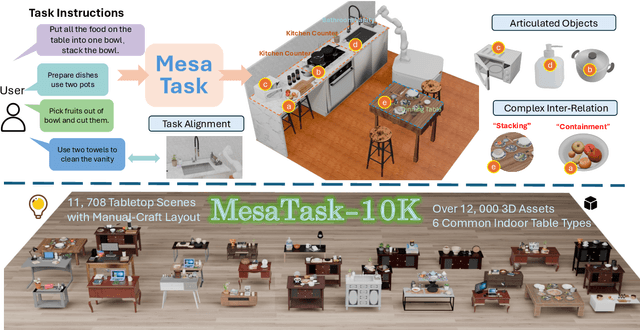
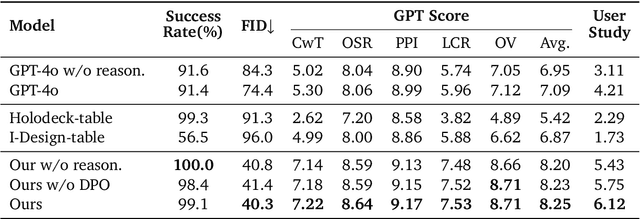
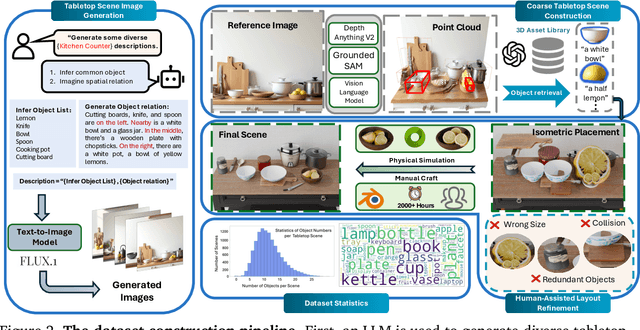
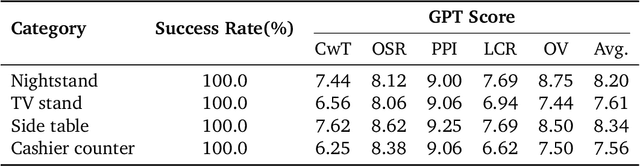
The ability of robots to interpret human instructions and execute manipulation tasks necessitates the availability of task-relevant tabletop scenes for training. However, traditional methods for creating these scenes rely on time-consuming manual layout design or purely randomized layouts, which are limited in terms of plausibility or alignment with the tasks. In this paper, we formulate a novel task, namely task-oriented tabletop scene generation, which poses significant challenges due to the substantial gap between high-level task instructions and the tabletop scenes. To support research on such a challenging task, we introduce MesaTask-10K, a large-scale dataset comprising approximately 10,700 synthetic tabletop scenes with manually crafted layouts that ensure realistic layouts and intricate inter-object relations. To bridge the gap between tasks and scenes, we propose a Spatial Reasoning Chain that decomposes the generation process into object inference, spatial interrelation reasoning, and scene graph construction for the final 3D layout. We present MesaTask, an LLM-based framework that utilizes this reasoning chain and is further enhanced with DPO algorithms to generate physically plausible tabletop scenes that align well with given task descriptions. Exhaustive experiments demonstrate the superior performance of MesaTask compared to baselines in generating task-conforming tabletop scenes with realistic layouts. Project page is at https://mesatask.github.io/
MeshCoder: LLM-Powered Structured Mesh Code Generation from Point Clouds
Aug 20, 2025Reconstructing 3D objects into editable programs is pivotal for applications like reverse engineering and shape editing. However, existing methods often rely on limited domain-specific languages (DSLs) and small-scale datasets, restricting their ability to model complex geometries and structures. To address these challenges, we introduce MeshCoder, a novel framework that reconstructs complex 3D objects from point clouds into editable Blender Python scripts. We develop a comprehensive set of expressive Blender Python APIs capable of synthesizing intricate geometries. Leveraging these APIs, we construct a large-scale paired object-code dataset, where the code for each object is decomposed into distinct semantic parts. Subsequently, we train a multimodal large language model (LLM) that translates 3D point cloud into executable Blender Python scripts. Our approach not only achieves superior performance in shape-to-code reconstruction tasks but also facilitates intuitive geometric and topological editing through convenient code modifications. Furthermore, our code-based representation enhances the reasoning capabilities of LLMs in 3D shape understanding tasks. Together, these contributions establish MeshCoder as a powerful and flexible solution for programmatic 3D shape reconstruction and understanding.
AnySplat: Feed-forward 3D Gaussian Splatting from Unconstrained Views
May 29, 2025We introduce AnySplat, a feed forward network for novel view synthesis from uncalibrated image collections. In contrast to traditional neural rendering pipelines that demand known camera poses and per scene optimization, or recent feed forward methods that buckle under the computational weight of dense views, our model predicts everything in one shot. A single forward pass yields a set of 3D Gaussian primitives encoding both scene geometry and appearance, and the corresponding camera intrinsics and extrinsics for each input image. This unified design scales effortlessly to casually captured, multi view datasets without any pose annotations. In extensive zero shot evaluations, AnySplat matches the quality of pose aware baselines in both sparse and dense view scenarios while surpassing existing pose free approaches. Moreover, it greatly reduce rendering latency compared to optimization based neural fields, bringing real time novel view synthesis within reach for unconstrained capture settings.Project page: https://city-super.github.io/anysplat/
Infinite Mobility: Scalable High-Fidelity Synthesis of Articulated Objects via Procedural Generation
Mar 17, 2025Large-scale articulated objects with high quality are desperately needed for multiple tasks related to embodied AI. Most existing methods for creating articulated objects are either data-driven or simulation based, which are limited by the scale and quality of the training data or the fidelity and heavy labour of the simulation. In this paper, we propose Infinite Mobility, a novel method for synthesizing high-fidelity articulated objects through procedural generation. User study and quantitative evaluation demonstrate that our method can produce results that excel current state-of-the-art methods and are comparable to human-annotated datasets in both physics property and mesh quality. Furthermore, we show that our synthetic data can be used as training data for generative models, enabling next-step scaling up. Code is available at https://github.com/Intern-Nexus/Infinite-Mobility