 Add to Chrome
 Add to Firefox
 Add to Edge
Learning Physical Interaction: A Survey of Tactile- and Force-aware Robot Learning
Aug 02, 2026
Physically grounded robot intelligence requires robots to perceive, reason about, and regulate their interactions with the physical world. This capability is particularly critical in contact-sensitive manipulation, where successful task execution depends not only on visual perception and motion generation, but also on force regulation and adaptive control. In this context, recent robot learning methods have made substantial progress by integrating force, tactile, vision, language, and proprioceptive sensing into learned manipulation policies. In parallel, many systems adopt multi-phase architectures that combine high-level policies, action-refinement modules, and low-level controllers to bridge semantic task understanding with reactive physical execution. Despite these advances, existing surveys have not explicitly reviewed force- and tactile-aware robot learning from a unified perspective that jointly captures multimodal sensing and multi-phase system design. This survey addresses this gap by proposing TF-ART, a Tactile/Force-Aware Robot learning Taxonomy for multimodal and multi-phase frameworks, which maps individual methods into a unified hierarchical structure. The framework characterizes how recent works organize observation modalities, encode and fuse heterogeneous sensory inputs, generate and refine actions across multiple phases, and connect learned policies to reactive robot-end control. Building on this methodological view, we further examine the task settings and infrastructure requirements of physical interaction, thereby integrating both algorithmic and practical perspectives on force- and tactile-aware robot learning.

Trans2Occ: Voxel Occupancy Estimation and Grasp for Transparent Objects from Simulation to Reality
Jun 01, 2026Transparent objects remain challenging for robotic perception due to unreliable depth sensing caused by refraction and reflection. While prior approaches rely on multi-view reconstruction or depth completion, they are often difficult to scale or deploy in real-world robotic systems. In this paper, we present a practical framework for transparent object perception and manipulation based on single-view RGB input. Our approach predicts voxel-space occupancy directly from a single image, providing a geometry-aware representation that supports downstream robotic grasping. To enable large-scale training, we construct a simulation pipeline that generates paired RGB images and voxel occupancy annotations under diverse materials and lighting conditions. We demonstrate that the predicted occupancy representation is robust to domain shifts and transfers effectively from simulation to real-world robotic setups without fine-tuning. A simple rule-based grasping strategy built on top of the occupancy further achieves reliable grasp performance on transparent objects. Extensive experiments in both simulation and real-world environments show that our framework provides accurate 3D understanding and enables practical manipulation of transparent objects. These results suggest that single-view occupancy prediction offers a scalable and effective solution for transparent object perception in robotics.
OccamToken: Efficient VLM Inference with Training-Free and Budget-Adaptive Token Pruning
May 28, 2026Vision-language models (VLMs) rely on long visual token sequences for visual understanding, making the prefill stage expensive in both computation and memory. Most existing pruning methods follow an absolute-ranking paradigm, assigning importance scores to visual tokens and retaining a fixed top-K subset. In this work, we argue that this paradigm is fundamentally brittle: attention sinks distort token importance rankings, while image redundancy and query-dependent visual evidence make fixed token budgets unreliable across inputs. We propose OccamToken, a training-free framework that replaces absolute token ranking with register-anchored relative evidence testing. Instead of asking which tokens are globally important, OccamToken evaluates whether a visual token provides information beyond a register-based reference. Our key insight is that register tokens naturally absorb low-information attention patterns, making them a stable reference for identifying genuinely informative visual evidence. Based on this principle, OccamToken performs both image-adaptive redundancy pruning and query-adaptive relevance pruning through dynamic thresholds derived from register attention. Across LLaVA-NeXT, LLaVA-v1.5, and Qwen3-VL, OccamToken consistently improves the accuracy-efficiency trade-off without additional training. Notably, on LLaVA-NeXT, it reduces 2,880 visual tokens to approximately 40 while preserving over 93% of the original accuracy, enabling stable visual token compression even in the extreme 1.4% retention regime.
CompassAD: Intent-Driven 3D Affordance Grounding in Functionally Competing Objects
Apr 02, 2026When told to "cut the apple," a robot must choose the knife over nearby scissors, despite both objects affording the same cutting function. In real-world scenes, multiple objects may share identical affordances, yet only one is appropriate under the given task context. We call such cases confusing pairs. However, existing 3D affordance methods largely sidestep this challenge by evaluating isolated single objects, often with explicit category names provided in the query. We formalize Multi-Object Affordance Grounding under Intent-Driven Instructions, a new 3D affordance setting that requires predicting a per-point affordance mask on the correct object within a cluttered multi-object point cloud, conditioned on implicit natural language intent. To study this problem, we construct CompassAD, the first benchmark centered on implicit intent in confusable multi-object scenes. It comprises 30 confusing object pairs spanning 16 affordance types, 6,422 scenes, and 88K+ query-answer pairs. Furthermore, we propose CompassNet, a framework that incorporates two dedicated modules tailored to this task. Instance-bounded Cross Injection (ICI) constrains language-geometry alignment within object boundaries to prevent cross-object semantic leakage. Bi-level Contrastive Refinement (BCR) enforces discrimination at both geometric-group and point levels, sharpening distinctions between target and confusable surfaces. Extensive experiments demonstrate state-of-the-art results on both seen and unseen queries, and deployment on a robotic manipulator confirms effective transfer to real-world grasping in confusing multi-object scenes.
Adaptive Manipulation Potential and Haptic Estimation for Tool-Mediated Interaction
Mar 11, 2026Achieving human-level dexterity in contact-rich, tool-mediated manipulation remains a significant challenge due to visual occlusion and the underdetermined nature of haptic sensing. This paper introduces a parameterized Equilibrium Manifold (EM) as a unified representation for tool-mediated interaction, and develops a closed-loop framework that integrates haptic estimation, online planning, and adaptive stiffness control. We establish a physical-geometric duality using an adaptive manipulation potential incorporating a differentiable contact model, which induces the manifold's geometric structure and ensures that complex physical interactions are encapsulated as continuous operations on the EM. Within this framework, we reformulate haptic estimation as a manifold parameter estimation problem. Specifically, a hybrid inference strategy (haptic SLAM) is employed in which discrete object shapes are classified via particle filtering, while the continuous object pose is estimated using analytical gradients for efficient optimization. By continuously updating the parameters of the manipulation potential, the framework dynamically reshapes the induced EM to guide online trajectory replanning and implement uncertainty-aware impedance control, thereby closing the perception-action loop. The system is validated through simulation and over 260 real-world screw-loosening trials. Experimental results demonstrate robust identification and manipulation success in standard scenarios while maintaining accurate tracking. Furthermore, ablation studies confirm that haptic SLAM and uncertainty-aware stiffness modulation outperform fixed impedance baselines, effectively preventing jamming during tight tolerance interactions.
Estimating Force Interactions of Deformable Linear Objects from their Shapes
Feb 01, 2026This work introduces an analytical approach for detecting and estimating external forces acting on deformable linear objects (DLOs) using only their observed shapes. In many robot-wire interaction tasks, contact occurs not at the end-effector but at other points along the robot's body. Such scenarios arise when robots manipulate wires indirectly (e.g., by nudging) or when wires act as passive obstacles in the environment. Accurately identifying these interactions is crucial for safe and efficient trajectory planning, helping to prevent wire damage, avoid restricted robot motions, and mitigate potential hazards. Existing approaches often rely on expensive external force-torque sensor or that contacts occur at the end-effector for accurate force estimation. Using wire shape information acquired from a depth camera and under the assumption that the wire is in or near its static equilibrium, our method estimates both the location and magnitude of external forces without additional prior knowledge. This is achieved by exploiting derived consistency conditions and solving a system of linear equations based on force-torque balance along the wire. The approach was validated through simulation, where it achieved high accuracy, and through real-world experiments, where accurate estimation was demonstrated in selected interaction scenarios.
Fast Payload Calibration for Sensorless Contact Estimation Using Model Pre-training
Sep 05, 2024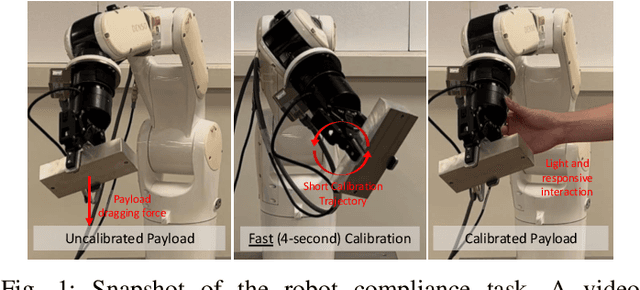
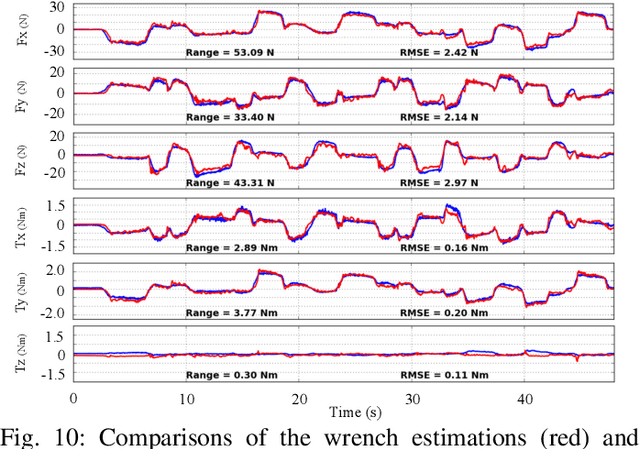
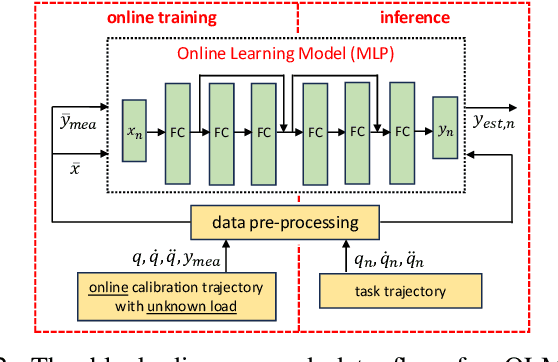
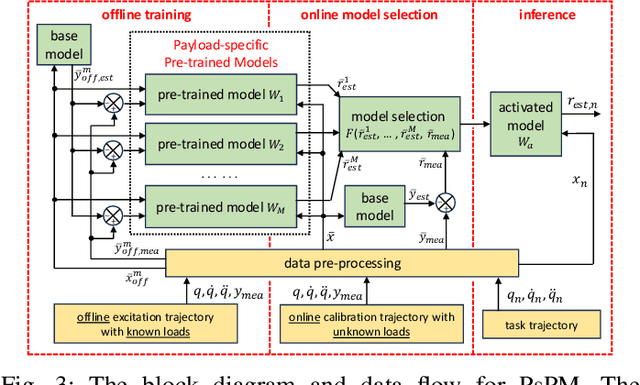
Force and torque sensing is crucial in robotic manipulation across both collaborative and industrial settings. Traditional methods for dynamics identification enable the detection and control of external forces and torques without the need for costly sensors. However, these approaches show limitations in scenarios where robot dynamics, particularly the end-effector payload, are subject to changes. Moreover, existing calibration techniques face trade-offs between efficiency and accuracy due to concerns over joint space coverage. In this paper, we introduce a calibration scheme that leverages pre-trained Neural Network models to learn calibrated dynamics across a wide range of joint space in advance. This offline learning strategy significantly reduces the need for online data collection, whether for selection of the optimal model or identification of payload features, necessitating merely a 4-second trajectory for online calibration. This method is particularly effective in tasks that require frequent dynamics recalibration for precise contact estimation. We further demonstrate the efficacy of this approach through applications in sensorless joint and task compliance, accounting for payload variability.
Sensorless Physical Human-robot Interaction Using Deep-Learning
Sep 28, 2023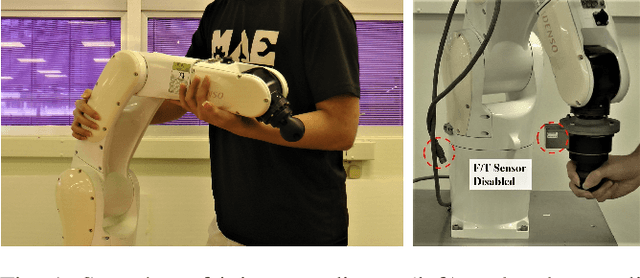
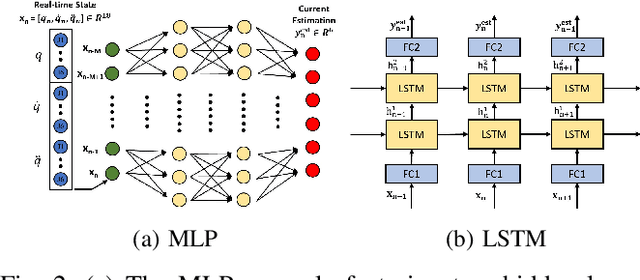

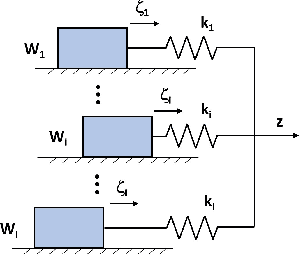
Physical human-robot interaction has been an area of interest for decades. Collaborative tasks, such as joint compliance, demand high-quality joint torque sensing. While external torque sensors are reliable, they come with the drawbacks of being expensive and vulnerable to impacts. To address these issues, studies have been conducted to estimate external torques using only internal signals, such as joint states and current measurements. However, insufficient attention has been given to friction hysteresis approximation, which is crucial for tasks involving extensive dynamic to static state transitions. In this paper, we propose a deep-learning-based method that leverages a novel long-term memory scheme to achieve dynamics identification, accurately approximating the static hysteresis. We also introduce modifications to the well-known Residual Learning architecture, retaining high accuracy while reducing inference time. The robustness of the proposed method is illustrated through a joint compliance and task compliance experiment.
Fine Robotic Manipulation without Force/Torque Sensor
Jan 31, 2023Force Sensing and Force Control are essential to many industrial applications. Typically, a 6-axis Force/Torque (F/T) sensor is mounted between the robot's wrist and the end-effector in order to measure the forces and torques exerted by the environment onto the robot (the external wrench). Although a typical 6-axis F/T sensor can provide highly accurate measurements, it is expensive and vulnerable to drift and external impacts. Existing methods aiming at estimating the external wrench using only the robot's internal signals are limited in scope: for example, wrench estimation accuracy was mostly validated in free-space motions and simple contacts as opposed to tasks like assembly that require high-precision force control. Here we present a Neural Network based method and argue that by devoting particular attention to the training data structure, it is possible to accurately estimate the external wrench in a wide range of scenarios based solely on internal signals. As an illustration, we demonstrate a pin insertion experiment with 100-micron clearance and a hand-guiding experiment, both performed without external F/T sensors or joint torque sensors. Our result opens the possibility of equipping the existing 2.7 million industrial robots with Force Sensing and Force Control capabilities without any additional hardware.