 Add to Chrome
 Add to Firefox
 Add to Edge
PASR: Pose-Aware 3D Shape Retrieval from Occluded Single Views
Apr 24, 2026
Single-view 3D shape retrieval is a fundamental yet challenging task that is increasingly important with the growth of available 3D data. Existing approaches largely fall into two categories: those using contrastive learning to map point cloud features into existing vision-language spaces and those that learn a common embedding space for 2D images and 3D shapes. However, these feed-forward, holistic alignments are often difficult to interpret, which in turn limits their robustness and generalization to real-world applications. To address this problem, we propose Pose-Aware 3D Shape Retrieval (PASR), a framework that formulates retrieval as a feature-level analysis-by-synthesis problem by distilling knowledge from a 2D foundation model (DINOv3) into a 3D encoder. By aligning pose-conditioned 3D projections with 2D feature maps, our method bridges the gap between real-world images and synthetic meshes. During inference, PASR performs a test-time optimization via analysis-by-synthesis, jointly searching for the shape and pose that best reconstruct the patch-level feature map of the input image. This synthesis-based optimization is inherently robust to partial occlusion and sensitive to fine-grained geometric details. PASR substantially outperforms existing methods on both clean and occluded 3D shape retrieval datasets by a wide margin. Additionally, PASR demonstrates strong multi-task capabilities, achieving robust shape retrieval, competitive pose estimation, and accurate category classification within a single framework.

MesaTask: Towards Task-Driven Tabletop Scene Generation via 3D Spatial Reasoning
Sep 26, 2025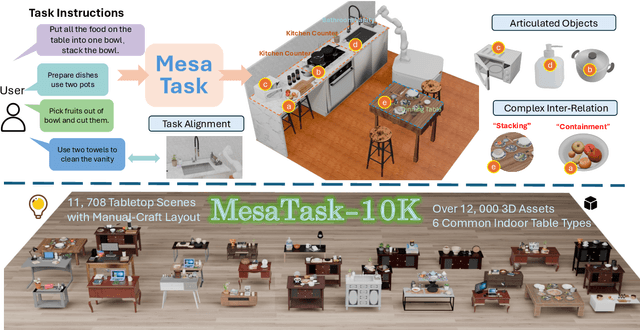
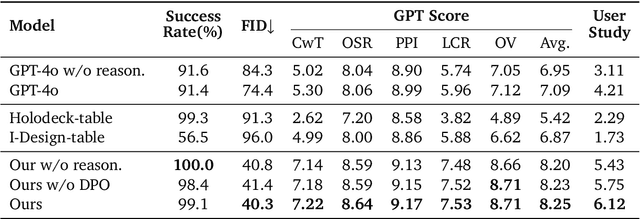
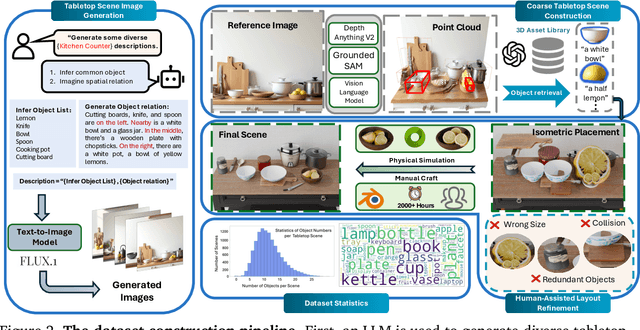
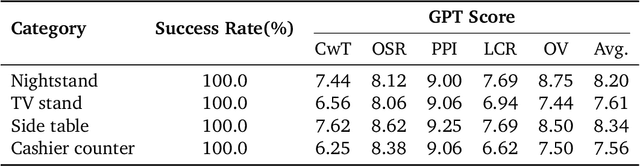
The ability of robots to interpret human instructions and execute manipulation tasks necessitates the availability of task-relevant tabletop scenes for training. However, traditional methods for creating these scenes rely on time-consuming manual layout design or purely randomized layouts, which are limited in terms of plausibility or alignment with the tasks. In this paper, we formulate a novel task, namely task-oriented tabletop scene generation, which poses significant challenges due to the substantial gap between high-level task instructions and the tabletop scenes. To support research on such a challenging task, we introduce MesaTask-10K, a large-scale dataset comprising approximately 10,700 synthetic tabletop scenes with manually crafted layouts that ensure realistic layouts and intricate inter-object relations. To bridge the gap between tasks and scenes, we propose a Spatial Reasoning Chain that decomposes the generation process into object inference, spatial interrelation reasoning, and scene graph construction for the final 3D layout. We present MesaTask, an LLM-based framework that utilizes this reasoning chain and is further enhanced with DPO algorithms to generate physically plausible tabletop scenes that align well with given task descriptions. Exhaustive experiments demonstrate the superior performance of MesaTask compared to baselines in generating task-conforming tabletop scenes with realistic layouts. Project page is at https://mesatask.github.io/