 Add to Chrome
 Add to Firefox
 Add to Edge
RoboSnap: One-Shot Real-to-Sim Scene Generation for Generalizable Robot Learning and Evaluation
Jul 07, 2026
Recovering real-world scenes as interactive simulation environments can enable generalizable robot learning and reproducible policy evaluation. However, constructing scenes that are both physically stable and visually faithful remains slow and expensive. In this work, we present RoboSnap, a real-to-sim framework that turns a single RGB image into a simulation-ready scene. The key idea is a layered design that separates the physics-critical interaction area from the surrounding visual context: collision-aware foreground assets are refined for stable robot interaction, while a 3D Gaussian splatting visual layer preserves faithful background appearance under novel views. Experiments on DROID scenes and real-robot tasks show that RoboSnap achieves reliable trajectory replay in the recovered scenes, supports task-specific synthetic data generation for policy training, and yields meaningful sim-real correlation for policy evaluation. To further support real-to-sim research, we introduce DROID-Sim, a real-to-sim companion dataset constructed from 564 real-world scenes in DROID. Extensive experiments suggest that the value of real-to-sim methods lies not only in high-fidelity visual reconstruction, but in turning real environments into reusable infrastructure for robot learning and evaluation.

Pair2Scene: Learning Local Object Relations for Procedural Scene Generation
Apr 13, 2026Generating high-fidelity 3D indoor scenes remains a significant challenge due to data scarcity and the complexity of modeling intricate spatial relations. Current methods often struggle to scale beyond training distribution to dense scenes or rely on LLMs/VLMs that lack the ability for precise spatial reasoning. Building on top of the observation that object placement relies mainly on local dependencies instead of information-redundant global distributions, in this paper, we propose Pair2Scene, a novel procedural generation framework that integrates learned local rules with scene hierarchies and physics-based algorithms. These rules mainly capture two types of inter-object relations, namely support relations that follow physical hierarchies, and functional relations that reflect semantic links. We model these rules through a network, which estimates spatial position distributions of dependent objects conditioned on position and geometry of the anchor ones. Accordingly, we curate a dataset 3D-Pairs from existing scene data to train the model. During inference, our framework can generate scenes by recursively applying our model within a hierarchical structure, leveraging collision-aware rejection sampling to align local rules into coherent global layouts. Extensive experiments demonstrate that our framework outperforms existing methods in generating complex environments that go beyond training data while maintaining physical and semantic plausibility.
MesaTask: Towards Task-Driven Tabletop Scene Generation via 3D Spatial Reasoning
Sep 26, 2025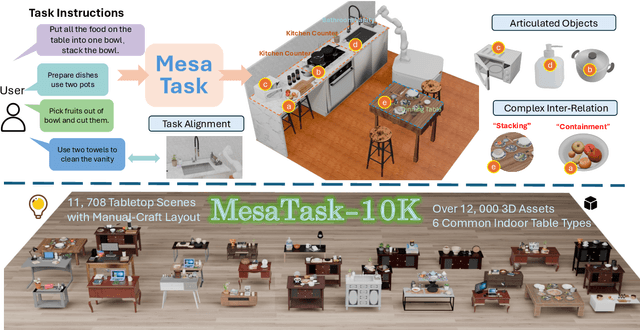
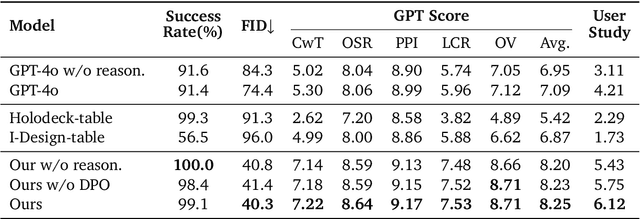
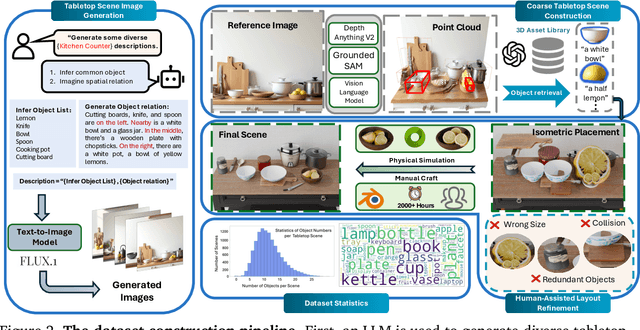
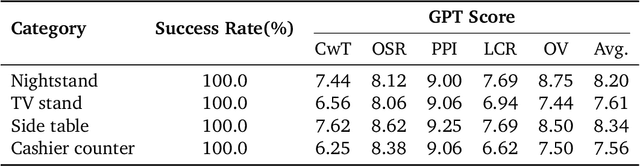
The ability of robots to interpret human instructions and execute manipulation tasks necessitates the availability of task-relevant tabletop scenes for training. However, traditional methods for creating these scenes rely on time-consuming manual layout design or purely randomized layouts, which are limited in terms of plausibility or alignment with the tasks. In this paper, we formulate a novel task, namely task-oriented tabletop scene generation, which poses significant challenges due to the substantial gap between high-level task instructions and the tabletop scenes. To support research on such a challenging task, we introduce MesaTask-10K, a large-scale dataset comprising approximately 10,700 synthetic tabletop scenes with manually crafted layouts that ensure realistic layouts and intricate inter-object relations. To bridge the gap between tasks and scenes, we propose a Spatial Reasoning Chain that decomposes the generation process into object inference, spatial interrelation reasoning, and scene graph construction for the final 3D layout. We present MesaTask, an LLM-based framework that utilizes this reasoning chain and is further enhanced with DPO algorithms to generate physically plausible tabletop scenes that align well with given task descriptions. Exhaustive experiments demonstrate the superior performance of MesaTask compared to baselines in generating task-conforming tabletop scenes with realistic layouts. Project page is at https://mesatask.github.io/